Marine inspection is being rebuilt around artificial intelligence, and 2026 is the year the gap between AI-equipped fleets and the rest becomes decisive. The leading platforms no longer just digitise a paper checklist — they generate the checklist from the vessel and its risk profile, detect corrosion and structural defects from images with computer vision, and turn thousands of inspection records into predictive analytics that flag a problem before it becomes a casualty. Early adopters are reporting dramatically fewer violations and inspections completed far faster, while fleets on basic tools face rising audit risk. But "AI" has become a marketing label stuck on everything, and the real capability behind it varies enormously. The features that actually matter are specific — AI checklist generation, computer-vision defect detection, and genuine predictive analytics — and they have to work in the marine reality of patchy connectivity and remote surveys. This guide reviews the best AI marine inspection software for 2026 with side-by-side comparison of exactly those capabilities, explains what separates real AI from a buzzword, and maps which kind of platform fits which fleet. To see AI-assisted inspection on a live vessel, book a Marine Inspection demo.
2026 buyer's guide
Best AI Marine Inspection Software for 2026
Compare the leading AI inspection platforms on what actually matters — checklist generation, computer-vision defect detection, and predictive analytics — so you choose a system that catches more and inspects faster, not just one with "AI" in the name.
Checklist AIGenerated from vessel type and risk profile
Defect CVCorrosion and damage detected from images
AnalyticsPredict the problem before the casualty
Edge / offlineRuns onboard, not only in the cloud
What "AI" Should Actually Mean Here
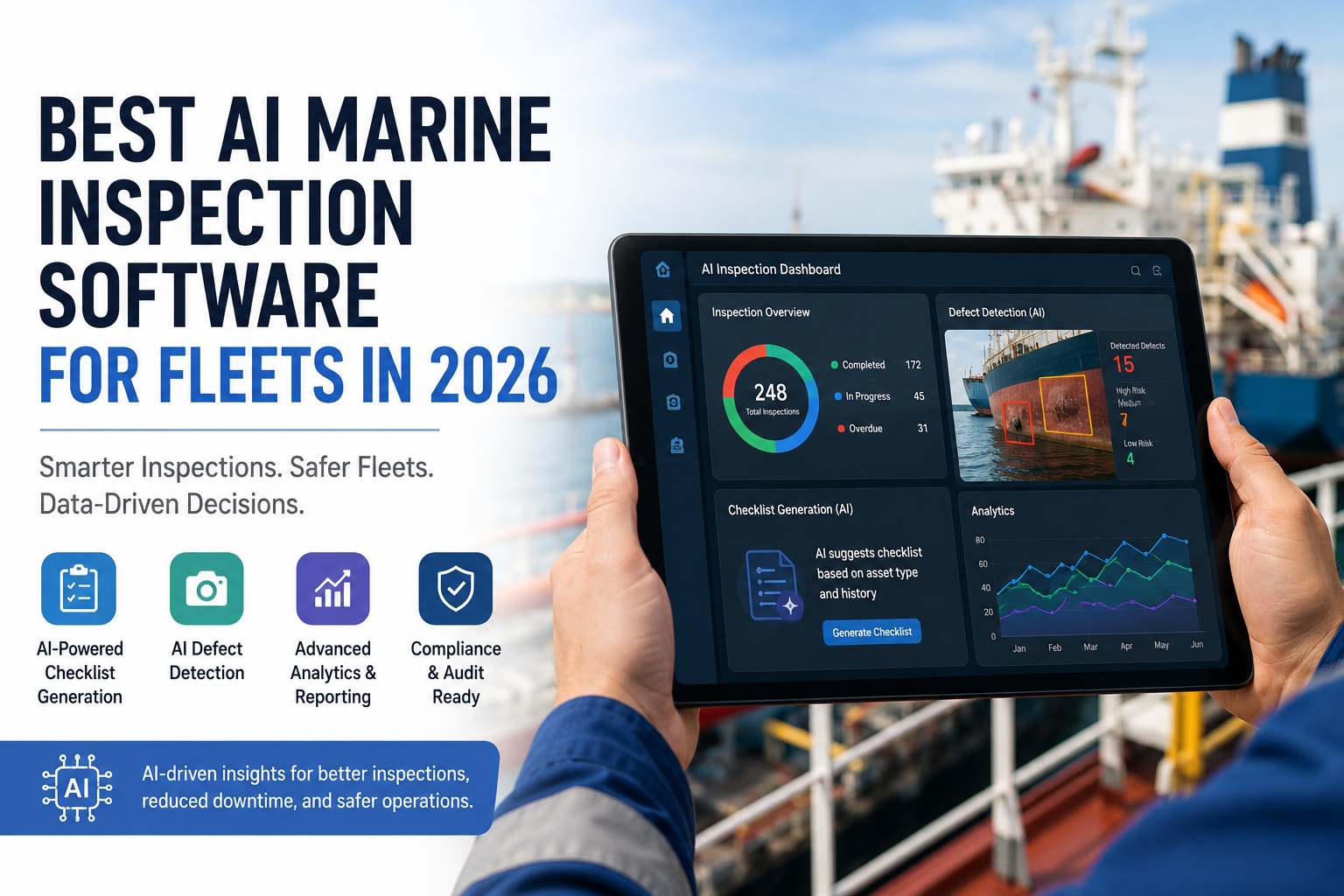
Before comparing platforms, separate genuine capability from the label. Real AI in marine inspection does three things a digital form cannot, and a platform claiming AI should demonstrate all three rather than one dressed up as the set. See real AI in a demo.
01
Checklist generation
It creates tailored inspection questions from the vessel type, equipment, and risk profile — not just a fixed template you fill in the same way every time.
02
Defect detection
Computer vision analyses photos and video to flag corrosion, cracks, and biofouling, with confidence scores — catching what a tired eye at the end of a survey misses.
03
Predictive analytics
It turns the history of findings across the fleet into trends and risk scores, surfacing the developing problem before it becomes a deficiency or a failure.
Deep Dive 1 — AI Checklist Generation
The first capability changes inspection from a static form into a dynamic, risk-aware process. Instead of every vessel running the same checklist regardless of its condition, AI tailors the inspection to what actually needs attention. See checklist generation in a demo.
Tailored questions
Inspection items generated from the vessel type, equipment fit, and operational profile, so the checklist matches the ship in front of you.
Risk-weighted focus
Structured risk ratings direct attention to the highest-risk areas first, rather than treating every item as equally important.
Natural-language input
Inspectors can describe a finding in plain language and have it structured into the right fields, cutting form-filling friction.
Regulation-aware
Checklists reflect current class, flag, and PSC requirements, so the inspection covers what an inspector will actually examine.
Deep Dive 2 — Computer-Vision Defect Detection
The second capability is where AI most visibly outperforms the human eye. Computer-vision models analyse inspection imagery to detect and localise defects consistently, every time, without fatigue. See defect detection in a demo.
Corrosion & structural defects
Models flag corrosion, cracks, coating breakdown, and deformation from photos, with bounding boxes and confidence scores for review.
Hull & biofouling
Underwater imagery from divers, drones, or ROVs is analysed for fouling and damage, supporting hull-cleaning and repair decisions.
Generative reasoning
Beyond detection, generative AI interprets borderline or ambiguous defects in context, reducing both false alarms and missed faults.
Edge processing
Detection runs onboard rather than relying on the cloud, so analysis happens in real time even in remote areas with no connectivity.
See it on your fleet
Compare Marine Inspection Against Your Shortlist
AI-assisted checklists tailored to the vessel, computer-vision defect detection from inspection photos, and analytics that trend findings across the fleet — all working offline at sea and linked to maintenance. Book a 30-minute demo to see the AI inspection workflow on a vessel like yours, or start a free trial and put it to the test today.
Deep Dive 3 — Predictive Analytics
The third capability is what turns inspection from a snapshot into foresight. By analysing the history of findings across vessels, AI surfaces the patterns that predict where the next problem will appear.
Defect trending
Recurring findings across inspections and vessels reveal a developing or systemic problem rather than a one-off, pointing to root cause.
Risk scoring
Vessels and components are scored on inspection history and condition, so attention and budget go where the risk is highest.
Maintenance integration
A flagged finding can raise a maintenance job, connecting inspection insight directly to the work that prevents the failure.
Natural-language insight
Managers query the data in plain language to uncover trends and filter findings without building complex reports.
The 2026 AI Inspection Landscape
The market splits into recognisable types. Rather than crown one platform best in the abstract, match the type to your fleet, your inspection scope, and whether you want AI inside your wider operations system. Scroll the table on mobile to compare.
AI Marine Inspection Platform Types
A consistent 2026 lesson is that AI is only as useful as its integration. A standalone defect detector finds corrosion, but a platform that links the finding to a risk score, a maintenance job, and a tamper-proof record turns that detection into action — which is where the reported gains in fewer violations and faster inspections actually come from.
The Buyer's Scorecard
Bring these questions to every demo. The answers separate genuine AI capability from a digital form with a clever label.
Does it generate checklists from vessel and risk?
Real checklist AI tailors items to the ship and its risk profile, not a fixed template.
Does defect detection give confidence scores?
Genuine computer vision localises defects and rates confidence for human review.
Does it run at the edge, offline?
Onboard processing means inspections work in remote areas without connectivity.
Are analytics predictive, not just reports?
Trending and risk scoring should surface the next problem, not just summarise the last.
Does it link findings to maintenance?
A detected defect should be able to raise a work order, closing the loop to action.
Is the record tamper-proof for audit?
AI findings still need an immutable, attributable trail for class, flag, and PSC.
Where Marine Inspection Fits
Marine Inspection sits in the fleet-platform tier, bringing AI-assisted inspection into the same system that runs maintenance, logbooks, and inventory — so a finding does not stay stranded in a standalone tool. It supports AI-assisted checklist creation tailored to the vessel, defect capture with photo evidence, analytics that trend findings across the fleet, and a tamper-proof record for class, flag, and PSC — all working offline at sea and linked to the maintenance that acts on what inspection finds. For fleets that want AI inspection connected to operations rather than bolted on, it is built for exactly that. Sign up free to try it, or book a demo to see the AI inspection workflow end to end.
Frequently Asked Questions
What is AI marine inspection software?
It is inspection software that uses artificial intelligence to do more than digitise a form — generating checklists tailored to the vessel and its risk, detecting defects like corrosion from images with computer vision, and turning inspection history into predictive analytics. The strongest platforms combine all three and work offline at sea, linking findings to maintenance.
What features matter most when comparing platforms in 2026?
Three capabilities define real AI inspection: checklist generation from vessel type and risk profile, computer-vision defect detection with confidence scores, and predictive analytics that trend findings and score risk. Beyond these, look for edge or offline processing, integration with maintenance, and a tamper-proof audit trail for class, flag, and PSC.
How accurate is AI defect detection?
Modern computer-vision models detect and localise defects such as corrosion, cracks, and biofouling consistently and without fatigue, returning confidence scores for human review. Generative AI adds contextual reasoning for borderline cases, reducing false alarms and missed faults. AI assists rather than replaces the inspector, who reviews and confirms flagged findings.
What is edge AI and why does it matter at sea?
Edge AI runs the detection models onboard the vessel rather than in the cloud, so analysis happens in real time even in remote areas with no internet. For marine inspection this is essential — a system that needs constant connectivity to analyse images would be unusable on a ship mid-ocean, where many inspections actually take place.
Does AI inspection replace the surveyor?
No. AI accelerates and strengthens inspection — generating checklists, flagging defects, and surfacing trends — but the surveyor or inspector reviews, interprets, and confirms. The value is catching more, inspecting faster, and standardising quality, while keeping human judgment in control of the findings that matter.
Should I choose a standalone AI tool or an integrated platform?
It depends on scope, but integration is where the gains compound. A standalone detector finds defects; an integrated platform links each finding to a risk score, a maintenance job, and a tamper-proof record. Most fleets are better served by an AI-enabled platform that connects inspection to the operations that act on it, rather than a disconnected tool.
Built for AI-assisted marine inspection
Catch More, Inspect Faster, Predict the Problem
AI-assisted checklists tailored to the vessel, computer-vision defect detection, fleet-wide predictive analytics, and a tamper-proof audit trail — offline-capable and linked to the maintenance that acts on every finding. Marine Inspection brings real AI to inspection, not a label. Book a tailored walkthrough or start a free trial today.