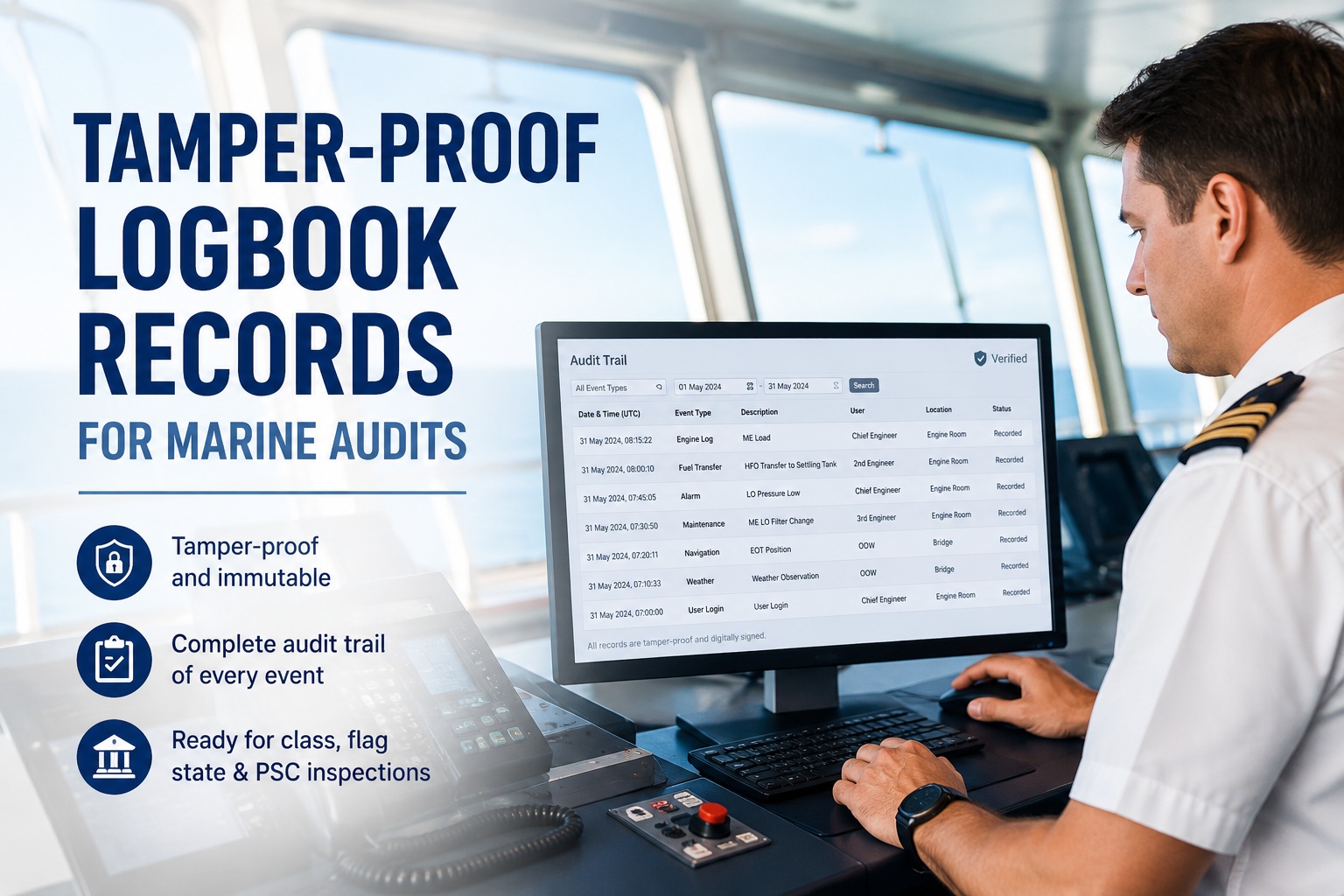
An audit trail is the difference between a record an inspector trusts and one they question. When a class surveyor, flag-state examiner, or Port State Control officer reviews a vessel's logs, they are not just checking that events were recorded — they are checking whether the record can be relied upon as evidence. A paper log can be back-dated, a page can go missing, an entry can be quietly amended, and the inspector knows it, which is why a discrepancy invites deeper scrutiny rather than the benefit of the doubt. A tamper-proof digital audit trail removes that doubt entirely. Every operational event is captured with an automatic timestamp, attributed to a named person, and locked so it cannot be silently altered or deleted; corrections are permitted but the original always remains visible. The result is a record that strengthens the vessel's position in any inspection, investigation, or claim instead of undermining it — and one that is produced in seconds rather than searched for by hand. This page walks through why the audit trail matters, what makes a record genuinely tamper-proof, who relies on it, and how a digital trail turns audit preparation from a scramble into a routine export. To see a tamper-proof audit trail on a live vessel, book a Marine Inspection demo.
Built for class, flag & PSC
A Tamper-Proof Audit Trail Inspectors Trust
Maintain a strict, immutable record of every operational event — timestamped, attributed, and locked against silent change — so your logs are ready for class society, flag state, and Port State Control inspections at a moment's notice.
ImmutableEntries locked against silent alteration
AttributedEvery event tied to a named person and time
RetrievableRecords produced in seconds at inspection
DefensibleEvidence that holds up in a claim
Why the Audit Trail Decides How an Inspection Goes
Inspectors work from a simple principle: a record is only as good as its integrity. The same entry carries completely different weight depending on whether it can be trusted not to have been altered after the fact. This is where a tamper-proof trail changes the dynamic of every inspection. See the audit trail in a demo.
Paper invites doubt
A handwritten log can be back-dated, amended, or have a page removed — so an inspector treats any inconsistency as a reason to dig deeper.
Missing records are findings
When a requested entry from months ago cannot be produced, the gap itself becomes a deficiency, regardless of whether the event was handled correctly.
Slow retrieval raises suspicion
Searching paper files for the better part of an hour signals disorganisation and prolongs the inspection, increasing scrutiny rather than easing it.
Weak evidence in a claim
In an investigation or insurance dispute, a record that could plausibly have been altered carries little weight exactly when the vessel needs it most.
What Makes a Record Genuinely Tamper-Proof
"Digital" alone does not mean tamper-proof — a spreadsheet is digital and trivially editable. A genuine audit trail is built on a specific set of properties that together make the record trustworthy as evidence, in line with the IMO's electronic record-book framework.
Immutable entries
Once saved, an entry cannot be silently altered or deleted. Any change is tracked as a new action, and back-dating is prevented by automatic timestamps.
Visible corrections
Errors can be corrected — as paper allows with a single struck line — but the original entry and the correction both remain viewable to authorized users.
Timestamps & attribution
Each event carries an automatic time, and where relevant position, plus the named person responsible, creating accountability no manual log matches.
Role-based access
Who can enter, approve, and view is controlled by role, so the trail records not just what changed but who was authorized to change it.
Encryption & backup
Strong encryption and automatic backups protect the record against loss and unauthorized access alike, preserving integrity end to end.
Exportable signed copy
The ability to produce a signed, tamper-evident export for an inspector or a legal proceeding, as the IMO guidelines require.
Who Relies on the Trail, and What They Get
An audit trail serves everyone who has to stand behind the vessel's record — onboard and ashore. Each gains something specific from a trail that cannot be questioned. See your role's view in a demo.
Master & Officers
Confidence that every logged action is on record and attributed, so a correctly handled event is provably correctly handled.
DPA & Shore
A fleet-wide, always-current record set that turns audit preparation into a review rather than a frantic gathering of paperwork.
Class & Flag
An immutable, attributable record that meets the electronic record-book standard and can be relied on without independent verification.
Insurer & Legal
Credible, timestamped evidence that strengthens a claim or defence instead of leaving room to question whether records were altered.
See it on your fleet
Walk Into Any Inspection With Nothing to Prove
Marine Inspection captures every operational event with an automatic timestamp and named attribution, locks it against silent change, keeps corrections visible, and produces the complete record in seconds for class, flag, or PSC. Book a 30-minute demo to see the audit trail on a vessel like yours, or start a free trial and make your records inspection-ready today.
Every Operational Event, on the Record
A complete audit trail covers far more than the official logbook. Any event that could matter in an inspection, investigation, or claim belongs in the trail — captured once, the moment it happens.
Navigation & engine logs
Bridge and engine-room entries — positions, readings, alarms, course and machinery events — each timestamped and signed.
MARPOL record books
Oil, garbage, ballast water, and cargo record-book entries held with the same immutability the regulations demand.
Inspections & checklists
Completed inspections, rounds, and checklists, with findings, evidence, and the inspector's attribution recorded.
Maintenance & defects
Work orders, completed jobs, and defect reports, linking the action taken to the equipment and the person who did it.
Drills & safety events
Drills, near-misses, and incidents logged with time and participants, evidencing the safety management system in action.
Approvals & handovers
Sign-offs, watch handovers, and authorizations, so the chain of responsibility is unbroken and fully traceable.
From Audit Scramble to Routine Export
The practical payoff of a tamper-proof trail is felt most at inspection time. What used to be days of gathering, copying, and cross-checking paper becomes a search and an export — and the record is more credible for it. See an inspection export in a demo.
Paper Audit Prep
Gather logs and files from multiple binders
Hunt for a specific entry from months ago
Hope no page is missing or illegible
Inconsistencies invite deeper scrutiny
Preparation takes days before an audit
Digital Audit Trail
All records in one searchable system
Any entry retrieved in seconds by date or type
Nothing missing — entries are immutable
Timestamps and signatures build trust
Preparation is a review, not a scramble
Why It Holds Up Where It Matters
An audit trail only earns its name if it works in real operating conditions and stands up to real scrutiny. Purpose-built marine software is designed for exactly that, where a generic document store or a paper system cannot.
Captured at the source
Events are logged the moment they happen, by the person responsible, so the trail reflects reality rather than a later reconstruction.
Works offline at sea
Entries are made without connectivity and sync to shore when the link returns, so the trail is never broken by a lost signal.
Immutable by design
The system enforces immutability automatically, so integrity does not depend on anyone remembering to follow a procedure.
Aligned to the standard
Built to the IMO electronic record-book framework, so the trail is acceptable to class and flag rather than merely internal.
Fleet-wide and current
Shore management sees every vessel's record in real time, so an audit can be prepared for any ship without waiting on the vessel.
One connected record
Logs, inspections, maintenance, and approvals share one trail, so the full story of any event is assembled rather than scattered.
The deeper reason it matters is that integrity is the entire value of a record. A log that might have been altered proves nothing; a log that demonstrably cannot have been altered proves everything it contains. A tamper-proof audit trail turns the vessel's records from a liability an inspector probes into an asset that closes questions — which is precisely what every class survey, flag inspection, PSC visit, and claim ultimately turns on. Book a demo to see it on your fleet.
Frequently Asked Questions
What is a maritime audit trail?
It is a complete, tamper-proof record of every operational event on a vessel — log entries, inspections, maintenance, approvals, and incidents — each captured with an automatic timestamp and attributed to a named person, and locked against silent alteration. It exists so the vessel's records can be relied upon as evidence in class, flag, and Port State Control inspections.
What makes a record tamper-proof?
Immutability is the core: once saved, an entry cannot be silently changed or deleted, and any correction is tracked while the original stays visible. Combined with automatic timestamps, named attribution, role-based access, encryption, backups, and the ability to export a signed copy, these properties make the record trustworthy as evidence rather than merely digital.
How does an audit trail help at inspections?
It lets any record be retrieved in seconds rather than searched for by hand, and because entries are immutable and attributed, inspectors can trust them without independent verification. This shortens inspections, removes the suspicion that slow retrieval and inconsistencies invite, and turns audit preparation from a multi-day scramble into a routine export.
Can corrections still be made to a tamper-proof log?
Yes. Genuine errors can be corrected, mirroring the paper practice of striking a single line and initialing it. The difference is that the original entry and the correction both remain visible to authorized users, with each attributed and timestamped — so the record stays honest and the correction itself becomes part of the trail.
Is a digital audit trail accepted by class and flag?
When built to the IMO's electronic record-book framework and accepted by the vessel's flag state, yes. The framework defines the security, audit-trail, access-control, and export requirements an electronic record must meet. A trail built to that standard is acceptable to class societies and flag administrations, not merely an internal convenience.
How does it help in an investigation or claim?
A tamper-proof, timestamped, attributed record is credible evidence. In an accident investigation, insurance dispute, or charterer claim, a record that demonstrably could not have been altered carries weight, whereas a paper log that could plausibly have been amended after the fact invites challenge exactly when the vessel needs its records to be believed.
Built for maritime compliance
Make Your Records an Asset, Not a Liability
Immutable entries, automatic timestamps and attribution, visible corrections, role-based access, and signed exports for class, flag, and PSC — across logs, inspections, maintenance, and approvals, offline-capable and fleet-wide. Marine Inspection turns audit preparation into a routine export. Book a tailored walkthrough or start a free trial today.