Fuel is the single largest controllable cost on a commercial vessel, often a quarter to a third of total operating expense — and for most fleets the data describing that spend arrives days or weeks after the money is gone. Bunker accounts and marine fuel cards generate a stream of transactions, but if they are reconciled by hand from statements and receipts at month-end, managers are working with a six-to-ten-day information lag: too late to question an anomaly, catch an unauthorized purchase, or correct an inefficiency before it compounds across the fleet. Connecting those fuel cards and accounts directly to your fleet platform closes that gap. Every transaction flows in automatically, matches to the right vessel and voyage, runs through anomaly checks within seconds, and lands in one consolidated cost report — turning fuel from a bookkeeping exercise into an active cost-control program. This guide explains how fuel card integration works, the reconciliation it automates, the anomaly checks that catch loss, and the consolidated reporting that finally makes fuel spend visible across the whole fleet. To see fuel card transactions synced and reconciled live, book a Marine Inspection demo.
Cards connected, data live
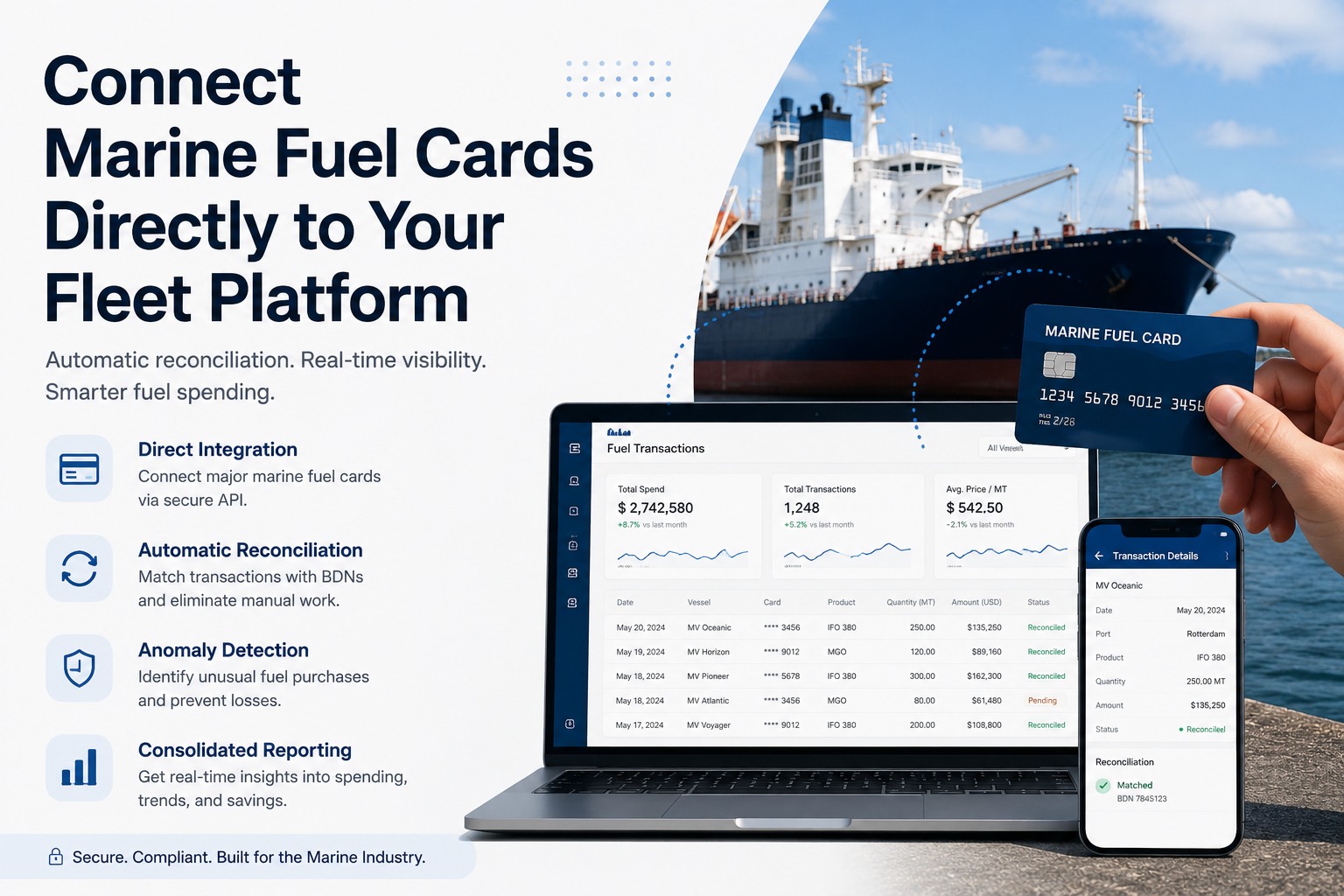
Connect Marine Fuel Cards to Your Fleet Platform
Sync every fuel card and bunker-account transaction directly into one platform — matched to the vessel, checked for anomalies in seconds, and rolled into consolidated cost reporting. No statements, no spreadsheets, no lag.
25–35%of operating cost is fuel
2–5%of fuel budget lost to fraud and misuse
secondsto flag an anomaly, not weeks
Book a Demo
Why Manual Fuel-Card Reconciliation Fails
The traditional process — downloading statements, sorting transactions by vessel, cross-referencing against logs — takes days every month and still misses the patterns that signal fraud or misuse. The problem is not effort; it is the lag and the manual matching, both of which integration removes.
The information lag
Statement-based reconciliation leaves a six-to-ten-day gap between a transaction and the data, so problems surface long after anyone could act on them.
Manual matching errors
Hand-attributing each transaction to a vessel is slow and error-prone, and a misattributed cost quietly corrupts the per-vessel picture.
Hidden fraud and misuse
Without automated checks, anomalies hide inside the monthly total — and fleets lose an estimated two to five percent of fuel budget to fraud and misuse.
No single picture
Card data sits apart from operational data, so nobody sees true per-vessel fuel cost against budget until the accounts close.
How Fuel Card Integration Works
Integration connects your fuel card and bunker-account providers directly to the fleet platform through a secure API or a daily data feed, so transactions arrive automatically and pass through a defined sequence before they ever reach a report. See the integration flow in a demo.
1
Connect the provider
Link the fuel card or bunker account via secure API or daily file transfer — no manual export from a provider portal.
2
Import transactions
Every purchase flows in automatically with date, location, grade, quantity, and price — eliminating manual data entry.
3
Match to vessel & voyage
Each transaction is attributed to the correct vessel and voyage automatically, building an accurate per-asset cost record.
4
Run anomaly checks
The transaction passes through a suite of validation rules within seconds, flagging anything that looks irregular for review.
5
File & report
Clean transactions post to the vessel's cost record automatically and roll into consolidated reporting in real time.
The decisive factor is timing. True real-time integration means transactions appear within seconds to minutes; if a platform waits twenty-four to seventy-two hours for batch uploads, it loses most of the anomaly-detection value that makes integration worth doing. The goal is to catch the irregular transaction while it still matters, not to tidy up the record after the fact.
The Anomaly Checks That Catch Loss
The real return on integration is automated anomaly detection — validation rules that run on every transaction and flag the irregular ones instantly, instead of letting them hide in a monthly statement. Each check targets a specific kind of loss or error.
Fuel-Card Anomaly Checks and What They Catch
Set custom limits — maximum quantity per transaction, spending caps per card, authorized locations and times — and instant alerts go out by email or message the moment a rule trips. This is how a fleet recovers the two-to-five percent of fuel budget that otherwise leaks away unnoticed, turning a monthly post-mortem into a same-day intervention.
See it on your fleet
Watch a Live Transaction Get Matched and Checked
Marine Inspection connects your fuel cards and bunker accounts, imports every transaction automatically, matches it to the vessel and voyage, runs anomaly checks in seconds, and rolls the cost into one fleet-wide report. Book a 30-minute demo to see fuel card integration on a fleet like yours, or start a free trial and connect your first card today.
Automatic Reconciliation Against Bunker Records
For a marine fleet, fuel card integration is most powerful when the transaction data is reconciled against the vessel's own bunker records — the delivery notes, soundings, and consumption already captured onboard. The card says what was paid for; the bunker record says what was actually received and burned. Reconciling them is where discrepancies surface. See reconciliation in a demo.
Card vs BDN
The card or account charge is matched against the bunker delivery note quantity, so billed and delivered figures must agree.
Charge vs received
What was paid is checked against what tank soundings confirm aboard, exposing short-delivery hidden in the paperwork.
Cost vs consumption
Spend is set against actual burn per voyage, so unexplained cost or consumption is flagged rather than absorbed.
Once, at the source
Because the data arrives automatically, reconciliation becomes a short exception review instead of a multi-day rebuild.
Consolidated Cost Reporting
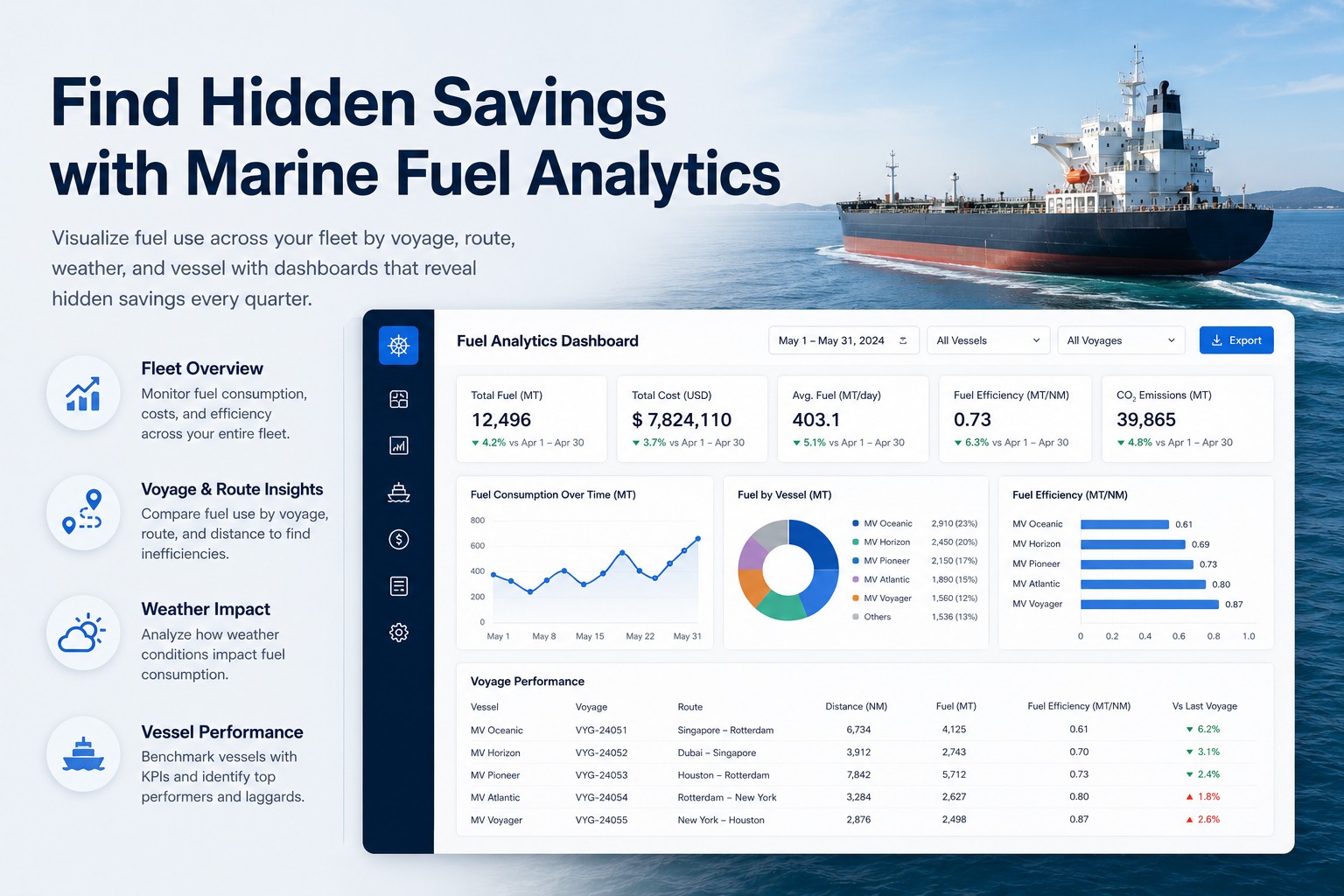
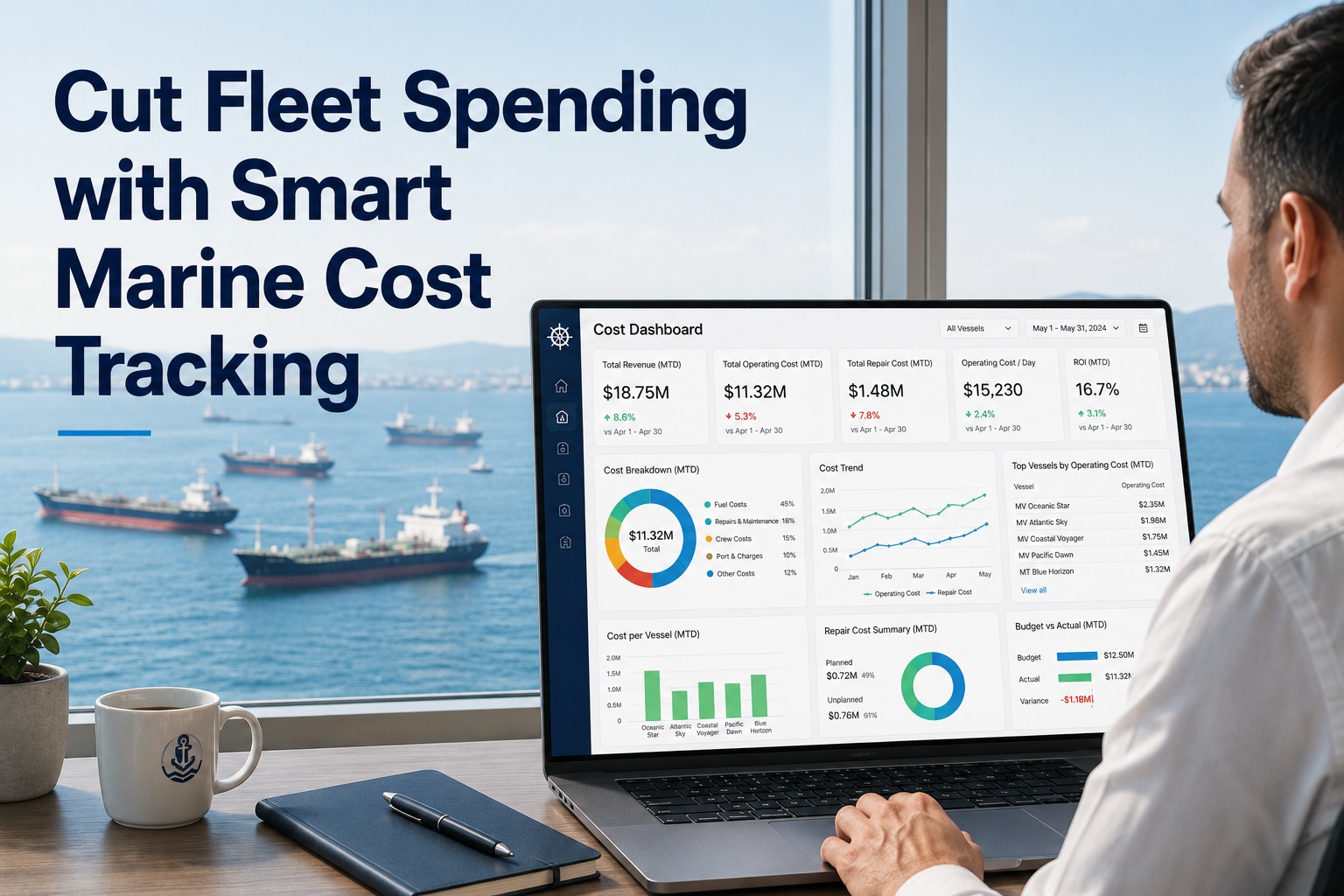
Once transactions flow in clean and matched, the payoff is a single, current view of fuel spend across the fleet — organised for decisions, not just accounting. Instead of stitching statements together, managers see where the money is going while they can still act on it.
Per-vessel fuel cost
Cost attributed to each vessel and voyage in real time, so the heavy and light consumers are visible at a glance.
Budget variance
Spend against budget with variance attributed to its cause — volume change, price change, or efficiency change.
Exception queue
A live list of flagged transactions awaiting review, so action items are explicit rather than buried in a report.
Fleet-wide rollup
Every vessel's fuel data aggregated into one dashboard, turning isolated card statements into a fleet cost picture.
The shift is from accounting reconciliation to operational decision-making. When fuel cost updates per vessel in real time and the month-end close becomes a short review rather than a multi-day project, fuel management stops being a backward-looking bookkeeping task and becomes an active lever on the fleet's largest controllable cost.
How Marine Software Runs Integration — and Why It's Needed
Fuel card integration only delivers if the platform connects reliably, matches accurately, and fits the marine context rather than a road-fleet one. Purpose-built marine software handles the connection and reconciliation where a generic tool or a manual process cannot.
Direct provider connection
Fuel cards and bunker accounts connect by secure API or daily feed, so transactions arrive automatically with no manual export or entry.
Vessel and voyage matching
Each transaction is attributed to the right vessel and voyage, building the per-asset cost history that decisions depend on.
Rule-based anomaly checks
Custom limits on quantity, spend, location, and timing fire instant alerts, recovering the budget that misuse otherwise drains.
Reconciled to bunker records
Card data is checked against BDNs, soundings, and consumption, so billed, delivered, and burned figures must tie out.
Consolidated reporting
Per-vessel cost, budget variance, and an exception queue roll up into one fleet dashboard built for action, not just audit.
One system, not a silo
Fuel sits alongside maintenance, inventory, and procurement, so cost data connects to the operations that drive it.
The deeper reason it is needed is that fuel is too large a cost to manage with a lag. A generic fuel-card tool built for road fleets matches transactions to trucks by GPS, but a marine platform must match to vessels and voyages and reconcile against bunker records — and it must do so as part of the same system that runs maintenance and inventory, so fuel cost connects to the operation that creates it. That integration is what converts a stream of card transactions into control. Book a demo to see it on your fleet.
Frequently Asked Questions
What is fuel card integration for vessels?
It is connecting marine fuel cards and bunker accounts directly to a fleet platform so transactions import automatically, match to the correct vessel and voyage, pass through anomaly checks, and roll into consolidated cost reporting. It replaces manual statement reconciliation with real-time, validated fuel data, turning fuel from a bookkeeping task into active cost control.
How does the integration connect to fuel card providers?
Through a secure API or a daily data feed from the provider, so transactions flow into the platform automatically without manual export from a provider portal. True real-time integration delivers transactions within seconds to minutes; batch uploads that take twenty-four to seventy-two hours lose most of the anomaly-detection value that makes integration worthwhile.
What anomalies can fuel card integration detect?
Common checks include over-capacity volume, off-hours purchases, velocity (multiple transactions in a short window), fuel-grade mismatch, location mismatch against the vessel's position, and duplicate transactions. Custom limits on quantity, spend, location, and time trigger instant alerts, helping recover the two to five percent of fuel budget typically lost to fraud and misuse.
How does it reconcile against bunker records?
The card or account charge is matched against the bunker delivery note quantity, checked against what tank soundings confirm was received, and set against actual consumption per voyage. Because the data arrives automatically, reconciliation becomes a short exception review rather than a multi-day rebuild, and discrepancies between billed, delivered, and burned fuel surface immediately.
What does consolidated cost reporting show?
It shows per-vessel and per-voyage fuel cost in real time, spend against budget with variance attributed to volume, price, or efficiency change, a live queue of flagged exceptions awaiting review, and a fleet-wide rollup. The data is organised for operational decisions rather than accounting reconciliation, so managers can act while spend is still controllable.
Why use a marine platform instead of a generic fuel-card tool?
Generic tools are built for road fleets and match transactions to vehicles by GPS. A marine platform matches to vessels and voyages, reconciles card data against bunker delivery notes, soundings, and consumption, and runs fuel alongside maintenance, inventory, and procurement in one system — so fuel cost connects to the operation that drives it rather than sitting in an isolated silo.
Built for marine fuel control
Turn Card Transactions Into Real Cost Control
Direct provider connection, automatic vessel and voyage matching, rule-based anomaly checks, reconciliation against bunker records, and consolidated fleet reporting — all in one platform alongside your maintenance and inventory. Marine Inspection closes the lag between spend and visibility. Book a tailored walkthrough or start a free trial today.