Fuel theft at sea rarely looks like theft. There is no broken lock or missing cargo — just a delivery that was a little short, a consumption figure that runs a little high, a transfer that does not quite reconcile. Each event is small enough to dismiss, and on paper they vanish into the monthly total. But across a fleet and a quarter, that steady leak adds up to two to five percent of the fuel budget, on a cost that is already the largest a vessel carries. The defence is not suspicion; it is reconciliation. Every litre of fuel should tie out across three numbers — what was supplied at the bunker, what was received aboard, and what was burned in service — and any gap between them is a signal. Automated fuel theft detection watches those three numbers continuously and flags the discrepancies the moment they appear, turning an invisible leak into a documented alert while there is still time to act, issue a Letter of Protest, or investigate. This guide explains where marine fuel goes missing, how three-way reconciliation catches it, the anomaly checks that expose tampering, and why automated detection beats a manual audit that always arrives too late. To see fuel reconciliation and anomaly alerts live, book a Marine Inspection demo.
Catch the leak before the quarter
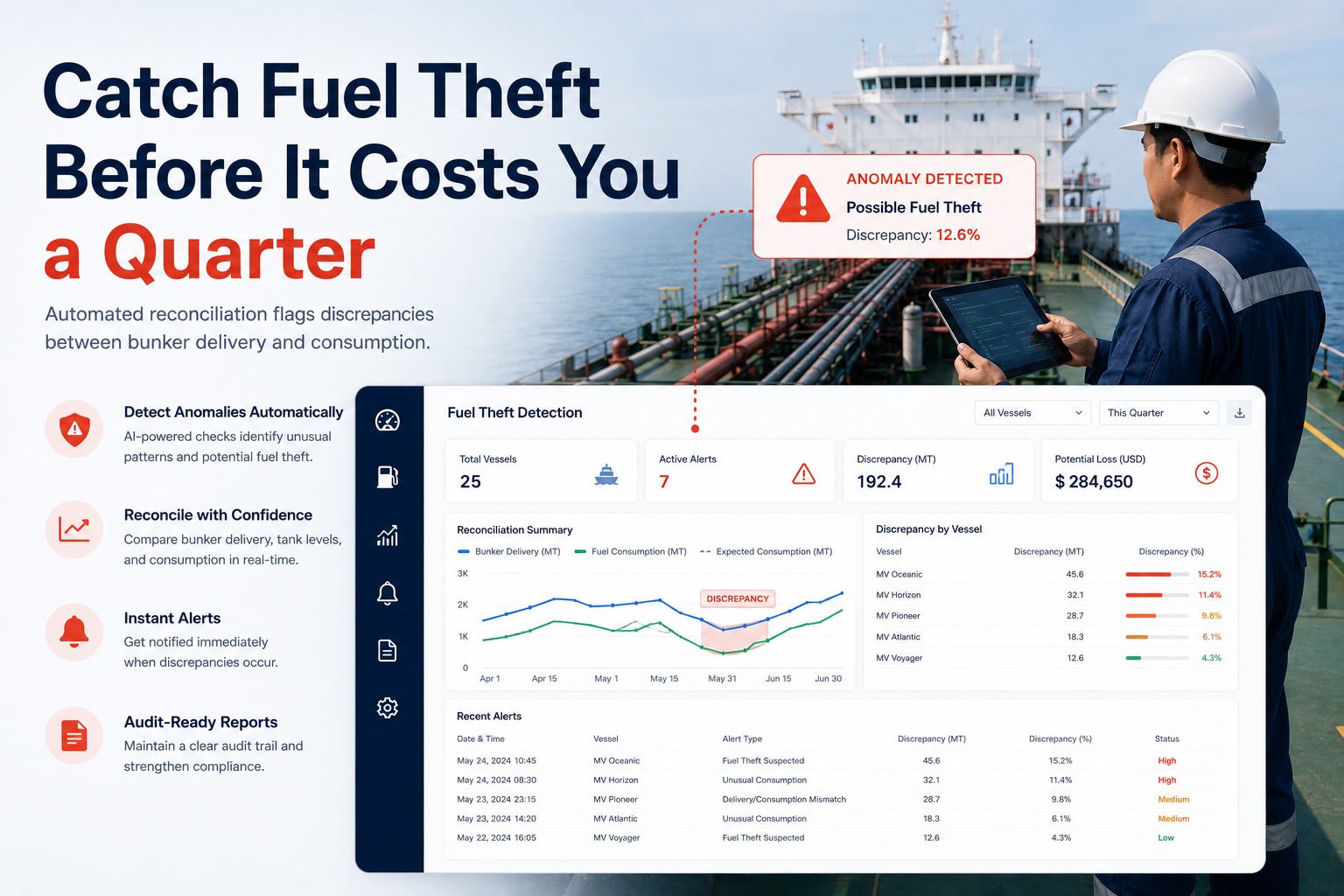
Catch Fuel Theft Before It Costs You
Automated reconciliation ties out supplied, received, and burned fuel on every operation — flagging short-delivery, tampering, and unexplained loss the moment a discrepancy appears, not weeks later in the accounts.
2–5%of fuel budget lost to theft and misuse
3-waysupplied, received, burned reconciliation
instantalerts the moment a gap appears
Book a Demo
Where Marine Fuel Goes Missing
Loss happens at predictable points, and most of it exploits the gap between what is measured and what is recorded. Knowing where to look is the first step; catching it automatically is the second. See loss detection in a demo.
The cappuccino effect
Air or gas injected into the bunker stream inflates apparent volume, so the vessel is billed for fuel it never received.
Temperature inflation
Fuel delivered warm reads as a larger volume; once it cools, the actual mass aboard is less than the paperwork states.
Short-delivery
Simply less fuel pumped than the bunker delivery note claims, hidden in volumetric uncertainty and tank-sounding conversions.
Pilferage & leakage
Fuel lost between what was received and what was burned — diverted, siphoned, or leaked — surfacing only as an unexplained gap.
Three-Way Reconciliation: The Core of Detection
The foundation of fuel theft detection is simple in principle: three numbers that should always agree. When they do not, the gap is the evidence. Automated reconciliation compares them continuously, so a discrepancy is caught at the operation rather than discovered in a year-end audit.
Supplied
What the BDN and bunker invoice say was delivered
vs
Received
What tank soundings and the mass flow meter confirm aboard
vs
Burned
What consumption monitoring records as actually used
The supplied-versus-received gap catches short-delivery and the cappuccino effect at the barge, where a Letter of Protest can still be issued. The received-versus-burned gap, tracked over a voyage, exposes pilferage and leakage that no single measurement would reveal. Neither gap is visible in a paper logbook; both are obvious in a system that reconciles automatically — which is the whole point of detection.
See it on your fleet
Turn an Invisible Leak Into a Flagged Alert
Marine Inspection reconciles supplied, received, and burned fuel on every operation, runs anomaly checks on each bunker and transfer, and fires instant alerts when a discrepancy appears — backed by the BDN and sounding records that support a dispute. Book a 30-minute demo to see theft detection on a fleet like yours, or start a free trial and protect your fuel today.
The Anomaly Checks That Expose Tampering
Beyond the headline reconciliation, automated detection runs a set of checks on every fuel event, each targeting a specific deception. Custom thresholds turn these into instant alerts the moment a rule is breached.
Fuel Anomaly Checks and What They Reveal
The key is comparing actual against expected. A consumption figure is only suspicious relative to what the voyage, speed, and conditions should have required — so detection models expected use and flags the deviation, catching not just theft but undetected faults that waste fuel just as quietly.
Why a Manual Audit Always Arrives Too Late
The traditional defence — a periodic audit of fuel records — fails for a structural reason: by the time the numbers are reviewed, the fuel is gone, the barge has sailed, and the dispute window has closed. Automated detection inverts that timing.
Manual Audit
Discrepancy found weeks or months later
Dispute window with the supplier already closed
No contemporaneous evidence to support a claim
Small losses dismissed as measurement noise
Automated Detection
Discrepancy flagged at the operation, in real time
Letter of Protest issued before the barge departs
BDN, soundings, and photos captured as evidence
Every gap logged and trended across the fleet
The difference is not just speed but leverage. A discrepancy caught at the barge, with the BDN and sounding records to back it, is a claim the supplier must answer. The same discrepancy found in a quarterly audit is a write-off. Detection is what preserves the ability to act.
How Marine Software Detects It — and Why It's Needed
Fuel theft detection only works if the system captures fuel data at the source, reconciles it automatically, and holds the evidence a dispute requires. Purpose-built marine software does exactly that, where a manual audit or a generic tool cannot.
Continuous reconciliation
Supplied, received, and burned fuel are compared automatically on every operation, so a gap surfaces instantly rather than at audit.
Rule-based anomaly alerts
Mass-versus-volume, temperature, consumption, and transfer checks fire instant alerts the moment a custom threshold is breached.
Evidence captured at source
The BDN, soundings, meter ticket, and photos are logged during bunkering, giving a contemporaneous record that supports a Letter of Protest.
Expected-use modelling
Consumption is judged against what the voyage should have required, so theft and fuel-wasting faults both stand out from normal burn.
Works offline at sea
Bunkering and consumption are captured offline and synced to shore, so detection holds even where there is no connectivity at the berth.
Fleet-wide loss trends
Every flagged gap is logged and trended, so a recurring problem at a port, supplier, or vessel becomes visible across the fleet.
The deeper reason it is needed is that fuel loss is a timing problem disguised as a measurement problem. The discrepancies are real and detectable, but they only carry leverage if they are caught at the moment of the transaction, with the evidence in hand. A manual audit has neither the timing nor the evidence; automated detection has both, which is why it converts a tolerated two-to-five percent leak into a defended cost. Book a demo to see it on your fleet.
Frequently Asked Questions
What is fuel theft detection software?
It is software that catches fuel loss by reconciling what was supplied, received, and burned, and running anomaly checks on every bunker and transfer. When the three figures do not agree, or a check is breached, it fires an instant alert — turning short-delivery, tampering, and pilferage from an invisible leak into a documented, actionable discrepancy.
How much fuel do fleets lose to theft and misuse?
Industry estimates put the loss at two to five percent of the fuel budget. Because fuel is the largest controllable cost on a vessel, that percentage represents substantial money across a fleet and a quarter — and because each individual loss is small, it typically goes undetected without automated reconciliation.
What is the cappuccino effect?
It is a bunkering fraud where compressed air or gas is injected into the fuel, creating bubbles that inflate the apparent volume so the vessel appears to receive more than it does. The shortfall often only emerges days later. Mass-versus-volume reconciliation and density-corrected measurement are the checks that expose it at the barge.
How does three-way reconciliation work?
It compares three figures that should agree: fuel supplied per the BDN, fuel received per soundings and the meter, and fuel burned per consumption monitoring. The supplied-versus-received gap catches short-delivery at the barge; the received-versus-burned gap over a voyage exposes pilferage and leakage. Discrepancies invisible on paper become obvious when reconciled automatically.
Why is automated detection better than a manual audit?
Timing and evidence. A manual audit finds a discrepancy weeks later, after the dispute window has closed and with no contemporaneous proof. Automated detection flags it at the operation, while a Letter of Protest can still be issued and the BDN, soundings, and photos are captured as evidence — preserving the leverage to actually recover the loss.
Can detection tell theft from an engine fault?
It flags both, because both show up as consumption higher than the voyage profile warrants. The alert prompts investigation, which then distinguishes diversion or pilferage from a mechanical fault burning excess fuel. Either way the loss is caught early — and a fuel-wasting fault identified this way also feeds condition-based maintenance.
Built for marine fuel security
Defend Your Largest Cost, Litre by Litre
Three-way reconciliation, mass-versus-volume and consumption anomaly checks, instant alerts, and source-captured evidence for every dispute — offline-capable and trended across the fleet. Marine Inspection turns a tolerated fuel leak into a defended cost. Book a tailored walkthrough or start a free trial today.