A fleet manager's day is full of questions that should take seconds to answer but routinely take an afternoon. Which vessels are overdue for maintenance? Which burned the most fuel last quarter? Whose certificates expire next month? The data exists — scattered across maintenance logs, inspection reports, fuel records, and compliance trackers — but getting it out means choosing a module, setting filters, building a report, and exporting it, for every single question. Conversational AI removes that whole layer. You ask in plain English, and the answer comes back instantly, pulled from across every vessel, inspection, and maintenance record at once. No report to build, no syntax to learn, no waiting on someone to compile it. The manager stops being a data-retrieval clerk and goes back to being a decision-maker, because the question-to-answer time collapses from an afternoon to a sentence. This page walks through the daily friction you already know, how asking replaces reporting, the kinds of questions it answers across the fleet, and why an assistant wired into your real data beats both manual reporting and a generic chatbot. To ask a live fleet your own questions, book a Marine Inspection demo.
Conversational fleet AI
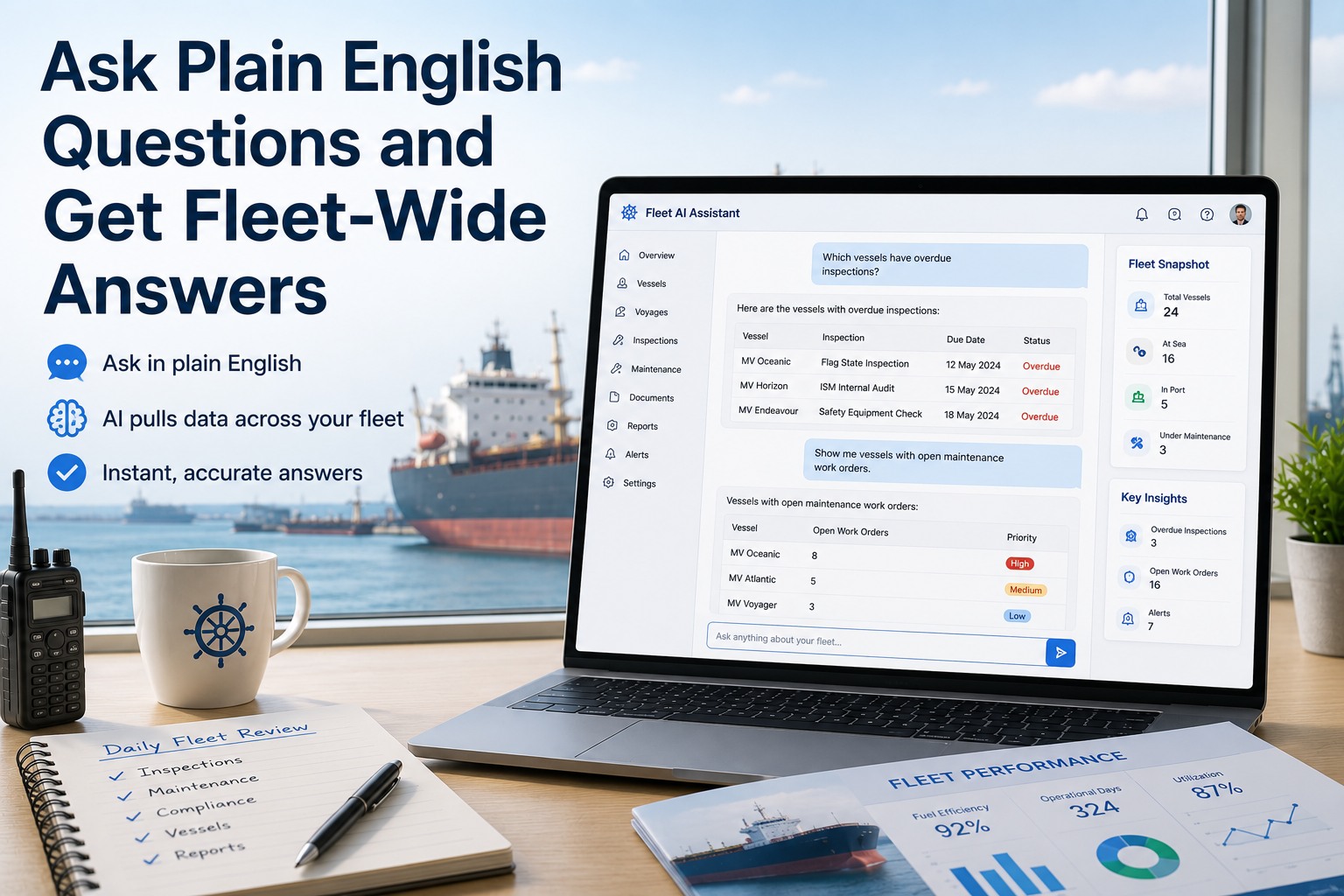
Ask in Plain English, Get Fleet-Wide Answers
Get instant fleet insights without writing a single report — conversational AI pulls data across vessels, inspections, and maintenance on demand, and answers the question the moment you ask it.
You ask
"Show me every vessel with an overdue inspection and an open critical defect."
The Question-to-Answer Gap You Live With
The problem is not that the data is missing — it is that getting to it is slow. Every routine question becomes a small project, and the friction adds up to hours a week and decisions made later than they should be. See the alternative in a demo.
Every answer is a report
A simple question means opening a module, setting filters, and generating a report — minutes of work for something you could ask in a sentence.
Data lives in silos
Maintenance, inspections, fuel, and compliance sit in separate places, so a question that spans them means stitching several reports together.
Answers arrive late
By the time the report is built and read, the moment to act has often passed, turning insight into hindsight.
It needs a specialist
Pulling the right data often means asking whoever knows the system, so the manager waits on someone else for a basic answer.
Asking Replaces Reporting
The shift conversational AI brings is simple to state and large in effect: you stop building reports and start asking questions. The same answer, reached a completely different way.
Building a Report
Decide which module holds the data
Set vessel, date, and status filters
Generate and export the report
Repeat for each system the question spans
Read and combine the results yourself
Asking a Question
Type the question in plain English
The AI reads it in marine context
It queries every relevant system at once
The answer returns in seconds, with the figures
Ask a follow-up to go deeper
One Question, Every System
The real power is that a single question can reach across all your fleet data at once — something no single report can do. The assistant pulls from each source and assembles one answer. See a cross-fleet query in a demo.
Maintenance
Inspections
Fuel
Inventory
Compliance
Logbooks
All queried at once for one answer
Because the question is answered against every system together, you can ask things that span them — an overdue inspection and an open defect on the same vessel, or fuel cost against maintenance spend per ship. A report built from one module could never join those; a conversational assistant connected to all of them does it in a sentence.
The Questions It Answers
The clearest way to picture conversational AI is the range of real questions it handles from your data, returning the figures rather than telling you where to look. Ask your own in a demo.
Across the fleet
"Which vessels have an overdue inspection right now?"
Performance
"Rank my ships by fuel cost per mile last quarter."
Risk
"Where do open critical defects and overdue work overlap?"
Compliance
"What expires in the next 60 days, and on which vessels?"
Spend
"Compare maintenance spend across the fleet this year."
Summary
"Summarize this month's defects by vessel and category."
See it on your fleet
Stop Building Reports. Start Asking Questions.
Marine Inspection's assistant understands plain-language questions in marine terms, queries your maintenance, inspection, fuel, and compliance data together, and returns the answer with real figures in seconds. Book a 30-minute demo to ask your own questions against a live fleet, or start a free trial and put it to work on your data today.
What Happens Behind the Question
Asking feels effortless, but the assistant does real work in the moment between your question and the answer — the work a person used to do manually. See it work in a demo.
1
Understands the question
It reads your plain-language question in marine context — recognising vessels, voyages, defects, and the terms you use — so it interprets what you actually mean.
2
Queries the real data
It translates the question into queries against your actual records across every relevant system, rather than answering from general knowledge.
3
Assembles the answer
It combines the results into one response — numbers, trends, and a plain summary — formatted so you can act on it without further digging.
4
Shows its working
It can explain how it read the question and which data it used, so you can trust the answer instead of taking it on faith.
Who Gets Their Day Back
Conversational access changes the working day for everyone who currently waits on a report. Each gets time and immediacy back. See your role's view in a demo.
Fleet Manager
Answers to operational questions in seconds, so decisions are made on current data instead of waiting on a compiled report.
Superintendent
A fast way to check status across every vessel at once, spotting the ship that needs attention without opening five systems.
Technical Team
Quick lookups of defect history, work status, and spares without building queries, freeing time for the actual engineering.
Senior Leadership
Self-service answers to high-level questions about cost, risk, and compliance without tasking anyone to prepare them.
Why an Integrated Assistant Beats a Generic Chatbot
A general chatbot can hold a conversation, but it cannot see your fleet. The value of conversational AI for a manager comes entirely from its connection to your real data — which is what separates a useful assistant from a clever one.
Answers from your data
It queries your actual maintenance, inspection, fuel, and compliance records, so answers reflect your fleet rather than a plausible guess.
Spans every system
Because it reaches all your data at once, it answers cross-fleet questions no single report could, joining sources in one response.
Speaks marine
It understands vessels, voyages, machinery, and defects, so it reads operational questions correctly instead of as generic business queries.
Returns real figures
Answers come as numbers, trends, and summaries you can act on, generated in seconds rather than as vague conversational prose.
Works at sea
Connected to a platform that captures data offline and syncs ship-to-shore, so the answers stay current across the whole fleet.
Trustworthy by design
It shows the data behind each answer, so a manager can rely on it for real decisions rather than treating it as a novelty.
The deeper reason it matters is that the value was never in the conversation — it is in the connection. A chatbot that talks well but cannot see your fleet answers nothing useful; an assistant wired into every system answers the questions that actually run an operation, and answers them the instant they are asked. That is what turns a manager's day from chasing reports into making decisions. Book a demo to see it on your fleet.
Frequently Asked Questions
What is conversational AI for fleet managers?
It is an assistant that lets a manager ask plain-language questions about the fleet and get instant answers drawn from real data, instead of building reports. It pulls across vessels, inspections, maintenance, fuel, and compliance at once, understands marine terminology, and returns figures and summaries you can act on immediately.
How is it different from running a report?
A report means choosing a module, setting filters, generating, and exporting — repeated for each system a question spans. Conversational AI collapses that into a single plain-English question answered across all systems at once, in seconds. The answer is the same data, reached without the manual work and without waiting on a specialist.
What kinds of questions can it answer?
Anything your data supports: which vessels are overdue for inspection, which burned the most fuel per mile, what certificates expire soon, where open defects and overdue work overlap, how maintenance spend compares across ships, or a summary of this month's defects. Because it spans systems, it can answer questions that cross maintenance, fuel, and compliance together.
Does it pull data from across all vessels?
Yes. That is the core advantage — a single question reaches every vessel and every connected system at once and assembles one answer. This is something a report built from a single module cannot do, and it is why conversational AI is most powerful for fleet-wide questions that span sources.
How do I know the answer is accurate?
A trustworthy assistant grounds every answer in your actual records rather than general knowledge, and can show how it interpreted the question and which data it used. That transparency lets a manager verify the reasoning and rely on the answer for real decisions, instead of treating it as guesswork.
Is it better than a general chatbot like a standalone AI?
For fleet management, far better. A general chatbot has no access to your fleet, so it cannot tell you which ship is overdue or what your fuel costs are. An integrated assistant is connected to your real data and marine context, so it answers specific operational questions about your vessels — which is where the value is.
Built for maritime fleet management
Turn Every Question Into an Instant Answer
Plain-English questions answered across maintenance, inspections, fuel, and compliance at once; real figures and summaries in seconds; marine context understood; and the data behind every answer shown — inside one connected platform that works ship-to-shore. Marine Inspection turns reporting into a conversation. Book a tailored walkthrough or start a free trial today.