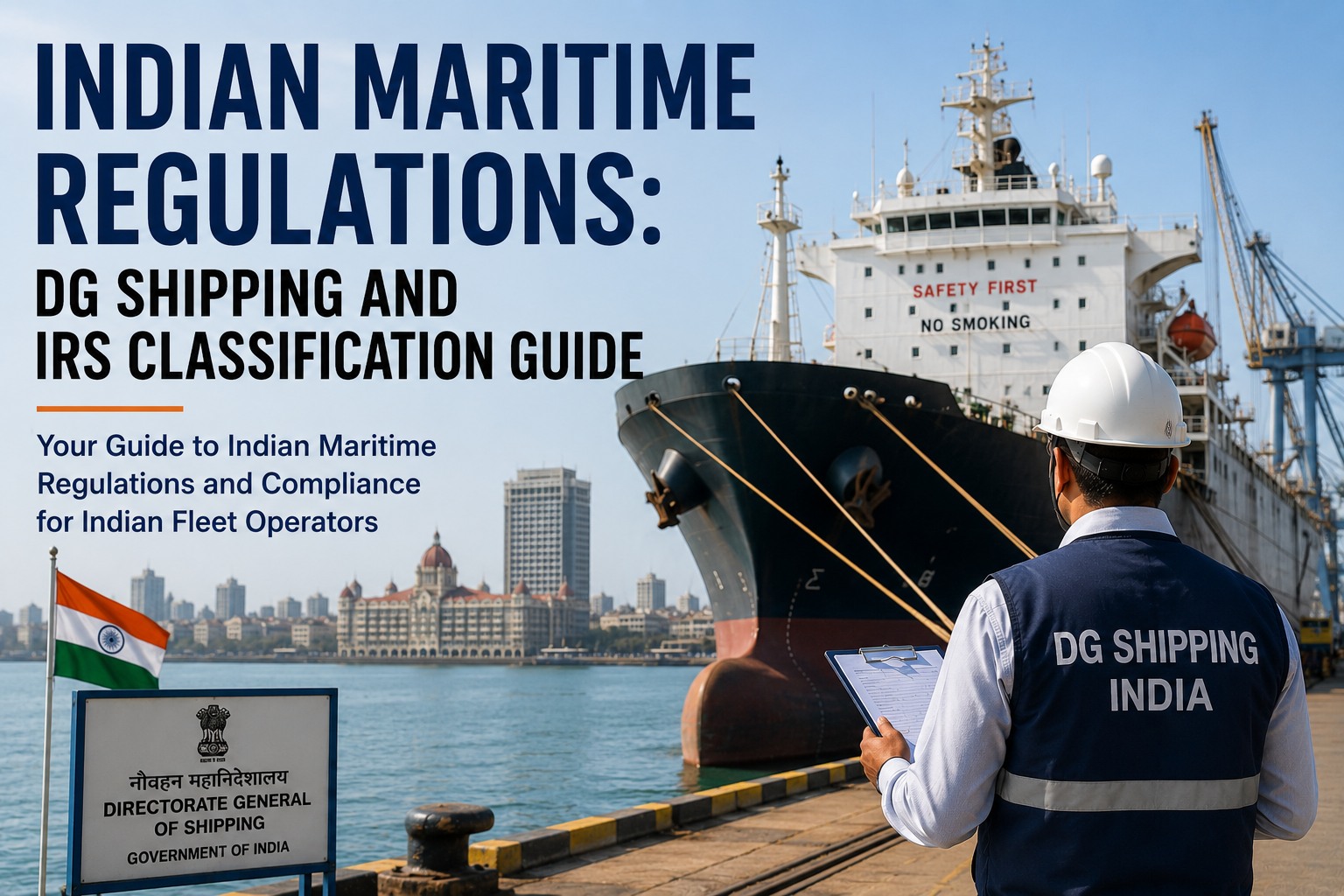
Indian maritime regulation is in the middle of its biggest overhaul in nearly seventy years, and operators working from outdated references are about to find that out. The Merchant Shipping Act, 1958 — the statute that has governed Indian shipping since independence-era legislation was consolidated — is giving way to the Merchant Shipping Act, 2025. Alongside it sit a new Coastal Shipping Act, a new Bills of Lading Act and a new Carriage of Goods by Sea Act, all of 2025 vintage. And the regulator itself is changing: as India transitions toward what it describes as a modern and facilitative maritime governance framework, the Directorate General of Shipping is evolving into the Directorate General of Maritime Administration, reflecting an expanded mandate and strategic reorientation. For Indian fleet operators, this is not a background legal development. It changes the statute your certificates are issued under, the licensing regime for coastal trade, the documents governing your cargo, and the name and remit of the authority you deal with. This guide covers the transition and what is replacing what, the DGMA's regulatory purview, how statutory survey and certification work through recognised organisations and IRS, the registration process, coastal shipping and cabotage licensing, and the seafarer certification regime that touches every Indian crew. Start free trial or book a demo to keep certificates, survey dates, and inspection records current through the regulatory transition.
REGIONAL COMPLIANCE · INDIA
India Is Replacing a 1958 Statute. Your References Just Aged.
The Merchant Shipping Act 2025, a new Coastal Shipping Act, new cargo legislation — and DG Shipping itself becoming the Directorate General of Maritime Administration. If your compliance manuals cite the 1958 Act, they are describing a system that is being replaced.
Moving from
Merchant Shipping Act, 1958
Directorate General of Shipping
Moving to
Merchant Shipping Act, 2025
Directorate General of Maritime Administration
The New Legislative Framework
The 2025 legislative package is broader than a single replacement Act. Several instruments arrive together, each covering a distinct part of the maritime legal landscape.
Merchant Shipping Act, 2025
The successor to the 1958 Act, framed as the foundation of a modern and facilitative maritime governance framework. It is the statute under which registration, survey, certification and the regulator's powers are being reconstituted.
Coastal Shipping Act, 2025
Governs coastal trade, including the licensing regime for foreign vessels. Section 11 licensing is the operative provision — and exemptions from it are already being issued by notification for defined categories.
Bills of Lading Act, 2025
Replaces the earlier bills of lading legislation, modernising the law on the document that functions as receipt, evidence of contract, and document of title.
Carriage of Goods by Sea Act, 2025
Updates the carriage regime governing carrier liability for cargo — the Indian counterpart to the international cargo conventions.
i
The regulator is being renamed and re-scoped, not merely rebranded. The Directorate is evolving into the Directorate General of Maritime Administration to reflect an expanded mandate and strategic orientation. Its stated purview covers implementation of national shipping policy and legislation, safety of life and ships at sea, prevention of marine pollution, promotion of maritime education and training in coordination with the IMO, registration, survey and certification of vessels, examination and certification of Merchant Navy officers, regulation of seafarer employment and welfare, development of coastal shipping, augmentation of India's shipping tonnage, and supervision of allied offices including the Mercantile Marine Departments and Seamen's Employment Offices.
Statutory Survey and the Role of ROs
India's statutory survey architecture has a specific legal foundation that operators should understand, because it explains why recognised organisations do the work and what authority they carry.
The statutory basis
Statutory surveys of Indian flag vessels are required to be undertaken by surveyors specifically appointed for the purpose by the Government of India under Section 9 of the Merchant Shipping Act — the provision that establishes who may lawfully survey an Indian ship.
Delegation to ROs
In line with international practice, the Directorate has issued procedures for statutory survey, certification and associated services of Indian flag ships by recognised organisations notified by the Government of India for that purpose, exercising powers under Section 9(1A) read with the relevant government notification.
Class and government agreement
The arrangement rests on a formal agreement between the classification society and the Government of India, with the RO engaged on being formally approached by the shipowner or ship operator.
Non-IACS tonnage
Vessels not classed with an IACS member are subject to an inspection equivalent to a Special Survey as applicable for IRS requirements, carried out by IRS — with drydocking requirements for such special surveys following extant IMO regulations.
The Indian Register of Shipping occupies a particular position in this structure. Beyond classification, IRS performs administrative functions on behalf of the flag — for example, submitting fuel consumption data to the IMO database on behalf of the administration and providing a compliance report to the Directorate, with companies submitting fuel consumption and related data for each Indian ship they manage to IRS in the standardised MEPC format.
Statutes change. Evidence requirements don't.
Carry Your Compliance Record Through the Transition
A new Act changes the legal basis of your certificates, not the underlying facts a surveyor examines — valid certification, current survey status, closed deficiencies, and maintenance history that supports the condition claimed. Marine Inspection holds that record per vessel with expiry alerts on certificates and survey due dates, structured inspections, and defect tracking through to verified closure.
Registration of Indian Ships
Registration follows the Merchant Shipping (Registration of Indian Ships) Rules, 1960, as successively amended, and the Directorate has issued modified guidance responding to industry representations about prevailing practice.
1
Technical clearance
The Directorate identified technical clearance, survey prior to registration, provisional registration and mortgage entry as areas needing detailed and modified guidelines — recognising the industry's need for clarity in expanding Indian tonnage.
2
Survey and measurement
Governed by Rule 5 of the 1960 Rules, alongside Rule 10 on marking of the ship and Rule 12 on acquisition of ships abroad — the three provisions that shape the pre-registration technical path.
3
Certificate of Survey and provisional registry
The attending surveyor may issue a Certificate of Survey and a Provisional Certificate of Registry irrespective of the vessel's location, if duly authorised by a Registrar of Ships — useful flexibility for tonnage acquired abroad.
4
Registration is not permission to trade
Issuance of the Certificate of Survey or the Certificate of Registry does not entitle the vessel to ply unless she also holds the required statutory certificates and valid documents. Registration and trading readiness are separate thresholds.
Age norms and qualitative parameters apply at the registration gate. The Directorate maintains age norms and other qualitative parameters governing registration and operation of vessels under the Indian flag — and the same parameters reach foreign-flag vessels required to apply for a licence under the coastal trade provisions. For an operator planning to bring secondhand tonnage onto the Indian register or to trade a foreign vessel on the Indian coast, those norms are a threshold question to settle before commercial commitment, not a formality at the end of the process.
Coastal Shipping and Cabotage Licensing
India's coastal trade is a licensed activity, and the framework is actively changing under the new legislation — with exemptions being issued that materially affect who can trade domestically.
The licensing requirement
Foreign vessels operating in Indian coastal trade require a licence, historically under Sections 406 and 407 of the Merchant Shipping Act 1958 and now under Section 11 of the Coastal Shipping Act 2025 — with the Directorate's age norms and qualitative parameters applying to applicants.
IFSC exemption
A Ministry notification exempts foreign vessels chartered by units established in the International Financial Services Centre from the Section 11 licensing requirement — a targeted liberalisation aimed at building IFSC-based ship chartering activity.
The coastal wing
A dedicated Coastal Shipping branch administers the domestic sector, including issuance of Sailing Vessel Identity Cards through a centralised system with regional and port officers in Mumbai, Jamnagar and Tuticorin under the Sailing Vessel Rules and associated circulars.
Specialised cargo rules
The branch also handles matters under the Merchant Shipping (Conditions for Carriage of Livestock) Rules and rules governing fishing vessels, alongside processing closure of sailing vessel registries.
Seafarer Certification and RPSL
No account of Indian maritime regulation is complete without the seafarer dimension, because India supplies crew far beyond its own fleet — approximately 80% of Indian seafarers are employed on foreign-flagged ships.
Approved training only
Modular courses required for obtaining a Certificate of Proficiency or Certificate of Competency must have been issued by maritime training institutes approved by the Directorate. Seafarers are directed to attend courses only at approved institutes and to refrain from fraudulent practices to obtain certificates purportedly from foreign administrations.
Flag endorsements
Seafarers must be engaged in a capacity commensurate with their qualifications and must obtain the necessary flag endorsements in accordance with STCW Regulation I/10 before deployment — a requirement that catches crewing teams out when a vessel changes flag mid-contract.
RPSL agencies
Recruitment and Placement Service Licence agencies approved by the Directorate under the Merchant Shipping (Recruitment and Placement of Seafarers) Rules, 2016 occupy a central role in placing Indian seafarers, with revised verification forms distinguishing Indian seafarers on foreign-flag ships, on Indian-flag ships, and non-seafarer categories.
Enforcement
Failure to comply attracts penal action under the applicable provisions of the Merchant Shipping Act and the RPSL Rules — enforcement directed through Surveyors-in-Charge at the Mercantile Marine Departments.
What Indian Operators Should Do Now
The transition period is where errors happen, because two frameworks coexist and references lag behind. A handful of disciplines carry an operator through it.
Re-baseline your legal references
Compliance manuals, SMS documents and contracts citing the Merchant Shipping Act 1958 or the old cargo statutes need review against the 2025 legislation. Citations that were correct last year may now point at superseded law.
Track DGS and DGMA circulars actively
The Directorate issues circulars, orders, MS notices and shipping notices continuously — including implementation notices for SOLAS amendments such as lifting appliances and anchor handling winches on Indian-flag vessels. Circulars are where the practical requirements land.
Confirm your RO authority
Statutory survey must be by surveyors appointed under the Act, working through ROs notified by the Government of India under a formal agreement. Verify that your society holds current Indian authorisation for the certificates you need.
Check coastal licensing status
If any part of your operation touches Indian coastal trade, confirm whether a Section 11 licence is required and whether any exemption — such as the IFSC charter exemption — applies to your structure.
Audit crew certification
Verify that certificates come from DGS-approved institutes, that flag endorsements under STCW I/10 are in place before deployment, and that RPSL documentation matches the seafarer's actual employment category.
Keep the evidence base current
Whatever the statute is called, a surveyor examines certificates, survey status, deficiencies and maintenance history. That record carries across legislative change unchanged in substance.
That final point is the practical reassurance in a period that otherwise looks disruptive. The Merchant Shipping Act 2025 changes the legal architecture — the statute your certificates are issued under, the name and mandate of your regulator, the licensing basis for coastal trade, and the law governing your bills of lading. What it does not change is the evidence any surveyor, port state officer or recognised organisation actually asks for: valid certificates, current surveys, deficiencies closed with proof, and a maintenance record supporting the condition claimed. Operators who keep that base continuously current move through the transition needing to update their references rather than rebuild their compliance. Those relying on institutional memory of the 1958 regime will find the gap widens with every circular. Book a demo to see certificates, surveys, and defect history as one current record.
Frequently Asked Questions
What is replacing the Merchant Shipping Act 1958?
The Merchant Shipping Act, 2025, as part of India's transition toward what the Directorate describes as a modern and facilitative maritime governance framework. It arrives alongside the Coastal Shipping Act 2025, the Bills of Lading Act 2025 and the Carriage of Goods by Sea Act 2025 — a package covering vessel regulation, coastal trade licensing and cargo documentation together.
Book a demo.
Is DG Shipping changing its name?
Yes. As India transitions under the Merchant Shipping Act 2025, the Directorate General of Shipping is evolving into the Directorate General of Maritime Administration, reflecting an expanded mandate and strategic orientation. Its purview covers national shipping policy and legislation, safety of life and ships at sea, marine pollution prevention, maritime education, vessel registration, survey and certification, officer certification, seafarer employment and welfare, coastal shipping development, tonnage augmentation, and supervision of the Mercantile Marine Departments and Seamen's Employment Offices.
Book a demo.
Who carries out statutory surveys on Indian flag ships?
Surveyors specifically appointed for the purpose by the Government of India under Section 9 of the Merchant Shipping Act. In line with international practice, the Directorate has issued procedures allowing statutory survey, certification and associated services to be performed by recognised organisations notified by the Government, under a formal agreement between the classification society and the Government of India, engaged when formally approached by the shipowner or operator.
Book a demo.
What happens if a vessel is not classed with an IACS member?
It is subject to an inspection equivalent to a Special Survey as applicable for IRS requirements, carried out by the Indian Register of Shipping, with drydocking requirements for such special surveys following extant IMO regulations. Non-IACS class therefore carries an additional survey burden rather than an exemption.
Book a demo.
Does a Certificate of Registry allow a ship to trade?
No. Issuance of the Certificate of Survey or the Certificate of Registry does not entitle the vessel to ply unless she also holds the required statutory certificates and valid documents. Registration and trading readiness are separate thresholds, and an attending surveyor may issue a Certificate of Survey and Provisional Certificate of Registry irrespective of the vessel's location if duly authorised by a Registrar of Ships.
Book a demo.
Do foreign vessels need a licence for Indian coastal trade?
Generally yes — historically under Sections 406 and 407 of the Merchant Shipping Act 1958 and now under Section 11 of the Coastal Shipping Act 2025, with the Directorate's age norms and qualitative parameters applying. However, a Ministry notification exempts foreign vessels chartered by units established in the International Financial Services Centre from the Section 11 licensing requirement.
Book a demo.
What are the rules for Indian seafarer certification?
Modular courses for a Certificate of Proficiency or Competency must be issued by maritime training institutes approved by the Directorate, and seafarers must attend only approved institutes. They must be engaged in a capacity commensurate with their qualifications and hold the necessary flag endorsements under STCW Regulation I/10 before deployment. Non-compliance attracts penal action under the Merchant Shipping Act and the RPSL Rules.
Book a demo.
What is the role of IRS beyond classification?
The Indian Register of Shipping performs administrative functions on behalf of the flag administration in addition to classification work. For example, it submits fuel consumption data to the IMO fuel oil consumption database on behalf of the administration and provides a compliance report to the Directorate, with managing companies submitting the required data for each Indian ship in the standardised MEPC format.
Book a demo.
New Statute. New Regulator. Same Evidence.
The Merchant Shipping Act 2025 changes the legal architecture of Indian shipping — but not what a surveyor asks to see. Marine Inspection keeps certificate validity and survey due dates per vessel with expiry alerts, runs structured inspections, and tracks defects to verified closure, so a fleet moves through legislative transition updating references rather than rebuilding compliance. This guide is an overview, not legal advice; refer to current DGS and DGMA circulars and take qualified Indian legal counsel for specific matters.