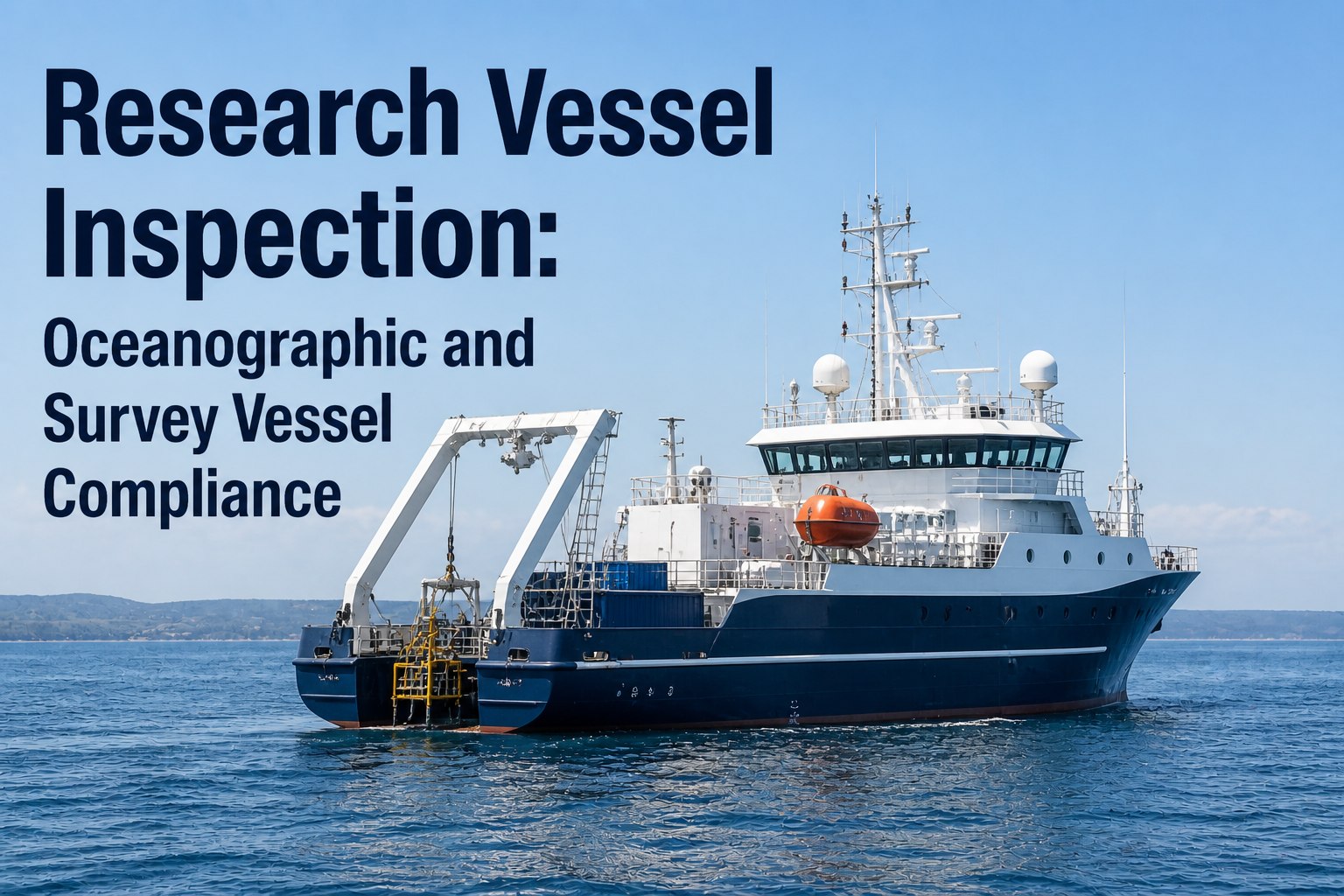
Research vessels occupy a unique seat in commercial shipping inspection. They are neither cargo ships nor passenger ships in the conventional sense — they carry "scientific personnel" who are legally classified as neither seamen nor passengers, alongside crew, sometimes industrial personnel, and a complement of laboratories, winches, A-frames, ROV launch systems, gravity coring rigs, seismic streamers, multibeam echo sounders and dynamic positioning suites that must be surveyed in addition to standard hull and machinery class. The regulatory landscape for these vessels shifted materially on 1 January 2026 as Polar Code amendments adopted by Resolutions MSC.532(107) and MSC.538(107) extended mandatory polar voyage planning to non-SOLAS research-class vessels, and as the IP Code (mandatory from 1 July 2024) reshaped how vessels carrying more than 12 industrial personnel must be certified and surveyed. Operators of US Academic Research Fleet (ARF) vessels, NOAA's 15-strong research/survey fleet, NERC's UK polar fleet, and dozens of national institutional fleets must navigate the SPS Code, IP Code, UNOLS RVSS 11th Edition, and now the expanded Polar Code in a layered compliance regime. Start a free trial of Marine Inspection to digitize cruise-by-cruise compliance across your research fleet.
2026 Inspection Landscape
Research Vessel Compliance Crosses a Regulatory Threshold
2026
Polar Code Expansion In Force
MSC.532(107) extends to vessels 300–500 GT, fishing 24m+, yachts 300 GT+ in polar waters
16
US Academic Research Fleet
UNOLS-coordinated; NSF/ONR/university owned; RVSS-governed
15
NOAA Research / Survey Vessels
Hydrography + fisheries + oceanography missions; Oceanographer + Discoverer newbuilds
125%
A-Frame / Winch Load Test
Every 2 years per 45 CFR 189.35-5 and UNOLS RVSS 12.1
Why Research Vessel Inspection Operates in a Class of Its Own
An oil tanker carries cargo. A cruise ship carries passengers. A research vessel carries neither — and both. Scientific personnel on oceanographic research vessels are explicitly defined under 46 CFR and reflected in UNOLS Research Vessel Safety Standards as a third legal category: not seamen, not passengers, but "persons" counted only when total complement matters. This distinction shapes everything downstream — the safety regime, the survey scope, the certification path, the manning rules, and the inspection priorities. Layered onto this is the operational reality: research vessels deploy heavy scientific equipment over the side at all hours, run laboratories with hazardous chemicals during transit, support deep submergence operations with human-occupied vehicles, and operate in environments — polar waters, deep ocean, remote stations — where the nearest assistance is days away. Book a Marine Inspection demo to see how research vessel operators digitize SPS Code surveys, RVSS audits, A-frame load tests, lab safety inspections, and Polar Code voyage compliance in one platform.
Four Research Vessel Mission Classes — Four Inspection Profiles
"Research vessel" is a single category covering vessels with sharply different mission profiles, equipment outfits and inspection priorities. NOAA operates across three classifications. The UNOLS Academic Research Fleet adds a fourth focused on deep-submergence and global oceanography. Polar-capable research vessels overlay an additional regulatory regime. Each class drives its own survey scope.
Multidisciplinary Ocean Science
Most diverse mission set: meteorology, sensor deployment, water column measurement, ocean exploration, sanctuary monitoring, plankton sampling, mapping. UNOLS Global Class (R/V Atlantis, R/V Roger Revelle) and NOAA's Ronald H. Brown represent the apex tier.
Equipment:CTD rosettes, multi-corers, ROVs, AUVs, ADCP, multibeam, A-frames, deck cranes, moon pool
Range:Global, weeks to months at sea, 30–60 scientific personnel
Inspection focus:Overboard handling systems, lab integrity, dynamic positioning, ROV/HOV systems, chemical inventory
Seabed Mapping & Survey
Mission-specific vessels mapping the ocean floor for charting, navigation safety, and offshore industry. Multibeam echo sounders dominate the equipment outfit; smaller survey launches deployed to map shallower areas. Increasingly autonomous — uncrewed surface vessel deployment growing rapidly.
Equipment:Hull-mounted multibeam, side-scan sonar, sub-bottom profiler, survey launches, USV deployment systems
Range:Coastal to ocean basin, multi-week deployments, smaller scientific complement
Inspection focus:Survey launch davits, sonar transducer mounts, IHO-compliant calibration records, USV launch/recovery systems
Marine Life & Stock Assessment
Vessels assessing fish populations, ecosystem health, and ocean conditions for sustainable resource management. Acoustic instruments (EK80 wide-band echo sounders) plus net deployment plus water and sediment sampling. NOAA Oscar Dyson and equivalent national institute vessels lead the segment.
Equipment:Stern trawl winches, scientific echo sounders, plankton nets, fish processing labs, refrigerated stowage
Range:Seasonal stock assessment, regional fisheries, mixed coastal/offshore operations
Inspection focus:Trawl winch SWL, towing point structural integrity, refrigerated cargo systems, biological hazardous material handling
Arctic & Antarctic Research
Ice-class research vessels operating in polar waters. Includes RRS Sir David Attenborough (UK, BAS), RV Kronprins Haakon (Norway, NPI), USCGC Healy (US), and CCGS Louis S. St-Laurent (Canada). Subject to the Polar Code AND the relevant national research fleet standard. As of 1 January 2026, the Polar Code expanded to non-SOLAS research vessels.
Equipment:Reinforced hull, ice-strengthened propulsion, helicopter hangar, ROV moon pool, polar-rated lifeboats
Range:Multi-month polar deployments, autonomous research stations, ice camps
Inspection focus:Polar Code compliance, hull steel-grade temperature ratings, ice-class machinery, polar PPE, helicopter facilities
The Three Regulatory Frameworks Covering Research Vessels
Research vessel inspection in 2026 is governed by a layered regulatory stack. SOLAS provides the baseline for vessels engaged on international voyages. The SPS Code (voluntary) governs vessels carrying more than 12 special personnel. The IP Code (mandatory from 1 July 2024) governs vessels carrying more than 12 industrial personnel. UNOLS RVSS provides the operational standard for the US Academic Research Fleet. National guidance (UK MGN 674(M), MCA, NOAA OMAO) overlays specific flag-state requirements.
Research Vessel Compliance Frameworks — How They Stack
VOLUNTARY
SPS Code 2008
Code of Safety for Special Purpose Ships
Adopted:IMO Resolution MSC.266(84), 13 May 2008
Application:Ships with more than 12 special personnel + crew
Mandatory:No — voluntary, applied at flag state discretion
Vessel scope:Research vessels, training ships, fisheries protection, expedition vessels
Certificate:Special Purpose Ship Safety Certificate (Form SPS)
UK reference:MGN 674(M) — application and exemption regime
MANDATORY
IP Code (Industrial Personnel)
SOLAS Chapter XV — Industrial Personnel Code
In force:1 July 2024 — mandatory under SOLAS Chapter XV
Application:Cargo ships ≥500 GT carrying more than 12 industrial personnel
Mandatory:Yes — under SOLAS Chapter XV
Vessel scope:Some research/survey vessels with industrial-personnel charter profile
Predecessor:IMO Resolution MSC.418(97) interim recommendations
Personnel transfer:Inspection of transfer appliances, periodic survey requirement
OPERATIONAL
UNOLS RVSS 11th Edition
Research Vessel Safety Standards
Latest:11th Edition, June 2023 Correction
Origin:First adopted May 1976; updated through 11 editions
Application:UNOLS-designated US Academic Research Fleet vessels
Status:De facto standard — exceeds USCG baseline regulations
Coverage:Hull, propulsion, lifesaving, scientific equipment, lab safety, harassment prevention, science party training
Reference:Appendix A (rope/cable), Appendix B (overboard handling), Appendix G (safety training)
Three Frameworks. One Inspection Platform.
SPS Code surveys, IP Code certification, UNOLS RVSS audits, Polar Code voyage planning, A-frame load tests, lab safety, scientific equipment surveys — Marine Inspection digitizes the layered research-vessel compliance regime.
The 1 January 2026 Polar Code Expansion
The most significant 2026 regulatory change for research vessels is the Polar Code expansion, adopted by IMO Resolutions MSC.532(107) and MSC.538(107) and entering into force 1 January 2026. The amendments introduce new chapters — 9-1 (Safety of Navigation) and 11-1 (Voyage Planning) — extending mandatory Polar Code requirements to vessel types previously outside its scope, including categories that capture many research, fisheries-research and expedition-research vessels.
Polar Code 2026 — Vessels Newly Brought Into Scope
Fishing
Fishing Vessels ≥24m in Length
Operating in polar waters — captures large fisheries research vessels and stock assessment platforms operating in Arctic and Antarctic regions. New chapters 9-1 and 11-1 of the Polar Code apply.
Yachts
Pleasure Yachts ≥300 GT (Not Engaged in Trade)
Includes some research-charter and expedition-charter platforms operating in polar waters under yacht registration. New navigation and voyage planning requirements apply at construction.
Cargo
Cargo Ships 300 GT to Below 500 GT
Smaller research vessels often registered as cargo ships now subject to Polar Code when operating in polar waters. New builds from 1 Jan 2026; existing vessels by 1 Jan 2027.
Apply
Compliance Timeline
Vessels constructed on or after 1 January 2026 must comply at construction. Vessels constructed before 1 January 2026 must comply by 1 January 2027 (often aligned with renewal surveys).
Scope
New Requirements Introduced
Up-to-date ice information, enhanced navigation equipment (echo sounding, anti-icing devices), detailed voyage planning, polar-specific risk assessments, immersion suits / thermal protective aids sized for all on board.
Scientific Equipment Surveys — The Inspection Beyond Class
Hull and machinery class is the floor for research vessel inspection. The differentiating layer is the scientific equipment outfit: A-frames, J-frames, hydrobooms, deck cranes, trawl winches, CTD winches, traction winches, ROV handling systems, gravity coring rigs, and seismic streamers. UNOLS RVSS Section 12 and 45 CFR 189.35-5 establish the load-test cycle that governs them. Sign up for Marine Inspection to digitize the scientific equipment survey cycle across your fleet.
A-Frame & J-Frame
Stern-mounted lifting structure for over-the-side deployment of CTD rosettes, multi-corers, plankton nets, ROVs, AUVs.
Load test: 125% of SWL every 2 years (45 CFR 189.35-5 & RVSS 12.1). SWL and last test date must be stencilled on the equipment.
CTD & Traction Winches
Deep-water winches deploying conductivity-temperature-depth instruments to 6,500m. Wire fatigue, drum integrity, level-wind alignment, brake system function.
Load test cycle per RVSS 12.1; cable inspection per RVSS Appendix A (Rope and Cable Safe Working Standards).
ROV / HOV Launch Systems
Tether management systems and launch and recovery systems (LARS) for Jason, Sentry, Alvin and equivalent platforms. Hydraulic, electrical, control system inspection.
DNV / ABS lifting appliance certification + RVSS 12 + IMCA M254 where motion-compensated. Cycle records by deployment.
Trawl & Net Handling
Stern trawl winches, gantries, towing points, net drums for fisheries research vessels. Heavy structural loading, fatigue critical.
Annual structural NDT of towing points; winch SWL load test 125% at 2-year intervals; brake and emergency-release function tests.
Multibeam & Sonar Mounts
Hull-penetration transducer mounts, gondola fairings, sea chests for hydrographic and oceanographic acoustic systems. Watertight integrity critical.
Hull integrity inspection at drydock cycle; calibration records per IHO standards; sea-chest sealing function-tested.
Moon Pool Systems
Through-hull deployment well for ROV, sediment coring, vertical profiling in heavy weather. Watertight closure, structural integrity, heave compensation.
Class society survey cycle; closure mechanism function-tested; pump and drainage system maintenance records.
Onboard Laboratory Safety: The Inspection Inside the Vessel
Research vessels carry laboratories that operate continuously during transit. Wet labs handle seawater samples, biological specimens, and chemical preservation. Dry labs operate sensitive electronics, computing equipment and acoustic processing systems. Hazmat storage holds chemicals — formalin, sodium azide, methanol, acids, radioisotopes for tracer studies — that on a typical cargo ship would never appear. UNOLS RVSS Chapter 9 (Scientific and Shipboard Hazardous Materials) and Section 8 (Scientific Support Equipment) address this layer.
WET LAB
Seawater & Biological Lab
Common hazards: Slips on wet decks, biological samples, formalin and ethanol preservation chemicals, exposure to seawater-contaminated organisms.
Inspection focus: Drainage, non-slip flooring, fume hoods, eye-wash stations, fire suppression compatible with chemical storage, watertight bulkheads to adjacent spaces.
DRY LAB
Electronics & Computing Lab
Common hazards: Sensitive electronics in marine environment, high power consumption, interference between scientific systems and ship navigation, thermal management.
Inspection focus: Electrical isolation from ship systems, UPS and emergency power, EMC verification, ventilation and HVAC, fire detection sensitivity calibration.
HAZMAT
Chemical Storage Locker
Common hazards: Flammable solvents (methanol, ethanol), toxics (formalin, sodium azide), corrosives (acids), oxidisers, sometimes radioisotopes for ocean tracer studies.
Inspection focus: Segregation per IMDG Code, ventilation, secondary containment, spill kit availability, manifest accuracy, pre-cruise inventory and post-cruise reconciliation.
REFRIG
Refrigerated & Frozen Sample Storage
Common hazards: -80C ultra-low freezers, liquid nitrogen storage, refrigerant gas leakage, asphyxiation risk in confined cold rooms.
Inspection focus: Temperature monitoring with alarm, oxygen depletion sensors in liquid nitrogen spaces, refrigerant leak detection, chain-of-custody for biological samples.
CLEAN
Trace Metal Clean Lab
Common hazards: Specialised lab for ultra-trace ocean chemistry. Contamination-controlled environment with HEPA filtration; acid cleaning of sample bottles; specialised PPE.
Inspection focus: HEPA filter integrity, positive-pressure verification, acid storage and disposal, dedicated water purification systems.
RAD
Radiochemistry / Tracer Studies
Common hazards: Some research programs carry low-activity radioisotopes for ocean tracer studies. Subject to flag-state nuclear regulator requirements in addition to maritime law.
Inspection focus: Source inventory, dosimeter records, shielding integrity, contamination monitoring, post-cruise decommissioning of work areas.
The Three-Class Personnel Taxonomy on Research Vessels
Few maritime sectors carry three legally distinct personnel categories simultaneously. Research vessels do — and that taxonomy drives manning rules, lifesaving equipment requirements, training records, and certificate scope. Understanding the distinction is foundational to research vessel inspection.
CREW
Crew
Personnel involved exclusively or primarily in the navigation and operation of the vessel. Subject to STCW certification, marine license requirements, ship's articles. Counted under crew accommodation regulations.
STCW certificates
Ship's articles
Marine medical fitness
Engine/deck rates
SCI
Scientific Personnel
Persons aboard solely for the purposes of scientific research. NOT seamen, NOT passengers — a distinct legal third category under 46 CFR. Includes scientists, technicians, students, expedition leaders. Counted only when total persons on board determines requirements.
Science party safety training
Pre-cruise medical screening
Station bill duties assigned
Drill participation mandatory
IND
Industrial Personnel (IP Code)
Workers on board for industrial activities — typically offshore wind, oil & gas service personnel. Different legal category from scientific personnel. Where research vessels charter for industrial work, IP Code applies (mandatory from 1 July 2024).
IP Code certification
SOLAS Chapter XV
Personnel transfer surveys
Distinct training regime
The Cost of Research Vessel Inspection Failure
Research vessel cruises typically cost $30K–$60K per day for ARF Global Class platforms, with NSF supporting roughly 70 percent of total US Academic Research Fleet utilisation. A failed inspection means more than a delayed survey — it can cancel a cruise mid-mobilisation, jeopardise multi-year science programs, and trigger institutional reputational damage that affects future funding awards.
$30–60K
Per-Day Cruise Cost
ARF Global Class operating cost. A single failed pre-cruise inspection delaying departure by a week consumes $200K+ from a typical NSF-supported program budget.
Cancel
Cruise Cancellation
Pre-mobilisation findings on A-frame, lab safety, scientific gear, ship systems can cancel cruises outright. Multi-PI science programs lose entire field seasons; weather/ice windows do not wait for re-survey.
Award
Funding Eligibility
NSF, NOAA, ONR and equivalent international funding bodies factor operator inspection track record into long-term ship support decisions. Persistent compliance issues affect operator ranking and award flows.
PSC
Port State Control
Research vessels visit port states across the world, often in remote regions. PSC findings on Polar Code, IP Code, SOLAS or class issues delay departure, sometimes for weeks while remote technicians and parts are shipped in.
How Marine Inspection Closes the Research Vessel Compliance Gap
The layered compliance regime — SPS Code, IP Code, RVSS, Polar Code, IHO calibration, flag state — combined with cruise-specific scientific equipment certification creates a compliance load that exceeds what paper systems and individual operator spreadsheets can sustain. Marine Inspection is built for this exact workflow. Book a demo to see research-fleet-specific workflows.
01
Scientific Equipment Load-Test Tracking
A-frames, J-frames, hydrobooms, cranes, trawl winches, CTD winches — automated 2-year load-test cycle reminders, certificate storage, SWL stencilling verification, RVSS 12.1 compliance evidence.
02
UNOLS RVSS 11th Edition Templates
Pre-loaded inspection templates aligned with RVSS chapters: scientific support equipment, hazardous materials, overboard handling, harassment prevention, science party safety training. Audit-ready for UNOLS designated operators.
03
Polar Code 2026 Voyage Compliance
New chapters 9-1 and 11-1 voyage planning and navigation requirements pre-loaded. Polar Code Risk Assessment templates, ice information records, immersion suit inventory, polar PPE tracking.
Cruise-by-Cruise Mobilisation Records
Pre-cruise mobilisation surveys, science party orientation records, scientific equipment installation certifications, hazmat manifest, cruise-specific safety briefings, post-cruise demobilisation reconciliation.
05
Lab Safety & Hazmat Inventories
Wet lab, dry lab, hazmat locker, refrigerated storage inspections. Pre-cruise chemical inventory, IMDG segregation verification, post-cruise reconciliation, RVSS Chapter 9 compliance evidence.
06
Multi-Framework Audit Packs
Single-click evidence packs for SPS Code surveys, IP Code (where applicable), Polar Code voyage submissions, UNOLS triennial inspections, NSF/NOAA program audits, port state inspections in any operating area.
From Pre-Cruise Mobilisation to Post-Cruise Demob — On One Platform
RVSS 11th Edition templates, Polar Code voyage compliance, scientific equipment load tests, lab safety inspections, hazmat inventories, multi-framework audit packs — Marine Inspection is built for research fleet operators.
Pre-Cruise Research Vessel Inspection Readiness Checklist
Use this as the master pressure-test before mobilisation, before departure, before any port state control inspection in remote operating areas, and before triennial UNOLS / NOAA / NERC institutional audits.
Research Vessel Pre-Cruise Quick-Check
Statutory & Class
SOLAS certificates current per vessel category (Cargo Ship Safety, Passenger Ship)
Special Purpose Ship Safety Certificate (where SPS Code applied) current
IP Code certification (where >12 industrial personnel carried)
Class society certificates (DNV, ABS, LR, BV) including special notations
ISM Document of Compliance and Safety Management Certificate
Polar Code certification + Polar Water Operational Manual (where applicable)
Scientific Equipment
A-frame, J-frame, deck cranes — 125% SWL load test current (within 2 years)
SWL and last test date stencilled on each piece of equipment
CTD winch and traction winch wire condition per RVSS Appendix A
ROV / HOV launch and recovery system certified (where carried this cruise)
Trawl winch towing point structural NDT (annual minimum on fisheries vessels)
Multibeam / echo sounder calibration records per IHO standards
Laboratory & Hazmat
Wet lab drainage, non-slip flooring, fume hoods, eye-wash function-tested
Dry lab electrical isolation, UPS, EMC verification documented
Hazmat locker chemical inventory matched to cruise plan (IMDG segregation)
-80C and liquid nitrogen storage temperature alarms, oxygen-depletion sensors
Spill kits inventoried, eye-wash and emergency shower available in each lab
Radioisotope inventory, dosimeters issued (where tracer studies aboard)
Personnel & Cruise Operations
Crew STCW certificates current and valid for area of operation
Scientific personnel pre-cruise medical screening complete
Station bills posted; science party station bill assignments confirmed
Science party safety training delivered per RVSS Appendix G
Harassment prevention training current per RVSS Appendix E
Pre-departure abandon-ship and fire drill conducted with full complement
Polar PPE issued (where polar voyage); immersion suits checked and sized
Frequently Asked Questions
What is the SPS Code and which research vessels need to comply?
The Code of Safety for Special Purpose Ships (SPS Code 2008) was adopted by IMO Resolution MSC.266(84) on 13 May 2008. It provides appropriate levels of safety for cargo ships carrying more than 12 persons in addition to the crew (special personnel + passengers) where compliance with passenger ship requirements would be inappropriate. Research vessels routinely qualify because they carry scientific personnel beyond the 12-person cargo-ship limit. The SPS Code is voluntary — applied at flag state discretion. The UK applies it via MGN 674(M); other administrations have similar implementations. Vessels comply by holding a Special Purpose Ship Safety Certificate (Form SPS) in addition to required SOLAS Cargo Ship certificates.
How does the SPS Code differ from the IP Code?
The IP Code (Industrial Personnel Code) became mandatory under SOLAS Chapter XV on 1 July 2024 for cargo ships and high-speed cargo craft of 500 GT and above carrying more than 12 industrial personnel. It targets the safe transport and transfer of workers in industrial activities (offshore wind, oil & gas, etc.). The SPS Code is voluntary and targets special personnel involved in specialised ship operations (research, training, expedition). The two regimes can apply to the same vessel at different times: a research vessel chartered to support offshore wind work may need to comply with the IP Code for that voyage and operate under the SPS Code for its scientific cruises.
What changed for research vessels in the Polar Code on 1 January 2026?
IMO Resolutions MSC.532(107) and MSC.538(107), adopted in 2023 and entering into force on 1 January 2026, expanded the Polar Code to vessel categories previously outside its scope. New chapters 9-1 (Safety of Navigation) and 11-1 (Voyage Planning) now apply to fishing vessels of 24m+ in length, pleasure yachts of 300 GT+ not engaged in trade, and cargo ships of 300–500 GT — categories that capture many research-class vessels. New builds from 1 Jan 2026 must comply at construction; existing vessels must comply by 1 Jan 2027. Requirements include up-to-date ice information, enhanced navigation equipment (echo sounding, anti-icing devices), detailed voyage planning, and polar-specific risk assessments.
What is UNOLS RVSS and why does it matter beyond US vessels?
The Research Vessel Safety Standards (RVSS) are operational standards developed by the University National Oceanographic Laboratory System (UNOLS), first adopted in May 1976. The 11th Edition (June 2023 Correction) is the current version. RVSS exceeds the baseline US Coast Guard regulations and is mandatory for the 16 vessels of the US Academic Research Fleet but is widely referenced as best practice internationally. Coverage includes scientific support equipment (Section 8), hazardous materials (Chapter 9), overboard handling (Appendix B), rope and cable safe working (Appendix A), harassment prevention (Appendix E), and science party safety training (Appendix G). Key provisions include the 125% SWL load test every 2 years on lifting equipment.
What is the legal status of scientific personnel on research vessels?
Under 46 CFR and reflected in UNOLS RVSS Chapter 3, scientific personnel on oceanographic research vessels are NOT considered seamen and NOT considered passengers. They are a third legal category — counted only when total persons on board determines requirements. They are aboard solely for scientific research purposes. This distinction matters because: research vessels may not carry passengers for hire (this would constitute trade or commerce); scientific personnel are not subject to STCW certification; manning rules and lifesaving equipment requirements may differ; pre-cruise medical screening, safety training and station bill assignments are mandatory regardless.
How often must scientific equipment be load-tested?
Per UNOLS RVSS Section 12.1 and 45 CFR 189.35-5, A-frames, J-frames, hydrobooms and deck cranes must be weight-tested by lifting 125% of their maximum SWL every 2 years. The SWL and date of the last weight test must be stencilled on the equipment. This is one of the most common discrepancies found during research vessel oceanographic inspections, alongside cable and wire condition (governed by RVSS Appendix A — Rope and Cable Safe Working Standards). Trawl winch towing points typically require additional annual structural NDT due to fatigue cycles in heavy-tow operations.
How does Marine Inspection support multi-framework research vessel compliance?
Pre-loaded templates for SOLAS, SPS Code, IP Code, Polar Code (with 2026 amendments), UNOLS RVSS 11th Edition (including all chapters and appendices), national flag state requirements, and class society notations. Cruise-by-cruise mobilisation surveys, scientific equipment load-test tracking with automated cycle reminders, lab safety and hazmat inventories with IMDG segregation, science party safety training records, and multi-framework audit packs in each authority's expected format. Built specifically for the layered compliance regime that distinguishes research vessel operations from any other commercial maritime sector.
From RVSS to Polar Code — Run Your Research Fleet Audit-Ready
SPS Code, IP Code, RVSS 11th Edition, Polar Code 2026, scientific equipment load tests, lab safety, hazmat inventories, science party safety training — Marine Inspection is the platform built for research fleet operators.