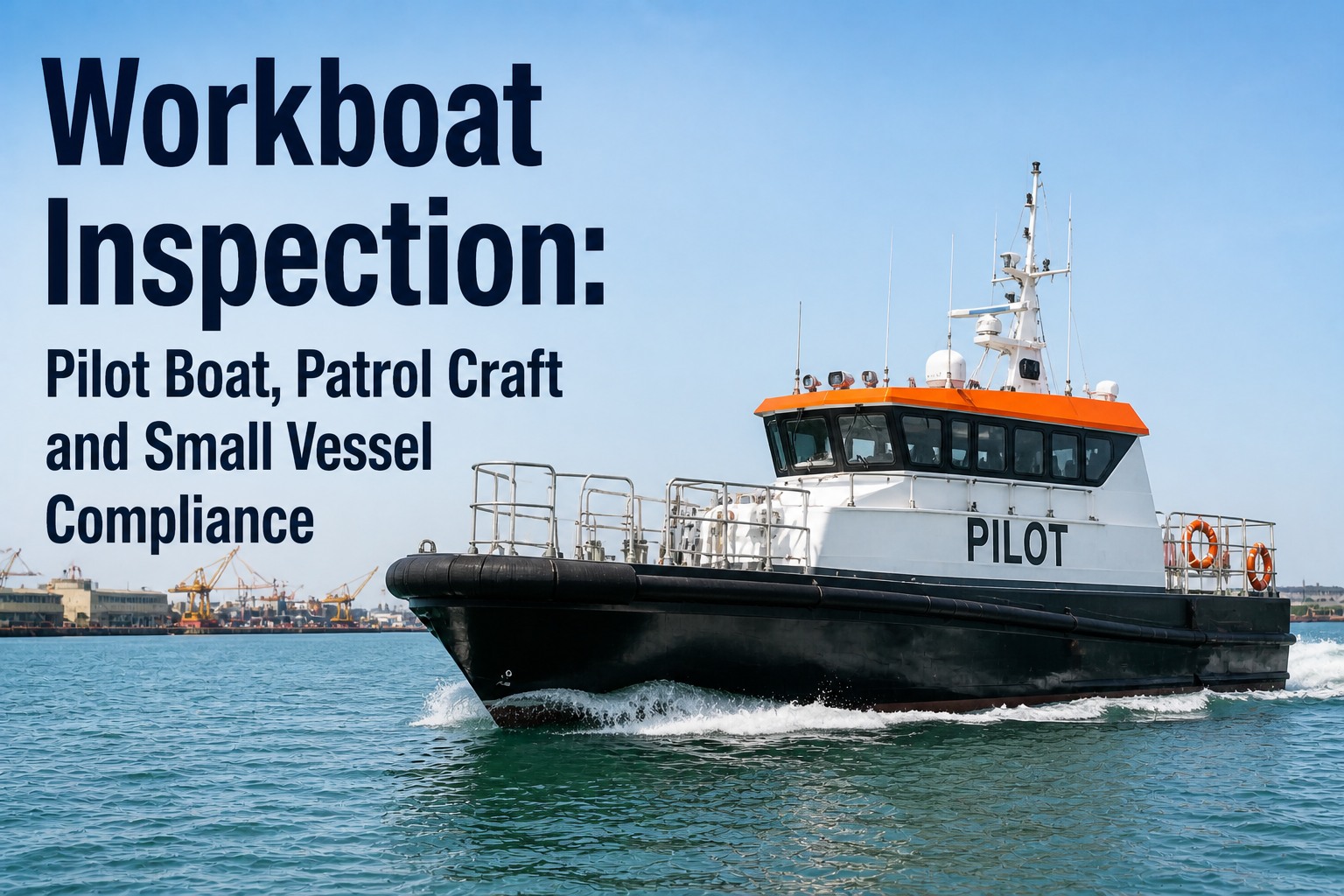
For the UK workboat sector, the most consequential inspection deadline of the decade arrives on 13 December 2026. After three years of phased transition, vessels still certificated under the legacy Brown Code (1998), MGN 280(M), or Workboat Code Edition 2 must by that date have completed transition to the MCA Workboat Code Edition 3 — the unified statutory code that came into force on 13 December 2023 under the Merchant Shipping (Small Workboats and Pilot Boats) Regulations 2023 (SI 2023/1216). The Maritime and Coastguard Agency and the Workboat Association issued a joint industry advisory in February 2026 urging operators to "check the code, prepare the vessel, book the survey" before certifying-authority capacity is overwhelmed in the year-end rush. The new regime applies to commercial vessels up to 24 metres including pilot boats, crew boats, patrol craft, utility workboats and police boats. It introduces mandatory Safety Management Systems (Annex 8) for every workboat regardless of size, regulates Remotely Operated Unmanned Vessels (Annex 2), tightens stability requirements via ISO 12217, and mandates continuous vibration exposure monitoring from December 2026. Start a free trial of Marine Inspection to digitize Workboat Code 3 transition surveys, pilot boat compliance, and SMS evidence across your fleet.
CRITICAL DEADLINE
13 December 2026
Workboat Code Edition 3 Final Transition Day
24m
Vessel Length Threshold
Workboat Code 3 applies to commercial vessels up to 24 metres including pilot, crew, patrol, utility & police boats
SMS
Mandatory Safety Management
Annex 8 requires SMS for every vessel regardless of size — a structural shift from prescriptive equipment lists
ROUV
Annex 2 Unmanned Vessel Regime
First-of-kind regulatory framework for Remotely Operated Unmanned Vessels and Remote Operation Centres
3
Legacy Codes Replaced
Brown Code 1998, MGN 280(M), Workboat Code Edition 2 — all consolidated into single unified instrument
Why Workboat Inspection Operates Apart From Large-Vessel SOLAS
Most workboats fall below SOLAS Cargo Ship Safety thresholds. They operate under national codes — UK Workboat Code 3, USCG Subchapter T (Small Passenger Vessels) and Subchapter L (Offshore Supply Vessels), Australian NSCV, Canadian TP 1332, Norwegian and equivalent flag-state instruments. They run high-cycle operations: pilot boats may make a dozen transfers daily; crew boats run multiple offshore round-trips per shift; patrol craft operate around the clock with two-watch crews. Maintenance windows are short, port state inspection happens frequently, and the operating economics are tight. The shift to Workboat Code 3 fundamentally changes the inspection paradigm for this sector — moving from prescriptive equipment lists to risk-based Safety Management Systems, with retrospective application to existing fleets. Book a Marine Inspection demo to see how port authorities, pilot service providers and small fleet operators digitize Code 3 transition, pilot transfer compliance and continuous-monitoring evidence.
Five Workboat Categories — Five Inspection Profiles
"Workboat" covers a broad and operationally distinct group of vessel types. Workboat Code 3 explicitly addresses each through dedicated sections and annexes — Section 27 for dedicated pilot boats, Annex 3 for police boats, plus the general code body for crew boats, utility craft and patrol vessels.
High-speed transfer vessels for marine pilots boarding and disembarking ships at port approaches. Either dedicated pilot boats or workboats with Pilot Boat Endorsement under Section 27. Subject to additional inspection scope: pilot transfer ladder/platform, lee-side approach geometry, MOB recovery capability, bow fender condition.
Cycle: 10–20+ transfers daily, year-round, all weather
Critical: Hull bow fender wear, deckhand fall protection, transfer-side handrails
External: SOLAS V/23, IMO A.1045(27), ICS/IMPA Guidance v3.0
High-speed offshore personnel transfer for oil & gas, offshore wind, aquaculture. Smaller than CTVs but operate similar duty cycles. Inspection focus on passenger seating arrangements (Workboat Code 3 introduces specific seating requirements), bow fendering for push-on transfers, fast-displacement hull integrity.
Cycle: Multiple shore-to-platform round-trips per shift
Critical: Seat anchorage, aluminium hull fatigue, twin-engine alignment
External: Charterer audit standards, Achilles for offshore
Patrol & Survey Craft
Code Body
Harbour authority patrol vessels, pollution response craft, fisheries enforcement, hydrographic survey launches. Often deployed from larger mother ships or operate independently in coastal waters. Inspection focus on dynamic positioning (where fitted), survey equipment installations, blue-light installations for enforcement craft.
Cycle: 24-hour operations with two-watch crewing
Critical: Hull stability (recent Welsh failures under ISO 12217), boarding rails
External: Local harbour authority bylaws, IHO survey standards
Tug & Utility Workboat
Code Body
Small harbour tugs, mooring boats, line-handling vessels, marina utility craft. Includes vessels engaged in towing, pushing, dredging support, project cargo movement. Inspection focus on towing equipment SWL, tow hook quick-release function, deck arrangements for line handling, anchor handling capacity.
Cycle: On-demand harbour ops, mooring assists, project work
Critical: Tow hook condition, fender integrity, deck SWL marking
External: Port limits authority approval, Subchapter M (US)
Marine police vessels operating in port and inland waters. Workboat Code 3 dedicates Annex 3 to police boats with specific construction standards for vessels operating in Cat C and Cat D waters only. Specialised inspection scope: blue-light/siren systems, pursuit-speed engine compliance, prisoner transfer arrangements.
Cycle: 24-hour patrol coverage, pursuit and rescue operations
Critical: Pursuit-speed engine cycles, structural impact testing
External: Police force operational standards, harbour authority MOU
The Workboat Code 3 Transition Pathway
The MCA's transitional approach gave operators three years from the Code's entry into force to bring legacy-certified vessels into full compliance. With the Code in force from 13 December 2023, the transition deadline is 13 December 2026 — or the vessel's next renewal examination, whichever is later. Vessels operating beyond 13 December 2026 without WB3 certification cannot continue commercial work.
Workboat Code 3 — From Brown Code to Unified Compliance
1998
Brown Code Era
Original "Code of Practice for the Safety of Small Workboats and Pilot Boats" published. Industry standard for 25 years.
2004
MGN 280(M)
MCA harmonisation attempt published as Marine Guidance Note 280. Brought multiple small-vessel codes under one technical annex.
2018
Workboat Code Edition 2
Driven by offshore wind sector growth and OESV technical evolution. Aligned UK standards with MARPOL and MLC.
13 Dec 2023
Workboat Code 3 In Force
SI 2023/1216 enters into force. New vessels must comply from this date. Three-year transitional clock begins for existing vessels.
13 Dec 2026
Final Transition Deadline
All workboats must hold WB3 certification or next-renewal-due. Vessels not transitioned cannot continue commercial operation.
The Annex 8 Safety Management System Mandate
The most fundamental shift in Workboat Code 3 is the move from prescriptive equipment lists to a risk-based Safety Management System. Annex 8 mandates that every workboat — regardless of size or use — implement a comprehensive SMS designed to meet the requirements of the IMO International Safety Management Code. This is the inspection element most operators underestimated when budgeting transition work. Sign up for Marine Inspection to deploy SMS templates aligned with Annex 8 across your fleet.
A
Safety & Environmental Protection Policy
Documented policy statement defining the company's commitment to safety and environmental protection. Signed by senior management; circulated to all crew; reviewed annually.
B
Defined Crew Responsibilities
Roles and responsibilities for skipper, engineer, deckhands, shore management. Designated Person Ashore (DPA) appointment, communication chain, authority for safety decisions.
C
Risk Assessments
Documented risk assessments for routine operations (pilot transfer, crew transfer, towing, mooring) and abnormal scenarios (heavy weather, MOB, fire, equipment failure). Reviewed periodically and after incidents.
D
Accident Reporting & Investigation
Procedures for reporting incidents, near-misses, and operational anomalies. Internal investigation framework, lessons-learned process, MAIB notification protocol.
E
Emergency Preparedness
Emergency response plans for fire, flooding, MOB, abandoning vessel, medical emergency, pollution. Drill schedule, crew familiarisation records, emergency contact directory.
F
Continuous Monitoring & Review
Internal SMS audits, management review, corrective action tracking. From December 2026, mandatory continuous monitoring of crew vibration exposure becomes part of the SMS scope.
The Pilot Boat Inspection Layer — SOLAS V/23 + IMPA + ISO 799
For pilot boats specifically, inspection scope extends beyond Workboat Code 3 Section 27 into the international pilot transfer regulatory ecosystem. SOLAS Regulation V/23 (Pilot transfer arrangements), IMO Resolution A.1045(27), ISO 799-1:2019 and ISO 5489:2008 (pilot ladder marking), and the ICS/IMPA Guidance v3.0 collectively define the standards. IMPA's annual safety campaign continues to identify persistent non-compliance — and the USCG Safety Alert 04-22-CH1 specifically addressed embarkation gate handhold arrangements.
SOLAS Regulation V/23 — Pilot Transfer Arrangements
The foundational binding requirement for all SOLAS-applicable vessels. Specifies arrangements, equipment, and operational procedures for pilot embarkation and disembarkation. IMPA considers V/23 a minimum requirement and not an aspirational target.
IMO Resolution A.1045(27)
Detailed technical specification for pilot ladder construction, materials, dimensions, securing arrangements. Shipping companies have a legal obligation to provide a conforming ladder and ship-borne fittings under associated SOLAS requirements.
ISO 799-1:2019 + ISO 5489:2008
Pilot ladder and embarkation ladder marking standards. Ladders intended for use on international voyages must be marked "ISO 799-1" or "ISO 5489" and "SOLAS". Manufacturer compliance verification at supply.
ICS / IMPA Guidance on Pilot Transfer Arrangements
Industry consensus guidance updated to v3.0. The IMO/IMPA Required Boarding Arrangements for Pilot poster (Figure 3) is the practical reference. ICS Bridge Procedures Guide reproduces the same.
IMPA Pilot Transfer Operations v1.0 (May 2024)
Operational guidance for pilot boats covering crew capability, training, MOB recovery, ladder rigging verification. Recommends practical ladder climbs in controlled environments to 9m progressively in demanding conditions.
USCG Safety Alert 04-22-CH1
Specifically addresses the importance of verifying the correct arrangement of handholds in embarkation gate arrangements for pilot ladders. Issued in response to recurring deficiencies during port state control inspections.
13 December 2026 Will Arrive Faster Than Survey Capacity
Workboat Code 3 transitions, Annex 8 SMS implementation, pilot transfer compliance, vibration monitoring, ROUV regulation — Marine Inspection digitizes the full WB3 compliance scope in one platform built for small fleet operators.
Annex 2 — The First Regulatory Framework for Unmanned Workboats
The Workboat Code 3 introduces the first dedicated UK regulatory framework for Remotely Operated Unmanned Vessels (ROUVs) — a category that did not exist when Workboat Code 2 was published in 2018. Annex 2 of WB3 defines roles such as the "Remote Operator" and sets requirements for Remote Operation Centres (ROCs). In August 2024, the hydrogen-powered vessel PIONEER became the first ROUV to be certified under these regulations — a milestone for autonomous workboat development.
01
Remote Operator Definition
Annex 2 establishes the Remote Operator as a defined role with associated competence and training requirements. The Remote Operator is responsible for safe vessel operation in lieu of a traditional onboard skipper.
02
Remote Operation Centre (ROC)
Physical control location requirements: communications redundancy, situational awareness systems, control system integrity, emergency intervention capability. ROC certification is a new inspection element.
03
Hardware-Software Certification
ROUV control systems must be verified for cyber security, fail-safe behaviour, and predictable response to communications loss. Software integrity assurance and update governance covered by classification society notation.
04
Hybrid & Alternative Fuels
Workboat Code 3 also provides regulatory framework for lithium-ion batteries and alternative fuel propulsion. PIONEER (hydrogen-powered) certified August 2024. Decarbonisation regulatory pathway now exists for small commercial vessels.
Stability and Hull Integrity — ISO 12217 and the Swamp Test
Workboat Code 3 adopts the latest ISO 12217 stability standards, including small-craft "swamp test" requirements that have proven challenging for some legacy fleets. In Wales, local authorities reported that existing harbour patrol vessels failed the new swamp test stability requirements, necessitating procurement of replacement vessels at substantial cost. Stability documentation is now a primary inspection focus across the workboat sector.
Stability Inspection Scope Under Workboat Code 3
Intact Stability
ISO 12217-aligned intact stability calculations submitted to Certifying Authority. Categories defined by area of operation (Category 0 unrestricted to Category 6 restricted) with progressively easier requirements for sheltered operations.
Swamp Test
Physical demonstration that an open or partially decked vessel can recover from being filled with water. Identified as failure mode in Welsh harbour patrol fleet — vessels failing the test required replacement, not modification.
Damage Stability
Where applicable to vessel category, demonstrated post-damage residual stability. Bulkhead arrangement, watertight subdivision, and progressive flooding paths assessed at survey.
Loading Limits
Maximum number of persons, deck load, towing pull all defined and documented. Operating limitations posted on vessel; skipper responsibility to verify each voyage.
Inclining Test
Required at first survey and after any modification affecting stability. Documented results form basis of stability booklet held onboard. Re-test required after major refit, equipment change, or ballast modification.
The Cost of Workboat Inspection Failure
Small fleet operators have less margin for inspection failure than large-vessel operators. A pilot boat or crew boat tied up awaiting survey-driven repairs can shut down a port pilotage rota or strand offshore wind technicians. The financial impact compounds quickly.
26.12.26
Hard Deadline
Vessels not certified under Workboat Code 3 by 13 December 2026 cannot continue commercial operation. No transitional flexibility beyond that date for legacy-certified fleet.
£1B
Sector-Wide Cost
Workboat Association estimated true sector cost of WB3 transition at approximately £1 billion against MCA's £800K estimate, citing knock-on engineering costs from larger anchor and equipment requirements.
PSC
Port State Control
Pilot transfer arrangement deficiencies remain among the most-cited findings in port state inspections globally. Detentions delay vessel turnaround and trigger reputational and commercial damage.
Survey
Capacity Bottleneck
MCA and Workboat Association joint advisory (February 2026) explicitly warns of certifying-authority survey capacity shortage as December 2026 deadline approaches. Late bookings risk vessels being tied up.
How Marine Inspection Closes the Workboat Compliance Gap
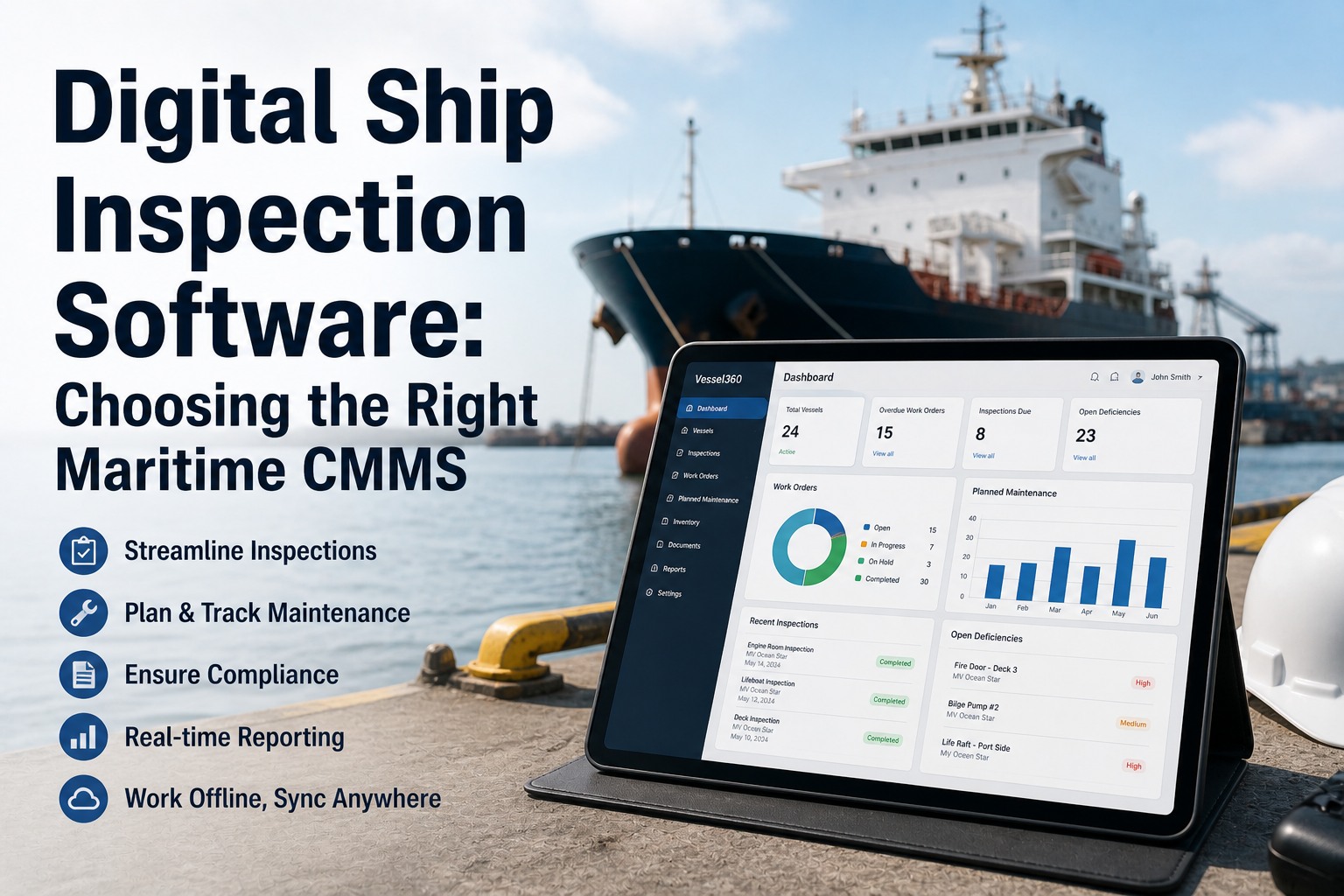
Marine Inspection is built for the operating reality of small fleet operators, port authority workboat operators, pilot service providers and police marine units. Cloud-based, mobile-first, designed for skippers and engineers who do not have a back office to draft SMS documentation or chase certification paperwork. Book a demo to see workboat-specific workflows.
01
Workboat Code 3 Pre-Loaded Templates
All sections and annexes of WB3 — general code body, Section 27 (pilot boats), Annex 2 (ROUVs), Annex 3 (police boats), Annex 8 (SMS) — pre-loaded as inspection templates. Aligned with Certifying Authority survey expectations.
02
Annex 8 SMS Builder
Step-by-step SMS development for small operators without back-office resources: safety policy, crew responsibilities, risk assessments, accident reporting, emergency preparedness, internal audits. Output meets Annex 8 requirements.
03
Pilot Transfer Compliance Workflow
SOLAS V/23, IMO A.1045(27), ISO 799-1, ICS/IMPA Guidance v3.0 — pilot transfer arrangement records, ladder inspection logs, pilot boat lee-side capability, USCG Safety Alert 04-22-CH1 handhold verification.
04
Vibration Exposure Monitoring (Dec 2026)
Continuous monitoring of crew vibration exposure becomes mandatory in December 2026. Marine Inspection logs daily exposure values, integrates with onboard sensors where fitted, generates compliance evidence per crew member.
05
Stability Documentation Vault
Stability booklet storage, inclining test records, ISO 12217 calculations, swamp test verification, loading limit posters. Critical for harbour authority and Certifying Authority audits.
06
Survey Booking & Renewal Calendar
Track 5-year certification cycles, plan pre-survey work backwards from renewal date, manage MCA-authorised Certifying Authority engagement, alert before deadline windows close. Critical for the December 2026 transition.
From Brown Code to WB3 — Run Your Workboat Fleet on the Latest Standard
Workboat Code 3 templates, Annex 8 SMS, pilot transfer compliance, ISO 12217 stability records, vibration monitoring, ROUV regulation — Marine Inspection is the platform built for workboat operators.
Workboat Code 3 Pre-Survey Readiness Checklist
Use this as the master pressure-test before any Certifying Authority survey, MCA audit, harbour authority inspection, or charterer audit. Items below cover the WB3 general code body plus Section 27 pilot boat requirements and Annex 8 SMS scope.
Workboat Code 3 Pre-Survey Quick-Check
Code Transition & Certification
WB3 transition status confirmed (new build, renewal-due, transition-pending)
Existing Brown Code / MGN 280(M) / WB2 certificate expiry within 13 Dec 2026
Certifying Authority booked for transition survey ahead of deadline
Tonnage Certificate of Survey current; vessel registration details verified
MLC Record of Inspections current (where vessel meets MLC threshold)
Annex 8 Safety Management System
Safety & Environmental Protection Policy signed, dated, displayed
Designated Person Ashore (DPA) appointed and contactable
Risk assessments documented for routine and abnormal operations
Accident reporting procedure published; near-miss reporting active
Emergency preparedness plans drilled per schedule; records kept
Internal SMS audit completed within prior 12 months
Stability, Construction & Equipment
Stability booklet onboard; inclining test record current
ISO 12217 stability calculations submitted to Certifying Authority
Swamp test verification (where applicable to vessel category)
Bilge pumping arrangements per WB3 specification
Seating arrangements compliant with WB3 (specific changes vs WB2)
Cabin wiring & lighting upgrades per WB3 (cabin boats)
Lifesaving equipment cycle; expiry dates within validity
Pilot Boat / Specialised Operations
Section 27 (Pilot Boat) requirements verified for dedicated pilot boats
Pilot transfer ladder/platform inspection log current
ICS/IMPA Guidance v3.0 onboard; IMO/IMPA boarding poster posted
Crew SSNR (Small Ships Navigation and Radar) qualifications current
MOB recovery equipment tested; demonstrated capability
Towing equipment SWL inspected (tug/utility workboats)
Annex 3 police boat requirements (for police vessel operators)
Annex 2 ROUV / Remote Operator certification (where unmanned)
Frequently Asked Questions
What is the 13 December 2026 Workboat Code 3 deadline?
The Workboat Code Edition 3 came into force on 13 December 2023 under the Merchant Shipping (Small Workboats and Pilot Boats) Regulations 2023 (SI 2023/1216). New vessels must comply from that date. Existing vessels certificated under the Brown Code (1998), MGN 280(M), or Workboat Code Edition 2 must transition to WB3 by their next renewal examination or three years after the entry into force of the Code, whichever is later. The first cohort of vessels affected by the three-year rule must hold full WB3 certification by 13 December 2026. The MCA and Workboat Association issued a joint advisory in February 2026 urging operators to book surveys early due to expected capacity shortages.
Which vessels does Workboat Code 3 apply to?
Workboat Code 3 applies to commercial vessels up to 24 metres operating in UK waters and to UK-flagged vessels operating internationally. This includes pilot boats, crew boats, patrol craft, utility workboats, harbour tugs, mooring boats, marina utility craft, hydrographic survey launches, fisheries patrol vessels, and dive support craft. Annex 3 specifically addresses police boats. Annex 2 addresses Remotely Operated Unmanned Vessels (ROUVs). The Code also impacts sport and pleasure vessels which have a light duty workboat endorsement.
What is Annex 8 and why is the SMS mandate so significant?
Annex 8 of Workboat Code 3 mandates that every workboat — regardless of size or use — implement a comprehensive Safety Management System designed to meet the requirements of the IMO International Safety Management Code. The SMS includes a safety and environmental protection policy, defined crew responsibilities, risk assessments, accident reporting, and emergency preparedness. This represents a fundamental shift from prescriptive equipment lists to a risk-based safety culture. For small operators without back-office resources, SMS implementation is the most challenging transition element. The administrative and action burden reportedly comes more easily to larger companies with established compliance infrastructure.
What changed for pilot boats specifically under Workboat Code 3?
Section 27 of Workboat Code 3 covers Dedicated Pilot Boats and Workboats with a Pilot Boat Endorsement. Requirements include pilot-transfer-specific construction features, MOB recovery capability, lee-side approach geometry, and operational arrangements aligned with international pilot transfer guidance. Pilot boats remain additionally subject to SOLAS Regulation V/23 (Pilot transfer arrangements), IMO Resolution A.1045(27) for ladder specifications, ISO 799-1:2019 and ISO 5489:2008 for ladder marking, and the ICS/IMPA Guidance v3.0 on Pilot Transfer Arrangements. The May 2024 IMPA Pilot Transfer Operations guidance v1.0 adds operational best-practice including practical training requirements.
What is the Annex 2 ROUV regime?
Annex 2 of Workboat Code 3 introduces the first dedicated UK regulatory framework for Remotely Operated Unmanned Vessels (ROUVs). It defines roles such as the "Remote Operator" and sets requirements for Remote Operation Centres (ROCs). In August 2024, the hydrogen-powered vessel PIONEER became the first ROUV to be certified under these regulations. Inspection scope includes Remote Operator competence, ROC physical requirements (communications redundancy, situational awareness, control system integrity), software integrity assurance for control systems, and cyber security verification. The Code also provides regulatory framework for lithium-ion batteries and alternative fuel propulsion.
Can a vessel partially transition to Workboat Code 3?
No. The Code is explicit: where any existing vessel upgrades and phases-in to the Workboat Code Edition 3 regime, it must do so fully. A vessel cannot meet a combination of the Workboat Code Edition 3 standards and those of earlier codes or standards. Operators planning a phased transition through 2026 should consult their MCA-authorised Certifying Authority early to plan the survey approach. Once the transition is initiated, full WB3 compliance must be achieved at that survey.
How does Marine Inspection support the WB3 transition?
Pre-loaded inspection templates aligned with Workboat Code 3 — general code body, Section 27 (pilot boats), Annex 2 (ROUVs), Annex 3 (police boats), Annex 8 (SMS). Step-by-step SMS Builder for operators without back-office resources. Pilot transfer compliance workflows with SOLAS V/23, IMO A.1045(27), ISO 799-1, ICS/IMPA Guidance. Continuous vibration exposure monitoring ahead of December 2026 mandate. Stability documentation vault with ISO 12217 calculations and swamp test verification. Survey booking and renewal calendar to track the certification cycle. Mobile-first design for skippers and engineers; cloud platform for shore management visibility.
13 December 2026 Is Closer Than You Think — Run Your Workboat Fleet Audit-Ready
Workboat Code 3, Annex 8 SMS, pilot transfer compliance, ISO 12217 stability, vibration monitoring, ROUV regulation, survey planning — Marine Inspection is the platform built for small fleet operators.