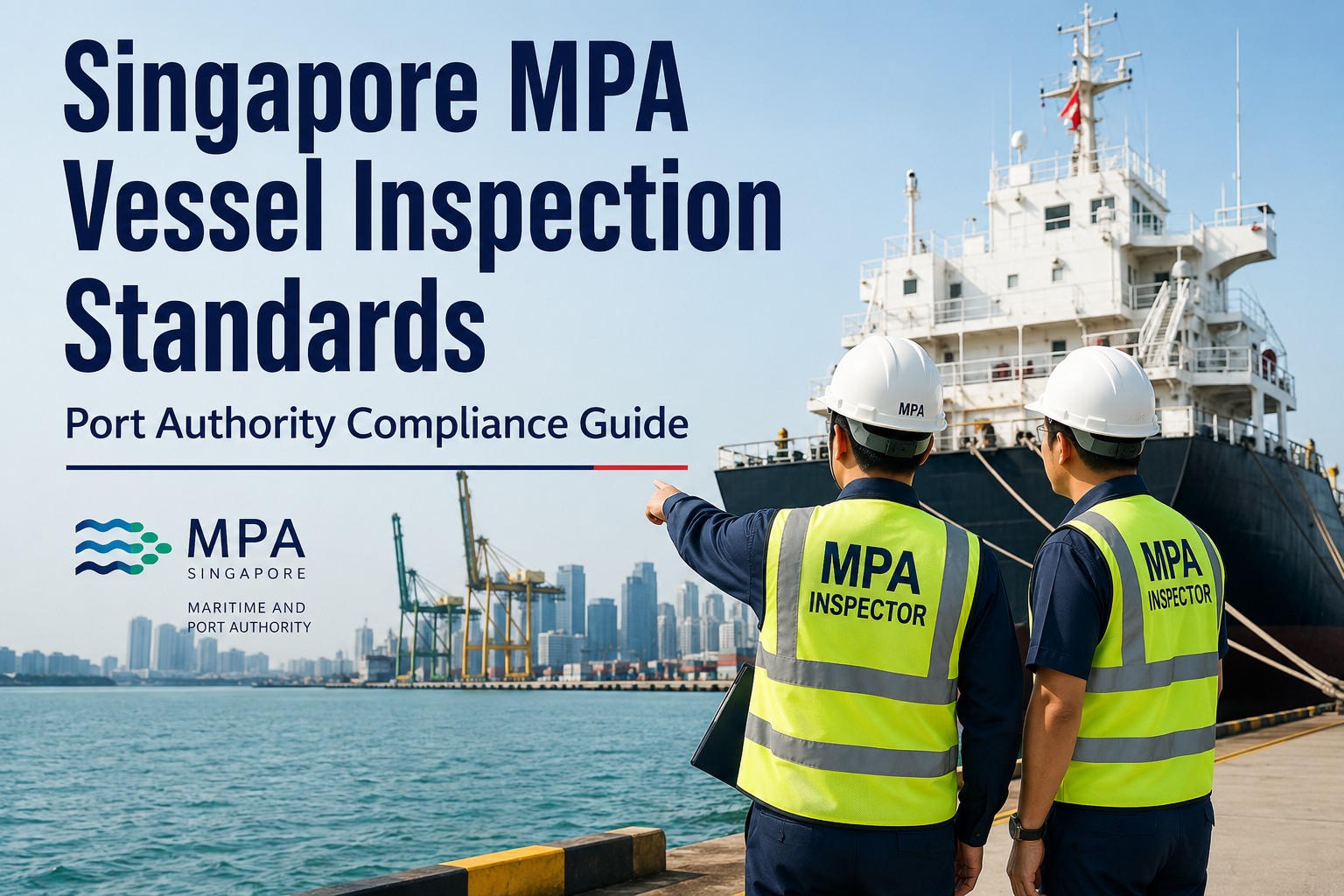
Most guidance about Singapore compliance is written for the ship arriving at the port — the foreign-flag vessel bracing for a Tokyo MOU inspection. This guide is written for the other side of the relationship: the operator whose ships fly the Singapore flag, and for whom the Maritime and Port Authority is not a port state to be survived but a flag administration to be worked with. That distinction matters, because MPA's flag-state role carries obligations most operators underestimate. MPA surveyors inspect and audit Singapore-registered ships and their companies' safety management systems directly. The Director of Marine can detain a Singapore-registered ship outright. A detention suffered anywhere in the world must be reported to MPA immediately, and MPA will investigate it. And on the other side of the ledger sit real financial incentives — a Green Ship Programme that can cut initial registration fees by up to 100% and annual tonnage tax by the same, if you can produce the certificates to prove it. The Singapore Registry of Ships closed 2025 at a record 137.46 million GT, up roughly 27% in a year, to become the world's fourth-largest registry — which means more operators than ever are now inside this regime. This guide covers flag-state control inspections and MPA's powers, detention and the appeal process, the reporting duty after a foreign PSC detention, the Green Ship Programme in detail, and what MPA's 2026 regulatory agenda means for Singapore-flagged fleets. Start free trial or book a demo to keep certificates, inspection findings, and corrective actions audit-ready for MPA.
REGIONAL COMPLIANCE · SINGAPORE MPA
Flying the Singapore Flag: What MPA Expects of Your Fleet
MPA is not just a port state to pass through. For Singapore-registered ships it is your flag administration — with its own inspectors, its own detention powers, a mandatory reporting duty after any foreign detention, and incentives worth up to 100% of your registration fee.
MPA as Your Flag Administration
Singapore is party to all the major IMO conventions on ship safety and pollution prevention, and has enacted them into domestic legislation so MPA can implement them directly. For a Singapore-flagged operator, that translates into a specific inspection relationship with your own administration.
A
Enforce the standard
Flag State control inspections enforce a high standard of compliance with international and national rules for Singapore-registered ships, supporting MPA's quality shipping objectives.
B
Verify the certificates are true
Inspections verify that the actual condition of the ship conforms to the certificates she carries. A valid certificate covering a condition that no longer matches it is exactly what these inspections exist to catch.
C
Audit the company, not just the ship
MPA surveyors may inspect and audit both a Singapore-registered ship and the safety management system of its company. The SMS is in scope, which puts shore-side document control on the line alongside shipboard condition.
D
Monitor the delegated work
Flag inspections also monitor work performed by recognised organisations and nominated surveyors acting on MPA's behalf — so the quality of your class and RO relationships is itself under observation.
i
The mechanics are straightforward, and the obligation lands on the master. Qualified MPA surveyors conduct the flag State control inspection. On completion, the master receives an inspection report — and the master is required to rectify any deficiencies in accordance with the conditions stated in that report. The report is not advisory; its conditions and deadlines are the compliance obligation. An operator whose corrective-action tracking cannot demonstrate closure against those stated conditions has a problem at the next inspection, whoever conducts it.
Detention and the Right of Appeal
MPA's flag-state powers include detention of its own tonnage, and the process around it has a specific timeline operators should know before they need it.
The power
The Director of Marine may detain a Singapore-registered ship if she is unsafe, or has violated requirements or regulations under the applicable legislation. This is the flag administration acting on its own fleet — separate from, and additional to, any port state's powers over the same vessel.
The appeal
The shipowner or company may appeal against a detention within 30 days of notification. Critically, the appeal does not suspend the detention — the ship stays where she is while the appeal runs, so rectification and appeal proceed in parallel, not in sequence.
The same 30-day, non-suspensory structure applies to detentions imposed by MPA in its port-state capacity in Singapore, where detained vessels must rectify the serious deficiencies and apply for a follow-up inspection before departure. MPA authorises eight Recognised Organisations to conduct those follow-up inspections; vessels classed with one of them may appoint their RO, and completed follow-up inspection reports are submitted to MPA's Port State Control department. Vessels classed elsewhere may need to approach MPA directly.
The Reporting Duty After a Foreign Detention
This is the obligation most easily missed, and it applies wherever in the world your Singapore-flagged ship happens to be.
Ships detained under PSC in a foreign port must be reported to MPA immediately. A Singapore-registered ship may be inspected by port state control anywhere she trades, and if serious deficiencies are found she may be delayed or detained until they are rectified. MPA takes a serious view of any Singapore-registered ship detained under PSC and will investigate the detention, to ensure the shipowner or company takes corrective action to improve the standard of their ships. In other words, a detention abroad does not end when the ship sails — it opens a second process with your own flag administration, and what you can show about root cause and corrective action determines how that process goes.
The commercial logic behind that vigilance is plain. The Singapore Registry sits on the white list of both the Tokyo and Paris MOUs and has qualified for the US Coast Guard's QUALSHIP 21 programme — and the registry recognises that maintaining high standards and low detention records in the major PSC regimes is critical to the reputation and attractiveness of the flag. Every detention is a small subtraction from that position, which is precisely why MPA investigates rather than merely noting them.
Corrective action, evidenced
Show MPA the Close-Out, Not Just the Intention
When MPA investigates a detention, what matters is whether you can demonstrate root cause and completed corrective action. Marine Inspection tracks deficiencies and defects from the moment they are raised through to verified closure, holds certificate and survey status per vessel, and keeps the inspection history retrievable — so a flag-state enquiry meets evidence instead of assurances.
The Green Ship Programme: Real Money for Verified Performance
The other half of the MPA relationship is incentive rather than enforcement. The Green Ship Programme, part of the Maritime Singapore Green Initiative, rewards Singapore-flagged ships that voluntarily exceed IMO environmental standards — and the concessions are substantial.
The EEDI concession on registration fees applies under both normal registration and the Block Transfer Scheme. Ships already on the register can participate too, though existing tonnage qualifying on the EEDI criterion has historically been limited to the tonnage-tax rebate rather than the registration-fee reduction, since the registration event has already passed.
What you have to produce to qualify
For the EEDI criterion
A copy of the International Energy Efficiency (IEE) Certificate with its accompanying supplement, proving the attained EEDI exceeds Phase 3 requirements by 10% or more for that ship type and size.
For the fuel criteria
The International Air Pollution Prevention (IAPP) Certificate with supplements, and the Engine International Air Pollution Prevention (EIAPP) Certificate, evidencing the engine's fuel capability.
Who issues the evidence
Ship owners may approach one of MPA's eight Recognised Organisations for issuance of the documentary evidence — the same RO network that supports flag inspections and PSC follow-ups.
Submit on time or lose it
There is no pro-rated rebate if documentation is not submitted on time. The concession is contingent on the paperwork arriving when it should — a certificate-tracking problem as much as an engineering one.
Recognition runs alongside the money: qualifying ships receive a Green Letter of Recognition from MPA, issued to the owning company as well as the ship, and MPA awards Green Ship Certificates annually — 34 of them in 2025 alone. There is also an "SRS Green Ship of the Year" award at the Singapore International Maritime Awards. For operators building a fleet identity around environmental performance, these are citable credentials, not just fee discounts.
What Is Coming in 2026
MPA's regulatory agenda moves quickly, and several changes land in 2026 that Singapore-flagged operators and those bunkering in the port should be tracking.
Q2 2026
TR56 upgraded to a Singapore Standard
MPA and Enterprise Singapore, through the Singapore Standards Council, are upgrading the existing Technical Reference for LNG Bunkering (TR56) to a full Singapore Standard — strengthening requirements for safe, transparent and quality-assured LNG bunkering.
Q2 2026
First Technical Reference for Ammonia Bunkering
Singapore publishes its first Technical Reference for ammonia bunkering, to guide safe and reliable operations and support trials and early adoption — the regulatory scaffolding ahead of ammonia moving into routine use.
2026
Standards for Port Limit LNG Bunker Vessels
New standards covering the equipment, operational performance and efficiency of port-limit LNG bunker vessels operating in Singapore, launched to enhance safety in the bunkering fleet itself.
Near term
First ammonia dual-fuelled vessel on the SRS
The registry has flagged five methanol-fuelled vessels since 2020 and expects to flag its first ammonia dual-fuelled vessel within the next two years — with the Green Ship Programme's zero-carbon tier waiting for it.
The wider context is a maritime administration investing hard in capability: technology and innovation centres established and operationalised in Singapore including the ABS Singapore Maritime Safety Centre, the BV-Singapore Institute of Technology Centre for Maritime Electrification, and the RINA Technology Demonstration Centre, alongside expanding MoUs with industry partners on digitalisation and R&D. The direction of travel is unambiguous — Singapore is building the standards, the infrastructure, and the incentive structure for alternative fuels well ahead of mandatory global requirements, and Singapore-flagged operators are the first to be measured against them.
Operating Compliantly Under the Singapore Flag
Pulling the threads together, the practical obligations for a Singapore-flagged operator resolve into a manageable set of disciplines — all of which depend on documentation being current and retrievable rather than reconstructed under pressure.
Keep condition matching the certificates
Flag inspections verify actual condition against the certificates carried. Survey due dates, certificate validity, and the physical state they attest to must stay aligned — the gap between them is the finding.
Close deficiencies to the report's conditions
The master must rectify deficiencies in accordance with the conditions stated in the inspection report. Track each one to verified closure against its stated deadline, with the evidence attached.
Keep the SMS audit-ready
MPA may audit the company's safety management system, not just the ship. Drill records, internal audits, non-conformity close-outs and document control are all in scope ashore as well as afloat.
Report foreign detentions immediately
A PSC detention anywhere must be reported to MPA at once, and MPA will investigate. Have the root-cause analysis and corrective-action record ready to support that investigation.
Track the green certificates
IEE, IAPP and EIAPP certificates are the currency of the Green Ship Programme, and late submission forfeits the rebate outright. Treat them as deadline-bearing documents, not filing.
Watch your own detention record
The flag's white-list standing and QUALSHIP 21 qualification depend on the fleet's aggregate record. Your detentions affect the flag; the flag's standing affects your inspection frequency everywhere.
That last point closes the loop, and it is the reason MPA's flag-state vigilance is in every operator's interest rather than merely imposed on them. Singapore's position on the Tokyo and Paris white lists and in QUALSHIP 21 is an asset every Singapore-flagged ship draws on at every port in the world, in the form of lower inspection priority and greater commercial credibility. It is also an asset every substandard ship on the register erodes. Operating well under this flag means keeping certificates current, condition matching them, deficiencies closed with evidence, the SMS genuinely audit-ready, and the green documentation submitted on time — continuously, across the fleet, and retrievable the moment MPA or any port state asks. Book a demo to see certificates, inspections, and corrective actions as one flag-ready record.
Frequently Asked Questions
What is an MPA flag State control inspection?
An inspection of a Singapore-registered ship by qualified MPA surveyors to enforce compliance with international and national standards and to verify that the ship's actual condition conforms to the certificates she carries. The scope can extend to auditing the safety management system of the ship's company, and to monitoring work performed by recognised organisations and nominated surveyors acting on MPA's behalf.
Book a demo.
Can MPA detain a Singapore-registered ship?
Yes. The Director of Marine may detain a Singapore-registered ship if she is unsafe or has violated applicable requirements or regulations. This flag-state power is separate from and additional to any port state's authority over the same vessel. The shipowner or company may appeal within 30 days of notification, but the appeal does not suspend the detention.
Book a demo.
What must I do if my Singapore-flagged ship is detained abroad?
Report it to MPA immediately. MPA takes a serious view of any Singapore-registered ship detained under port state control and will investigate the detention to ensure the shipowner or company takes corrective action to improve their standards. A detention abroad therefore opens a second process with your flag administration, in which your root-cause analysis and evidenced corrective action are what matter.
Book a demo.
How does a ship get released from detention in Singapore?
Vessels detained for serious deficiencies must rectify them satisfactorily and apply for a follow-up inspection before being allowed to depart. MPA authorises eight Recognised Organisations to conduct follow-up inspections arising from PSC detention in Singapore; vessels classed with one of them may appoint that RO, and the completed report is submitted to MPA's Port State Control department. Vessels classed elsewhere may need to apply to MPA directly.
Book a demo.
What incentives does the Green Ship Programme offer?
Concessions on Initial Registration Fee and Annual Tonnage Tax for Singapore-flagged ships exceeding IMO environmental standards. Exceeding MARPOL Annex VI Phase 3 EEDI by 10% or more earns a 50% IRF reduction and 20% ATT rebate; a low-carbon fuelled engine with CF below 1.375 earns 75% and 50%; a zero-carbon fuelled engine such as ammonia earns 100% and 80%; and zero-emission technology such as hydrogen or battery earns 100% on both.
Book a demo.
What documents prove Green Ship Programme eligibility?
For the EEDI criterion, the International Energy Efficiency (IEE) Certificate with its supplement showing the attained EEDI exceeds Phase 3 by 10% or more. For the fuel criteria, the International Air Pollution Prevention (IAPP) Certificate with supplements and the Engine IAPP (EIAPP) Certificate. Owners may approach one of MPA's eight Recognised Organisations to issue the documentary evidence — and there is no pro-rated rebate if submissions are late.
Book a demo.
How large is the Singapore Registry of Ships?
The SRS closed 2025 at a record 137.46 million gross tons, an increase of about 27% on 2024, making it the world's fourth-largest ship registry. It awarded 34 Green Ship Certificates during 2025, has flagged five methanol-fuelled vessels since 2020, and expects to flag its first ammonia dual-fuelled vessel within the next two years.
Book a demo.
Why does Singapore's flag standing matter to my fleet?
Because it follows your ships everywhere. The Singapore Registry sits on the white list of both the Tokyo and Paris MOUs and has qualified for the US Coast Guard's QUALSHIP 21 programme, and the registry treats low detention records as critical to the flag's reputation and attractiveness. A strong flag standing means lower inspection priority and greater credibility at every port — which is why MPA investigates detentions rather than simply recording them.
Book a demo.
Be Flag-Ready Before MPA Asks.
Overview only · Not legal or regulatory advice · Refer to MPA shipping circulars for current requirements
Certificates and survey due dates with expiry alerts, structured inspections against flag and PSC focus areas, deficiencies and defects tracked to verified closure, and the green-certificate documentation the Green Ship Programme runs on — held per vessel across the fleet, timestamped and retrievable. Marine Inspection keeps a Singapore-flagged fleet ready for its own administration as well as every port it calls at.