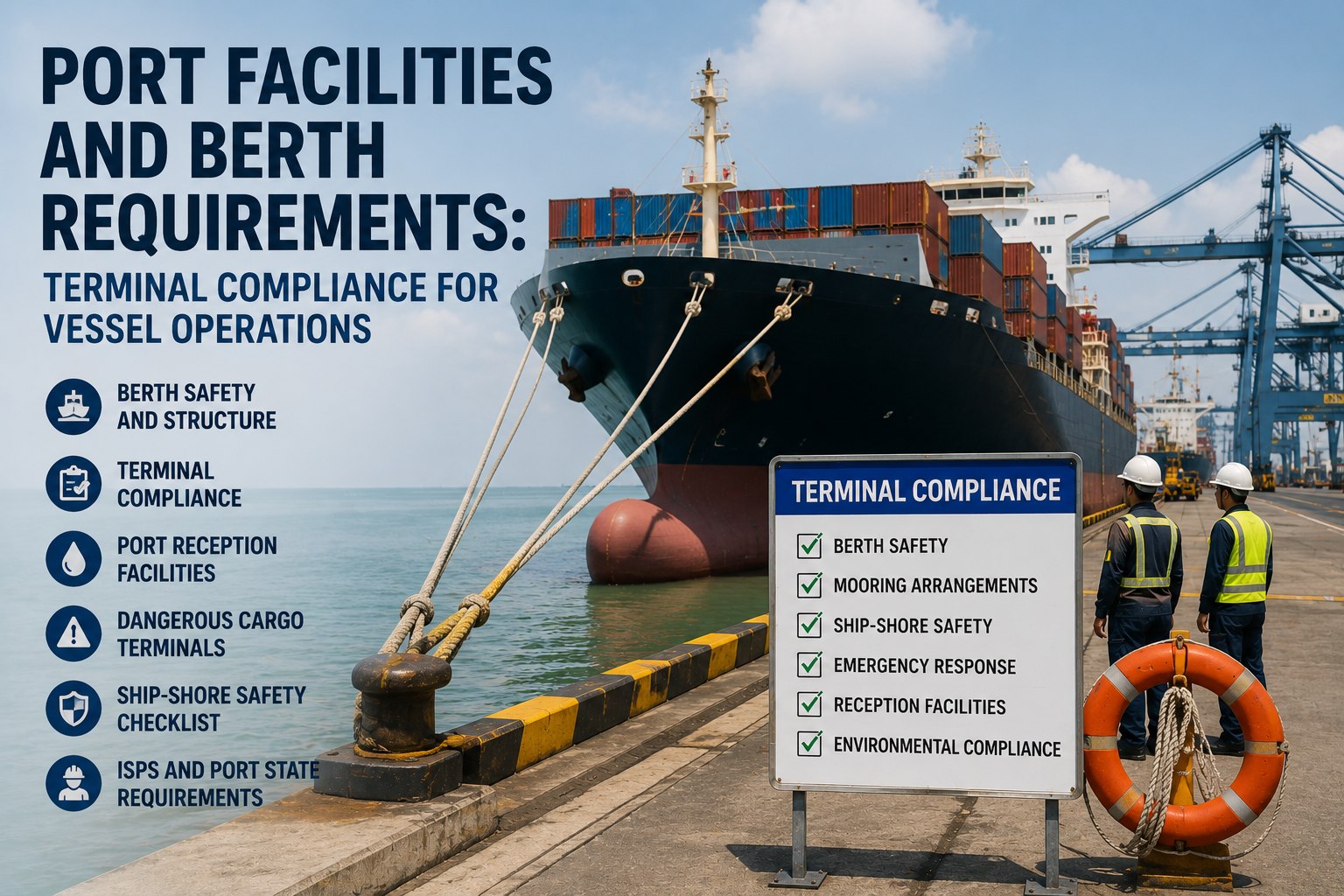
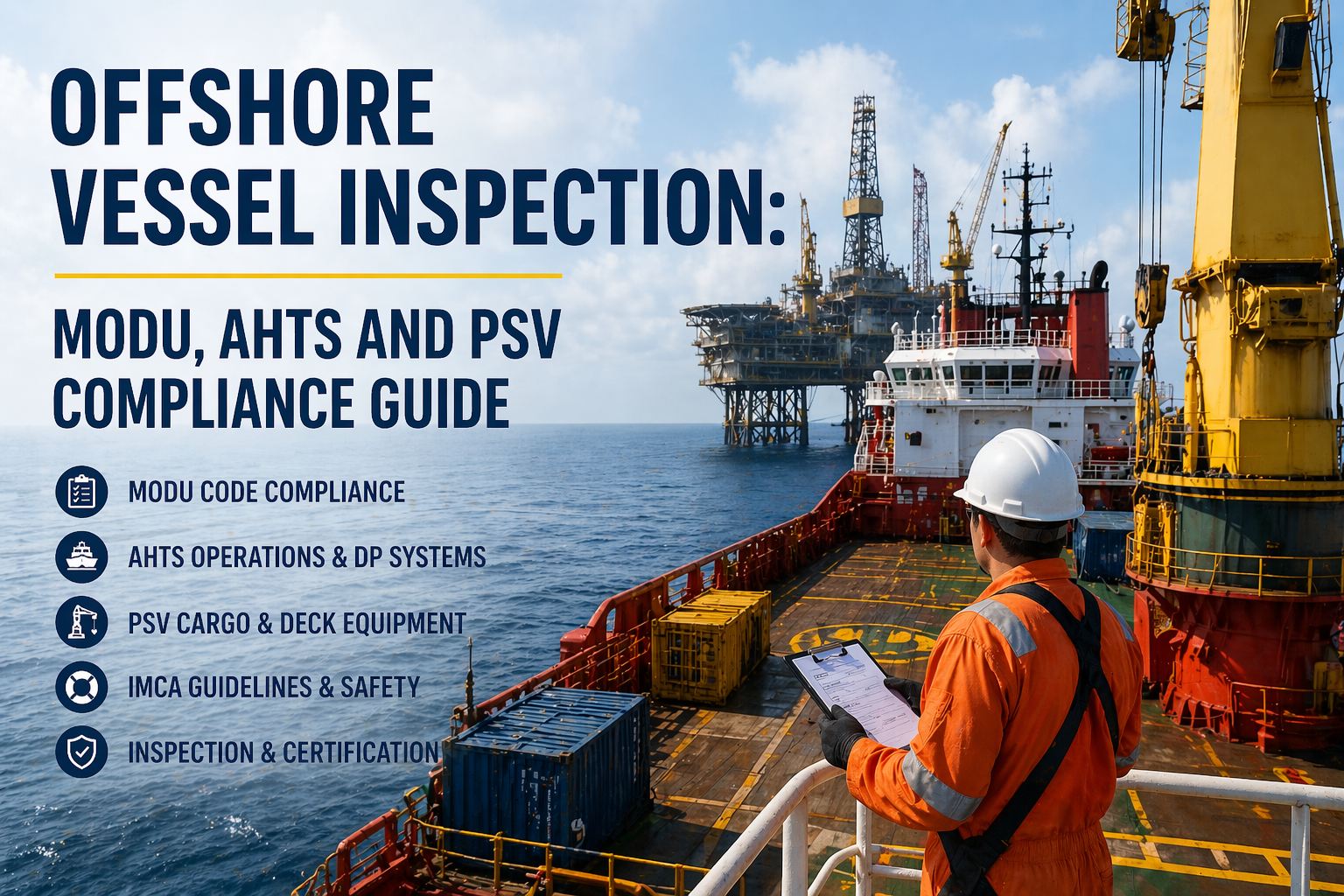
The moment a ship comes alongside, two separate worlds — the vessel and the terminal — have to operate as one safe system, and the line where they meet is where most port incidents happen. A berth is not just a place to tie up; it is a regulated interface with its own safety, security, environmental, and operational requirements, and responsibility for meeting them is split between ship and shore in ways that are easy to get wrong. A mooring that does not meet the terminal's pattern, a draft that exceeds the berth's limit, a Declaration of Security that was never completed, a dangerous-cargo segregation that breaches the IMDG Code — any of these can stop operations, trigger a detention, or cause a casualty. For port operators and ship agents, knowing what a compliant berth actually requires, and who is responsible for each element, is the difference between a smooth call and an expensive one. This guide covers the ship-shore interface and its safety checklist, berth and mooring requirements, ISPS port facility security, port reception facilities and environmental compliance, dangerous cargo terminals, and the emergency preparedness a berth must have in place. The connecting thread is that terminal compliance is a documented, joint discipline — the requirements are only met when both sides confirm them, in writing, before the interface begins. Start free trial or book a demo to keep berth checklists, inspection records, and compliance documentation retrievable across every call.
COMMERCIAL & OPERATIONS · PORT FACILITIES & BERTHS
The Ship-Shore Interface: Where Terminal Compliance Is Won or Lost
A berth is a regulated interface, not just a place to tie up. Safety, security, environmental and mooring requirements are split between ship and shore — and met only when both sides confirm them, in writing, before operations begin.
Safety
The ship-shore safety checklist, mooring, fendering, and safe cargo transfer
Security
ISPS, the Port Facility Security Plan, and the Declaration of Security
Environment
MARPOL port reception facilities and pollution prevention at the berth
The Ship-Shore Interface
Safe operations at a berth depend on one thing above all: good communication between terminal and ship, from before arrival through to after departure, and compliance with agreed safe procedures at every stage. The tool that structures that communication is the ship-shore safety checklist.
1
Pre-arrival communication
The checklist starts communication before the vessel's arrival, so any identified issue can be addressed before it becomes a problem. VTS and terminal pre-arrival notification is sent, and the terminal's information — berth characteristics, regulations, hazards — is received and reviewed.
2
Confirm the ship fits the berth
Vessel draft and air draft must be within the terminal's operational limits before securing. A ship that exceeds the berth's physical envelope is a problem identified best on paper, well before she is committed to the approach.
3
Complete the checklist jointly
The ship-shore safety checklist is completed jointly with the terminal, with the berth section signed off as satisfactory. The modern positive-affirmation approach requires each applicable item to be actively confirmed, and clearly differentiates ship and terminal responsibilities.
4
Maintain through to departure
Communication continues from arrival at the berth through completion of cargo operations to departure. The interface is not a one-time sign-off but a continuous state that both parties monitor and maintain until the ship is clear.
i
For tankers, ISGOTT sets the standard. The International Safety Guide for Oil Tankers and Terminals — now ISGOTT 6 — provides the ship-shore safety checklist used at oil and chemical berths, structured around positive affirmation and cross-referenced to its own detailed guidance. Its revision aligned with OCIMF's Mooring Equipment Guidelines and drew on human-factors best practice from the airline industry to make the checklist genuinely effective rather than a tick-box. Related regimes govern other trades — SIGTTO's guidelines for LNG terminal interfaces, OCIMF's ship-to-ship transfer guide — but the principle is universal: the interface is managed through a jointly completed, referenced checklist.
Berth and Mooring Requirements
Holding a ship safely alongside is the physical foundation of everything else at the berth. Secure mooring is not merely tying up — it is a continuously managed condition against forces that never stop working on the ship.
Mooring pattern and condition
The mooring pattern should meet OCIMF's Mooring Equipment Guidelines, with all lines in good condition and properly led. The pattern is designed for the berth and the forces expected there — an ad hoc arrangement is a breakaway waiting to happen.
Keep lines taut
Ships must remain securely positioned with all mooring lines kept taut to prevent ranging along the pier or quay. Slack lines let a ship surge, which loads the remaining lines unevenly and risks parting them.
Monitor the environment
Wind, currents, tides, and the effects of passing vessels require continuous monitoring and adjustment. The forces on the moorings change through the tide and with every ship that passes, so the arrangement is tended, not set and forgotten.
Fendering and access
Adequate fendering prevents contact damage between ship and berth, and the gangway must be rigged safely with a net and safety equipment. Ship-shore bonding cable or insulating flanges are fitted where required for the cargo.
The berth itself has to be matched to the ship before any of this: the pre-arrival exchange confirms the ship's dimensions against the berth's characteristics and limits. A berth compliant for one class of vessel may be entirely wrong for another, which is why the terminal's information on berth characteristics, regulations, and hazards is exchanged and checked before the vessel commits to coming alongside.
Every call generates checklists and records — keep them retrievable.
Ship-shore checklists, mooring records, Declarations of Security, inspection findings. Marine Inspection keeps berth and interface documentation structured and timestamped per call — so compliance is provable and the next inspection meets a complete record.
ISPS and Port Facility Security
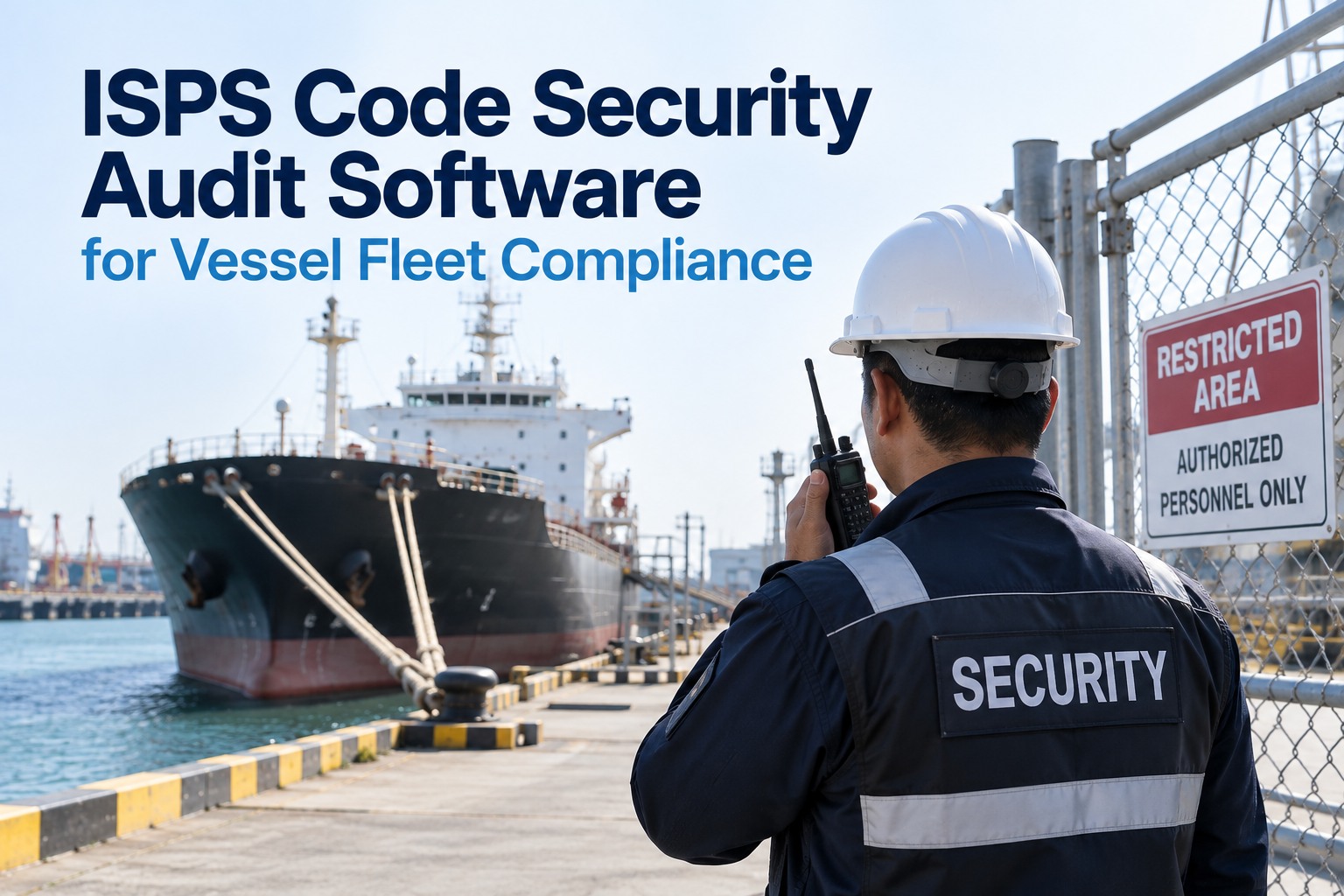
Since the ISPS Code, every port facility operates within a formal security framework, and the ship-port security interface is a shared responsibility that must be actively managed at each call. A security breach at a port can disrupt trade, endanger lives, and cause significant economic loss.
The Port Facility Security Plan
The ISPS Code requires port facilities to operate at designated security levels and to hold a Port Facility Security Plan (PFSP) approved by the national competent authority or a Recognized Security Organization. Regular security assessments are mandatory to keep the plan current and effective.
The people: PFSO, CSO, SSO
The Port Facility Security Officer coordinates security between the port and visiting vessels; the Company Security Officer ensures each ship has an approved Ship Security Plan; the Ship Security Officer liaises with the PFSO on access control. Security measures only work when implemented by competent, trained personnel.
The Declaration of Security
A Declaration of Security (DoS) is an agreement between vessel and port facility setting out security requirements and responsibilities during the ship-port interface — completed with berthed vessels as required, and confirming that vessel and port security levels are compatible.
Access control and monitoring
Controlling access is the first line of defence — gangway and access-point checks, watchkeeping, identification, physical barriers preventing unauthorised boarding, CCTV covering required areas, and stowaway-prevention measures such as checking under trucks and in containers.
Non-compliance has teeth: failure can result in vessel delays, loss of certification, and denial of entry to ships calling at non-compliant facilities. The security dimension is therefore not separable from the commercial one — a port that lets its ISPS compliance lapse jeopardises the trade of every ship that calls there, and a ship arriving at a facility whose security level does not match its own has a problem to resolve before cargo can move.
Port Reception Facilities and the Environment
A compliant port is also an environmentally compliant one, and MARPOL places a specific obligation on ports to receive the waste that ships cannot lawfully discharge at sea.
MARPOL requires ports to provide adequate reception facilities. Because the convention restricts what ships may discharge overboard — oily residues, garbage, sewage, noxious liquids, and more — ports must provide facilities to receive those wastes so that compliant ships have somewhere lawful to land them. An inadequate reception facility is not just a port's problem; it puts the calling ship in the impossible position of holding waste it cannot legally discharge, which is why reception-facility adequacy is a genuine terminal-compliance requirement, not an optional amenity. For a port operator, provision and capacity of reception facilities is part of what makes the facility usable by MARPOL-compliant tonnage.
Dangerous Cargo Terminals
Terminals handling dangerous or hazardous cargo carry an additional layer of requirement, because the consequences of an incident are correspondingly larger. The rules govern how such cargo is stored, segregated, and secured.
IMDG segregation
Dangerous goods must be segregated, labelled, and stored in compliance with the IMDG Code. Incompatible classes kept apart, correct labelling, and proper storage are the baseline for any facility handling packaged dangerous goods.
Secured hazardous areas
Dangerous-goods and hazardous-materials areas must be secured so cargo is not accessible to unauthorised persons — a requirement that sits at the intersection of the safety and security regimes.
Cargo-specific interface rules
Liquid and gas bulk terminals apply their own regimes — ISGOTT for oil and chemical tankers, SIGTTO for LNG interfaces — with bonding, inert-gas, and transfer procedures matched to the cargo's hazards.
Fire prevention
Cargo operations at a dangerous-cargo berth run under fire-prevention regimes aligned to SOLAS, with ignition sources controlled and firefighting readiness maintained throughout the transfer.
Emergency Preparedness
A compliant berth is one that is ready for the operation to go wrong, not just to go right. Emergency preparedness is woven through the interface, the security plan, and the cargo regime rather than sitting separately.
Agreed emergency procedures
Emergency signals, communication protocols, and stop-cargo procedures are agreed between ship and terminal as part of the pre-operation exchange, so both sides act the same way if something goes wrong.
Firefighting readiness
Firefighting capability is maintained at the berth throughout cargo operations, with clear responsibility for shore and ship contributions and access for shore fire services.
Pollution response
Spill-containment and response arrangements are in place for cargoes that pose a pollution risk, with equipment and procedures ready before transfer begins rather than improvised after.
Rapid unberthing
The ability to get a ship off the berth quickly in an emergency — tugs, line-handling, and an escape route — is part of what a compliant berth plans for, especially at dangerous-cargo terminals.
The through-line across every element — safety checklist, mooring, security, reception facilities, dangerous cargo, emergency response — is that terminal compliance is a jointly documented state, confirmed before the interface and maintained through it. The requirements are met not when one side believes them satisfied but when both sides have confirmed and recorded them: the checklist completed and signed, the Declaration of Security agreed, the mooring pattern verified, the berth limits checked against the ship. For port operators and ship agents managing call after call, that documentation is the proof of compliance an inspection or an incident investigation will demand — and the record that lets recurring issues at a berth be spotted and fixed. Held in one structured, retrievable place, it turns terminal compliance from a scramble at each arrival into a repeatable, provable process. Book a demo to see berth checklists, security records, and inspection findings as one retrievable system.
Make Terminal Compliance Provable, Call After Call
Marine Inspection keeps ship-shore safety checklists, mooring and berth records, Declarations of Security, dangerous-cargo documentation and inspection findings structured, timestamped and retrievable per call — so compliance is demonstrable to inspectors, recurring berth issues surface early, and every interface is managed on a record instead of by memory. Turn a scramble at each arrival into a repeatable process.
Ship-shore checklist records
Security & DoS documentation
Mooring & berth records
Inspection findings tracked
Frequently Asked Questions
What is the ship-shore safety checklist?
A jointly completed checklist that structures communication between ship and terminal from before arrival through to departure, confirming that agreed safe procedures are in place at each stage. For tankers it is provided by ISGOTT 6, using a positive-affirmation approach where each applicable item is actively confirmed and ship and terminal responsibilities are clearly differentiated. It is completed jointly, with the berth section signed as satisfactory.
Book a demo.
What are the mooring requirements at a berth?
The mooring pattern should meet OCIMF's Mooring Equipment Guidelines, with all lines in good condition and properly led, and kept taut to prevent the ship ranging along the pier. Wind, currents, tides, and passing-vessel effects require continuous monitoring and adjustment. Adequate fendering prevents contact damage, the gangway must be safely rigged with a net, and bonding or insulating flanges are fitted where the cargo requires.
Book a demo.
What is a Declaration of Security?
Under the ISPS Code, a Declaration of Security (DoS) is an agreement between a vessel and a port facility setting out the security requirements and responsibilities of each during the ship-port interface — cargo operations, passenger embarkation, stores delivery. It is completed with berthed vessels as required and confirms that vessel and port facility security levels are compatible.
Book a demo.
What is a Port Facility Security Plan?
The PFSP is the security plan the ISPS Code requires every port facility to hold, approved by the national competent authority or a Recognized Security Organization. It addresses identified risks, sets the facility's operation at designated security levels, and is kept current through mandatory regular security assessments. The Port Facility Security Officer implements and maintains it and coordinates with visiting vessels.
Book a demo.
What are port reception facilities?
Facilities that MARPOL requires ports to provide so ships can lawfully land the wastes they cannot discharge at sea — oily residues, garbage, sewage, noxious liquid residues and more. Because the convention restricts overboard discharge, adequate reception facilities are what let a compliant ship offload waste legally, making their provision and capacity a genuine terminal-compliance requirement rather than an optional service.
Book a demo.
What extra requirements apply to dangerous-cargo terminals?
Dangerous goods must be segregated, labelled and stored in compliance with the IMDG Code, and hazardous-materials areas secured against unauthorised access. Bulk liquid and gas terminals apply cargo-specific regimes — ISGOTT for oil and chemical tankers, SIGTTO for LNG interfaces — with bonding, transfer and fire-prevention procedures matched to the hazard, and cargo operations run under fire-prevention regimes aligned to SOLAS.
Book a demo.
What happens if a port facility is non-compliant?
Non-compliance carries real consequences: vessel delays, loss of certification, and denial of entry to ships calling at non-compliant facilities. Because a security or safety failure at a berth affects every ship that calls, terminal compliance is inseparable from the commercial viability of the facility — and a ship arriving where security levels or berth limits do not match has an issue to resolve before cargo can move.
Book a demo.
Who is responsible for what at the ship-shore interface?
Responsibility is split, which is exactly why the checklist matters. The modern ship-shore safety checklist clearly differentiates ship and terminal responsibilities for each item, using positive affirmation so both sides actively confirm their part. Security responsibilities are coordinated between the PFSO ashore and the SSO aboard, and the Declaration of Security records who is responsible for what. The interface is a shared, documented state, not one party's job.
Book a demo.
Confirm It, Record It, Prove It — Every Interface, Every Call.
Terminal compliance is a jointly documented state, met only when both ship and shore confirm and record it. Marine Inspection keeps ship-shore checklists, mooring and berth records, Declarations of Security, dangerous-cargo documentation and inspection findings structured and retrievable per call — so compliance is provable and recurring issues surface early. This guide is an overview, not regulatory advice; follow the applicable ISPS, ISGOTT, MARPOL and SOLAS requirements and your terminal's own procedures.
Overview only · Follow applicable ISPS, ISGOTT, MARPOL & SOLAS requirements · Records that prove every call