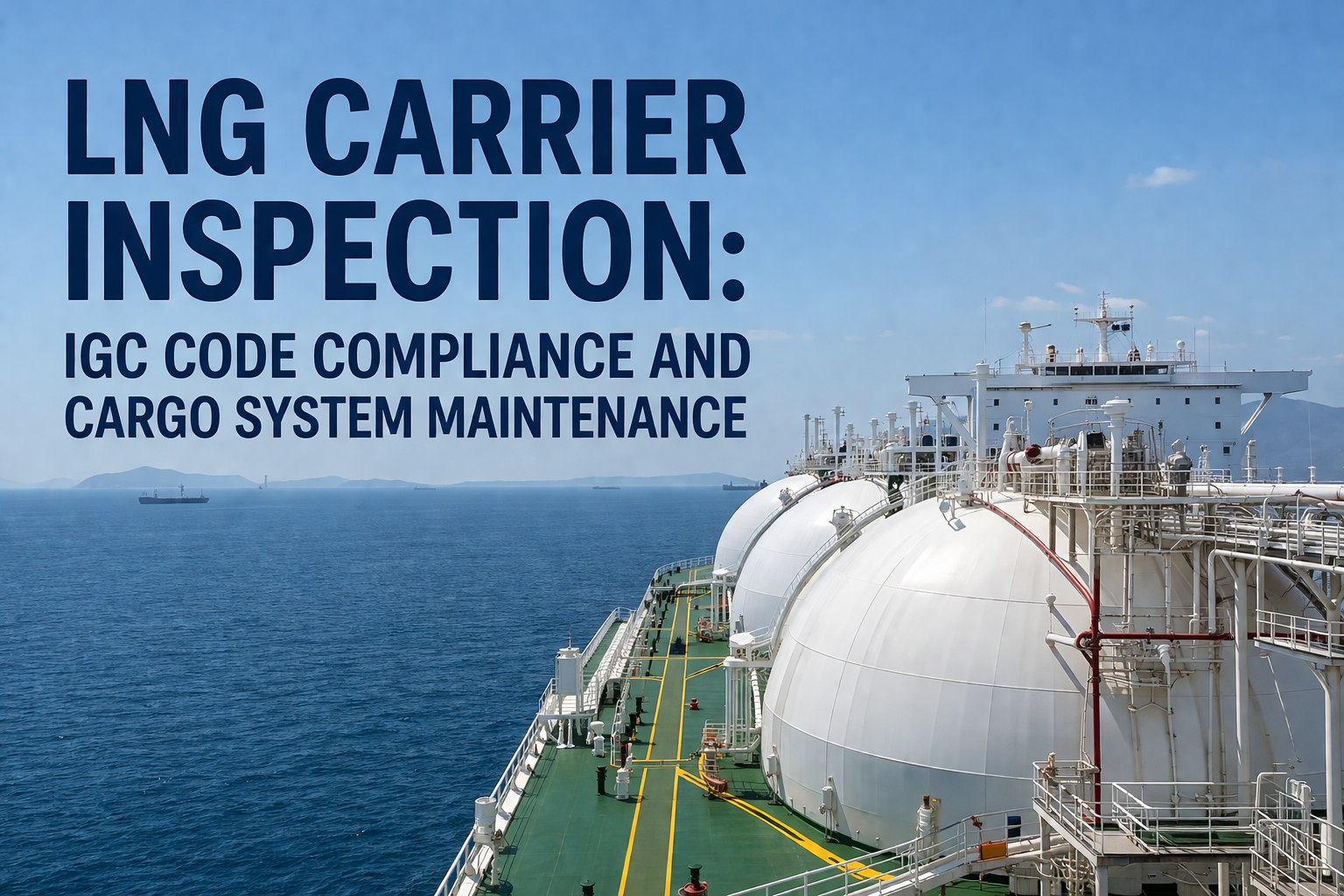
On a gas carrier the certificate is not a record of compliance. It is the licence to trade, and it carries operating limits printed on its face. The International Certificate of Fitness for the Carriage of Liquefied Gases in Bulk is issued under the IGC Code, the International Code for the Construction and Equipment of Ships Carrying Liquefied Gases in Bulk, which has governed every gas carrier built after 30 June 1986 as a mandatory instrument under SOLAS. The Code defines four hazard-based ship types, four containment system types, the approved cryogenic materials, the cargo handling and gas management architecture, and the Maximum Allowable Relief Valve Setting — the MARVS — which appears on the Certificate of Fitness itself and establishes the pressure regime the vessel may operate within. Behind that single document sits a multi-layer protection concept: cargo containment, secondary barrier where cargo is carried below minus fifty-five degrees, cargo area segregation, emergency shutdown, gas detection, and MARVS-governed pressure relief. Every layer must be independently maintained and independently evidenced. The result is the largest evidence burden per vessel in commercial shipping, held together by one certificate. Start a free trial of Marine Inspection and see the whole structure held in one place.
The Document That Is Also the Operating Envelope
International Certificate of Fitness
for the Carriage of Liquefied Gases in Bulk
Issued under the IGC Code following construction survey and maintained through annual, intermediate and renewal surveys. The intermediate survey endorses the certificate; the renewal survey extends it. Where a survey is not completed within the periods specified in the Code, the certificate position is compromised and with it the vessel's ability to load.
Printed on it, and binding
MARVS, the Maximum Allowable Relief Valve Setting, which establishes the operational pressure regime
The cargoes the vessel is fit to carry, tied to containment type and material selection
Ship type classification among the four hazard-based categories defined by the Code
Conditions and limitations arising from the survey and certification regime
Six Layers, Six Evidence Trails
The IGC Code's safety record rests on defence in depth rather than on any single system, and that architecture is the reason the maintenance burden is what it is. No LNG carrier has suffered a major cargo release at sea since the Code entered force in 1986 — a record produced by layers that each require their own inspection regime, their own test records and their own calibration evidence. Book a Marine Inspection demo and see each layer held as a distinct evidence trail rather than as one cargo system entry.
Layer 1
Cargo Containment System
Independent Type A, Type B, Type C or membrane, with insulation, supporting structure and spaces forming the complete arrangement. Material selection governed by the Code's cryogenic tables, which have been amended over time — confirm the current edition applies to your build.
Evidence: containment surveys, insulation condition, tank inspection records, loading limit documentation
Layer 2
Secondary Barrier
Required where cargo is carried at temperatures below minus fifty-five degrees, under IGC 13.5.2 and 13.5.4. The relationship between tank type, cargo temperature and secondary barrier requirement is determinative rather than discretionary, and it is one of the first things a foreign gas carrier examiner establishes.
Evidence: barrier integrity monitoring, interbarrier space records, tightness testing history
Layer 3
Cargo Area Segregation
Physical and systemic separation of the cargo area from accommodation and machinery spaces, including air locks, ventilation arrangements and the integrity of boundaries between zones. Recent SOLAS amendments have added requirements around watertight door indicators.
Evidence: air lock function, ventilation system testing, boundary integrity, door indicator status
Layer 4
Emergency Shutdown
The ESD system stops cargo liquid and vapour flow in an emergency and brings cargo handling to a safe static condition. The Code specifies shipboard requirements but does not address activation at shore installations, which is why linked systems and the ship-shore link matter operationally.
Evidence: function test records per valve, alarm channel testing, response time verification
Layer 5
Gas Detection
Fixed and portable systems, in cycled and continuous configurations, frequently combined with suction sampling for holds and unmanned spaces and electronic detection for accommodation and manned spaces. Calibration is evidenced through span gas analysis certification.
Evidence: calibration history per detector, span gas certificates, function tests, alarm logs
Layer 6
Pressure Relief Under MARVS
Relief valve sizing, vent mast arrangement, vent location and height, and flame arresters, all operating within the setting stated on the Certificate of Fitness. Vent masts are a backup route rather than an operating strategy, and treating them otherwise creates both a safety and a regulatory exposure.
Evidence: valve setting records, overhaul history, vent system condition, pressure logs
The Part of the Code That Class Does Not Cover
This is the most consequential thing most gas carrier operators have never been told plainly, and it changes how a compliance position should be assembled. Several parts of the IGC Code sit outside the scope of classification as defined in society rules, with responsibility for interpretation resting with the Administration of the flag state. Sign up for Marine Inspection and hold flag-scope evidence alongside class-scope evidence rather than in a separate file.
Outside the scope of classification
Chapter I, Section 1.4 — Equivalents
Chapter I, Section 1.5 — Surveys and certification
Chapter II — Ship Survival Capability
Chapter XIV — Personnel Protection
Chapter XVIII — Operating requirements
Why this matters operationally
A fleet that treats class approval as equivalent to IGC compliance has a gap it cannot see, because the areas outside classification scope include operating requirements and personnel protection — precisely the areas a foreign gas carrier examiner or flag inspector will probe. Responsibility for interpreting the Code for the purpose of issuing the Certificate of Fitness lies with the Administration, not with the society.
What to do about it
Map your evidence by Code chapter rather than by class survey item, so the chapters outside classification scope are visibly covered rather than assumed. Confirm your flag administration's interpretation on the equivalents provision specifically, since that is where design deviations are authorised and where documentation most often falls between two authorities.
Map Evidence to Code Chapters, Not Just Survey Items
Containment surveys, secondary barrier monitoring, gas detector calibration with span gas certificates, ESD function tests per valve, relief valve settings against MARVS, vent system condition, instrumentation redundancy and loading limit documentation — held against IGC chapters and against annual, intermediate and renewal survey cycles, exportable as an evidence pack for class or flag on demand.
What the Maintenance System Has to Hold
Below is the obligation set translated into system requirements, ordered by the structure of the Code rather than by the shape of a generic maintenance product. The final column is where fleets usually come unstuck. Schedule a walkthrough and test each row against your own vessel records.
Table 1: IGC Obligations Translated Into System Requirements
Boil-Off: The Only Cargo That Manages Itself Into a Problem
Every other cargo sits still. LNG boils continuously, typically at around 0.10 to 0.15 percent of cargo volume per day, and that vapour has to go somewhere every hour of every voyage. The three disposal routes each carry their own machinery, their own failure modes and their own maintenance obligations, and the choice between them is commercial as well as technical. Start a free trial and hold BOG plant alongside the rest of the machinery record.
Burn as fuel
Dual-fuel engines and boilers consume boil-off, converting a disposal problem into propulsion energy. The maintenance obligation follows the gas supply train — gas valve units, fuel gas handling, and the dual-fuel plant itself — rather than sitting in the cargo system.
Highest commercial value, deepest machinery dependency
Reliquefy
A reliquefaction plant returns vapour to the tank, preserving cargo volume and therefore delivered quantity. Performance test procedures for onboard LNG boil-off gas reliquefaction systems were published as an international standard in 2025, which gives operators a defined basis for verifying mechanical performance rather than relying on maker practice alone.
Preserves cargo, adds a complex cryogenic plant to maintain
Gas combustion unit
A GCU burns excess vapour without recovering value, used when demand cannot absorb generation. Availability matters disproportionately because it is the route of last resort before pressure rises toward the relief setting.
No commercial return, but its failure is the one that escalates
Where the maintenance windows actually sit in the cycle
LoadingShore flow ramps up while crew manage levels, pressures and routine checks on cargo system valves and instrumentation. No maintenance window exists here; attention is fully consumed by flow rates and manifold alignment.
Laden passageBoil-off managed continuously via fuel use, reliquefaction or GCU, with tank pressure held within design values. The plant in use cannot be worked on; the plant not in use can.
DischargeCargo pumps discharge to shore, vaporisers or vapour crossover supply gas back, compressors control tank pressure. Spray pumps strip the remainder. Vent masts remain a backup only.
Ballast passageHeel retained in each tank maintains cool-down through the return leg. This is the genuine maintenance window on a gas carrier, and it is the one most worth planning against explicitly.
Plan the ballast leg as your maintenance window, and hold the BOG plant, reliquefaction train and GCU in the same record as the cargo system.
ESD and the Ship-Shore Link
The emergency shutdown system is where the IGC Code stops and the terminal interface begins, and that boundary creates a maintenance obligation that sits partly outside the Code itself. The Code specifies requirements for shipboard ESD systems but does not address activation and operation at shore installations, so linked arrangements — where a trip on the ship signals shore and vice versa — are governed by industry guidance rather than by the Code alone. Book a walkthrough and see ESD and link testing held as scheduled, evidenced activity.
Ship-shore link types in service
ElectricAn explosion-proof connector with an umbilical cable, provided by shore or in some cases by the ship, enabling ship-to-ship transfer with ESD and hotline telephone. Circuits are protected with zener barriers as secondary protection in case the ship breaks away while energised.
SIGTTO-approved connectionDesigned to industry recommendations and intended as the international standard for intrinsically safe ESD links, covering both ship-to-shore and shore-to-ship directions.
Optical and pneumaticAlternative physical link methods in service across different terminal generations, each with its own connector inventory and test regime.
WirelessEquivalent capability through transmitters and receivers with no physical link, removing the break-away exposure and introducing a different one.
What has to be maintained
Every ESD valve with its own function test record. Alarm and function channels tested individually rather than as a system pass. Connector inventory covering the link types your trade requires, since a terminal will not adapt to a ship that arrives without the right box. And the link functions themselves tested, which industry guidance addresses directly alongside overflow control and emergency release systems.
The newer exposure
Current industry guidance on ESD systems now includes cyber security considerations associated with linked ship-shore systems, which the 2009 predecessor publication did not. A linked ESD is a connection between two organisations' control systems at the moment of highest consequence, and it should be treated as an item with a security posture rather than only a functional test.
The Jurisdictional Divergence Nobody Budgets For
A gas carrier's compliance state is not constant across a voyage. The same vessel operates under different limits depending on destination, and United States waters impose the tightest of them. This is a routing-dependent obligation, which makes it a planning problem as much as an engineering one. Start a free trial and hold destination-specific compliance evidence ready before arrival rather than during it.
Lower relief valve settings
United States waters require lower MARV settings than international operation, so the operating pressure envelope narrows on approach. The setting change is an engineering action with an evidence requirement attached, not a switch flipped on arrival.
No cargo vapour venting
Cargo vapour venting is prohibited in US ports, which removes the backup route entirely and places the full disposal burden on fuel consumption, reliquefaction or the gas combustion unit for the duration of the call.
Extended pressure hold
Pressure must be maintainable for twenty-one days or more without venting for LNG on US-bound voyages, which is a demonstrated capability rather than a design claim, and which depends directly on BOG plant availability across the whole passage.
Examination on arrival
Foreign gas carrier examination compares the Certificate of Fitness against the vessel's actual equipment and arrangement, checks the secondary barrier position against cargo temperature, and verifies that personnel with cargo duties hold the certification required under STCW.
Evaluating a Platform for a Gas Carrier Fleet
Generic maintenance capability will not distinguish shortlisted platforms here. These questions will. Schedule a demo and work through them with a gas engineer and a marine superintendent present.
Table 2: Buyer Questions Specific to Gas Carriers
2026 GAS CARRIER COMPLIANCE REALITY
Interpretation rests with the Administration. Responsibility for interpreting the IGC Code for the purpose of issuing the Certificate of Fitness lies with the Administration of the flag state, and several Code chapters fall outside the scope of classification. Confirm your flag's position rather than inferring it from class survey coverage. The Code continues to be amended. Materials tables and chapter provisions have been revised over time, including amendments extending the Code toward ammonia used as fuel, so verify the current edition and applicable amendments for your specific build date and trade. Industry guidance sits alongside the Code, not inside it. ESD arrangements and linked ship-shore systems are addressed by SIGTTO guidance which now updates and replaces the 2009 publication and adds cyber security coverage; the Code specifies shipboard ESD requirements but does not address shore-side activation. The statutory floor still applies. ISM Code Element 10 requires a documented maintenance system and SOLAS Chapter IX makes ISM mandatory for SOLAS-certified ships, independently of everything above.
Frequently Asked Questions
What is the IGC Code and which vessels does it apply to?
The IGC Code is the International Code for the Construction and Equipment of Ships Carrying Liquefied Gases in Bulk, mandatory under SOLAS amendments and governing all gas carriers built after 30 June 1986. It replaced an earlier voluntary framework: the Gas Carrier Code adopted by IMO Resolution A.328(IX) in 1975, with an Existing Ship Code completed in 1976 which remains an IMO recommendation for older tonnage. The Code defines four hazard-based ship types, four containment system types including independent Type A, Type B, Type C and membrane, the approved cryogenic materials, the cargo handling and gas management architecture, the MARVS pressure relief regime, and the survey and certification regime producing the Certificate of Fitness.
What is MARVS and why does it appear on the certificate?
MARVS is the Maximum Allowable Relief Valve Setting, and it is stated on the Certificate of Fitness because it establishes the operational pressure regime the vessel may work within. It is not an internal engineering parameter but a certificated limit, which is why relief valve settings, overhaul history and current settings per valve belong in a retrievable record rather than in an engineer's knowledge. It also varies by jurisdiction: United States waters require lower MARV settings than international operation, so the same vessel carries different limits depending on where it is trading, and the change carries an evidence requirement.
When is a secondary barrier required?
Where cargo is carried at temperatures below minus fifty-five degrees Celsius, under IGC 13.5.2 and 13.5.4. The relationship between tank type, cargo temperature and secondary barrier requirement is determinative and is set out in the Code, and it is among the first things a foreign gas carrier examiner establishes when comparing the Certificate of Fitness against the vessel's actual arrangement. Because the barrier is not directly observable in normal operation, its status tends to be assumed rather than evidenced, which is exactly the gap that creates difficulty during examination. Interbarrier space monitoring and tightness testing history should be held per tank.
Does class approval mean we are IGC compliant?
Not entirely, and this is worth being precise about. Several parts of the IGC Code fall outside the scope of classification as defined in society rules, including the equivalents provision, surveys and certification, ship survival capability, personnel protection and operating requirements. Responsibility for interpretation for the purpose of issuing the Certificate of Fitness lies with the Administration of the flag state. The practical implication is that evidence should be mapped by Code chapter rather than only by class survey item, so the chapters outside classification scope are demonstrably covered rather than assumed to be handled by someone else.
How much boil-off does an LNG carrier generate, and what happens to it?
Typically around 0.10 to 0.15 percent of cargo volume per day, generated continuously by heat ingress. There are three disposal routes and most vessels use a combination. Burning it as fuel in dual-fuel engines and boilers converts the vapour into propulsion energy and carries the highest commercial value. Reliquefaction returns it to the tank and preserves delivered cargo quantity, with international performance test procedures for onboard reliquefaction systems published as a standard in 2025. A gas combustion unit burns excess without recovering value and functions as the route of last resort before pressure rises toward the relief setting, which is why its availability matters more than its utilisation.
What extra requirements apply on US-bound voyages?
Three that materially affect operation. Lower MARV settings apply in United States waters than in international operation. Cargo vapour venting is prohibited in US ports, removing the backup disposal route for the duration of the call. And pressure must be maintainable for twenty-one days or more without venting for LNG, which is a demonstrated capability depending on boil-off plant availability across the entire passage rather than a design claim. Foreign gas carrier examination on arrival compares the certificate against actual equipment, checks the secondary barrier position against cargo temperature, and verifies that personnel with cargo duties hold the certification required under STCW.
One certificate
Six Layers Behind It, Every One Independently Evidenced
Containment and secondary barrier records per tank, gas detector calibration with span gas certification, ESD function tests per valve and per channel, relief valve settings against MARVS, instrumentation redundancy, custody transfer calibration, loading limits held permanently, and BOG plant in the same hierarchy as the rest of the machinery — mapped to IGC chapters, tied to survey windows, captured offline in a cargo machinery room, and exportable as an evidence pack for class, flag or a foreign examiner.