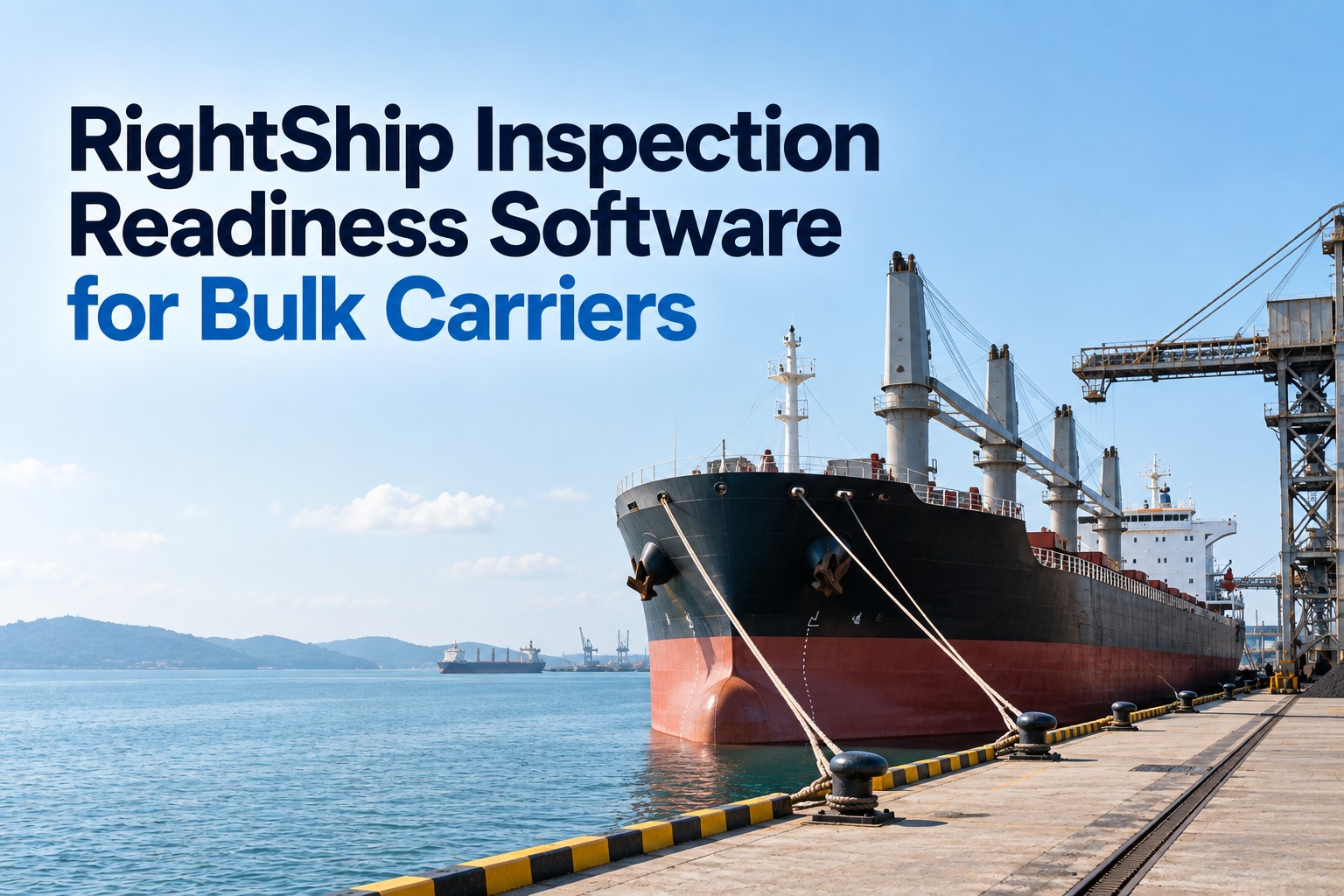
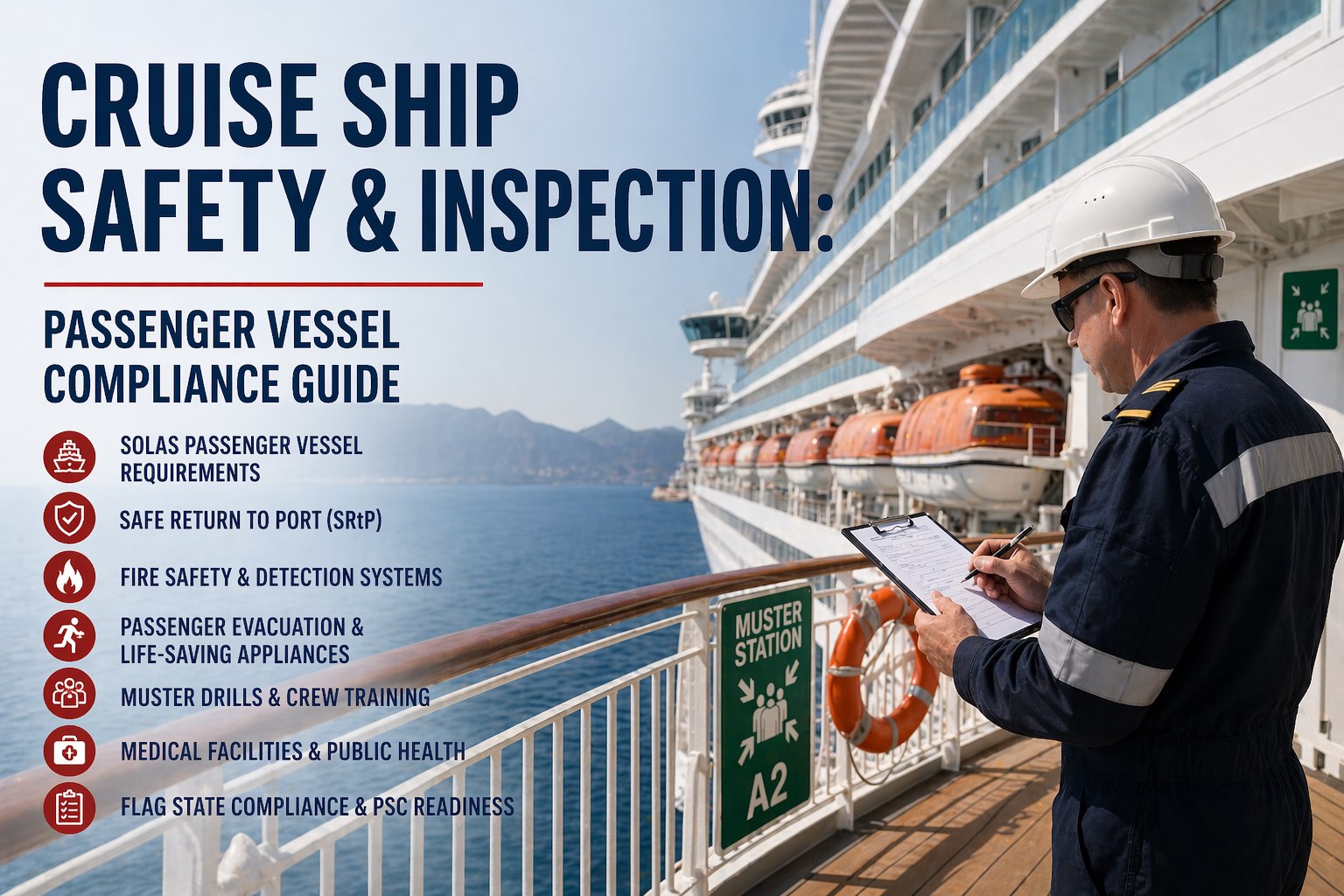
A RightShip inspection is not a test you can revise for the night before. The inspector spends the better part of two working days aboard, works through a questionnaire covering safety management, maintenance standards, safety culture, crew welfare and environmental management, and asks for a document pack running to dozens of items — and much of what determines the outcome was decided months earlier by how the vessel was maintained and how previous findings were closed. Meanwhile the commercial stakes have sharpened considerably. The inspection age trigger has been tightening year on year, and a vessel that meets the age criteria without a valid RightShip inspection has its Safety Score forced down to two out of five, which sits below the threshold most charterers require before they will even proceed to a full vet. That is not a scoring inconvenience; for a bulk carrier competing for cargoes from the major commodity houses, it is the difference between trading and idling. This guide covers what a RISQ inspection actually examines, the findings that recur most often, a structured preparation runway working back from inspection day, and how closing findings properly protects the score you are trying to defend. To build that readiness continuously across your fleet, book a demo or start a free trial.
READINESS GUIDE · BULK CARRIER FLEETS
RightShip Inspection Readiness for Bulk Carrier Fleets
What a RISQ inspection examines, the findings inspectors keep recording, and a structured preparation runway that has the vessel ready — and the findings closed — long before the inspector steps aboard.
14.1 hrs
Average onboard time for a standard inspection, with hybrid inspections averaging around 11.5 hours.
86 docs
The document pack — roughly 63 reusable across inspections and 23 prepared for each one.
2 of 5
The Safety Score forced on an age-triggered vessel that lacks a valid RightShip inspection.
Why Readiness Now Decides Commercial Access
The context that makes preparation urgent is the age trigger, which has been tightening in phases and now reaches vessels far younger than it once did. A vessel that falls within the applicable age band without a valid RightShip inspection does not merely lose a credential — its Safety Score is downgraded to two out of five, below the level most charterers require before proceeding to a full vet.
2025Vessels aged 13 years and above require a valid inspection
1 Apr 2026Extends to vessels aged 12 years and above
1 Jul 2026Extends to vessels aged 11 years and above
1 Jan 2027Extends to vessels aged 10 years and above
The practical implication for a fleet with mixed vessel ages is that inspection planning has become a rolling exercise rather than a response to a charterer's request. Ships approaching each threshold need an inspection scheduled proactively, and — more importantly — need to be genuinely ready when it happens, because an inspection that generates a long list of findings damages the position it was meant to protect. With major commodity charterers using the platform for vetting, a score sitting at two effectively removes a vessel from those trades. To plan inspection readiness across a mixed-age fleet, book a demo or start a free trial.
What a RISQ Inspection Actually Examines
The RISQ questionnaire deliberately reaches past regulatory minimums. Where a Port State Control officer checks compliance against convention requirements, a RISQ inspector is assessing operational quality — whether the management system works in practice, whether maintenance standards hold up under examination, and whether the crew culture supports safe operation.
Safety management systems
Whether procedures are implemented and followed in practice, not merely documented and filed.
Maintenance standards
Condition of equipment and structure, and the maintenance record that explains how it got there.
Safety culture
How the crew actually behave and communicate around safety-critical work, observed rather than asserted.
Crew welfare
Living and working conditions, hours of rest, and the wider welfare picture aboard.
Environmental management
Environmental procedures and performance, increasingly weighted as charterers apply ESG criteria.
The document pack
Around 86 documents, most reusable between inspections and the remainder prepared each time — a substantial administrative task if assembled from scratch.
That document pack deserves attention, because it is where preparation quietly fails. The larger, reusable portion should be maintained as a standing set rather than rebuilt for every inspection, leaving only the per-inspection items to prepare fresh. Fleets that treat the whole pack as a one-off assembly job each time lose days to it and still arrive with gaps.
The Findings Inspectors Keep Recording
Across recent inspections, findings cluster in a consistent set of areas. Knowing them lets a fleet direct preparation where it will actually change the outcome rather than spreading effort evenly across everything.
1Enclosed space entry procedures — the discipline around permits, testing and rescue arrangements, and whether crew can demonstrate it rather than describe it
2Firefighting equipment condition — servicing currency, physical condition and accessibility of the full outfit
3Lifesaving equipment readiness — davits, liferafts, immersion suits and launching arrangements in genuinely serviceable condition
4Hatch cover condition and testing — sealing arrangements, securing devices and evidence of testing, a persistent bulk carrier weak point
5Machinery space readiness — cleanliness, leak management, insulation, and the general standard the space presents
6Pilot ladder safety compliance — rigging arrangements and equipment condition, an area under sustained industry scrutiny
Two things stand out about this list. First, none of these are obscure — they are core operational areas any well-run bulk carrier should already be strong in, which means findings here usually indicate a maintenance or verification gap rather than an unlucky inspection. Second, several are the same areas that generate Port State Control deficiencies, so work done here pays twice: it improves the inspection outcome and reduces the PSC deficiency record that separately feeds the Safety Score. To target preparation on these areas systematically, book a demo or start a free trial.
The Preparation Runway
Working backwards from inspection day turns preparation from a scramble into a sequence. The timings below are indicative rather than prescriptive, but the ordering matters.
90 days out
Run a full self-inspection against the RISQ scope, treating it as though it were the real thing. Raise everything found as a tracked defect with an owner and a deadline, so there is time to actually rectify rather than merely note. Confirm the reusable document set is current and identify what is missing. This is the window where physical work can still be planned into normal operations.
30 days out
Verify that defects raised at the ninety-day mark are closed with evidence attached, not merely marked complete. Focus a second pass on the recurring finding areas — enclosed space entry, firefighting and lifesaving equipment, hatch covers, machinery spaces and pilot ladder arrangements. Prepare the per-inspection documents and check certificate and survey status leaves nothing expiring around the inspection window.
7 days out
Brief the crew on what will be asked and, more importantly, on demonstrating tasks rather than reciting procedures. Confirm the people who actually perform each safety-critical operation will be aboard and available. Walk the vessel with fresh eyes for presentation and housekeeping, and confirm the full document pack is assembled and accessible rather than scattered.
Inspection day
Expect a long day aboard — a standard inspection averages over fourteen hours. Make the right crew available for their own areas, produce documents promptly rather than searching, and answer what is asked plainly. An inspector forms a view of operational quality partly from how readily the vessel can produce its own records.
Afterwards
Convert every finding into a tracked corrective action with root cause identified and evidence of completion, then cascade the lessons fleet-wide. Findings on one vessel almost always indicate the same exposure on sister ships, and closing them there before the next inspection is the cheapest score improvement available.
Run the runway as a standing process
Self-inspections against the RISQ scope, defects raised with owners and deadlines, evidence attached at closure, document sets kept current, and findings cascaded across sister vessels — this is ordinary operational discipline, held continuously rather than assembled before a deadline. Marine Inspection runs it across the fleet with offline capture and full corrective-action tracking.
Book a demo to see it on your vessels, or
start a free trial to try it yourself.
Closing Findings Is the Score Work
The most consequential and least glamorous part of readiness is what happens to findings after they are raised. This is where the inspection outcome connects to the Safety Score, and where most of the recoverable ground sits.
Since the move to severity-weighted deficiency scoring, the nature of a finding matters as much as the count. Deficiency types are graded by severity, so a critical lifesaving or firefighting fault carries substantially more weight than a minor documentation oversight, and a fleet can no longer manage its position simply by minimising the number of items recorded. The practical consequence is that preparation should prioritise the high-severity areas — which is precisely why the recurring finding list above is worth working through deliberately. It also means close-out quality is not administrative housekeeping: an item closed with a proper root-cause analysis and evidence of completion demonstrates a working management system, while one closed with a bare assertion invites the next inspector to reopen the same ground.
Timing works against you here, which is why early action pays disproportionately. Port State Control history influences the score over a twenty-four-month window and incident history over sixty months, so damage lingers well beyond the event and improvement accrues slowly. Detentions in particular carry the heaviest negative weight and recover most slowly of all. A fleet that closes findings promptly and prevents repeat deficiencies starts the clock on recovery immediately; one that defers is still carrying the same weight two years later. To keep findings closing with evidence rather than assertion, book a demo or start a free trial.
Defending the Score Before the Inspector Boards
The phrase worth holding onto is that the inspection largely confirms a position rather than creating one. By the time the inspector arrives, the maintenance either was or was not done, the findings either were or were not closed, and the records either exist or do not. Readiness work in the final week can improve presentation; it cannot manufacture a history.
This is the argument for treating RightShip readiness as a continuous operational state rather than an event. The same daily disciplines that produce a good inspection also reduce Port State Control deficiencies, satisfy class requirements and support charterer vetting more broadly — maintained equipment with documented evidence, competent crews with training records, and corrective actions tracked through to evidenced closure. Handled that way, an inspection stops being a threat to the score and becomes the mechanism that confirms a position already earned. And the operators who fare best are simply those whose ordinary systems generate the proof as a by-product of running the fleet, so that when the inspector asks for the maintenance history behind a piece of equipment, the answer takes seconds rather than an afternoon of searching. To put your fleet on that footing before the next age threshold applies, book a demo or start a free trial.
Frequently Asked Questions
How long does a RightShip inspection take and what should we expect?
Plan for a long day aboard. Standard inspections average around 14.1 hours onboard, with hybrid inspections averaging closer to 11.5 hours. The inspector works through the RISQ questionnaire covering safety management systems, maintenance standards, safety culture, crew welfare and environmental management, and requests a document pack of roughly 86 items — around 63 of which are reusable between inspections, with about 23 prepared for each specific inspection. Practically, this means making the crew who actually perform each safety-critical operation available for their own areas, producing documents promptly rather than searching for them, and expecting the inspector to look past regulatory minimums at operational quality. How readily a vessel can produce its own records itself contributes to the impression of how well the ship is run.
What happens if our vessel hits the age trigger without a valid inspection?
The Safety Score is downgraded to two out of five, which sits below the threshold most charterers require before proceeding to a full vet. Since major commodity charterers use the platform for vetting, a score at that level effectively removes the vessel from those trades regardless of how it is otherwise performing. The trigger has been tightening in phases — applying to vessels of 13 years and above during 2025, then 12 years from April 2026, 11 years from July 2026 and 10 years from January 2027 — so fleets with mixed vessel ages need rolling inspection planning rather than a reactive approach. The important point is to schedule proactively and, critically, to be genuinely ready when the inspection happens, since an inspection producing a long list of findings damages the very position it was meant to protect.
Which areas should we prioritise in preparation?
Recent inspection findings cluster consistently in six areas: enclosed space entry procedures, firefighting equipment condition, lifesaving equipment readiness, hatch cover condition and testing, machinery space readiness, and pilot ladder safety compliance. Directing preparation at these delivers more improvement than spreading effort evenly. Two features of the list are worth noting. None of these areas are obscure — they are core operational areas a well-run bulk carrier should already be strong in, so findings usually reveal a maintenance or verification gap rather than bad luck. And several overlap with common Port State Control deficiencies, so the work pays twice: a better inspection outcome, plus a reduced PSC deficiency record that separately feeds the Safety Score. Under severity-weighted scoring, the high-severity items among them — particularly lifesaving and firefighting equipment — carry the most weight.
How does closing findings properly affect our score?
Substantially, because deficiency scoring is now severity-weighted rather than a simple count. Deficiency types are graded high, medium or low severity, so a critical lifesaving or firefighting fault weighs far more than a minor documentation oversight, and a fleet cannot manage its position merely by minimising the number of items recorded. Close-out quality matters too: an item closed with a proper root-cause analysis and documented evidence of completion demonstrates a functioning management system, whereas one closed with a bare assertion invites the next inspector to reopen the same ground. Timing compounds this. Port State Control history influences the score over roughly a twenty-four-month window and incident history over sixty months, so damage persists well beyond the event and recovery is gradual. Detentions carry the heaviest weight and recover slowest, which is why prompt closure and prevention of repeats matter so much.
Can we improve a poor Safety Score quickly?
Not quickly, but steadily and predictably. The score draws on six sub-scores, and the ones an operator most directly controls are vessel incident performance, Port State Control deficiency performance, detention performance and the management company's fleet-wide record. Because those windows run to twenty-four months for Port State Control history and sixty months for incidents, past events continue to weigh for some time and improvement accrues as clean months accumulate rather than arriving in a step change. That said, the clock only starts when the underlying behaviour changes, so prompt action is worth far more than deferred action. Practical priorities are minimising deficiencies with particular attention to high-severity items, avoiding detentions, maintaining a clean incident record, scheduling a RightShip inspection proactively before the age trigger applies, and addressing all findings with documented evidence of completion.
How far in advance should preparation start?
Around ninety days is a sensible working horizon for structured preparation, though the underlying readiness should be continuous. At ninety days, run a full self-inspection against the RISQ scope and raise everything found as a tracked defect with an owner and deadline, so there is genuine time for physical rectification within normal operations. At thirty days, verify those defects are closed with evidence attached rather than simply marked complete, run a second pass over the recurring finding areas, prepare the per-inspection documents and confirm no certificates or surveys expire around the inspection window. At seven days, brief the crew on demonstrating tasks rather than reciting procedures, confirm the right people will be aboard, and assemble the document pack. The reusable portion of that pack should be maintained as a standing set rather than rebuilt each time.
Ready Before the Inspector Boards
A RightShip inspection confirms a position rather than creating one — the maintenance was either done or not, the findings either closed or not, the records either there or not. Marine Inspection holds that readiness continuously: self-inspections against the RISQ scope, defects tracked to evidenced closure, document sets current, and findings cascaded across sister vessels, all captured offline at the point of work.
Book a demo or
start a free trial.