Most fleets do not have a data problem — they have a data-that-cannot-move problem. The ERP holds the purchase orders, the ECDIS and navigation systems hold the voyage data, the telematics and onboard sensors hold engine and fuel readings, the accounting package holds the invoices, and the inspection platform holds the surveys and findings — and none of them talk to each other. The result is a fleet where the most sophisticated integration layer is a person: someone re-keying a noon report into a spreadsheet, copying a purchase order from the ERP into the accounting system, or reconciling telematics figures against a maintenance log by hand. That manual bridging is slow, expensive and quietly error-prone, and it is exactly the work a marine API integration hub removes. Instead of every system standing alone, the hub connects them — pulling data in through prebuilt connectors and an open developer API, pushing events out through webhooks, and turning a scatter of disconnected tools into one connected operation with a single source of truth. This page explains what a marine API integration hub does, the systems it connects, how the developer API and webhooks work, how it stays secure, and the operational payoff of finally letting your systems share data automatically. To connect your ERP, navigation, telematics and accounting systems to your inspection and fleet data in one place, start a free trial or book a demo.
REPORTS & SYSTEM · INTEGRATION
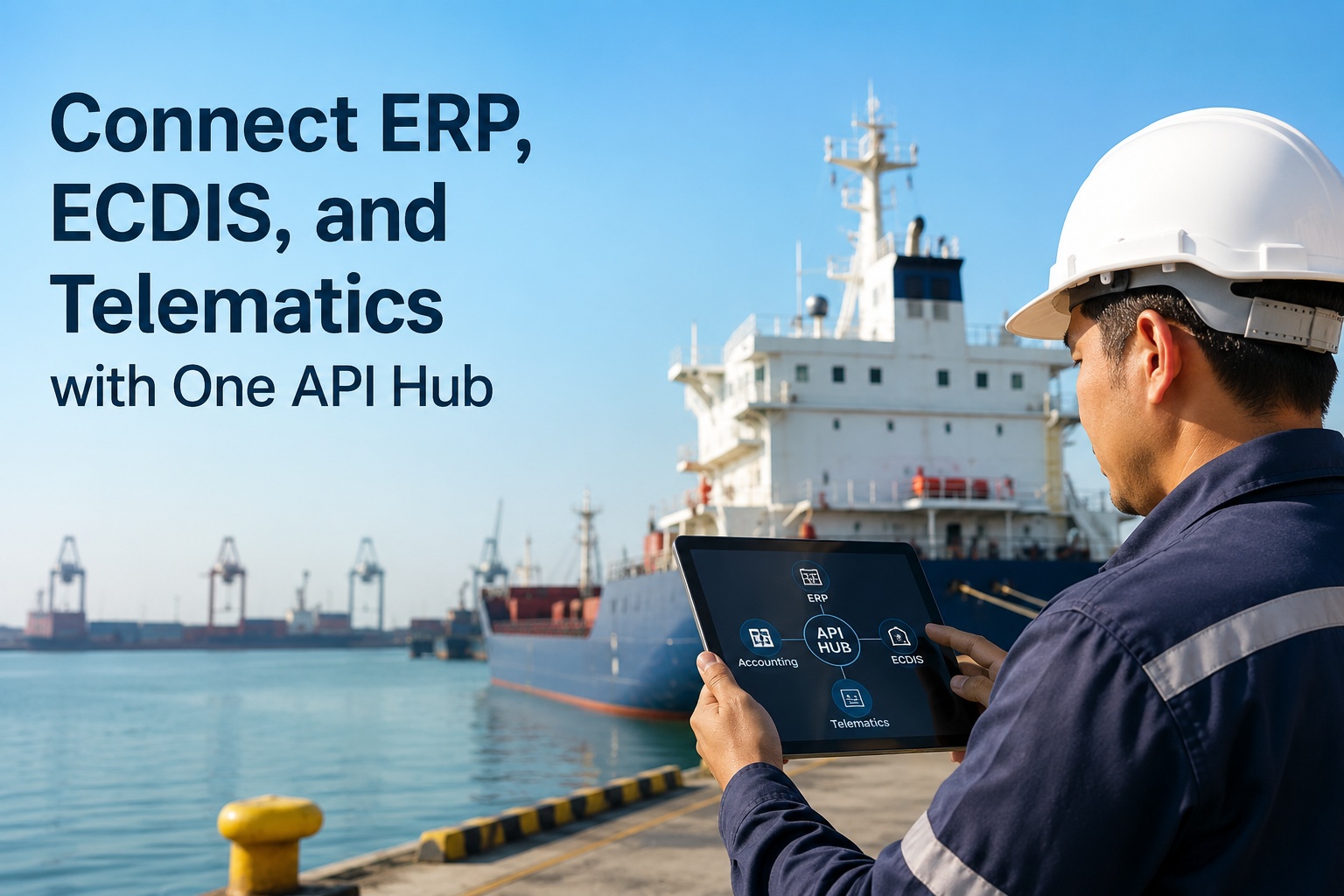
Connect ERP, ECDIS and Telematics With One API Hub
A marine API integration hub that links your ERP, navigation, telematics, accounting and inspection systems through prebuilt connectors and an open developer API — so data flows automatically between them, and your team stops being the integration layer.
ERP
ECDIS
Telematics
Accounting
HUB
The Cost of Systems That Do Not Talk
When systems cannot exchange data, the team is forced to become the connection, spending time on manual data entry that is inefficient, costly and prone to error. This is the everyday reality of the disconnected fleet, and its costs are larger than they look because they are spread across every department and every day.
Duplicate data entry
The same figures — a purchase order, a fuel reading, a crew record — typed into two or three systems by hand, multiplying work and inviting transcription errors every time.
Data silos and blind spots
Each system holds part of the picture and none holds all of it, so no one has a single, trustworthy view of the fleet and decisions rest on data that is partial or out of date.
Reconciliation overhead
Staff spend hours matching figures between systems that should already agree — telematics against maintenance logs, invoices against purchase orders — work that adds cost but no value.
Slow, fragmented reporting
Pulling a fleet-wide report means gathering exports from several tools and stitching them together, so the report is late, laborious and stale by the time it is finished.
The common thread is that the fleet's data exists but cannot move, and the people become the movers. A marine API integration hub replaces that human bridging with automatic data flow, and the effect compounds: every connection made is manual work removed permanently, not just this week. To see how much re-keying and reconciliation an integration hub removes from your operation, start a free trial or book a demo.
The Systems It Connects
The hub links the platforms a fleet already runs, through prebuilt connectors where they exist and the open API where they do not. These are the connections fleets most often need.
ERP and accounting
The most common integration of all: linking to platforms such as SAP, Oracle NetSuite, Microsoft Dynamics and Xero to automate the flow of purchase orders, invoices and financial data, so procurement and finance stop double-keying and figures reconcile themselves.
Navigation and ECDIS
Voyage and navigation data brought together with the rest of the operational picture, so passage and voyage information can enrich performance, compliance and reporting rather than sitting isolated on the bridge system.
Telematics, IoT and AIS
Data feeds from onboard sensors, machinery control systems, telematics and AIS providers received automatically, laying the groundwork for real-time monitoring and predictive analytics instead of manual readings copied from screens.
HR, payroll and crew systems
Crew master data synchronised with the central HR or payroll system, so employee records stay consistent across platforms and no one manages two separate sets of the same data.
Third-party data services
Weather routing services, bunker price indexes and port information databases fed straight into voyage and performance management, enriching decisions with external data without manual lookup and entry.
Custom systems via the open API
Anything without a prebuilt connector links through the open developer API and webhooks — bespoke tools, legacy systems and in-house apps — so the hub adapts to the systems you rely on today and stays ready for the ones you add tomorrow.
Bridge new platforms to legacy systems without replacing them
Fragmented legacy systems are the norm in maritime, and ripping them out is rarely realistic. An API hub acts as the middleware that connects new platforms to existing infrastructure — so you modernise the flow of data without a full system replacement.
How the API and Webhooks Work
Under the connectors sits a straightforward, standards-based integration model. Understanding its two directions — pulling data in and pushing events out — is enough to see how the whole hub behaves.
PULL
REST API — request and retrieve
A RESTful developer API lets your systems request data on demand — work orders, inspection findings, vessel records, maintenance status — and retrieve it in a clean, structured format. Request-and-response logic for maintenance, billing and operational events means another system can ask the hub for exactly the data it needs, exactly when it needs it, without anyone exporting a file.
PUSH
Webhooks — subscribe and react
Where the API is pulled, webhooks push. Your systems subscribe to events — an inspection completed, a finding raised, a threshold crossed — and the hub notifies them the moment it happens, so downstream systems react in real time instead of polling for changes. This is what turns a set of connected systems into a live, event-driven operation rather than a batch of nightly file transfers.
Because the API follows the RESTful standard with token-based authentication, developers get what they need to build confidently: clear documentation, predictable behaviour, cross-vendor compatibility, and a way to test integrations safely before they go live. The two-way nature matters too — data does not just flow out of your other systems into the hub, it can flow back, so each platform stays current with the others. To put the developer API and webhooks to work connecting your systems, start a free trial or book a demo.
Secure by Design
Connecting systems must not mean opening them up, so the hub is built to exchange data safely rather than creating new ways in. Security is a design principle of the integration, not an afterthought bolted on.
Token-based authentication
Access is controlled through modern token-based authentication, so every system connecting to the hub proves who it is and is granted only the access it should have.
No new attack surface
Secure APIs let telemetry sources, operational systems and financial platforms exchange data safely without creating new points of exposure, so connectivity does not come at the cost of security.
Scoped, controlled access
Each integration is granted access only to the data it needs, so a connector for accounting sees financial data and a telematics feed sees operational data, nothing more.
Test before you go live
A safe testing path lets integrations be validated before they touch live data, so connections are proven correct before they carry real operational and financial information.
What Changes When Systems Connect
The payoff of an integration hub is not abstract — it shows up as time returned, errors removed and decisions made on better data. When the systems finally share data automatically, the whole operation runs differently.
A single source of truth
Data from every system flows into one connected picture, giving fleet managers real-time visibility and reporting across the whole operation instead of a patchwork of exports that never quite agree.
Administrative time given back
Automating the flow between systems removes the manual re-entry that consumes hours every day — in one integration case, connecting the ERP directly to operational data cut administrative data-entry time by around eighty per cent.
Faster procurement and finance
Integrated procurement and financial data streamlines purchasing and reconciliation, with integrated procurement systems shown to cut purchasing cycle times by around fifteen to twenty-five per cent while improving transparency.
The groundwork for predictive analytics
With sensor, telematics and maintenance data flowing together automatically, the fleet has the connected data foundation that real-time monitoring and predictive maintenance depend on.
The larger shift is competitive. Fleets that embrace connectivity run leaner, smarter and faster, while those that stay siloed are left with higher costs and slower decisions, and the gap widens as data volumes grow. A marine API integration hub is how a fleet moves from the second group to the first — not by replacing the systems it already depends on, but by finally connecting them into one ecosystem where data moves on its own. To connect your ERP, navigation, telematics, accounting and inspection systems through one hub and turn your fleet's scattered data into a single connected operation, start a free trial or book a demo.
Frequently Asked Questions
What is a marine API integration hub?
It is a platform that connects the separate software systems a fleet runs — ERP, navigation and ECDIS, telematics and IoT sensors, accounting, HR and inspection tools — so data flows between them automatically instead of being re-keyed by hand. It works through prebuilt connectors for common systems and an open developer API with webhooks for everything else, acting as the central point through which your systems exchange data. The result is a single connected operation with one source of truth, rather than a collection of tools that each hold part of the picture and none of the whole.
Which systems can it connect to?
The common integrations are ERP and accounting platforms such as SAP, Oracle NetSuite, Microsoft Dynamics and Xero for purchase orders, invoices and financial data; navigation and ECDIS for voyage data; telematics, onboard IoT sensors and AIS for operational readings; HR and payroll systems for crew master data; and third-party services like weather routing, bunker price indexes and port databases. Anything without a prebuilt connector — bespoke tools, legacy systems or in-house apps — links through the open developer API and webhooks, so the hub adapts to the specific mix of systems your fleet already relies on.
Do I have to replace my existing systems?
No. An integration hub is specifically designed to avoid that. Fragmented legacy systems are the norm in maritime, and full replacement is rarely realistic, so the hub acts as middleware that connects new platforms to your existing infrastructure without ripping anything out. You keep the ERP, accounting package and onboard systems you already run, and the hub connects them so data flows between them. This lets you modernise how your data moves — and add new tools over time — while protecting the investment in the systems your fleet already depends on.
What is the difference between the REST API and webhooks?
They handle the two directions of data flow. The REST API is pull-based: your systems request data from the hub on demand — work orders, findings, vessel records — and retrieve it in a structured format when they need it. Webhooks are push-based: your systems subscribe to events such as an inspection being completed or a threshold being crossed, and the hub notifies them the instant it happens, so downstream systems react in real time rather than repeatedly polling for changes. Used together, they let integrations both fetch data when required and respond immediately to events as they occur.
Is connecting systems through an API secure?
Yes, when the integration is built for it. The hub uses token-based authentication so every connecting system proves its identity and receives only the access it should have, and secure APIs let systems exchange data without creating new points of exposure. Each integration is scoped to the data it needs — an accounting connector sees financial data, a telematics feed sees operational data — and integrations can be validated in a safe testing path before they touch live information. Security is treated as a design principle of the integration rather than something added afterward, so connectivity does not come at the cost of exposure.
What results can a fleet expect from integration?
The main gains are a single source of truth across the fleet, large reductions in manual data entry, faster procurement and finance, and the data foundation for predictive analytics. Removing manual re-entry has cut administrative data-entry time by around eighty per cent in one integration case, and integrated procurement has been shown to reduce purchasing cycle times by roughly fifteen to twenty-five per cent while improving transparency. Beyond the numbers, connected fleets make faster decisions on better data and run more efficiently than siloed ones — a competitive gap that widens as the volume of fleet data keeps growing.
Stop Being the Integration Layer
Connect your ERP, navigation, telematics, accounting, HR and inspection systems through one marine API integration hub — prebuilt connectors where you need them, an open developer API and webhooks where you do not, and security built in throughout. Turn your fleet's scattered, siloed data into one connected operation with a single source of truth, and give your team back the hours they spend moving data by hand.