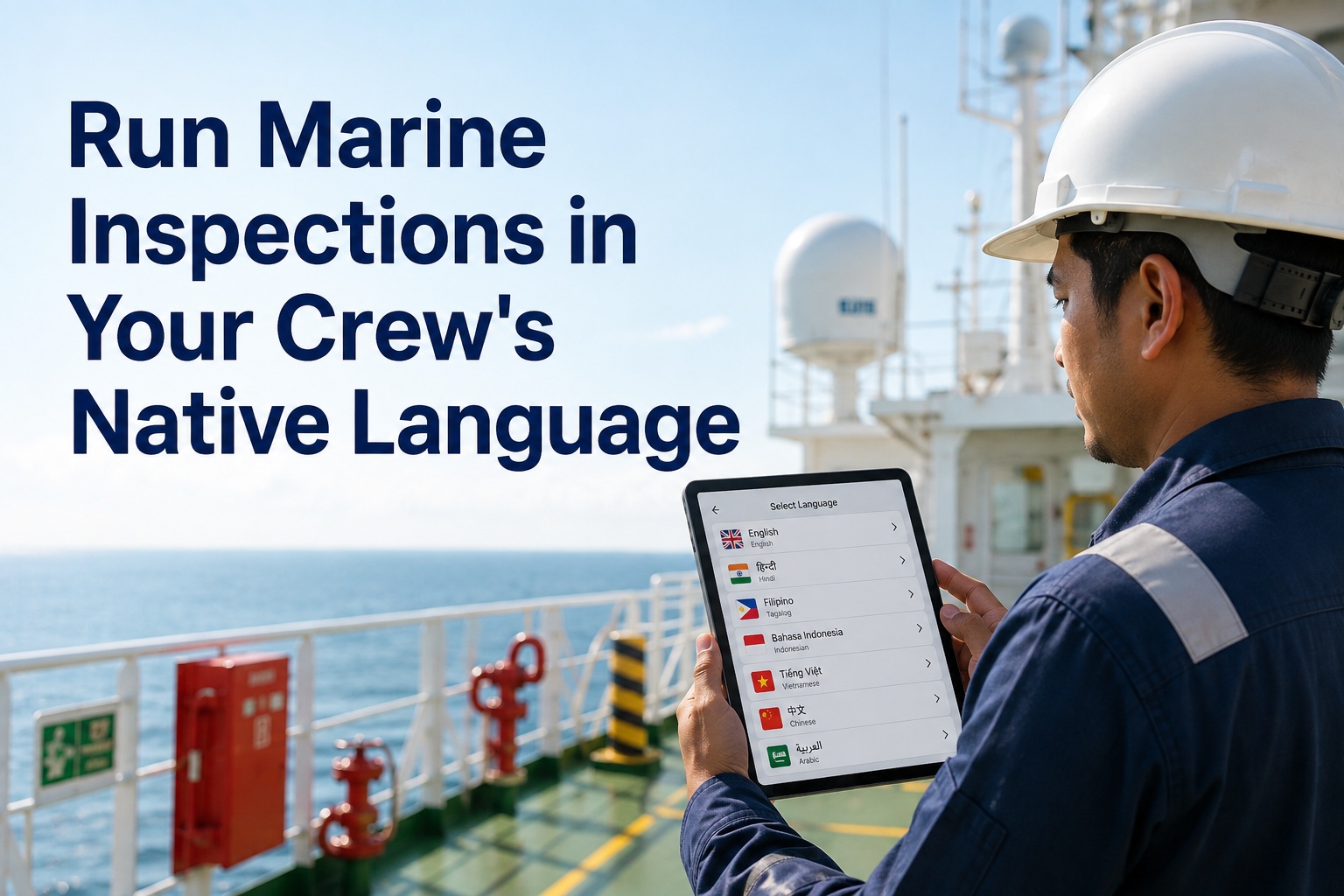
Walk onto almost any merchant ship today and you will find a crew that does not share a first language. A Filipino captain, an Indian chief engineer, a Ukrainian deck officer and a Chinese rating can all be aboard the same vessel, and the working language that binds them — Maritime English — is a second, third or fourth language for most of them, learned to the minimum standard needed to work. That arrangement holds up in routine operations. It frays under pressure, in an emergency, over a failing radio, or when a safety procedure written in dense English has to be understood exactly and acted on immediately. Miscommunication is one of the leading causes of collisions, groundings and spills, and in one investigated case a crew member entered a cargo tank and died of vapour exposure, after which the inquiry recommended translating the safety management system into languages every crew member could actually understand. This is the gap multi-language marine software closes. When a seafarer can run an inspection, read a checklist, log a finding and follow a procedure in their own native language rather than decoding it from unfamiliar English, comprehension rises, errors fall, and the record of the work is both faster to produce and more trustworthy. This page explains why native-language software matters for a multinational crew, how multi-language inspection software works, the breadth of languages it supports, and the safety and quality gains that follow. To run inspections in your crew's native language across your fleet, start a free trial or book a demo.
REPORTS & SYSTEM · LOCALIZATION
Run Marine Inspections in Your Crew's Native Language
Multi-language marine software that lets seafarers run inspections, follow checklists and log findings in the language they think in — supporting 20+ languages including Tagalog, Hindi and more, so comprehension rises, errors fall, and the record is trustworthy.
Tagalog
हिन्दी
中文
English
Українська
Español
Bahasa
Русский
Português
Why Native Language Is a Safety Matter
The maritime workforce is one of the most multinational on earth. Around 1.89 million seafarers crew the world fleet, drawn heavily from the Philippines — which supplies close to one in five of all seafarers — along with India, China, Ukraine and Eastern Europe, and many more. Maritime English is the mandated working language under the STCW framework, and it does essential work, but comprehension levels vary widely, and English is a learned second language for the majority. That difference between speaking enough English to work and understanding it perfectly under pressure is where risk lives.
When comprehension fails, safety fails
A seafarer who understands only well-structured English is at a disadvantage the moment communication becomes pressured or confusing — in an emergency, over a poor radio signal, or when a safety-critical procedure must be understood exactly. The consequences are real: in one investigated case a crew member entered a cargo tank and died from vapour exposure, and the investigation recommended translating the safety management system and procedures manual into languages understood by all crew, especially non-English speakers, so safety procedures are comprehended rather than approximated. A procedure that is not fully understood is a procedure that can be followed wrongly.
The lesson the industry keeps relearning is that expecting every seafarer to fully absorb complex English is unrealistic, and that giving them information in their own language is a recognised way to close the comprehension gap. Translation tools and crew systems that work in native languages are named among the practical mitigations for exactly this reason. For inspection and safety work — where a misread checklist item or a misunderstood finding has direct consequences — running the software in the crew's own language is not a convenience feature; it is a safety and quality control. To give your crew inspections and checklists in the language they understand best, start a free trial or book a demo.
How Multi-Language Inspection Software Works
The principle is simple: the same inspection, seen by each user in their own language. What one crew member completes in Tagalog, another reviews in English, and the underlying data stays identical. A few capabilities make that work in practice.
Per-user language selection
Each crew member sets their own interface language, so the whole app — menus, checklists, prompts, buttons — appears in the language they think in, independent of what anyone else on the vessel has chosen.
One dataset, many languages
The inspection template and its data live once, presented in each user's language. A finding entered by one seafarer is readable by a superintendent ashore in theirs, so language never fragments the record — the data underneath is one shared source of truth.
Native-language checklists and findings
Checklist items, guidance and the findings a seafarer writes are all in their language, so nothing critical has to be mentally translated in the moment — the item is understood directly, and the finding is recorded in the words that come naturally.
Consistent across ship and shore
The crew works in their languages aboard; the office reviews and reports in theirs. Because the data is shared and language is just a display layer, ship and shore stay aligned on one record without anyone translating documents by hand.
The same inspection, understood by everyone who touches it
A seafarer completes the check in Tagalog, a superintendent reviews it in English, and the data never changes. Marine Inspection presents one shared record in each user's own language — so comprehension is native at every step and nothing is lost in translation.
Built for the Languages Your Crew Actually Speaks
Coverage matters, because a multilingual feature is only useful if it includes the languages your seafarers actually speak. The software supports more than twenty languages, spanning the nationalities that make up the bulk of the global crewing pool and beyond.
Tagalog
Filipino crews — close to one in five seafarers worldwide
हिन्दी
Hindi, for the large Indian officer and rating pool
中文
Chinese, a major source of officers and ratings
Українська
Ukrainian, for Eastern European crews
Español
Spanish, across Latin American and European crews
Bahasa
Indonesian, a growing crewing nationality
Русский
Russian, widely spoken across many crews
English
The working language, for officers and shore staff
20+ total
And more, covering the full multinational crew
What Native-Language Software Changes
Giving a crew software in their own language is not a cosmetic touch — it changes the quality of the work and the safety of the vessel in ways that show up quickly.
Procedures understood, not approximated
Safety-critical checklists and instructions are comprehended directly rather than decoded from unfamiliar English, closing exactly the comprehension gap that investigations have linked to serious incidents.
Fewer errors and omissions
When a seafarer reads a checklist item in their own language, they are far less likely to misread it, skip it or misjudge what it asks — so inspections are completed correctly and completely.
Faster, more confident completion
Working in a native language removes the constant mental translation that slows crews down and drains focus, so inspections are quicker to complete and the person doing them is more confident in the result.
More trustworthy records
Findings written in the words that come naturally are richer and more accurate than ones squeezed into limited English, giving the office a clearer, more reliable picture of what was actually found aboard.
The deeper effect is inclusion. A multinational crew where every member can do their safety and inspection work in a language they fully understand is a crew where no one is quietly disadvantaged by the working language, where procedures are genuinely followed rather than half-understood, and where the vessel's record reflects what the crew actually knows rather than what they could manage to express in English. That is better for safety, better for compliance, and better for the seafarers themselves. Native-language software is how a fleet turns its linguistic diversity from a source of risk into a workforce that is fully equipped to do its job. To give every seafarer in your fleet inspections and checklists in their own language, start a free trial or book a demo.
Frequently Asked Questions
What is multi-language marine software?
It is inspection and fleet software that presents its interface, checklists and workflows in each user's chosen language, so a multinational crew can each work in their own native language rather than only in English. The same inspection and its data exist once, displayed to each person in their language — so a seafarer might complete a check in Tagalog while a superintendent reviews it in English, with the underlying record identical. For maritime, where crews are drawn from many nationalities and English is a learned second language for most, this closes the comprehension gap that undermines safety and quality when procedures are only available in English.
Why does native-language software matter for safety?
Because comprehension under pressure is a safety issue. Maritime English is the mandated working language, but it is a second language for most seafarers and understanding varies, so a crew member may cope in routine work yet struggle when communication becomes pressured or a safety-critical procedure must be followed exactly. Miscommunication is a leading cause of collisions, groundings and spills, and in one investigated fatality the inquiry recommended translating the safety management system into languages all crew understood. Presenting inspections and procedures in a seafarer's own language means safety-critical information is comprehended directly rather than approximated, reducing the risk of a procedure being followed wrongly.
How many languages does it support?
The software supports more than twenty languages, chosen to cover the nationalities that make up the bulk of the global crewing pool and beyond — including Tagalog for Filipino crews, Hindi for Indian seafarers, Chinese, Ukrainian and other Eastern European languages, Spanish, Indonesian, Russian and more, alongside English as the working language for officers and shore staff. Because the Philippines alone supplies close to one in five seafarers and crews are highly multinational, breadth of coverage matters: the feature is only useful if it includes the languages the crew actually speaks, which is why the supported set spans the major crewing nationalities.
Can crew and office work in different languages on the same inspection?
Yes — that is the core of how it works. The inspection template and its data exist once, and language is simply a display layer on top, so each person sees the same inspection in their own language. A seafarer can complete a checklist in Tagalog and a superintendent ashore can review the identical record in English, with no translation of documents by hand and no divergence in the data. This keeps ship and shore aligned on one shared source of truth while letting everyone read and write in the language they understand best, so language differences never fragment the record.
Does English still work for officers and inspectors?
Yes. English remains fully supported as the working language, so officers, inspectors and shore staff who prefer or require it use the software in English exactly as before. Multi-language support adds native-language options for the crew members who benefit from them without removing or diminishing English — each user simply selects their own language. This means the vessel keeps its English-language working record for compliance and shore review while individual seafarers gain the option to do their part of the work in the language they understand best, with the underlying data shared across all of them.
How does working in a native language improve inspection quality?
In several ways. Checklist items read in a seafarer's own language are far less likely to be misread, skipped or misjudged, so inspections are completed more correctly and completely. Working in a native language removes the constant mental translation that slows crews down and drains focus, making completion faster and the person more confident in the result. And findings written in the words that come naturally are richer and more accurate than ones squeezed into limited English, giving the office a clearer and more reliable picture of what was found. Together these raise both the accuracy of the work and the trustworthiness of the record it produces.
Give Every Seafarer Their Own Language
Marine Inspection runs in 20+ languages including Tagalog, Hindi, Chinese and more, so every member of a multinational crew can complete inspections, follow checklists and log findings in the language they think in — while ship and shore stay aligned on one shared record. Turn your fleet's linguistic diversity from a source of risk into a crew fully equipped to work safely and accurately.