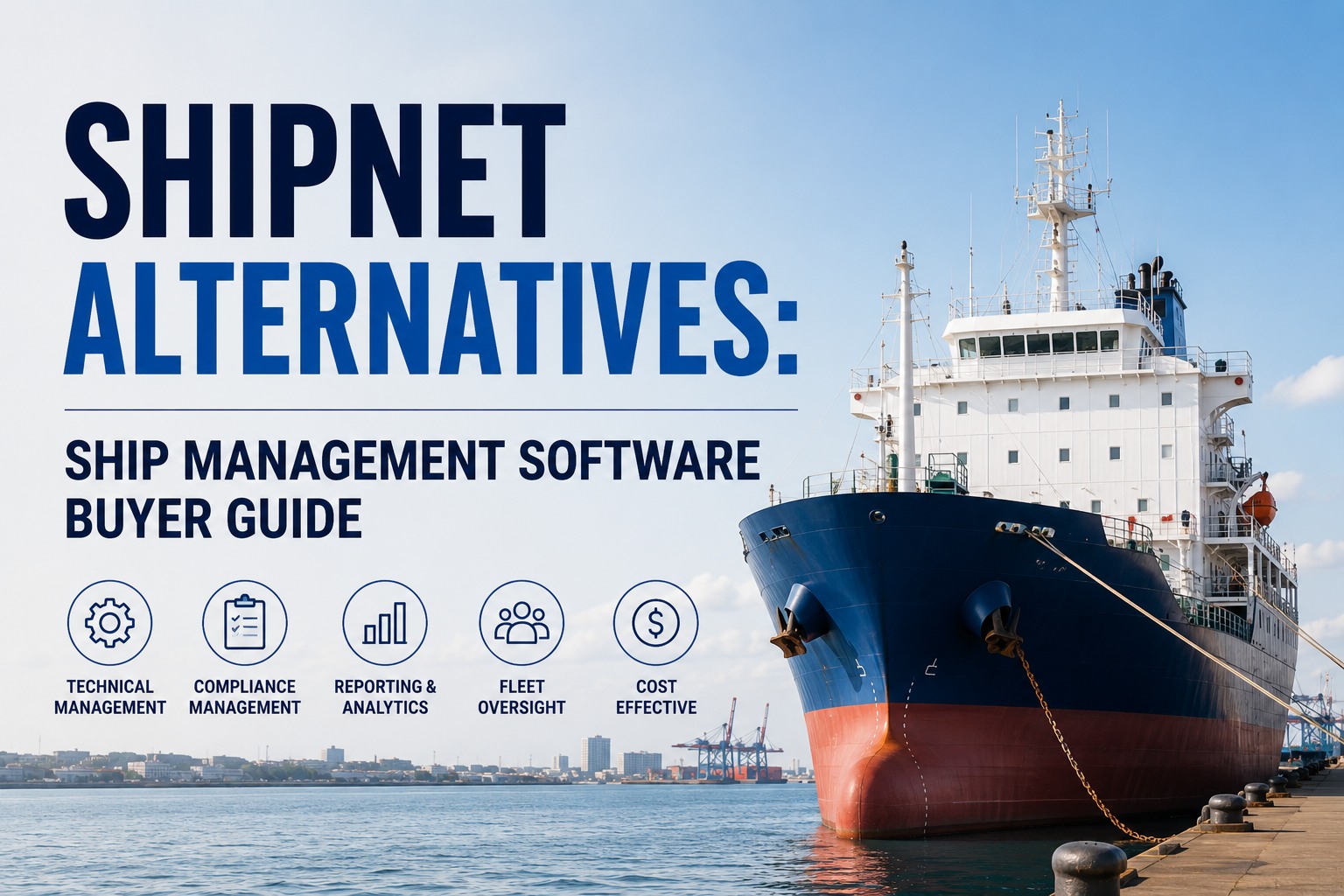
ShipNet is the most commercially weighted platform in this category, and that single characteristic should shape your entire evaluation. Founded in 1991 and headquartered in Oslo, the company serves more than 150 businesses across 31 countries, and Shipnet ONE brings commercial operations, technical management, safety, procurement, analytics and financial control into one ecosystem. Maritime accounting sits at the core of the product rather than at its edge: multi-currency handling built for complex ownership structures, intercompany transactions, fleet-level reporting and invoice capture, with commercial voyage management wired directly into procurement and the ledger. The Technical module is type-approved by ClassNK and DNV, supporting UMS notations and the Enhanced Survey Programme, so this is not a business system with a token maintenance bolt-on. But the centre of gravity matters. ShipNet is a business platform that includes technical management, not a technical platform that grew business functions, and that distinction determines whether it is the right answer for your fleet or an expensive way to solve an engine room problem. Start a free trial of Marine Inspection and see what a purpose-built technical platform looks like beside it.

Shipnet at a Glance
1991
Founded, Oslo
150+
Businesses served
31
Countries
ClassNK, DNV
Technical type approvals
Cloud or on-prem
Deployment options
Positioned for medium to large shipping and logistics organisations, with a higher cost tier than entry-level platforms and a configuration effort that assumes real change management capacity.

Which Department Is Actually Buying?

Maritime ERP evaluations fail most often because four departments want four different things from the same purchase order. Find the role driving your process below and read the honest answer rather than the pitch. Book a Marine Inspection demo if the technical or HSE lens describes your situation, and compare a purpose-built platform against the suite.

The Finance Director
"Can one system carry our accounting, ownership structures and fleet reporting?"
This is ShipNet's strongest ground. Accounting has been core to the platform for decades, with multi-currency handling designed around complex ownership structures and intercompany transactions, fleet-level reporting, and invoice capture reducing manual processing. Few technical platforms attempt this and none match it. If finance is driving the purchase, the suite has a genuine advantage.
The Commercial Director
"Can voyage execution connect to procurement and the ledger without re-keying?"
Also strong ground. Commercial voyage management connects directly to financial and operational data, cargo evaluation runs on desktop and mobile, and a 2025 integration with Procureship added automated quotations, a supplier recommendation engine and AI-assisted invoice verification into the procurement workflow. End-to-end voyage through to invoicing is the product's design intent.
The Technical Director
"Will my chief engineers actually close jobs in this at 03:00 in a vibrating engine room?"
Verify carefully. The Technical module holds real credentials with ClassNK and DNV type approval, UMS notation support and Enhanced Survey Programme handling. The open question is execution architecture rather than capability: where the maintenance workflow physically happens for a crew member, how much works offline, and whether closing a job requires a desktop in the ship's office.
The HSE Manager
"Does inspection and safety work get captured at the point of work?"
Verify carefully. Safety automation and inspection tooling exist within the ecosystem, and the vendor positions them for reducing administrative burden. Test whether internal inspections, near-miss reporting and defect capture happen on the device the crew already carries, or get reconstructed at the end of a watch, because that gap is what shows up in evidence quality.

What the Type Approvals Actually Cover

Technical credentials get quoted in sales conversations without much explanation of what they mean for your fleet. Here is what each one is and what it does not do.

ClassNK and DNV Type Approval
The Technical module has been assessed at product level against two societies' requirements. This is a real credential and a useful shortlist filter.
What it does not doType approval does not approve your fleet. Class societies still approve the owner's maintenance system and conduct an initial survey on your vessels.
UMS Notation Support
Unattended machinery space notations carry specific alarm, monitoring and periodic-inspection obligations, and the module is built to support that regime rather than treating it as a generic asset.
What to confirmWhether your specific notation and society combination is covered, and how the required records are produced during survey.
Enhanced Survey Programme
ESP is mandatory for bulk carriers and oil tankers under IACS unified requirements, and platform-level support means the close-up survey and thickness measurement regime is modelled rather than improvised.
What to confirmWhether your machinery survey regime already supports the arrangement you are assuming, since that is a class question rather than a software one.

Capability Comparison: Business-Led ERP Against Technical-Led PMS

These platforms are built from opposite ends of the same problem. The comparison below is about which end your fleet needs, and the final column settles each line inside a demo rather than a datasheet. Schedule a walkthrough and run the tests against your own vessel data.

Table 1: Business-Led Maritime ERP Compared With Technical-Led Cloud PMS
Line Business-Led ERP Pattern Technical-Led Cloud PMS Pattern Test in the Demo
Centre of gravity Accounting, voyage and commercial control, with technical management as one connected arm Maintenance, inspection and compliance evidence as the entire product Ask which department the last three product releases were built for
Financial capability Multi-currency accounting for complex ownership structures, intercompany transactions and fleet-level reporting None; finance stays in your existing accounting platform with data exchanged by integration Map which system owns the ledger, and how maintenance cost reaches it
Commercial capability Voyage management and cargo evaluation connected through to procurement and invoicing None; chartering and voyage stay in separate systems List the commercial workflows you would genuinely run in year one
Class credentials Technical module type-approved by ClassNK and DNV, with UMS notation and ESP support Class-neutral, with certificate windows and survey due dates native to the record Confirm acceptance with each society in your fleet, whichever you pick
Crew working model Web and mobile access across the ecosystem; verify how much of the maintenance workflow completes on a device Every core workflow native to phone or tablet, including create, edit and submit offline Airplane mode, close a job with photos, reconnect and watch the sync resolve
Deployment Cloud or on-premise, the latter carrying servers, backup systems and dedicated IT for maintenance Multi-tenant cloud only, no server, no client install, no version pinned to a vessel Ask what the on-premise option costs across a full hardware refresh cycle
Configuration model Workflows configurable around your own processes rather than a fixed structure, which requires effort to tailor Opinionated defaults with pre-built equipment templates, configured rather than built Ask how many consulting days the last comparable customer needed
Procurement Full logistical control with supplier, warehouse and consolidated shipment handling, plus e-procurement integration Stock levels, thresholds, requisition and reorder; heavy procurement via integration Trace your actual requisition-to-purchase-order chain end to end
Time to first value Enterprise ERP timeline with customisation, change management and training as named dependencies Roughly 6 to 12 weeks, and 6 to 10 weeks for five to eight vessels with usable records Request a phased plan with named milestones, not an average timeline
2026 EVALUATION REALITY
The regulatory floor is platform-independent. ISM Code Element 10 requires every company holding a Document of Compliance to run a documented maintenance system, and SOLAS Chapter IX makes ISM mandatory for SOLAS-certified ships, so passenger ships, cargo ships of 500 GT and above and mobile offshore drilling units are in scope whichever software they run. IACS formalised PMS requirements in 2001, and Bureau Veritas, DNV, Lloyd's Register and ABS approve owners' systems and conduct the initial survey. Type approval is a product credential, not a fleet exemption. Published pricing does not exist for this tier. One software directory estimates a monthly band running from around a thousand dollars to tens of thousands depending on fleet size and modules, which is an aggregator estimate rather than a vendor rate card — treat any number you have not received in writing as a placeholder.
If the Technical Lens Is Driving Your Purchase, Compare Both Ends
Equipment registers, interval and running-hour triggers, defect-to-work-order closure, spares, certificate windows and class survey dates — built for chief engineers and superintendents rather than adapted from a business suite, with true offline capture on any device.

Total Cost of a Business-Wide Platform

A business-wide ERP carries cost lines that a technical platform simply does not have, and most of them sit outside the licence. Market analysis puts unlisted items at 20 to 40 percent of first-year total cost of ownership when they are not surfaced before signature, and enterprise implementations commonly add 20 to 30 percent in professional services. Start a free trial to see per-vessel pricing applied to your fleet without a custom-quote cycle.

Table 2: Cost Lines, Typical Patterns and the Question That Surfaces Each
Cost Line Business-Led ERP Pattern Technical-Led SaaS Pattern Put This in Writing
Customisation Workflows configured to your processes, which is a strength that consumes consulting days Opinionated defaults with equipment templates, configured in hours not weeks Consulting days quoted for go-live, and the day rate beyond that
Change management A named dependency across finance, commercial, technical and HSE teams simultaneously Scoped to technical and HSE users only Which departments must change process, and who owns that internally
On-premise infrastructure Servers, backup systems and dedicated IT staff for maintenance where that option is chosen None, with hosting, backup and patching held by the vendor Full cost across one hardware refresh cycle, if choosing on-premise
Chart of accounts mapping A distinct workstream where the platform carries the ledger Not applicable; finance stays where it is Who performs the mapping, and how long it takes
Module scope Commercial, financial, technical, safety, procurement and analytics licensed across the suite Defined technical module set at a published price point Itemised price per module, and the cost of dropping one at renewal
Crew turnover Per-user training repeated as crews rotate every few months Role-based onboarding and in-product guidance for new joiners Retraining cost for a full crew change on a single vessel
Contract exposure Custom terms with uplift at renegotiation and early termination provisions Annual or monthly terms at published rates Contractual cap on annual increases, and the exit data export path

Where Your Fleet Lands on the Spectrum

The honest verdict changes with scale and with how many departments genuinely share one system. Find your zone, then test the conclusion rather than accepting it. Book a walkthrough and pressure-test whichever answer describes you.
Under 15 vessels
Technical-Led Wins
At this scale the finance function usually runs on an established accounting package that nobody is willing to replace, and the commercial side may be a handful of people or outsourced entirely. Buying a business-wide ERP to fix maintenance and inspection means funding two departments' worth of capability you will not use, and absorbing a customisation and change-management burden that a lean team cannot carry. A purpose-built technical platform deploys in six to ten weeks at published per-vessel pricing.
15 to 60 vessels
Genuinely Contested
This is where the decision is real. If finance, commercial, technical and procurement would all move onto one system and stay there, the integration argument is strong and a business-led suite earns its cost. If two of those four would keep their existing tools, you are paying for a shared source of truth that is not actually shared. Count the departments that will genuinely migrate, in writing, before shortlisting.
60+ vessels
Business-Led Often Wins
At this scale the cost of reconciling technical, commercial and financial data across separate platforms starts to exceed the cost of a suite, and the accounting complexity — multiple ownership structures, intercompany flows, fleet-level consolidation — is exactly what a business-led platform was designed for. The remaining question is narrower: whether crew execution on the technical side is strong enough, or whether a mobile-first layer belongs alongside it.

Frequently Asked Questions

What is Shipnet ONE and how does it differ from the older ShipNet modules?
Shipnet ONE is the unified platform bringing the company's products, tools and applications into one ecosystem covering commercial operations, technical management, safety, procurement, analytics, financial control, dry docking and document handling. Older documentation describes the product as a set of separate modules including operations, liner management, finance, technical management, procurement and disbursement. Independent reviewers have noted that some longer-standing commercial modules carry modernisation debt, so during evaluation ask specifically which parts of the ecosystem you would be licensed on and what their current architecture is, rather than accepting a platform-level description.
What are the main alternatives to ShipNet in 2026?
Alternatives group into tiers rather than a ranked list. Full maritime ERP suites integrate technical, commercial, crewing and financial management on one data model, and compete with ShipNet directly on its own ground. Established maritime PMS specialists offer deep maintenance and procurement without the commercial and financial layers. Modern cloud PMS platforms including Marine Inspection are mobile-first and technical-led with published pricing and deployment in weeks. Generic industrial CMMS products suit shore facilities and shipyards but lack Continuous Machinery Survey logic and ship-to-shore offline sync. Choose the tier by which department is driving the purchase, then compare products inside it.
Is ShipNet suitable for a small fleet?
It is positioned for medium to large shipping and logistics organisations, and independent analysis places it in a higher cost tier than entry-level platforms with a customisation effort that assumes real change-management capacity. That does not make it unusable at smaller scale, but the value case depends entirely on how many departments genuinely consolidate onto it. A ten-vessel operator moving finance, commercial, technical and procurement onto one system gets the integration benefit. A ten-vessel operator whose accounting stays put and whose commercial function is two people is buying breadth it will not reach.
Does the ClassNK and DNV type approval mean our vessels are automatically compliant?
No. Type approval confirms the software has been assessed at product level against those societies' requirements, which is a genuine credential and a useful shortlist filter. Your own maintenance system still requires approval: class societies approve the owner's system and conduct an initial survey on your vessels, and what they assess is whether adequate maintenance was carried out at the right interval by competent people with the right parts, and whether the condition found was recorded. Confirm acceptance for every society and flag in your fleet regardless of which platform you select.
Should we replace ShipNet or add a technical layer alongside it?
Adding rather than replacing is a legitimate answer and often the cheaper one. If finance and commercial are working well on the platform but crews are recording maintenance on paper and entering it later, the problem is execution architecture rather than the ERP, and a mobile-first technical layer feeding the suite by integration solves it without disturbing the ledger. Replace outright only when several departments would move together. Whichever route you take, establish the data export path in open format and the integration terms in writing before signature.
Solve the Engine Room Problem With an Engine Room Tool
Whether you replace the suite or run alongside it, Marine Inspection gives chief engineers and superintendents every core workflow on the device they already carry — offline capture, sub-minute defect logging, photo evidence, instant sync, and class-neutral certificate and survey tracking across every society in your fleet.