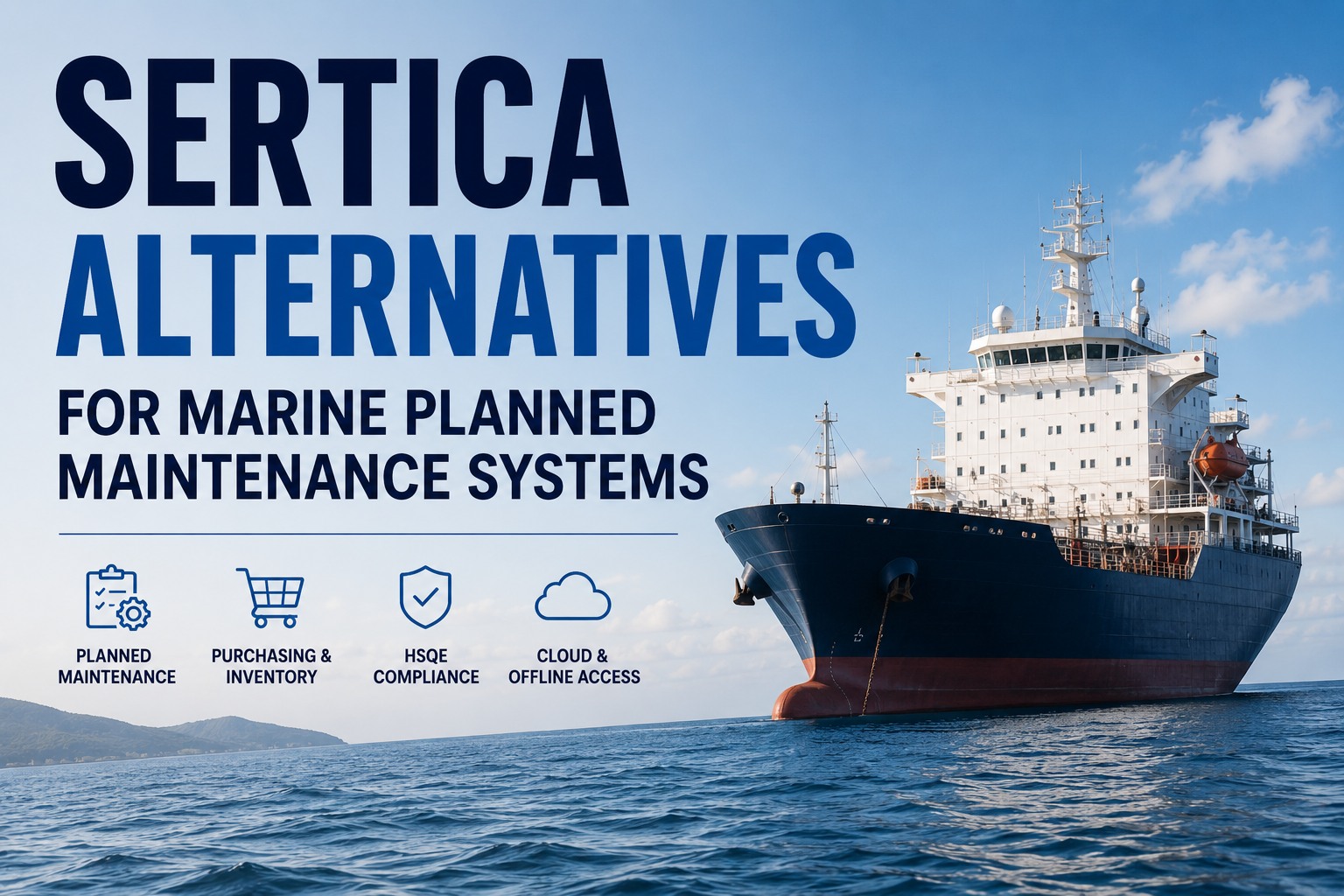
SERTICA deserves a more careful comparison than most fleet software incumbents, because it is not a legacy system limping toward the cloud. Presented in 1991 by the Danish engineering company Logimatic and acquired by the class society RINA in 2021 with more than 1,400 vessels installed, it is class-type approved by DNV and Bureau Veritas, spans maintenance, procurement, HSQE, crewing, performance, logbook and project management, and ships genuine offline mobile apps for inspections and approvals. Its SIRE 2.0 work is serious: observations link directly to SIRE 2.0 questions through a cause analysis tool, the OCIMF questionnaire converts into an internal pre-SIRE audit, and the Inspection App runs offline on iOS and Android with ratings, remarks and photo documentation against a pre-planned route. Operators such as Hapag-Lloyd, Scandlines and Tarbit Shipping run it in production. So the honest question is not whether SERTICA is capable. It is narrower and more useful: does the app layer reach far enough into your crew's daily work, does the suite breadth match what you actually operate, and does a class-society-owned platform sit comfortably with your fleet's class mix. Start a free trial of Marine Inspection and put a mobile-first platform next to it on your own equipment register.
An Honest Capability Scorecard
A comparison that pretends the incumbent is weak wastes your time. Below is where SERTICA is genuinely strong, where it is solid, and where the answer depends entirely on your fleet. Read the evidence line before the rating. Book a Marine Inspection demo to see how the same areas score on a platform built mobile-first from the start.
The App Layer Question
This is the line that separates a system crews use from one they work around, and it is where SERTICA's own positioning is most precise. The apps are described as giving access to selected areas of the system rather than the whole of it, which is a meaningfully different architecture from a platform where every core workflow is native to the device. Map your crew's actual day against both layers. Sign up for Marine Inspection and test the same day against a platform with no layer split.
Capability Comparison: Suite Platform Against Mobile-First PMS
These are the lines where architecture and ownership force a genuine difference rather than a feature-list tie. Use the final column to settle each one inside a demo. Schedule a walkthrough and run the tests against your own vessel data instead of a vendor sandbox.
| Line | Marine Suite Pattern | Mobile-First Cloud PMS Pattern | Test in the Demo |
|---|---|---|---|
| Mobile scope | Dedicated apps covering selected areas — inspections, approvals, jobs and forms — with the wider suite on the full system | Every core workflow native to the device, including create, edit and submit offline | Walk a full chief engineer day and count the times the person leaves the app |
| Functional scope | Maintenance, procurement, HSQE, crewing, performance, logbook, project management and analytics | Maintenance, inspection, defect management, spares and compliance evidence only | Price only the module families you would genuinely operate in year one |
| Vetting and SIRE 2.0 | Deep tanker orientation with cause analysis, questionnaire conversion and OCIMF record comparison | SIRE 2.0 and CVIQ coverage built into the inspection workflow as the primary product | Run a pre-SIRE internal audit end to end and export the evidence pack |
| Class position | Class-type approved by DNV and Bureau Veritas, and owned by a classification society | Class-neutral, with no ownership relationship between vendor and any survey authority | Ask how a vessel classed with a competing society is handled on identical terms |
| Hosting | Vendor-hosted cloud option alongside self-managed deployment, depending on contract | Multi-tenant cloud only, no server, no client install, no version pinned to a vessel | Ask who patches what, and what a version upgrade costs in fleet downtime |
| Time to first value | Suite-platform timeline, commonly 3 to 6 months module by module, longer for full-suite rollouts | Roughly 6 to 12 weeks, and 6 to 10 weeks for five to eight vessels with usable records | Request a phased plan with named milestones, not an average timeline |
| Commercial model | Custom quotation skewing toward enterprise budgets, with services and data conversion priced separately | Published per-vessel or per-user subscription with the module set fixed at signature | Ask for year-one and year-three totals in writing, services included |
| Regulatory coverage | IHM through item certificate handling with analytics templates for Part I and Part III reporting | Certificate windows, survey due dates and audit trails native to the maintenance record | Generate the ISM Element 10 evidence pack live from your own data |
| Integration | Third-party integration and data conversion offered as named professional services | Documented API access, typically inside the subscription | Name your finance and telematics systems and ask for a working reference |
Total Cost Across the Module Families
SERTICA's modular structure makes the entry price reasonable and the third-year picture different, and the services lines — data conversion, third-party integration, training, customer success — are named separately in the vendor's own service catalogue. Market analysis puts unlisted items at 20 to 40 percent of first-year total cost of ownership when they are not surfaced before signature. Start a free trial to see per-vessel pricing applied to your fleet without a custom-quote cycle.
| Cost Line | Suite Platform Pattern | Cloud Subscription Pattern | Put This in Writing |
|---|---|---|---|
| Module families | Maintenance, procurement, HSQE, crewing, performance and project management licensed as separate families with sub-modules inside each | Defined module set at a published price point | Itemised price per family and per sub-module, plus the renewal cost of dropping one |
| Data conversion | Named professional service covering extraction and conversion from the previous system | Standard extract, cleanse, map and validate cycle inside onboarding | Years of job history included, and who owns the cleansing work |
| Third-party integration | Named professional service, typically scoped per connected system | Documented API access, usually inside the subscription | Is integration access included at our tier, or behind an upgrade? |
| Hosting | Vendor cloud hosting available as a priced service alongside self-managed options | Included, with backup and patching held by the vendor | Hosting cost per vessel per year, quoted separately from licences |
| Training and enablement | Training and customer success offered as ongoing engagements | Role-based onboarding and in-product guidance for new joiners | Retraining cost for a full crew change on a single vessel |
| App licensing | Confirm whether inspection, approval and maintenance apps are included or licensed per user | Mobile access included for every licensed user by default | Per-user app cost, and whether every rank onboard is covered |
| Contract exposure | Custom terms skewing toward enterprise budgets with uplift at renegotiation | Annual or monthly terms at published rates | Contractual cap on annual increases |
Three Scenarios, Two Honest Answers Each
The verdict genuinely changes with vessel type and operating model. Find the scenario closest to yours and read both sides before deciding which one describes your fleet. Book a walkthrough and pressure-test whichever answer you land on.