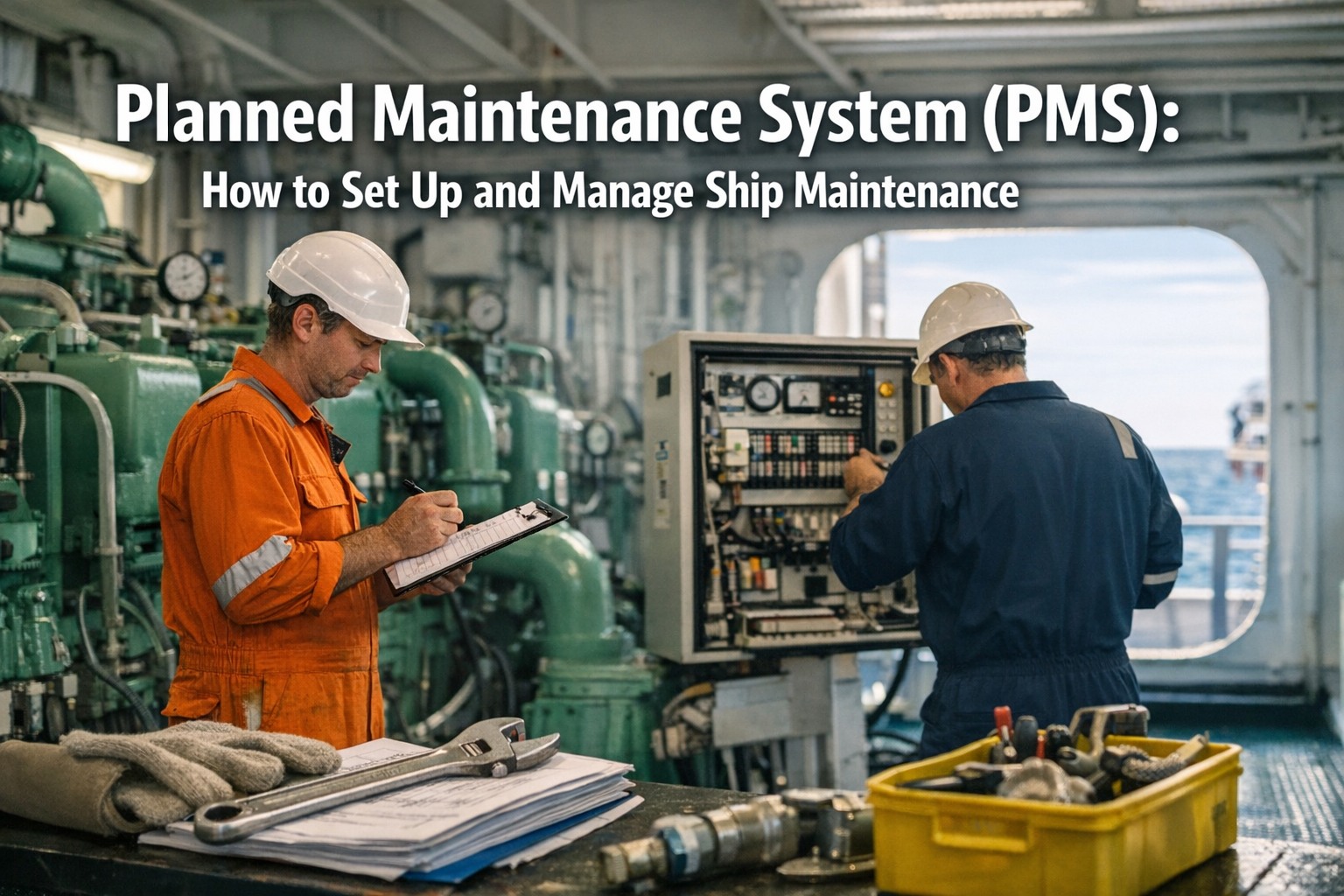
Planned Maintenance System (PMS): How to Set Up and Manage Ship Maintenance
A Planned Maintenance System (PMS) is the operational backbone of every ISM Code-compliant vessel — the structured system that schedules, tracks, records, and verifies every maintenance activity across every piece of equipment on the ship, from main engine cylinder overhauls to fire extinguisher inspections. ISM Code Section 10 requires companies to establish a maintenance system that ensures the ship and its equipment are maintained in conformity with the provisions of relevant rules and regulations and with any additional requirements established by the company — and this system must include inspections at appropriate intervals, reporting of non-conformity with possible cause, and appropriate corrective action. In practice, this means PMS is not optional operational software — it is a regulatory requirement verified during ISM audits, class surveys, flag state inspections, and PSC boardings. A vessel found with a poorly functioning PMS during ISM audit faces non-conformity findings that can escalate to major non-conformity and ultimately threaten the vessel's Safety Management Certificate (SMC). For superintendents and fleet managers, implementing PMS correctly is the single most consequential systems decision in fleet management — a well-structured PMS delivers systematic maintenance that prevents equipment failures, satisfies class survey requirements, provides evidence for PSC inspections, and controls maintenance costs. A poorly structured PMS generates excessive paperwork without preventing failures, creates false compliance documentation, and ultimately costs more than the breakdowns it was supposed to prevent. The difference is in the implementation: equipment hierarchy, maintenance job design, interval calibration, spare parts integration, running hours accuracy, and the feedback loop that adjusts the programme based on actual equipment performance. To see how Marine Inspection provides the complete PMS platform built specifically for maritime operations — from equipment hierarchy to class survey integration, running hours to spare parts — book a Marine Inspection demo.
Why PMS Is Mandatory: The Regulatory Framework
ISM Code Section 10
Companies must establish a maintenance system ensuring ship and equipment conform to relevant rules, include inspections at appropriate intervals, and report/correct non-conformities with root cause analysis.
SOLAS Chapter IX
Makes ISM Code mandatory. Safety Management System (SMS) must include procedures for maintenance of ship and equipment. Verified during ISM audits by flag state or RO.
Class Society Rules
Classification societies (DNV, Lloyd's, BV, ABS, ClassNK) accept PMS as evidence of maintenance compliance during surveys. Class-approved PMS may qualify for extended survey intervals (e.g., Condition-Based Maintenance).
Port State Control
PSC officers review PMS records during inspections. Deficiencies in maintenance records, incomplete work orders, or evidence of deferred maintenance contribute to detention decisions.
The Five Pillars of Effective PMS Implementation
PMS implementation fails or succeeds based on five foundational elements. Skip any pillar and the system produces paperwork without preventing failures. Build all five and the system delivers genuine operational value. Superintendents who book a Marine Inspection demo can see how the platform builds each pillar into a unified fleet management system.
1
Equipment Hierarchy
Every piece of equipment catalogued in a logical tree structure: System → Sub-system → Component → Sub-component. Example: Propulsion System → Main Engine → Cylinder Unit No.1 → Exhaust Valve. Each node carries manufacturer data, model, serial number, class reference, and criticality rating. The hierarchy determines what gets maintained, at what level of detail, and how maintenance rolls up to system-level readiness.
2
Maintenance Job Library
Standardised maintenance jobs defined for each component: what to do, how to do it, what tools and parts are needed, safety precautions, acceptance criteria, and time estimate. Jobs are triggered by calendar interval (e.g., monthly, quarterly, annually), running hours (e.g., every 4,000 hours), or condition (e.g., vibration threshold exceeded). Well-designed jobs include clear pass/fail criteria that make completion verification objective, not subjective.
3
Scheduling & Work Order Management
The system generates work orders based on due dates (calendar or running hours), assigns them to responsible officers, tracks completion status, and records results. Overdue work orders are flagged with escalation to superintendent and fleet manager. Deferral requires documented justification, risk assessment, and approval chain — not just a click. Critical path scheduling ensures safety-critical and class-related maintenance is never deferred without formal review.
4
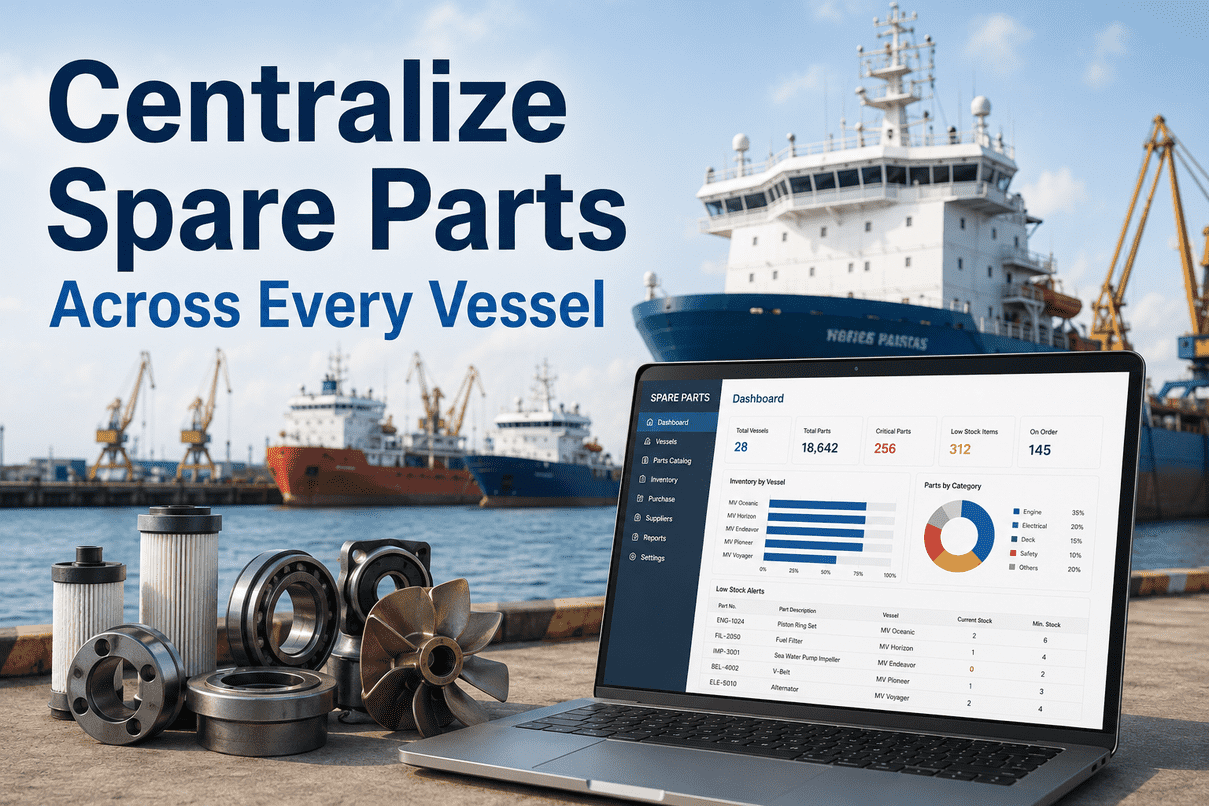
Spare Parts & Inventory Management
Every maintenance job links to the spare parts required for execution. Inventory tracked at vessel level and fleet level. Minimum stock levels trigger reorder alerts. Parts consumption history enables demand forecasting. Without spare parts integration, work orders get generated but cannot be executed — the PMS becomes a list of things that should be done rather than things that are being done.
5
Feedback Loop & Continuous Improvement
Completion data feeds back into the system to adjust intervals, identify recurring failures, and optimise maintenance strategy. If a component consistently fails before its scheduled maintenance interval, the interval is too long. If a component is consistently found in perfect condition at maintenance, the interval may be too short and wasting resources. Condition-based maintenance (CBM) extends this — replacing fixed intervals with data-driven triggers from monitoring sensors.
Equipment Hierarchy: How to Structure It Right
The equipment hierarchy is where most PMS implementations go wrong — either too flat (everything at one level, making it impossible to track component-specific maintenance) or too deep (so many levels that navigation becomes impractical and crew stop using the system). The optimal structure uses 4-5 levels with consistent naming conventions across the fleet.
Valve Seat • Valve Spindle • Turbo Nozzle Ring • Bearing Shell • Seal Ring
Maintenance Job Design: Calendar vs Running Hours vs Condition
Every maintenance job in the PMS is triggered by one of three mechanisms. Understanding when to use each prevents both under-maintenance (failures) and over-maintenance (wasted resources).
Calendar-Based
Triggered by: Fixed time intervals — daily, weekly, monthly, quarterly, semi-annual, annual, 2.5 years, 5 years.
Best for: Equipment affected by time regardless of use (corrosion, rubber degradation, lubricant aging); regulatory inspections with fixed intervals (fire equipment, LSA, navigation); SOLAS-mandated tests (steering gear, emergency systems).
Example: Fire extinguisher annual inspection; lifeboat monthly test; steering gear emergency drill every 3 months; hull coating condition.
Risk: Does not account for actual usage — a standby pump on calendar maintenance may be over-maintained while a continuous-duty pump may be under-maintained.
Best for: Rotating machinery where wear is proportional to operating time — main engine cylinder overhauls, generator inspections, pump overhauls, separator maintenance, compressor valve inspections.
Example: ME exhaust valve overhaul every 8,000 running hours; separator minor overhaul every 4,000 hours; turbocharger inspection every 12,000 hours.
Requirement: Accurate running hour meters on every piece of equipment. Manual entry errors are the most common source of running hour inaccuracy — digital hour meters with automatic PMS integration preferred.
Best for: High-value equipment where condition monitoring is feasible — main engine condition monitoring, stern tube bearing wear-down sensors, generator vibration, separator efficiency samples, HVAC compressor performance.
Example: Main engine overhaul triggered by cylinder pressure deviation rather than fixed running hours; bearing replacement triggered by vibration trend; oil change triggered by TAN analysis.
Advantage: Optimises maintenance timing — neither too early (wasting resources) nor too late (risking failure). Requires sensor infrastructure and data analysis capability.
How Marine Inspection Delivers PMS for Maritime Operations
Most PMS software was designed for land-based industrial maintenance and adapted — often poorly — for maritime use. Marine Inspection is built from the ground up for ship operations, addressing the specific challenges that make maritime PMS different: connectivity constraints at sea, crew rotation (knowledge must be in the system, not in people's heads), multi-vessel fleet management, class survey integration, and the regulatory evidence requirements of ISM, SOLAS, and PSC.
Maritime Equipment Hierarchy
Pre-built templates for common vessel types (bulk carrier, tanker, container, passenger) with system/sub-system/equipment/component structure. Customisable per vessel while maintaining fleet-wide consistency.
Running Hours + Calendar Scheduling
Dual-trigger scheduling combining calendar and running hour intervals. Automatic work order generation. Overdue alerts to vessel, superintendent, and fleet manager. Deferral workflow with approval chain.
Work Order Management
Generate, assign, execute, and close work orders with structured completion data. Photo evidence capture. Pass/fail criteria enforcement. Time and parts recording. History preserved across crew rotations.
Spare Parts Integration
Parts linked to maintenance jobs. Vessel-level inventory with minimum stock alerts. Fleet-wide spare parts database. Consumption tracking enables demand forecasting and budget planning.
Class Survey Alignment
PMS maintenance records serve as evidence for class surveys. Survey due dates integrated with PMS scheduling. Pre-survey preparation workflows ensure equipment is maintained before survey window opens.
Fleet Analytics & KPIs
PMS completion rates, overdue job counts, deferral rates, parts consumption, and cost tracking across the fleet. Superintendent dashboard for multi-vessel oversight. Benchmark vessels against each other.
Maritime PMS Built for Your Fleet
See Marine Inspection's PMS in Action
Book a 30-minute demo. See how the platform manages equipment hierarchy, work orders, spare parts, running hours, class survey integration, and fleet-wide KPIs — purpose-built for maritime operations.
Implementing PMS on a vessel — or migrating from paper-based or legacy digital systems — follows a defined sequence. Rushing implementation produces a system nobody uses; methodical implementation produces a system that becomes operationally indispensable.
Step 1
Equipment Audit & Inventory
Walk the vessel systematically — engine room, deck, bridge, accommodation, safety systems. Document every piece of equipment with manufacturer, model, serial number, location, and criticality. This typically takes 2-4 weeks per vessel and is the foundation of everything that follows. Skip this step and you'll be correcting data for years.
Step 2
Build Equipment Hierarchy
Organise equipment into 4-5 level hierarchy using consistent naming conventions. Align with class society equipment numbering where applicable. Use manufacturer-provided equipment trees where available. Ensure naming is intuitive for crew (not engineering code that requires a decoder).
Step 3
Define Maintenance Jobs
Create maintenance job cards for each component based on: manufacturer's maintenance manual, class society requirements, company experience, and regulatory obligations. Each job specifies what, how, parts needed, tools, safety precautions, time estimate, and acceptance criteria. Start with critical equipment and work outward.
Step 4
Set Intervals & Triggers
Assign calendar intervals, running hour triggers, or condition-based thresholds to each maintenance job. Start with manufacturer recommendations and class requirements as baseline. Conservative intervals initially — better to over-maintain at startup than to discover critical gaps.
Step 5
Load Spare Parts & Link to Jobs
Inventory all spare parts on board. Link each part to the equipment and jobs that consume it. Set minimum stock levels based on consumption rates and supply chain lead times. Establish procurement procedures with approved vendors.
Step 6
Train Crew & Go Live
Train all officers and relevant crew on system use — not just data entry but understanding the purpose, workflow, and reporting. Go live with superintendent support available. Plan for 2-3 month stabilisation period where completion rates, data quality, and crew feedback are actively monitored and addressed.
Step 7
Review, Adjust & Optimise
After 6-12 months, review: Which jobs are consistently finding equipment in perfect condition? (Interval may be too short.) Which equipment fails between scheduled maintenance? (Interval too long or wrong job content.) Which jobs are consistently deferred? (Resource mismatch or unrealistic scheduling.) Adjust intervals, job content, and resource allocation based on actual performance data.
Common PMS Implementation Mistakes
Understanding what goes wrong helps avoid the most expensive implementation errors. Sign up for Marine Inspection with implementation support that addresses these pitfalls systematically.
Copy-Paste from Sister Ship Without Verification
Sister ships have equipment variations (different generators, different pump configurations, different serial numbers). Copying a PMS template without physical verification creates phantom equipment and missing critical items.
Jobs Without Clear Acceptance Criteria
"Inspect main engine" is not a maintenance job — it's a placeholder. Without specific tasks, measurements, and pass/fail criteria, crew mark jobs complete without doing meaningful work and the PMS produces false compliance.
Ignoring Running Hour Accuracy
Running hour-based maintenance only works if running hours are accurate. Manual entry errors, forgotten updates, and incorrect meter readings create scheduling drift that compounds over time. Digital hour meters with PMS integration solve this.
No Deferral Governance
Easy deferral without documentation, risk assessment, and approval creates a culture where maintenance is routinely postponed. ISM auditors and PSC officers look specifically at deferral patterns — chronic deferral indicates systemic SMS failure.
Spare Parts Disconnected from PMS
Work orders that generate without checking parts availability produce unexecutable maintenance. Crew defer the job, the deferral compounds, and eventually the equipment fails — all because the PMS didn't check if the seal ring was in the stores.
No Feedback Loop
A PMS that never adjusts its intervals based on actual findings is static documentation, not active maintenance management. Equipment performance data should drive interval optimisation — this is where PMS transitions from record-keeping to genuine maintenance intelligence.
PMS KPIs: What to Measure and Track
What gets measured gets managed. PMS effectiveness requires specific KPIs tracked at vessel and fleet level — giving superintendents visibility into where maintenance discipline is strong and where it needs intervention. Book a Marine Inspection demo to see how the platform automatically calculates and dashboards these KPIs across your fleet.
PMS Performance KPIs
KPI
Definition
Target
What It Reveals
PMS Completion Rate
Percentage of scheduled jobs completed on time within the reporting period
>90%
Overall maintenance discipline; crew workload vs capacity; job scheduling realism
Reactive (breakdown) maintenance as % of total maintenance
<20%
PMS programme maturity; predictive capability
Spare Parts Stock-Out Rate
Percentage of jobs delayed due to unavailable spare parts
<5%
Procurement effectiveness; inventory management
PSC Maintenance Deficiencies
Number of PSC findings related to maintenance during inspection
Zero
Regulatory compliance; PMS evidence quality
Fleet-wide KPI comparison reveals best practices and systemic issues. Individual vessel KPIs drive operational improvement; fleet benchmarking drives strategic decisions.
Conclusion
A Planned Maintenance System is not optional software — it is the ISM Code-mandated operational backbone that ensures every vessel's equipment is maintained in conformity with relevant rules and regulations. Implementation success depends on five foundational pillars: equipment hierarchy (4-5 levels with manufacturer data), maintenance job library (specific tasks with pass/fail criteria), scheduling and work order management (calendar + running hours + condition-based triggers), spare parts integration (linked to jobs with stock alerts), and feedback loop (interval adjustment based on actual performance data). The seven-step implementation process (equipment audit → hierarchy → job design → intervals → spare parts → training → optimisation) typically takes 3-6 months per vessel to reach operational maturity. Common mistakes — copy-paste without verification, vague jobs, inaccurate running hours, no deferral governance, disconnected spare parts, no feedback loop — are preventable with methodical implementation. PMS effectiveness is measured through KPIs: completion rate (>90%), critical equipment completion (100%), deferral rate (<10%), unplanned maintenance ratio (<20%), and zero PSC maintenance deficiencies. Marine Inspection provides the purpose-built maritime PMS platform that addresses all five pillars — book a live demo today to see how it transforms maintenance management across your fleet.
Frequently Asked Questions
FAQ 01
Is PMS mandatory on ships?
Yes. ISM Code Section 10 requires companies to establish a maintenance system ensuring ship and equipment comply with relevant rules and regulations. SOLAS Chapter IX makes ISM Code mandatory for all SOLAS-certified vessels. The PMS must include inspections at appropriate intervals, reporting of non-conformity with possible cause, and appropriate corrective action. ISM auditors verify the maintenance system during ISM audits for Document of Compliance (DOC) and Safety Management Certificate (SMC). Class societies accept PMS records as evidence of maintenance compliance during surveys. PSC officers review PMS records during port state inspections — incomplete or poorly maintained PMS contributes to detention decisions.
FAQ 02
What PMS completion rate should vessels target?
Industry standard target for overall PMS completion rate is above 90%. Critical equipment (safety systems, class-required items, propulsion, steering, fire-fighting) should target 100% completion with zero deferrals. Class societies and ISM auditors view completion rates below 80% as indicative of systemic SMS weakness. Deferral rates should be below 10%, with every deferral documented with justification, risk assessment, and approval chain. Unplanned (reactive) maintenance should be below 20% of total maintenance — a fleet averaging above 30% reactive maintenance has a PMS that isn't preventing failures effectively.
FAQ 03
How long does PMS implementation take?
Complete PMS implementation typically takes 3-6 months per vessel to reach operational maturity. Equipment audit and inventory takes 2-4 weeks of intensive vessel walkthrough. Hierarchy building and job definition takes 4-8 weeks (faster with fleet-standard templates). Spare parts loading and linking takes 2-4 weeks. Training and go-live takes 1-2 weeks. Stabilisation period with active support runs 2-3 months. First interval optimisation review at 6-12 months post-implementation. Fleet rollout can be accelerated after the first vessel establishes templates — second and subsequent vessels typically take 40-60% less time if equipment is similar.
FAQ 04
What is the difference between calendar-based and running hours-based maintenance?
Calendar-based maintenance triggers at fixed time intervals regardless of equipment usage — best for equipment affected by time (corrosion, rubber aging), regulatory inspections (fire equipment, LSA), and SOLAS-mandated tests (steering gear, emergency systems). Running hours-based maintenance triggers based on accumulated operating time — best for rotating machinery (engines, generators, pumps, separators, compressors) where wear is proportional to operating time. The most effective PMS uses both: calendar-based for time-dependent items and running hours for usage-dependent items. Condition-based maintenance (CBM) adds a third dimension — triggered by measured equipment condition (vibration, oil analysis, temperature trends) — optimising maintenance timing based on actual rather than assumed degradation.
FAQ 05
Can PMS satisfy class survey requirements?
Yes — classification societies accept well-maintained PMS records as evidence of maintenance compliance during surveys, and class-approved PMS systems may qualify for extended survey intervals or condition-based maintenance (CBM) programmes. DNV, Lloyd's Register, Bureau Veritas, ABS, and ClassNK all have PMS approval or acceptance frameworks. Class-approved PMS requires that the system meets specific standards for job definition, completion recording, and verification capability. During surveys, the class surveyor reviews PMS completion history for relevant equipment as part of the survey evidence. Vessels with class-approved PMS and strong completion records may qualify for Continuous Machinery Survey (CMS) or similar flexible survey arrangements that reduce dry dock requirements.
Book Your Live Demo
The PMS Platform Built for Maritime Operations
30 minutes with our team. See how Marine Inspection delivers equipment hierarchy, work orders, running hours, spare parts, class survey integration, and fleet KPIs — purpose-built for superintendents and fleet managers who need PMS that actually prevents failures, satisfies regulators, and controls costs.