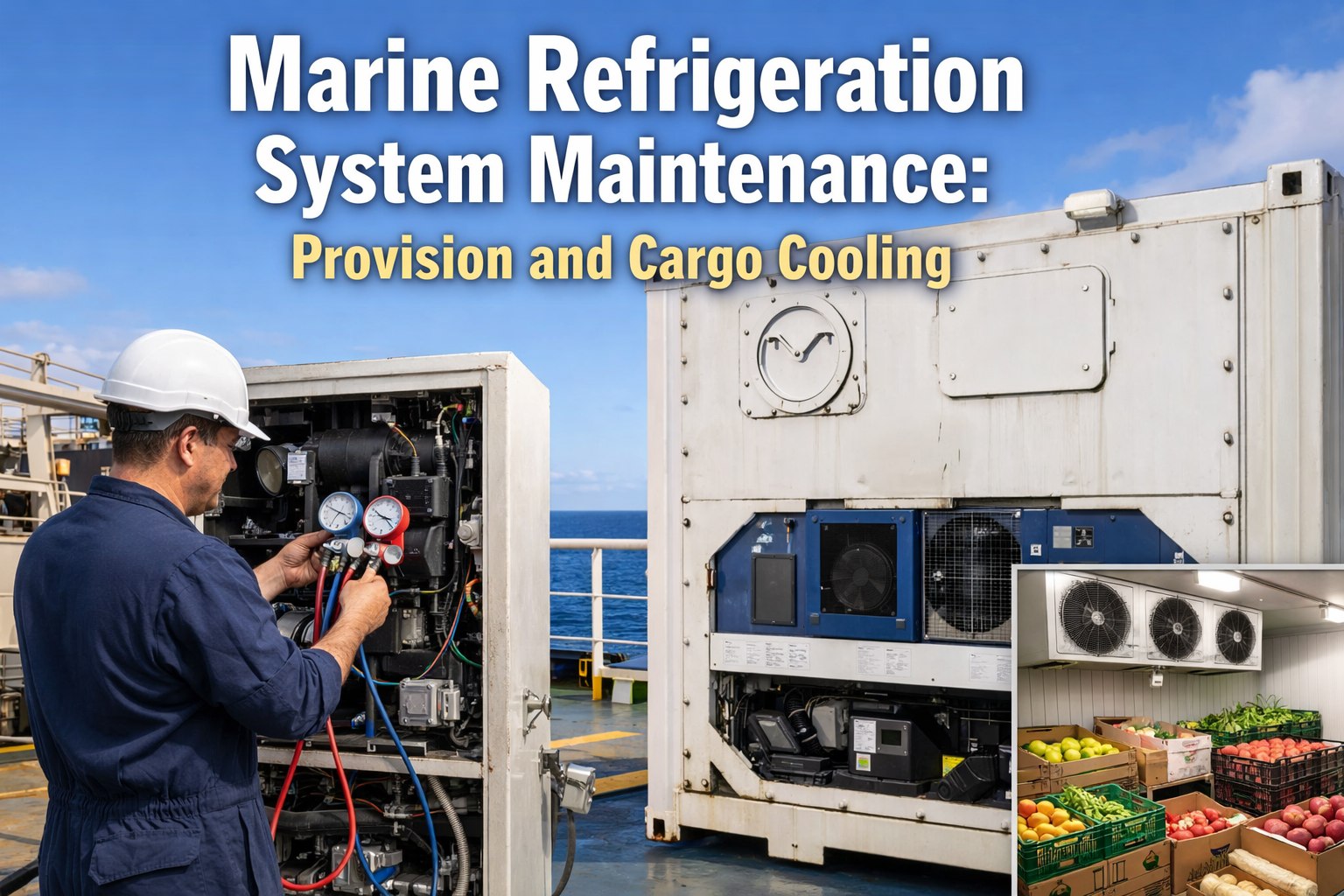
Marine Refrigeration System Maintenance: Provision and Cargo Cooling
Marine refrigeration is the engine room discipline where a single degree of temperature deviation can trigger a $500,000 cargo loss claim before the vessel reaches its next port — and where a failed provision cooling system can cost $5,000+ in lost crew provisions even on vessels carrying no refrigerated cargo. Every commercial vessel carries refrigeration: provision rooms for crew food (meat, fish, vegetable, dairy storage); reefer containers on container ships (requiring continuous power and monitoring for thousands of temperature-sensitive units); dedicated cargo refrigeration systems on specialized reefer vessels carrying perishables; and increasingly, refrigerated transport of pharmaceuticals, specialty chemicals, and temperature-sensitive industrial cargoes. The refrigeration cycle is conceptually simple — compressor pressurises refrigerant vapour, condenser rejects heat to seawater, expansion valve drops pressure, evaporator absorbs heat from the space being cooled — but failures propagate rapidly and expensively. A malfunctioning expansion valve causes evaporator icing that stops cooling entirely. A leaking refrigerant charge degrades capacity until cargo temperature drifts out of specification. A fouled condenser forces compressor high-pressure trips that interrupt cooling. In tropical waters (Panama Canal, Suez, Singapore) with ambient temperatures hitting 35°C and 90% humidity, refrigeration systems operate at peak capacity continuously — making maintenance discipline the difference between reliable cargo delivery and costly claims. For marine engineers, refrigeration maintenance combines refrigerant handling regulations (HFC phase-down under F-gas rules, R404A recovery requirements), thermodynamic troubleshooting, compressor mechanical discipline, and temperature monitoring documentation. To see how Marine Inspection digitalises refrigeration maintenance records, temperature logs, refrigerant tracking, and reefer container monitoring across your fleet, book a Marine Inspection demo.
$500K+
Cargo loss claim per reefer container failure
$5K+
Provision spoilage per provision room failure
0.1°C
Temperature sensor calibration accuracy required
35°C / 90%
Tropical ambient stress on refrigeration systems
Three Refrigeration Applications Every Vessel Has
Marine refrigeration spans three distinct application categories, each with its own system design, maintenance discipline, and failure consequences. Understanding these categories shapes your maintenance strategy. To see how Marine Inspection structures refrigeration maintenance by application type, book a live platform demo.
Application 1
Provision Rooms (All Vessels)
Crew food storage across multiple temperature zones: meat room (-18°C or lower), fish room (-18°C to -20°C), vegetable room (0-4°C), dairy room (0-4°C), and dry stores (ambient). Single refrigeration plant with multiple expansion valves serves different rooms at different evaporator pressures.
Maintenance Priority: Continuous reliability — failure spoils crew food supply on long voyages with no restocking options.
Application 2
Reefer Containers (Container Ships)
Self-contained refrigerated containers powered from vessel electrical grid. Ship provides power, monitoring connections, and repair support. Each reefer independent with own compressor, condenser, evaporator. Vessel crew monitors temperatures, responds to alarms, performs basic repairs.
Maintenance Priority: Power reliability + monitoring + ventilation. Cargo claims run into hundreds of thousands per container.
Application 3
Cargo Refrigeration (Reefer Ships)
Dedicated refrigerated cargo holds on specialised reefer vessels carrying bananas, meat, fish, pharmaceuticals, specialty chemicals. Large central refrigeration plants with multiple compressors, extensive piping, cold room evaporators, and sophisticated temperature control. Continuous duty at design load.
Maintenance Priority: Maximum system redundancy and reliability. Cargo value per voyage can exceed $10 million.
The Refrigeration Cycle: Four Critical Components
Every marine refrigeration system — whether provision room plant, reefer container unit, or cargo refrigeration system — operates on the same four-component vapour compression cycle. Understanding each component's function and failure modes is foundational.
1
Compressor
Pressurises refrigerant vapour from evaporator
Reciprocating (single or two-stage), screw, or scroll types on marine applications. Suction at low pressure/low temp; discharge at high pressure/high temp. Oil level via sight glass, crankcase heater during standby, suction and discharge pressure monitoring.
Common failures: valve leaks, worn bearings, shaft seal leakage, motor overload
2
Condenser
Rejects heat to seawater, condensing vapour to liquid
Shell-and-tube or plate type heat exchanger. Seawater flows on one side; refrigerant condenses on other. Condenser cleanliness directly determines high-side pressure — fouled condenser = high pressure trips.
Common failures: tube/plate fouling, seawater flow issues, tube leaks mixing seawater with refrigerant
3
Expansion Valve
Drops pressure, causing refrigerant to flash evaporate
Thermostatic expansion valve (TEV) most common on marine — responds to evaporator outlet temperature. Electronic expansion valves (EEV) on modern systems for better control. Manual valves on backup circuits.
Common failures: blocked orifice, stuck valve, sensor bulb loss of charge, wrong superheat setting
4
Evaporator
Absorbs heat from cold space, boiling refrigerant
Finned coil in cold rooms or reefer containers. Blower fans circulate air across coil. Frost forms on coil — defrost cycles (electric, hot gas, or water) remove frost periodically to maintain heat transfer.
Common failures: icing (blocked airflow), fan failure, defrost system malfunction, tube corrosion
Marine Refrigerants: What You're Managing
Refrigerant selection, handling, and environmental compliance have become increasingly regulated. HFC refrigerants like R404A are subject to phase-down requirements in multiple jurisdictions. Panama's Law 1 of 2023, for example, mandates certified recovery and disposal of R-134a and R-404A refrigerants. Understanding which refrigerant is in which system matters for both operations and compliance. Book a Marine Inspection demo to see how the platform tracks refrigerant charge records across every cooling system on your vessel.
HFC phase-down target; recovery mandated (e.g. Panama Law 1/2023); R407A alternative (50% GWP reduction)
R407C
HFC blend
Retrofit applications replacing R22
Polyol Ester (POE)
Zeotropic blend — requires liquid charging; temperature glide
R410A
HFC blend
Some marine AC applications
Polyol Ester (POE)
Higher operating pressures than R22/R404A
R22
HCFC
Legacy systems (being phased out)
Mineral oil
Production phase-out complete; service only; retrofit planning essential
R744 (CO2)
Natural
Emerging on modern vessels
POE / PAG
Zero GWP; very high operating pressures; specialised equipment
R290 (Propane)
Hydrocarbon
Small self-contained units
Mineral oil
Very low GWP; flammable — charge size restrictions apply
R717 (Ammonia)
Natural
Large dedicated cargo refrigeration (some reefer vessels)
Mineral oil
Zero GWP, excellent efficiency; toxic — safety protocols essential
R404A and R22 require mineral oil vs POE lubricant mismatch during retrofits — complete flush required. R404A exhaust flow 1.5× and pressure 1.2× R22; system modifications needed for direct replacement.
Common Refrigeration Problems: Diagnosis & Solutions
Marine engineers diagnose refrigeration problems by recognising symptom patterns. Eight common problems cover the vast majority of refrigeration defects seen on ships.
1. Compressor Frequent Cut-In/Cut-Out
Causes: HP cutout set too high / LP cutout set too low; differential setting span too small; defective discharge or line solenoid valve; refrigerant undercharge
Actions: Verify cutout settings against specification; increase differential span; check valve operation; leak test and recharge if needed
2. Compressor Runs Continuously
Causes: Insufficient cooling capacity for load; refrigerant undercharge; fouled condenser; defective expansion valve; high ambient temperature beyond system design
Causes: Oil carryover due to refrigerant flooding; excessive oil migration; oil separator malfunction; high compression ratio increasing oil discharge
Actions: Check superheat (prevent flooding); inspect oil separator; verify oil return from system; address high compression ratio root cause
8. HP Cutout Trip (Panel Shows High Pressure)
Causes: Dirty condenser; wrong HP setting; refrigerant overcharge; liquid backed up in receiver; defective water regulating valve; low seawater flow
Actions: Reset manually (required — plant won't restart otherwise); systematic diagnosis before running again; do not ignore repeat trips
Safety Devices and Protection Systems
Refrigeration systems include multiple safety devices that protect both the equipment and crew. Understanding each device's function is part of safe operation and troubleshooting.
Low Pressure (LP) Cutout
Compressor safety — trips compressor when suction pressure drops too low. Prevents oil return issues and motor overload from low density refrigerant.
High Pressure (HP) Cutout
Compressor safety — trips compressor when discharge pressure exceeds setpoint. Requires manual reset to prevent repeat tripping on same fault.
Oil Pressure Differential Switch
Trips compressor if oil pressure fails to develop within time delay. Prevents bearing damage from oil starvation.
Discharge Temperature Cutout
Trips compressor if discharge temperature exceeds safe limit. Prevents oil breakdown and mechanical damage.
Crankcase Heater
Prevents refrigerant migration to oil during standby. Must be energised 3+ hours before starting to prevent liquid slugging.
Relief Valve
Pressure relief on high side and low side protects from overpressure. No O2 in crankcase means explosion unlikely, but overpressure still dangerous.
Master Solenoid Valve
Isolates entire refrigerant flow on trip. Prevents refrigerant migration and protects compressor on restart.
Individual Room Solenoids
Isolates individual cold room expansion valves. Allows single room service without shutting down entire plant.
How Marine Inspection Streamlines Refrigeration Management
Marine refrigeration generates ongoing documentation across multiple compliance dimensions: daily temperature logs for provision rooms, continuous reefer container monitoring, refrigerant charge records (mandated under F-gas regulations), leak test records, compressor hour meters, and refrigerant recovery certificates. Paper-based systems lose this data between watches and make trend analysis practically impossible. Here's specifically how Marine Inspection addresses marine refrigeration management:
Temperature Log Digitalisation
Replace paper cold room logs with structured digital entries for every provision room, every reefer container, and every cargo cooling zone. Timestamped, automatically trended, alerts on deviation.
Refrigerant Charge Tracking
Document every refrigerant addition with type, quantity, date, system, and technician signature. Required under F-gas regulations for HFC refrigerants. Recovery certificates for regulated disposal.
Reefer Container Monitoring
Centralised dashboard of all reefer containers with temperature trends, alarm history, power supply status. Early warning before cargo claims develop.
Compressor Maintenance Intervals
Running-hour based maintenance scheduling for compressors, automatic alerts for oil change, valve inspection, and major overhauls. Maintenance history preserved across crew rotations.
Leak Detection Records
Periodic leak test documentation (electronic detector, UV dye, soap bubble). Track leak locations, repair history, fleet-wide leak trends. Compliance with F-gas inspection frequency requirements.
Survey-Ready Documentation
Instant retrieval during class surveys, PSC inspections, and port health authority checks. Temperature records, refrigerant logs, maintenance evidence all accessible in seconds.
See Refrigeration Management in Action
Book a 30-minute Marine Inspection demo. See temperature logs, refrigerant tracking, reefer monitoring, and survey documentation demonstrated on your fleet configuration.
Systematic PM intervals for marine refrigeration combine manufacturer specifications with industry practice. This schedule captures standard commercial vessel maintenance.
Daily
Log temperature readings for every cold room and reefer container. Check compressor suction/discharge pressures. Verify oil level via sight glass. Check sight glass for bubbles (indicates undercharge or flash gas). Note any alarm activity.
Weekly
Manual defrost cycle verification. Check condenser seawater flow and outlet temperature. Inspect for refrigerant leaks (visual oil stains, frost patterns on suction line). Door seal condition check on cold rooms. Reefer container cable inspection.
Monthly
Clean evaporator coils and defrost drains. Verify all safety cutouts function (LP, HP, oil pressure differential). Check expansion valve operation (superheat measurement). Inspect compressor belts (where fitted). Temperature calibration check on control systems.
Quarterly
Electronic leak detection survey on entire refrigerant circuit. Condenser chemical cleaning or mechanical brushing. Compressor oil analysis (acidity, moisture, contamination). Filter/drier replacement. Cold room door gasket condition.
Annually
Comprehensive leak test. Safety valve testing. Control system calibration. Compressor inspection (valve plates, gaskets, wear). Heat exchanger cleaning. Thermostatic expansion valve overhaul or replacement per manufacturer schedule.
Dry Dock
Major compressor overhaul per running hours. Condenser tube/plate inspection and cleaning. Piping insulation repair. Electrical system inspection. Evaporator coil replacement if corroded. Refrigerant recovery if system opened — use certified recovery equipment per F-gas regulations.
Energy Efficiency & Commercial Impact
Refrigeration systems are significant electrical loads on commercial vessels — cargo refrigeration on reefer ships can consume 30-40% of total auxiliary power, and reefer containers on container ships can collectively draw megawatts. Under EU ETS and FuelEU Maritime, every kilowatt of refrigeration consumption translates directly into carbon cost and potential regulatory penalty.
Clean condensers: Fouled condensers increase compressor discharge pressure, which increases compressor power consumption exponentially. Regular cleaning delivers measurable fuel savings.
Door discipline: Cold room door left open costs 3-5x the energy to recover temperature. Simple behavioural discipline delivers significant savings.
Insulation integrity: Damaged cold room insulation allows heat ingress that runs compressors harder continuously. Repair damaged insulation during dry dock.
Defrost optimization: Too-frequent defrost wastes energy; insufficient defrost allows ice buildup reducing heat transfer. Tune defrost cycles to actual conditions.
Variable speed drives: Modern installations with VSD compressor motors match capacity to load rather than cycling — significant efficiency gains, especially in tropical waters.
Conclusion
Marine refrigeration maintenance spans three distinct application categories — provision rooms (all vessels), reefer containers (container ships), and dedicated cargo refrigeration (reefer vessels) — with shared technical fundamentals (compressor, condenser, expansion valve, evaporator) but different commercial stakes. A single reefer container failure can trigger $500,000+ cargo claims; a provision cooling failure costs thousands in spoiled food on long voyages; a cargo refrigeration failure on a reefer vessel can exceed $10 million in cargo value. The regulatory environment is evolving with HFC phase-down under F-gas rules, mandated refrigerant recovery, and potential EU ETS/FuelEU Maritime exposure for refrigeration energy consumption. Systematic preventive maintenance — daily temperature logging, weekly defrost verification, monthly cleaning and leak checks, quarterly electronic leak surveys and oil analysis, annual comprehensive testing, and dry-dock major overhauls — delivers the reliability that protects both cargo and commercial performance. The marine engineers who deliver reliable refrigeration are those whose maintenance programmes are systematic, digitalised, and trend-analysed. To see how Marine Inspection transforms refrigeration management across your fleet, book a live demo today.
Frequently Asked Questions
Q1
What refrigerants are used on ships today?
The most common marine refrigerants are R134a (widely used for accommodation AC, provision rooms, medium-temperature applications), R404A (provision refrigeration and low-temperature freezer applications), R407C (retrofit replacement for R22), and R410A (some marine AC applications). Legacy R22 systems are service-only now (production phase-out complete). Emerging natural refrigerants include R744 (CO2, zero GWP but very high operating pressures), R290 (propane, low GWP but flammable — charge size restricted), and R717 (ammonia, excellent efficiency on large reefer vessels but toxic). HFC refrigerants (R134a, R404A, R407C) are subject to F-gas phase-down regulations and mandated recovery/disposal in jurisdictions like Panama (Law 1 of 2023).
Q2
Why does the refrigeration compressor trip on high pressure?
High pressure (HP) cutout trips indicate discharge pressure exceeded the safe setpoint — the cutout protects the compressor from damage. Common causes: (1) Dirty condenser preventing heat rejection — most common cause, cleaning usually resolves. (2) Wrong HP cutout setpoint. (3) Refrigerant overcharge. (4) Liquid refrigerant backed up in the receiver. (5) Defective water regulating valve reducing seawater flow. (6) Low seawater flow from pump issues or strainer blockage. (7) Air (non-condensables) in the system. HP cutouts require manual reset — the plant won't restart automatically. Never just reset without investigating — repeat trips indicate an uncorrected fault that will damage the compressor.
Q3
How often should marine refrigeration systems be maintained?
Layered maintenance schedule: Daily — temperature logs, pressure readings, oil level check. Weekly — defrost verification, condenser seawater check, leak inspection, door seals. Monthly — coil cleaning, safety cutout function test, expansion valve superheat, insulation testing. Quarterly — electronic leak detection survey, condenser chemical cleaning, oil analysis, filter/drier replacement. Annually — comprehensive leak test, safety valve testing, control calibration, compressor valve inspection. Dry dock — major compressor overhaul per running hours, condenser tube/plate inspection, piping inspection, refrigerant recovery if opened. F-gas regulations in some jurisdictions require specific leak inspection frequencies based on system charge size.
Q4
What is the difference between reefer containers and cargo refrigeration?
Reefer containers are self-contained refrigerated containers powered from the vessel's electrical grid on container ships. Each container has its own compressor, condenser, evaporator, and controls — the ship provides power, monitoring connections, and basic repair support. Vessel crew monitors temperatures and responds to alarms for hundreds of independent containers. Cargo refrigeration refers to dedicated refrigerated cargo holds on specialised reefer vessels carrying bananas, meat, fish, pharmaceuticals, or specialty chemicals. These use large central refrigeration plants with multiple compressors, extensive piping, cold room evaporators, and sophisticated temperature control serving the entire cargo space. Cargo refrigeration systems operate at design load continuously during voyages, while reefer containers are independently powered equipment the ship supports rather than operates directly.
Q5
How do I handle refrigerant recovery on a ship?
Refrigerant recovery is required whenever a refrigeration system is opened for repair — both for equipment protection (preventing moisture and contaminants entering) and environmental compliance (preventing atmospheric release). Use certified recovery equipment with refrigerant-specific hoses and cylinders. Recovery cylinders must be certified empty (proper evacuation) and marked with refrigerant type. Documentation required: quantity recovered, refrigerant type, date, technician identity, destination (reclaim, disposal, reuse). Jurisdictions like Panama (Law 1 of 2023) require certified disposal of recovered HFCs (R134a, R404A). During port stays, arrange recovery services with certified refrigeration contractors. Never vent refrigerant intentionally — beyond environmental damage, it triggers regulatory violations with substantial fines.
Ready to Protect Your Cargo & Crew Provisions?
Book Your Personalised Marine Inspection Demo
30 minutes. Your fleet configuration. See how the platform digitalises temperature logs, refrigerant tracking, reefer container monitoring, and survey-ready refrigeration documentation.