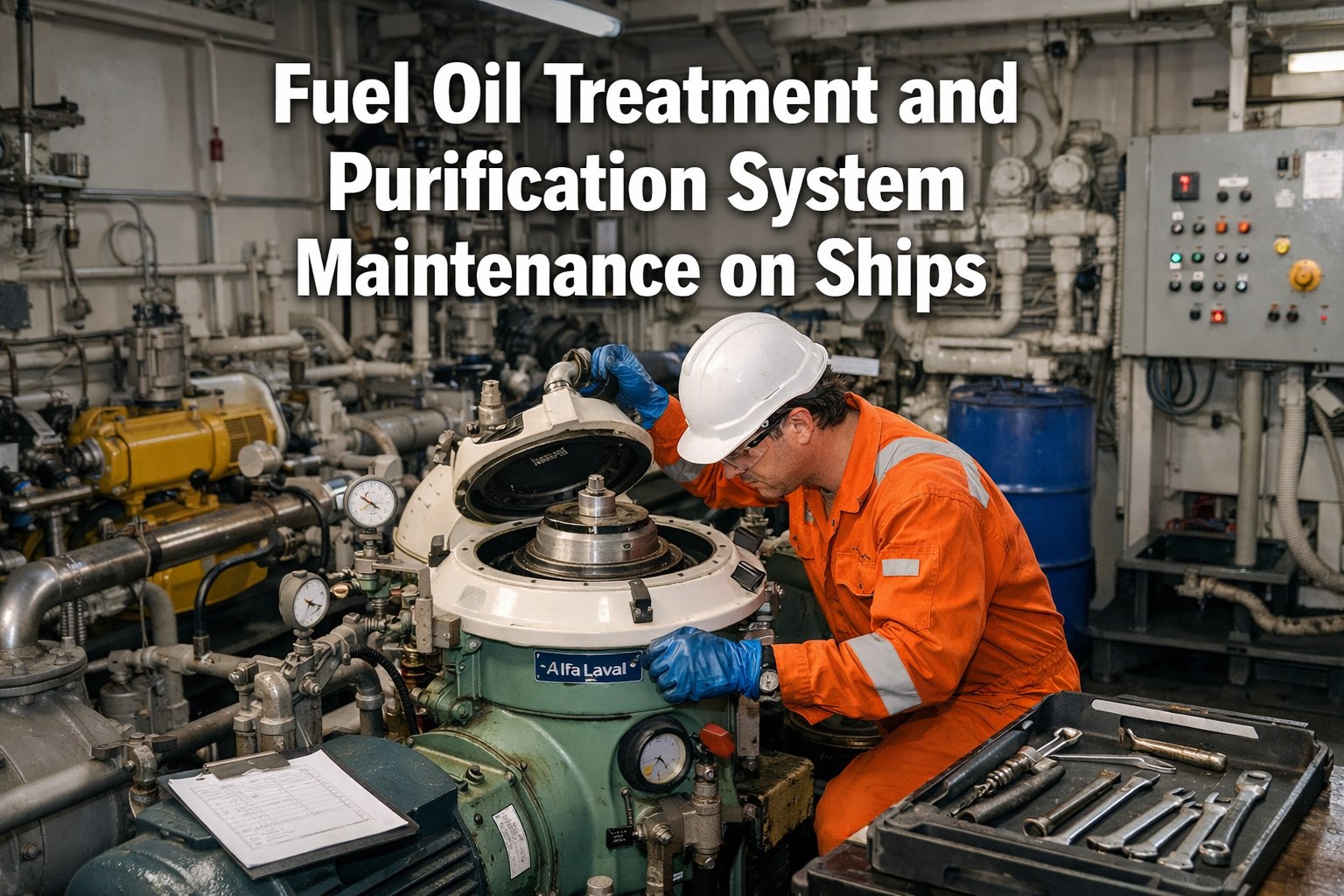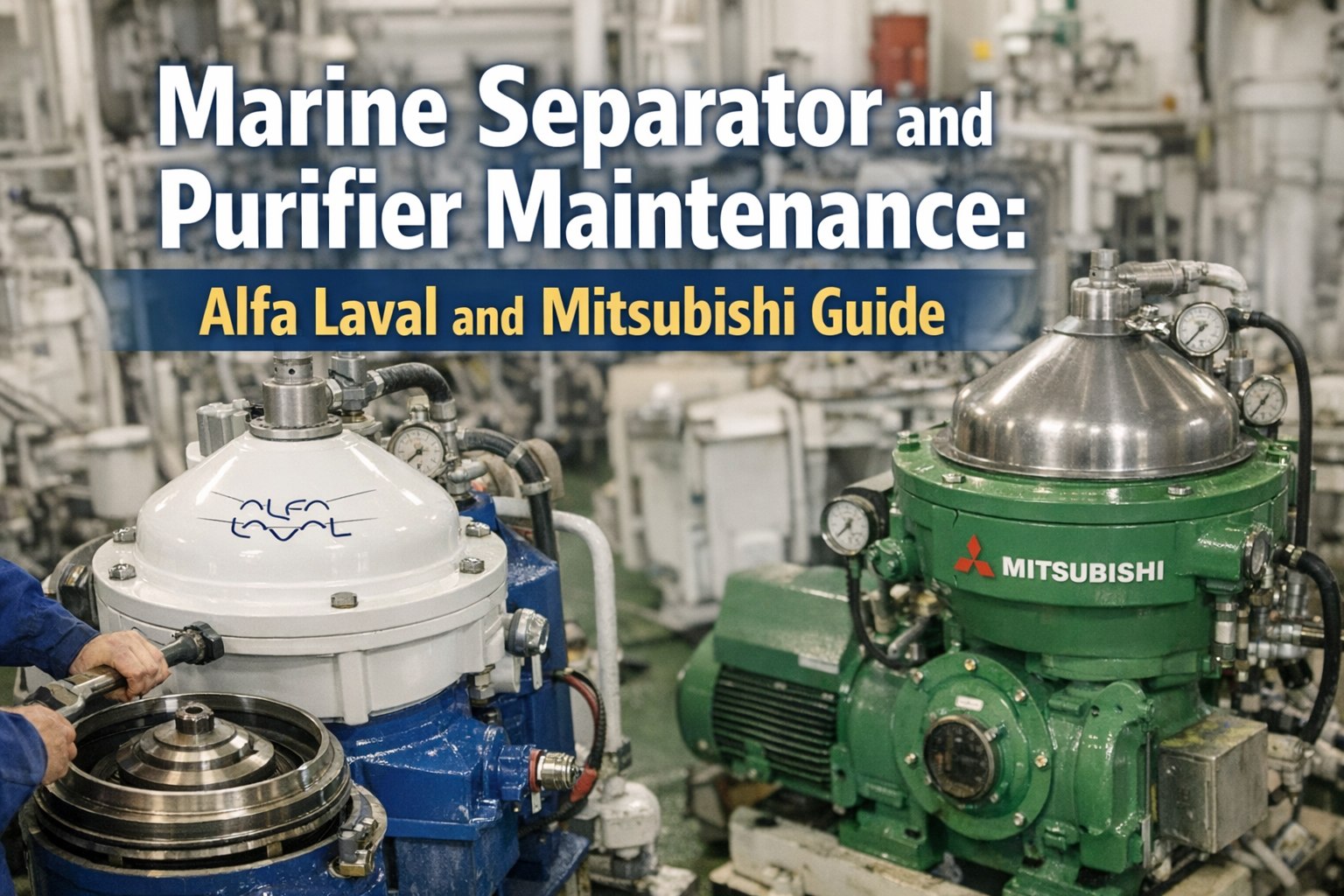
The centrifugal separator is the most critical precision machine in the engine room — spinning at thousands of RPM to separate water, catalytic fines, and solid contaminants from fuel and lubricating oil using centrifugal force many thousands of times stronger than gravity. A properly maintained separator protects main engines worth millions from the catfine damage, water contamination, and sludge that characterise modern marine fuels. A poorly maintained separator does the opposite — it delivers contaminated fuel to the engine and creates the conditions for the $650,000-$1.2 million damage incidents that VPS data shows vessels experience 1-2 times during their operational lifetime. Two manufacturers dominate the marine separator market: Alfa Laval (P series with gravity disc technology and S series with ALCAP automatic interface control) and Mitsubishi (SJ series with pilot valve operating water control). Both use disc-stack centrifugal separation — conical discs stacked inside a high-speed bowl creating enormous separation surface area — but differ in how they control the oil-water interface, how they execute bowl opening and sludge discharge, and how their maintenance procedures are sequenced. For marine engineers, separator maintenance is the engine room task where precision matters most: wrong gravity disc selection causes oil loss; incorrect bowl closing water timing causes overflow; worn seal rings cause leaking; dirty disc stacks reduce separation efficiency; and incorrect throughput rates allow catfines through to the engine. To see how Marine Inspection digitalises separator maintenance records, sludge discharge logs, and efficiency monitoring across your fleet, book a Marine Inspection demo.
Core Separation Principle: What Happens Inside the Bowl
Every marine separator — regardless of manufacturer — operates on the same physical principle. Understanding it prevents the most common maintenance mistakes.
Purifier Mode vs Clarifier Mode
Separators can be configured as purifier or clarifier. This is not a trivial distinction — the wrong mode for your application wastes oil, delivers contaminated product, or both. Book a Marine Inspection demo to see how the platform tracks separator operating mode, gravity disc selection, and efficiency parameters.
Function: Removes both water AND solids from oil. Two outlets — clean oil and separated water. Requires gravity disc or ALCAP for interface control.
Used for: Fuel oil purification (primary application). Lube oil when water contamination suspected.
Critical: Gravity disc selection must match fuel density. Wrong disc = broken water seal = oil loss or poor separation.
Function: Removes only solids from oil. No water separation — single outlet for clean oil. No gravity disc required.
Used for: Lube oil cleaning (primary). Fuel oil polishing where water is minimal.
Critical: Cannot handle significant water content — water will remain in oil. Not suitable for fuel oil primary treatment.
Gravity Disc Selection: The Most Common Separator Mistake
Wrong gravity disc selection is the single most common separator problem on ships — and it creates expensive consequences. The gravity disc sets the position of the oil-water interface inside the spinning bowl. The correct disc depends on the specific gravity (density) of the oil being processed and the operating temperature. ALCAP-equipped S series separators eliminate this problem with automatic adjustment, but P series separators and many legacy installations require manual selection.
Maintenance Schedule: From Daily Checks to Major Overhaul
Separator maintenance follows layered intervals that combine daily operational monitoring with periodic component overhauls. Running hours determine major overhaul timing (typically 4,000-8,000 hours depending on manufacturer and application). Sign up for Marine Inspection to track running hours and automate maintenance scheduling across every separator on your vessel.
| Interval | Activities | Key Checks |
|---|---|---|
| Daily | Monitor operating parameters: throughput, temperatures, pressures, sludge discharge frequency | Verify correct gravity disc fitted (P series). Check ALCAP transducer indication (S series). Oil loss in sludge? |
| Weekly | Clean separator bowl exterior. Check vibration levels. Verify sludge discharge timing and completeness | Abnormal vibration = disc imbalance or bearing wear. Incomplete discharge = operating water issue |
| Monthly | Open bowl and inspect disc stack for fouling, damage. Clean discs if necessary. Check seal ring O-ring condition | VLSFO clogs discs faster than HSFO — adjust cleaning frequency. Count discs on reassembly |
| 500 Hours | Bowl opening water nozzle cleaning. Inspect sliding bowl bottom. Check operating water solenoid valve function | Blocked nozzles cause bowl opening/closing failures — most critical periodic task |
| 2,000-4,000 Hours | Minor overhaul: replace seal ring (large and small O-rings), inspect bowl lock ring, check friction pads, inspect paring disc/impeller | Seal ring wear causes leaking and efficiency loss. Always replace all O-rings together |
| 4,000-8,000 Hours | Major overhaul: spindle bearings, main seal ring replacement, complete disc stack inspection and replacement if worn, gear transmission service | Bearing replacement requires proper alignment tools. Disc inspection: check for cracks, corrosion, distortion |
| Dry Dock | Complete overhaul per manufacturer schedule. Vibration survey. Motor insulation testing. Foundation bolt torque. Piping inspection | Align major overhaul with dry dock to minimise operational disruption |
Eight Common Separator Problems and Diagnosis
Separator problems follow recognisable patterns. Each symptom points to specific root causes, and systematic diagnosis avoids the most expensive mistake — replacing parts that aren't faulty while missing the actual problem.
How Marine Inspection Digitalises Separator Management
ALCAP vs Gravity Disc: Which Is Better?
The choice between ALCAP (S series) and gravity disc (P series) separators depends on operational profile, fuel variety, and crew capability. Neither is universally superior — each fits specific operational contexts.
| Feature | ALCAP (S Series) | Gravity Disc (P Series) |
|---|---|---|
| Interface Control | Automatic — water content transducer adjusts interface continuously | Manual — gravity disc selected per fuel density; requires crew intervention |
| Multi-Fuel Flexibility | Excellent — handles HFO, VLSFO, MDO without disc changes | Requires disc change for each fuel density change |
| Crew Intervention | Minimal — set parameters via process controller; automatic operation | More crew involvement required for disc selection, monitoring |
| Biofuel Ready | Yes — handles HVO and FAME blends automatically | Requires careful disc selection for biofuel density |
| High-Density Fuels | Designed for high-density residual fuels up to density limits | Reliable within disc range but less adaptable to extremes |
| Maintenance Complexity | Higher — transducer calibration, software updates, more electronics | Lower — mechanically simple, well-understood technology |
| Cyber Resilience | IACS UR E27 compliant on current models (S and P Flex range) | Less electronics = less cyber exposure |
| Cost | Higher acquisition; potentially lower operational cost through reduced oil loss | Lower acquisition; potentially higher operational cost if wrong disc selected |
Conclusion
Marine separator maintenance is the precision discipline that stands between your engine and the contaminated fuel that damages it. Whether you operate Alfa Laval S series (ALCAP automatic interface), P series (gravity disc manual selection), or Mitsubishi SJ series (pilot valve control), the separation principles are identical: high-speed centrifugal force separates water, solids, and catfines from oil across a disc stack — but only when operating temperature (95°C for HFO), throughput rate (25% of rated capacity for maximum efficiency), interface control (correct gravity disc or calibrated ALCAP), and disc stack cleanliness are maintained simultaneously. VLSFO operations have increased maintenance demands — faster disc clogging from asphaltene precipitation, more frequent cleaning cycles, compatibility issues between fuel batches. Systematic running hour tracking, gravity disc selection logging, efficiency sample verification, and overhaul scheduling turn separator maintenance from reactive repair into proactive engine protection. To see how Marine Inspection provides the digital platform for systematic separator management across your fleet, book a live demo today.