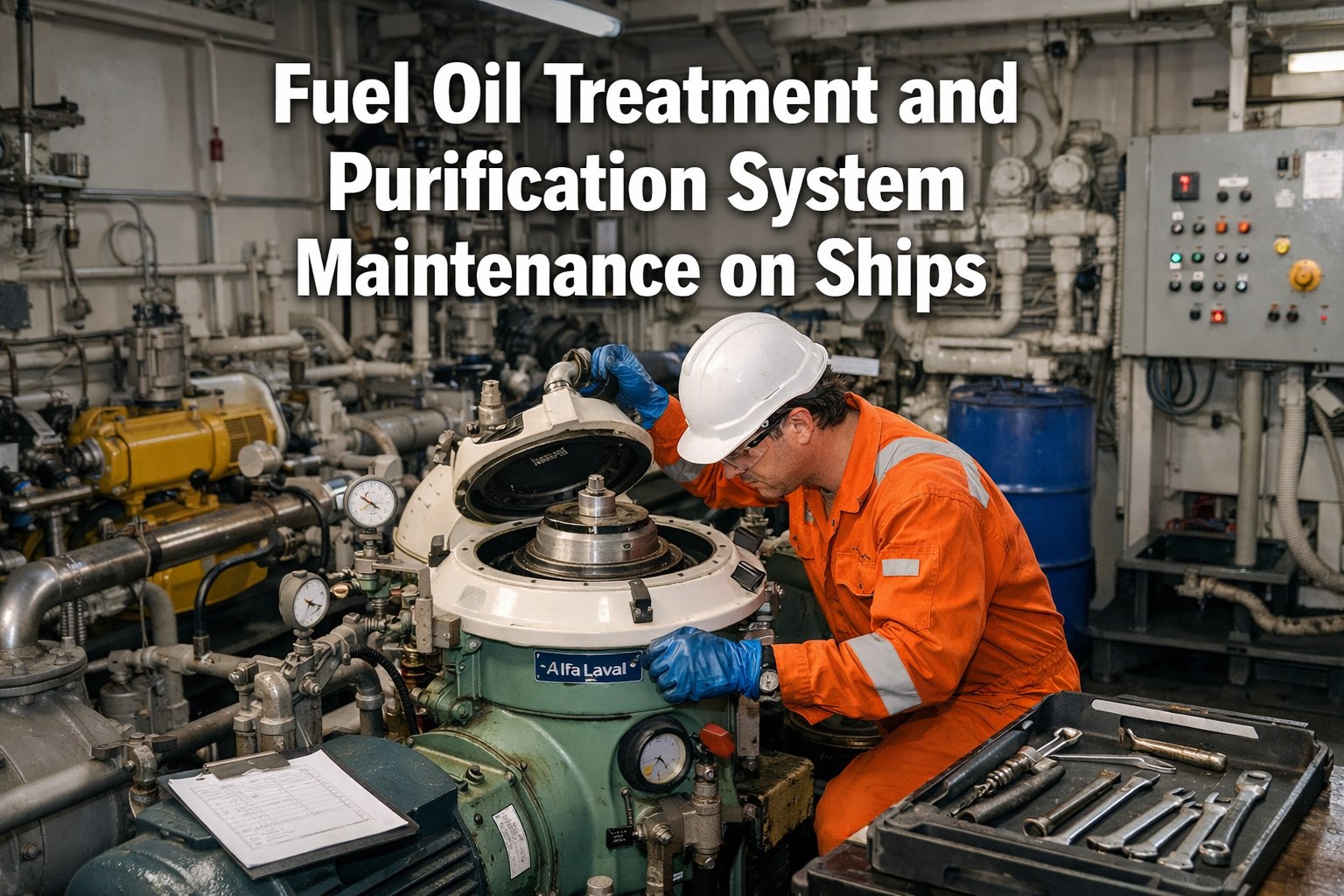
Fuel Oil Treatment and Purification System Maintenance on Ships in 2026
Fuel oil treatment is the single most consequential engine room discipline separating vessels that run reliably from those that suffer catastrophic main engine damage costing $650,000-$1.2 million per incident. The fuel arriving at the bunker manifold is not the fuel the engine needs — it typically carries water, sediment, catalytic fines (aluminum-silicon particles from refinery processes), bacterial growth, and in the VLSFO era, asphaltene instability, wax precipitation, and compatibility issues that trigger operational problems within hours of bunkering. Between August 11-31 2025, Veritas Petroleum Services recorded a "global pandemic" of elevated catfine levels ranging from 62-176 ppm across major bunkering hubs, and 19% of VLSFO bunker deliveries in Q1 2025 contained cat-fines above 40 mg/kg — meaning vessels without effective purification face engine damage risk on roughly one in five bunker deliveries. The fuel oil treatment system — settling tanks, purifiers, service tanks, homogenisers, and filtration stages — is the line of defence protecting the main engine from this contamination. For chief engineers and marine engineers, fuel treatment combines chemistry (additives, compatibility testing), fluid mechanics (temperature, viscosity, residence time), centrifugal separation theory (gravity disc selection, throughput rates), and regulatory compliance (ISO 8217, sulphur limits including the Mediterranean ECA effective May 1, 2025). To see how Marine Inspection digitalises fuel treatment records, purifier efficiency tracking, and bunker quality documentation across your fleet, book a Marine Inspection demo.
The Commercial Stakes of Fuel Oil Treatment
$650K-1.2M
Main engine damage cost per incident
1-2 incidents
Engine damage per vessel lifetime
19%
VLSFO deliveries with catfines >40 mg/kg (Q1 2025)
10-15 mg/kg
Max catfines at engine inlet (OEM recommendation)
The Fuel Oil Treatment Journey: Bunker Manifold to Engine Inlet
Fuel oil moves through six distinct treatment stages between the bunker manifold and the engine fuel injector. Each stage has specific temperature, residence time, and filtration requirements. Failure at any stage compromises the downstream stages and eventually delivers contaminated fuel to the engine. To see how Marine Inspection tracks fuel treatment performance at every stage with real-time alerts on deviations, book a platform walkthrough.
1
Bunker Manifold & Storage Tanks
Fuel received at bunker manifold via 30×30 mesh strainers. MARPOL bunker sample drawn continuously throughout delivery. Tank selection based on previous fuel in tank (compatibility), segregation requirements, and stability. Storage temperature maintained 15°C above pour point — critical for VLSFOs which may contain paraffinic wax.
2
Settling Tank
Fuel heated to ~65°C to reduce viscosity and enable water and sediment settling. Double settling tanks ideal — one settling, one feeding purifier. Water drains every 2 hours on high-catfine fuel. Tank bottoms cleaned regularly to remove accumulated sediment. Critical: water must be removed before purification as catfines emulsify with water and won't separate.
3
Purifier Feed Heater
Fuel heated to 95°C at purifier inlet (manufacturer specification). Correct temperature reduces viscosity for effective centrifugal separation. Under-heating reduces separation efficiency; over-heating risks vapour lock and flash point issues.
4
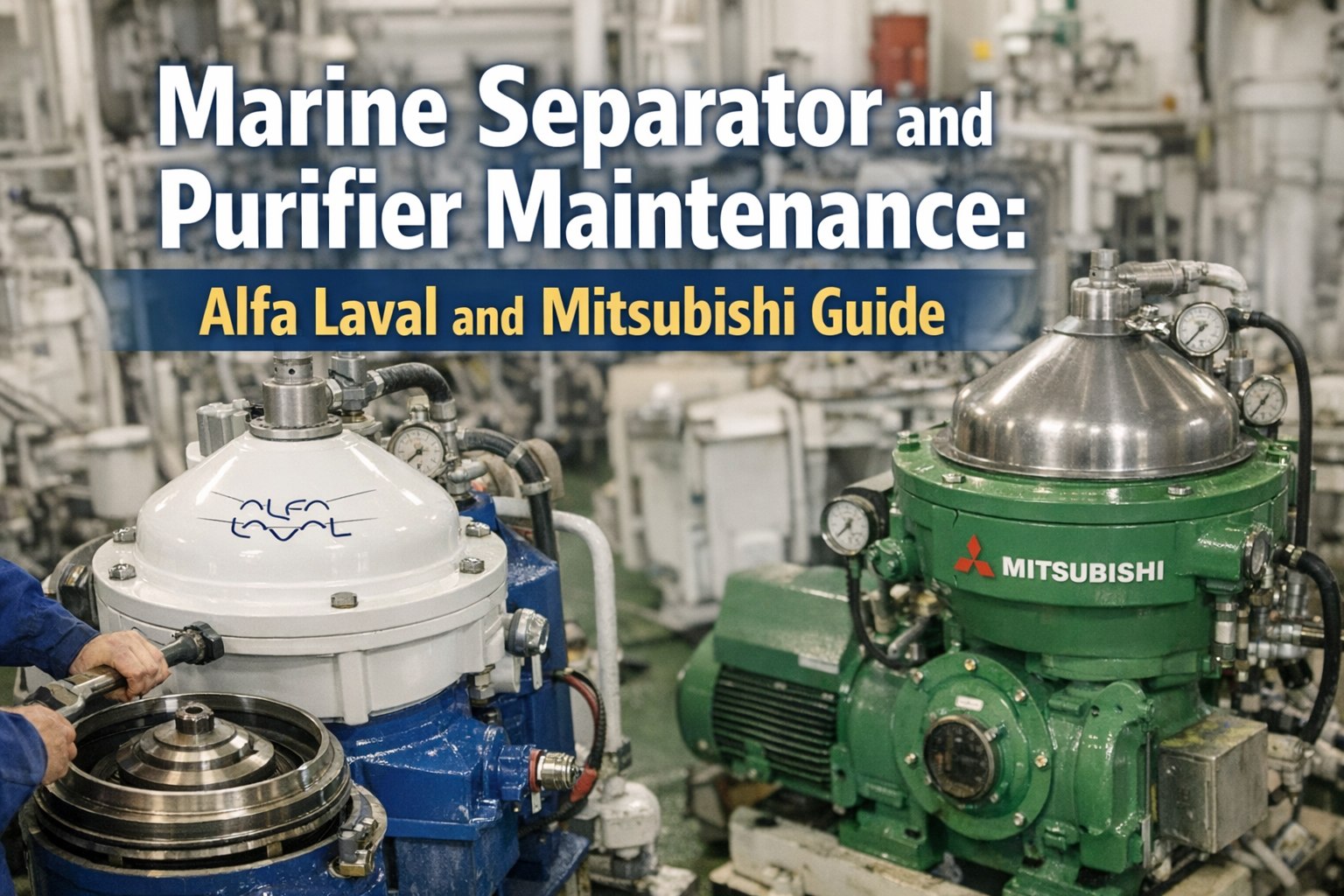
Centrifugal Purifier (Separator)
The heart of fuel treatment. Centrifugal force (several thousand g) separates water and heavy solids from oil. Gravity disc selected for specific fuel density. Throughput reduced to 25% of rated capacity for maximum efficiency. Operate in parallel (not series) to increase residence time. Independent tests show 80% catfine removal efficiency at reduced throughput.
5
Service Tank
Clean fuel stored at 90°C+ temperature ready for engine use. Drained regularly — every 2 hours on high-catfine fuel. Never stir or homogenise upstream of purifiers as this re-suspends settled contaminants. Service tank drain must never be recycled back for engine consumption via settling tank.
6
Fine Filter & Engine Supply
5-micron self-cleaning filter just ahead of main engine — the last line of defence. Backwash frequency is direct indication of fuel quality or purifier efficiency. Fuel supplied to engine at minimum 70°C, viscosity not below 2 cSt (lubricity falls below this). Never bypass this filter — contaminated fuel causes fuel injection system and cylinder component wear.
Centrifugal Purifier: The 10 Critical Operating Rules
The purifier is where most fuel treatment failures originate. Operating a purifier correctly is not difficult, but requires discipline across ten specific practices. ExxonMobil and VPS technical guidance — consistent across the industry — identifies these as the non-negotiables. Request a Marine Inspection demo to see how the platform captures purifier operating parameters and surfaces deviations before they compromise fuel quality.
1
Maintain purifier inlet temperature at 95°C. Too low reduces separation; too high causes issues with fuel stability and flash point.
2
Reduce throughput to 25% of rated capacity. Independent tests show this achieves 80% catfine removal efficiency — dramatically better than rated throughput.
3
Operate purifiers in parallel, not series. Parallel operation increases residence time within each bowl; series is no better than single operation.
4
Select gravity disc matching fuel density. Wrong gravity disc = broken water seal = oil loss or poor separation. Match the actual fuel being processed.
5
Never stir or homogenise fuel upstream of purifiers. Homogenisation re-emulsifies water and re-suspends settled particles, undoing settling tank work.
6
Drain settling and service tanks regularly. Every 2 hours on high-catfine fuel. Water must be removed before purification — catfines emulsify with water.
7
Sample before and after purifier for efficiency verification. After-purifier should be below 15 mg/kg catfines if purifier working properly.
8
Clean purifier disks on schedule. VLSFO clogs disks faster than HSFO due to asphaltene precipitation. Cleaning frequency increases significantly with VLSFO.
9
Never recycle purifier sludge drains via settling tank. The sludge you just separated will return to contaminate the clean fuel circuit.
10
Never bypass the fine filter. The 5-micron filter is the engine's last defence. Bypassing sends contaminated fuel directly to injectors and cylinder components.
See Marine Inspection's Fuel Management Platform in Action
In 30 minutes, our team will demonstrate how Marine Inspection digitalises purifier operating parameters, bunker quality records, fuel sample analysis, and tank management logs — turning fuel oil treatment from reactive troubleshooting into systematic operational discipline that protects main engines worth millions.
VLSFO Challenges: Why Fuel Treatment Has Become Harder
Since IMO 2020, VLSFO (Very Low Sulphur Fuel Oil, max 0.5% S) has become the dominant fuel for non-scrubber vessels — and the challenges it creates have reshaped fuel treatment practice. The Mediterranean ECA designation effective May 1, 2025 further reduces permissible sulphur content to 0.1% in those waters, making fuel management even more complex for operators transiting the region.
Asphaltene Instability
VLSFO blends show higher stratification rates than HSFO. Asphaltenes precipitate as heavy sludge that clogs purifier disks at much higher frequency. Purifier cleaning becomes more frequent with more effort required each time.
Wax / Cold Flow Issues
Many VLSFO blends are paraffinic. Waxing occurs at low temperatures, clogging filters and solidifying in bunker storage tanks. Cold Filter Plugging Point (CFPP) and pour point management becomes critical. Waxed fuel requires intensive manual labour to remove.
Compatibility Problems
Different VLSFO blends may be incompatible with each other. Mixing incompatible fuels triggers rapid sludge formation. Compatibility test (spot test) recommended before changeover. Different producers may not match specifications even with same grade.
Reduced Separator Efficiency
VLSFO's typically low viscosity reduces effectiveness of centrifugal separators. Varied composition makes behaviour unpredictable. Insufficient heating causes wax precipitation that further diminishes separation efficiency.
Fuel Wastage
Due to VLSFO characteristics, 1-3% of fuel typically wasted in tank bottoms. Up to 10% utilised at reduced efficiency due to lower calorific value and reduced combustion efficiency. Direct commercial impact on voyage economics.
Lubricity Concerns
Ultra-low sulphur content reduces natural lubricity. Fuel temperature must not drive viscosity below 2 cSt — lubricity decreases sharply below this level. Low-sulphur fuel may require lubricity additives for fuel injection system protection.
Catfines: The Silent Engine Killer
Catalytic fines (catfines) are microscopic aluminum-silicon particles from refinery fluid catalytic cracking processes. They are extremely hard and abrasive — when they enter an engine, they scratch or embed in steel surfaces, causing rapid wear and scuffing of fuel injection components and cylinder surfaces. Along with viscosity and water, catfines are considered one of the three most critical fuel properties to monitor at engine inlet.
Catfines: ISO 8217 Limits & Industry Thresholds
Threshold
Limit
What It Means
Recommended Action
ISO 8217 Spec Limit
60 mg/kg maximum
Maximum allowed in bunker fuel delivery; exceeding triggers quality claim
Reject delivery or segregate and downgrade
VPS FSC Trigger
>40 mg/kg at manifold
High enough to cause concern; triggers additional Fuel System Check sampling
Request Before & After purifier samples for efficiency verification
Engine Inlet Target
Below 15 mg/kg
Purifier working properly should deliver below this level
If above 15 mg/kg after purifier — investigate purifier operation
OEM Recommendation
10-15 mg/kg maximum at inlet
Engine manufacturer general recommendation to prevent wear
Design fuel treatment to consistently achieve this level
Composition
Aluminum (Al) + Silicon (Si)
Combined Al+Si value used for catfine measurement
Lab analysis (ICP-AES or similar technique)
Q1 2025 Bunker Data
19% of VLSFO >40 mg/kg
Roughly 1 in 5 VLSFO deliveries risk engine damage without purification
Quarterly fuel system check sampling as standard practice
VPS Pandemic Period
62-176 ppm (Aug 11-31, 2025)
Elevated levels recorded across major bunkering hubs globally
Increased vigilance on bunker quality; source from reputable suppliers
Sample analysis: ISO 8217 spec limit rarely exceeded (less than 2% of bunker samples) but 13-19% of deliveries contain catfines above engine-damaging 40 mg/kg threshold.
Temperature Management: The Master Variable
Temperature is the single variable that determines whether every fuel treatment process functions correctly or fails silently. Get temperature wrong at any stage and the downstream consequences cascade through the system.
Fuel Oil System Temperature Requirements
Location
Target Temperature
Why
Storage Tanks
15°C above fuel pour point
Prevents wax formation, maintains pumpability. Raise to 45°C a day before use for VLSFO.
Settling Tank
~65°C
Reduces viscosity for effective water and sediment settling
Purifier Inlet
95°C (per manufacturer)
Optimal viscosity for centrifugal separation of water and catfines
Service Tank
Above 90°C
Aids water content removal; maintains fuel ready for engine supply
Minimum System
70°C minimum anywhere
Below this viscosity rises, increasing fuel pump and injector strain
Steam tracing for all pipelines monitored during use. Can be turned off for fuels below 10 cSt provided fuel maintained 15°C above pour point.
Bunker Quality Management: What to Do Before and After Bunkering
Fuel treatment starts before fuel arrives on board. Poor bunker quality makes downstream treatment impossible; good bunker quality reduces treatment workload. To digitalise bunker quality documentation with automated sample tracking and quality claim management, book a Marine Inspection demo.
Before Bunkering
Source fuel from reputable suppliers. Define clear specifications in charter parties including ISO 8217 latest standard, recommended suppliers, handling and sampling requirements. Prepare receiving tank — clean, drained of water, compatible with incoming fuel.
During Bunkering
Continuous MARPOL sample drawn throughout delivery. Independent witness sampling where specified. Monitor delivery flow and temperature. Temperature and volume verified against Bunker Delivery Note.
Sample Analysis
Send samples for ISO 8217 analysis. Key parameters: viscosity, density, flash point, water content, pour point, catfines (Al+Si), sulphur content, compatibility (if mixing). Quarterly Fuel System Check (FSC) sampling before and after purifier for efficiency verification.
Tank Segregation
Keep new bunker segregated in separate tank where possible. Where vessel has single tank arrangement, prior tank fuel must be run down to minimum before receiving new. Compatibility test required before mixing different batches or grades.
Quality Claims
If off-specification detected, formal quality claim via charterer. Retain MARPOL sample sealed. Document fuel characteristics, handling, any operational issues. Engine wear analysis via cylinder scrape-down if engine damage suspected.
Long-Term Monitoring
Quarterly cylinder scrape-down analysis to check for abrasive wear. Track catfine removal efficiency over time. Build supplier performance database. Identify trends in fuel quality from specific ports or suppliers.
Regulatory Framework: ISO 8217, MARPOL, and ECA
Fuel oil treatment operates within an overlapping regulatory framework that defines fuel specifications, sulphur limits, sampling requirements, and documentation obligations.
ISO 8217 (Latest: 2024 / Draft 2025)
International marine fuel quality standard defining categories, limits for viscosity, density, flash point, water, sulphur, catfines, compatibility, and other parameters. Commonly referenced in charter parties and bunker specifications. 2024 edition addresses bio-components and FAME.
MARPOL Annex VI
Sulphur limits: 0.5% global cap; 0.1% in Emission Control Areas (ECAs). Mediterranean ECA effective May 1, 2025 adds region to existing North Sea, Baltic, North American, and US Caribbean ECAs. Bunker Delivery Note and MARPOL sample requirements.
ECA Compliance Options
(1) Low-sulphur fuel (MGO or compliant VLSFO). (2) Exhaust gas cleaning (scrubber) with HSFO. (3) Alternative fuels (LNG, methanol, biofuels). HSFO-VLSFO spread reached $300+ per tonne, affecting commercial viability of each option.
Fuel Changeover
Before entering ECA, changeover from HSFO to compliant fuel must complete before ECA entry. Settling tank volumes calculated for voyage planning. Engine load restrictions during changeover per engine manufacturer. Cylinder oil feed rate adjustment (may need BN reduction).
Expert Review: Fuel Treatment as Engine Protection Economics
Industry Analysis
The commercial case for disciplined fuel treatment is not debatable. A single main engine damage incident costs $650,000 to $1.2 million per claim. Vessels typically experience 1-2 such incidents over operational lifetime — and the leading cause consistently tracks back to fuel quality and handling issues. The preventive alternative is not expensive: systematic purifier operation, regular tank draining, temperature management, and fuel sample analysis. The gap between preventive cost and failure cost is roughly 1,000x.
What has changed since IMO 2020 is the complexity of the treatment challenge. VLSFO behaviour is less predictable than the HSFO engineers trained on for decades. Blend compatibility varies between bunker ports and even between deliveries from the same supplier. Catfine levels have been elevated across global bunkering hubs during specific periods — the August 2025 "pandemic" recorded by VPS is a recent example, not an anomaly. The crews that consistently avoid engine damage in this environment are those whose fuel treatment discipline is systematic, documented, and data-driven. Quarterly Fuel System Check sampling. Tracked purifier operating parameters. Logged bunker quality records. Trending of catfine levels before and after purification.
Digital maintenance platforms connect these data points into the pattern recognition that reveals developing problems before they cause main engine damage. For chief engineers and marine engineers, this is not replacing traditional engine room seamanship — it is amplifying it with the systematic data capture that spreadsheet-based systems cannot reliably produce. Schedule a walkthrough to see how Marine Inspection turns fuel treatment records into engine protection intelligence.
Conclusion
Fuel oil treatment is the engine room discipline with the highest commercial consequences — protecting main engines worth millions from catfines, water, sediment, and the compatibility issues that characterise modern VLSFO. The six-stage treatment journey (bunker manifold → storage → settling tank → purifier feed heater → centrifugal purifier → service tank → fine filter → engine) must operate correctly at every stage, with temperature management, drain discipline, purifier operation, and sampling programmes all contributing to catfine levels consistently below the 10-15 mg/kg engine inlet target. The 2025 regulatory environment adds complexity: Mediterranean ECA effective May 1 2025 extends low-sulphur requirements; documented "pandemic" catfine levels during August 2025 show that bunker quality risk is not decreasing. The chief engineers and marine engineers who consistently protect their engines are those whose fuel treatment discipline is systematic, documented, and data-driven. Marine Inspection provides the digital platform that turns fuel oil treatment from reactive problem-solving into proactive engine protection — book a live demo today to see how.
Frequently Asked Questions
What are catfines and why are they dangerous to marine engines?
Catalytic fines (catfines) are microscopic aluminum-silicon particles from refinery fluid catalytic cracking processes that end up in residual fuel oils. They are extremely hard and abrasive — when they enter a marine engine, they scratch or embed in steel surfaces of components that move against each other, causing rapid wear and scuffing of fuel injection system parts and cylinder components. Along with viscosity and water, catfines are considered one of the three most critical fuel properties to monitor. ISO 8217 sets maximum 60 mg/kg at delivery; engine manufacturers recommend no more than 10-15 mg/kg at engine inlet. Q1 2025 data showed 19% of VLSFO deliveries exceeded 40 mg/kg — roughly 1 in 5 bunker deliveries risk engine damage without effective purification.
What is the correct temperature for each stage of fuel treatment?
Storage tanks: 15°C above fuel pour point (raise to 45°C a day before use for VLSFO). Settling tank: approximately 65°C to reduce viscosity and enable water/sediment settling. Purifier inlet: 95°C per manufacturer specification for optimal centrifugal separation. Service tank: above 90°C to aid water removal. Minimum system temperature: 70°C anywhere in fuel system. Viscosity floor: not below 2 cSt (lubricity falls sharply below, damaging fuel pumps and injectors). Steam tracing for all pipelines monitored during use. Wrong temperature at any stage cascades into downstream problems — under-heated fuel at settling tank prevents proper water separation; over-heated fuel at purifier risks vapour lock.
How should fuel oil purifiers be operated for maximum efficiency?
Ten critical rules: (1) Maintain 95°C inlet temperature. (2) Reduce throughput to 25% of rated capacity — independent tests show 80% catfine removal at this rate. (3) Operate purifiers in parallel, not series. (4) Select gravity disc matching fuel density. (5) Never stir or homogenise upstream of purifier. (6) Drain settling and service tanks regularly — every 2 hours on high-catfine fuel. (7) Sample before and after purifier to verify efficiency (below 15 mg/kg after if working properly). (8) Clean purifier disks on schedule — VLSFO clogs more frequently than HSFO. (9) Never recycle sludge drains via settling tank. (10) Never bypass the fine filter downstream — it's the engine's last defence.
Why is VLSFO harder to treat than HSFO?
Six major challenges: (1) Higher stratification and asphaltene precipitation cause faster purifier disk clogging. (2) Paraffinic blends create wax issues at low temperatures — bunker storage tanks can solidify. (3) Compatibility problems between different VLSFO blends trigger rapid sludge formation when mixed. (4) Lower viscosity reduces centrifugal separator effectiveness. (5) 1-3% of fuel wasted in tank bottoms; up to 10% used at reduced efficiency. (6) Ultra-low sulphur reduces natural lubricity — fuel temperature must not drive viscosity below 2 cSt. The Mediterranean ECA designation effective May 1, 2025 further reduces sulphur limit to 0.1% in those waters, adding more complex fuel management requirements for operators transiting the region.
How often should fuel samples be tested?
Every bunker delivery requires MARPOL sample drawn continuously throughout delivery, sealed and retained. Pre-use analysis of representative sample against ISO 8217 specifications should be standard. Quarterly Fuel System Check (FSC) sampling is best practice — taking samples before and after purifier to verify purifier efficiency. If manifold sample shows catfines above 40 mg/kg, FSC sampling should be triggered immediately. Periodic cylinder scrape-down analysis checks for abrasive wear evidence. The economic case is clear — a single main engine damage incident costs $650K-$1.2M per claim versus modest fuel testing costs that catch problems before they cause damage.
Protect Your Main Engines With Systematic Fuel Management
Book a personalised Marine Inspection demo with our team. In 30 minutes, see how the platform digitalises purifier operating parameters, bunker quality records, fuel sample analysis, tank management logs, and catfine trend tracking — the systematic fuel treatment discipline that protects main engines worth millions.