For most of maritime history, harassment and bullying at sea were treated as culture rather than conduct — something a seafarer endured, not something the training system addressed. That changed on 1 January 2026. On that date, IMO Resolution MSC.560(108) entered into force, adding a new mandatory competence to every seafarer's Basic Safety Training: the ability to contribute to the prevention of and response to violence and harassment, including sexual harassment, bullying, and sexual assault. It is the first time such training has been a mandatory global standard under international maritime law — not a flag-state recommendation, not a company welfare initiative, but a minimum requirement under the STCW Code that applies to every seafarer on an international trading SOLAS vessel. For a crew manager or training officer, this is a compliance event with a hard date and real documentary consequences, and it arrives wrapped in a set of employer responsibilities that go well beyond sending crew on a course. The evidence behind it is stark: the industry has long known that a large majority of accidents trace back to human factors, and harassment, bullying, and interpersonal conflict sit squarely among them, disproportionately affecting women seafarers and junior ranks. This guide sets out exactly what changed, who is affected and when, what the training must cover, the employer obligations that accompany it, how to build reporting and anti-retaliation procedures, and how to evidence the whole thing for inspection. Because compliance here is a matter of tracking certification, policy, and training records across a crew, book a Marine Inspection demo to see it managed in one place.
Crew & training · harassment prevention
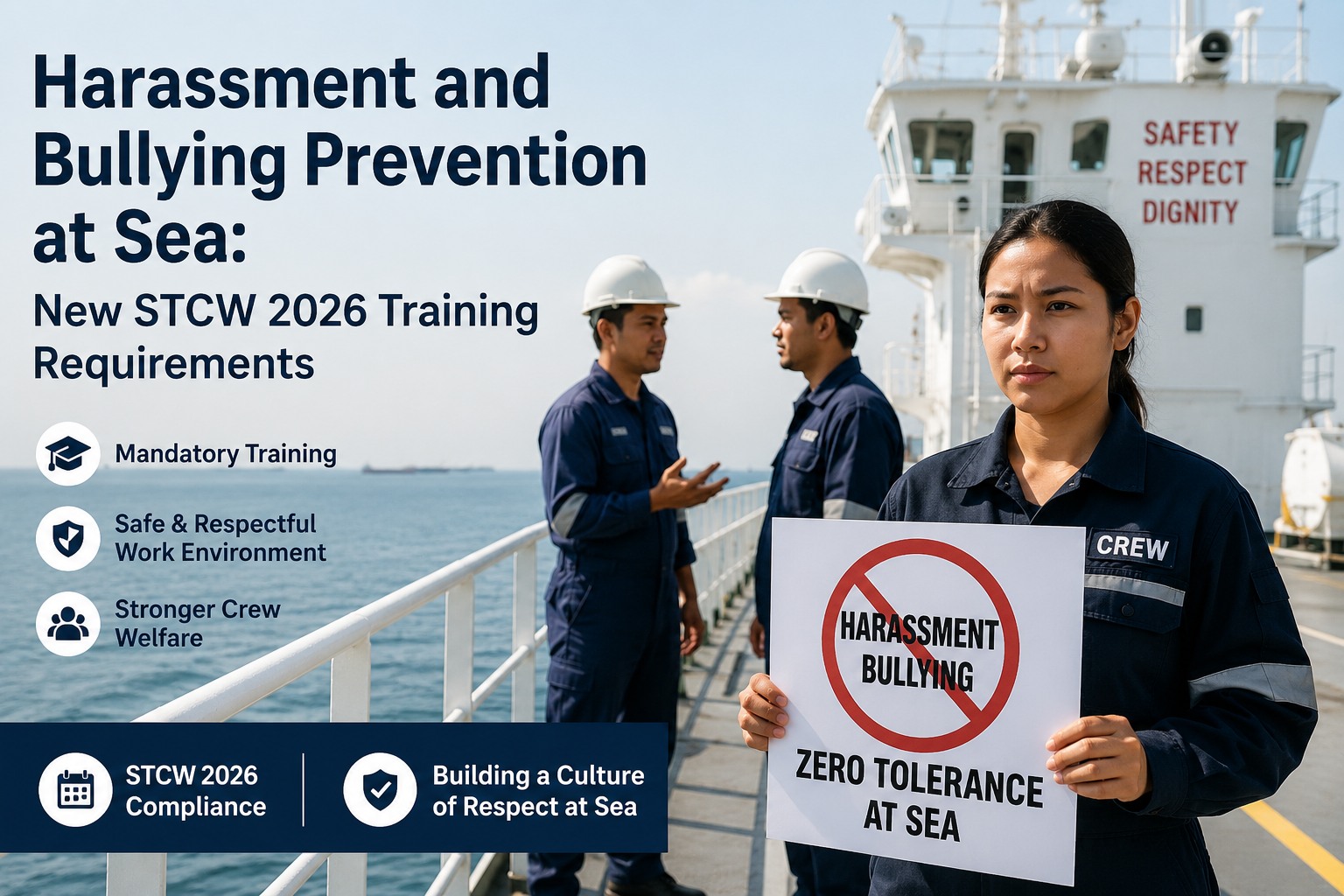
Harassment and Bullying Prevention at Sea: New STCW 2026 Training Requirements
A compliance guide for crew managers and training officers — what MSC.560(108) changed, who is affected and when, the required training content, employer obligations, reporting and anti-retaliation procedures, and how to evidence it all.
MSC.560(108)
Adopted 23 May 2024, in force 1 January 2026
Table A-VI/1-4
The PSSR competence table, revised with a new mandatory item
First of its kind
First mandatory global STCW standard on harassment
What Actually Changed
The change is precise and worth stating exactly, because it is frequently misunderstood. IMO Resolution MSC.560(108), adopted on 23 May 2024, amended Part A of the STCW Code and fully replaced Table A-VI/1-4, the Personal Safety and Social Responsibilities module of Basic Safety Training. See certification tracking in a demo.
The new competence
The revised table adds a seventh item to the competence column: "Contribute to the prevention of and response to violence and harassment, including sexual harassment, bullying, and sexual assault." Previously the table held six competences.
Where it sits
Within PSSR, one of the four elements of Basic Safety Training. Because every seafarer completes Basic Training, the requirement reaches the entire workforce, not a specialist subset.
A mandatory minimum
This is a minimum standard under international maritime law, applicable to every seafarer on an international trading SOLAS vessel — not a recommendation, a company policy, or an optional module.
How competence is shown
Through assessment of evidence obtained from approved instruction, in line with the standard method for demonstrating a PSSR competence. Approved training providers have updated their PSSR courses to deliver it.
Why now
The amendment followed the work of the ILO/IMO Joint Tripartite Working Group and growing evidence of harassment at sea, particularly affecting women seafarers and junior ranks, combined with the recognised safety cost of interpersonal conflict.
The alignment matters too: the amendment deliberately brings STCW into line with the Maritime Labour Convention's expectations of a harassment-free workplace, and reflects wider industry commitments to diversity, inclusion, and psychological safety. This is the training system catching up with a duty that already existed in principle.
Who Is Affected, and When
The most common confusion is over retroactivity. The rule is applied prospectively, and understanding that saves a great deal of unnecessary retraining. See expiry tracking in a demo.
1
New PSSR from 1 January 2026
Every seafarer obtaining or revalidating PSSR — as part of Basic Training or a refresher — on or after this date must receive the new competence. Approved courses now include it as standard.
2
Existing certificates stay valid
A Basic Safety Training certificate issued before 1 January 2026 remains legally valid until its expiry date. STCW amendments are applied prospectively, not retroactively, so joining a vessel in 2026 does not by itself trigger a renewal.
3
The new competence arrives at refresher
Existing seafarers pick up the training naturally at their next five-yearly BST refresher or revalidation, when the updated PSSR content is delivered. No mid-certificate retraining is mandated.
4
But companies should not simply wait
Flag administrations and welfare bodies encourage early alignment. Even where retraining is not mandatory, providing training and guidance in line with MSC.560(108) is recommended to promote a safe and supportive working environment now.
So the compliance picture is twofold. The hard legal requirement is that anyone certificated from 2026 holds the new competence — a matter of checking certificates and provider content. The softer but strongly encouraged expectation is that companies do not simply wait five years for the fleet to cycle through refreshers, but move proactively to close the gap, because the underlying problem does not wait for certificate expiry.
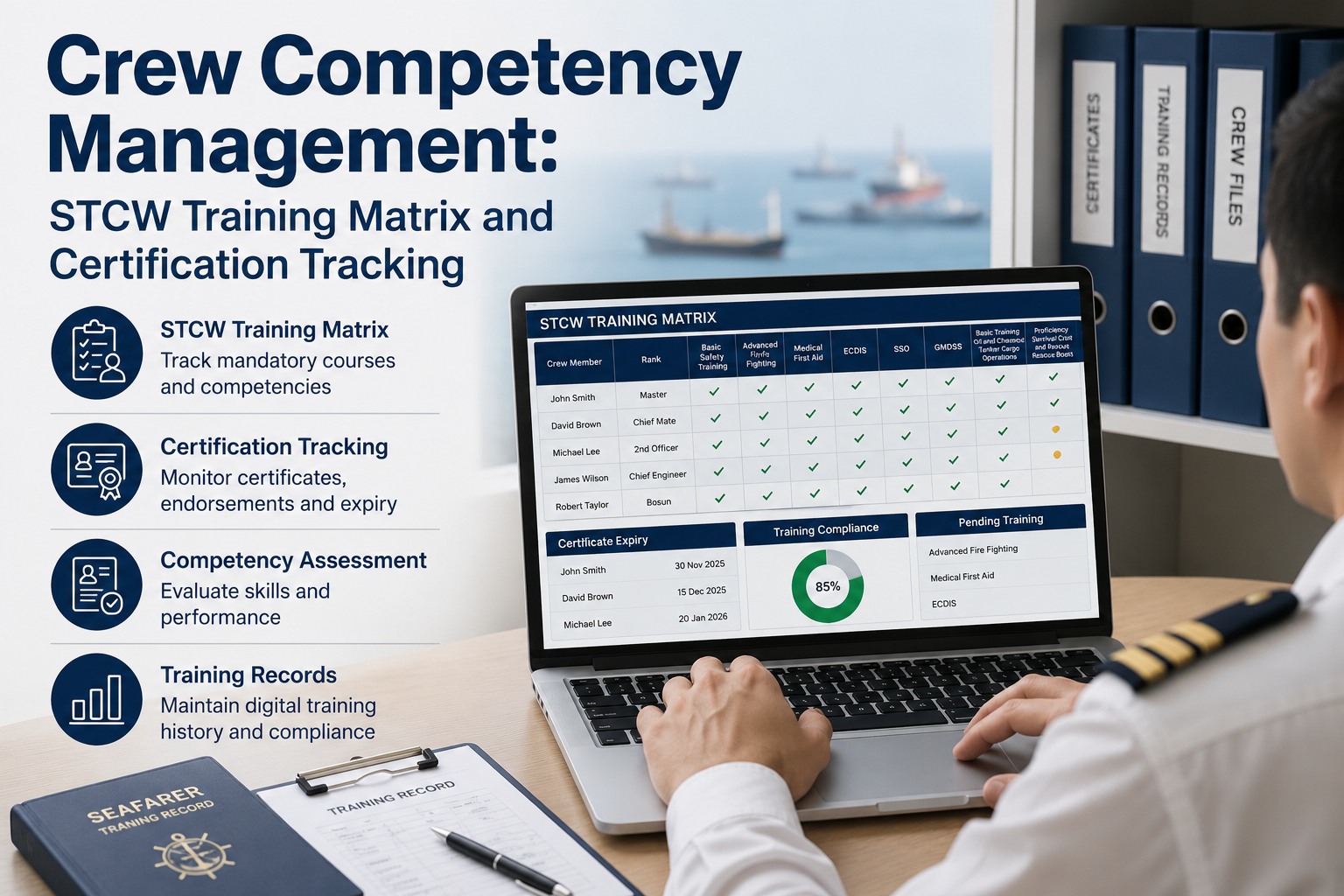
Know exactly who holds the new competence
Track PSSR Certification Across the Whole Crew
The 2026 competence arrives on rolling refresher dates across your crew pool, and you need to know precisely who has it and who does not. Marine Inspection tracks PSSR and Basic Training certification per seafarer, flags upcoming refreshers, records policy acknowledgement and any supplementary training, and keeps the documentary evidence a flag or vetting inspector will ask for. Book a 30-minute demo to see crew certification tracking, or start a free trial today.
What the Training Must Cover
The revised PSSR competence is not a single lecture but a set of learning outcomes aimed at changing behaviour and building the confidence to act. A crew manager should know what a compliant course delivers.
Recognising the behaviour
What constitutes violence and harassment, including sexual harassment, bullying, and sexual assault — so seafarers can identify unacceptable conduct at an early stage rather than normalising it.
Understanding the impact
The consequences of such conduct for crew welfare, mental health, and ship safety, framing harassment as a safety issue and not merely a personal grievance.
Knowing the risk factors
The conditions that enable harassment — power imbalance, isolation, fatigue, stress, and alcohol — so both individuals and companies can address the environment, not just the incident.
Responding and reporting
How to respond to an incident, the reporting procedures available, and the role of the bystander in intervening safely and supporting a colleague who has been targeted.
Supporting a respectful culture
Building and sustaining a respectful working environment, understanding cultural differences on a multinational crew, and the individual's part in the shipboard culture.
Basic trauma-informed response
Principles for responding to a person who has experienced harassment or assault with sensitivity, avoiding further harm, and directing them toward support.
The design intent, as the IMO put it, is to strengthen crew readiness, promote reporting, and support safer shipboard environments — recognising that interpersonal behaviour and psychological safety are integral to overall maritime safety. Training is the visible part; the harder work is what surrounds it.
Employer Obligations Beyond the Course
MSC 108 was explicit that training alone is not enough. It set out a series of actions for stakeholders that turn a trained crew into a genuinely safer workplace, and these are where a crew manager's real responsibility lies. See policy records in a demo.
Implement policies
Clear, written anti-harassment and anti-bullying policies that define unacceptable conduct and the company's expectations, applying to onboard and shore personnel alike.
Establish open reporting
Reporting procedures that seafarers trust and can actually use, including routes that do not depend solely on reporting to the very person who may be the problem.
Prevent retaliation
Concrete measures to protect anyone who reports an incident from retaliation. Fear of reprisal is the single greatest barrier to reporting, so anti-retaliation protection is what makes a reporting system real.
Provide care and assistance
Support for victims — access to welfare services, confidential help, and appropriate follow-up. A report that leads nowhere teaches the crew not to report.
Set the tone from the top
Leadership that models respect and treats the policy as real. A master and senior officers who take harassment seriously do more for the culture than any single training module.
The relationship between these obligations and the training is symbiotic. Training tells a junior seafarer that raising a concern is legitimate; the reporting procedure gives them a channel; anti-retaliation protection makes it safe to use; and victim support proves the system works. Remove any one and the others weaken. The 2026 requirement is best understood not as a training box to tick but as the trigger to build the whole framework.
Building Reporting and Anti-Retaliation Procedures
Because fear of reprisal is what silences most incidents, the reporting mechanism deserves particular care. A procedure that looks complete on paper can still fail the seafarer who needs it.
Multiple channels
More than one route to report — to the master, to a designated officer, to shore management, and to a confidential external line — so a seafarer is never forced to report to their harasser.
Confidentiality
Handling reports discreetly, sharing information only as far as needed to act, and protecting the identity of the reporter as far as the investigation allows.
Explicit anti-retaliation
A written, enforced guarantee that reporting in good faith will not damage a seafarer's position, contract, or future employment, with consequences for those who retaliate.
Defined response
A clear process for what happens after a report — acknowledgement, investigation, and outcome — so the seafarer knows the report will be taken seriously and acted upon.
Records and follow-through
Documented handling of each report, both to demonstrate the company acted and to surface patterns that point to a person or vessel needing intervention.
External support signposted
Awareness of confidential welfare helplines and seafarer support organisations, so a crew member has somewhere to turn beyond the company chain if they need it.
None of this replaces the company's duty; it operationalises it. And it connects directly to seafarer mental health, because harassment and bullying are documented drivers of depression, anxiety, and worse at sea. A functioning reporting and support system is a mental-health intervention as much as a compliance one.
Evidencing Compliance
Finally, the 2026 requirement changes what a company must be able to prove, and a crew manager should be clear on where the documentary burden falls.
Certification evidence
That seafarers certificated from 2026 hold PSSR reflecting the new competence, and that the training provider's course is approved and current. Certificates and their validity are the core record.
Policy evidence
A current anti-harassment policy, crew acknowledgement that they have read and understood it, and reporting procedures documented and communicated to all personnel.
Training evidence
Records of any supplementary onboard training, awareness sessions, or briefings the company provides ahead of the natural refresher cycle, demonstrating proactive alignment.
Handling evidence
Where incidents occur, documented handling that shows the reporting procedure worked, retaliation was prevented, and the victim was supported — the proof the framework is real.
Compliance auditing and inspection will confirm that PSSR courses cover the new requirements and that seafarers on board after 1 January 2026 hold the relevant certification or evidence of the training. That is a records discipline layered on top of the deeper cultural work — and the two reinforce each other. The company that tracks certification cleanly, documents its policy and reporting framework, and records how incidents were handled has both the compliance evidence and the operating system of a respectful workplace. The 2026 requirement is the occasion; the lasting value is the culture it forces into being. Book a demo to see certification, policy, and training records in one system.
Frequently Asked Questions
What is the new 2026 STCW harassment training requirement?
IMO Resolution MSC.560(108), adopted on 23 May 2024 and in force from 1 January 2026, amended STCW Table A-VI/1-4 (the PSSR module of Basic Safety Training) to add a mandatory competence: contributing to the prevention of and response to violence and harassment, including sexual harassment, bullying, and sexual assault. It is the first mandatory global STCW standard on the subject.
Do existing seafarers need to retrain immediately?
No. STCW amendments are applied prospectively, not retroactively. A Basic Safety Training certificate issued before 1 January 2026 remains valid until its expiry date, and the new competence is picked up at the next five-yearly refresher. However, flag administrations and welfare bodies recommend companies align early rather than waiting for the fleet to cycle through refreshers.
Who does the requirement apply to?
Every seafarer on an international trading SOLAS vessel, because the competence sits within PSSR, an element of Basic Safety Training that all seafarers complete. Any seafarer obtaining or revalidating PSSR on or after 1 January 2026 must receive the new competence through an approved course.
What must the training cover?
Recognising violence and harassment including sexual harassment, bullying and sexual assault; understanding the impact on welfare, mental health and safety; the risk factors such as power imbalance, isolation, fatigue and stress; how to respond and report; the bystander role; supporting a respectful culture across a multinational crew; and basic trauma-informed response principles.
What are the employer's obligations beyond training?
MSC 108 called for implementing clear anti-harassment policies, establishing open reporting procedures, putting measures in place to prevent retaliation against those who report, and providing care and assistance to victims. Training equips the crew; these obligations build the framework that makes reporting safe and support real.
How does this relate to the Maritime Labour Convention?
The STCW amendment deliberately aligns with the Maritime Labour Convention's expectations of a harassment-free workplace, and reflects broader industry commitments to diversity, inclusion, and psychological safety. Together they move harassment from an informal matter of shipboard culture to a defined obligation under maritime law.
How is compliance evidenced?
Through certification showing seafarers hold PSSR reflecting the new competence, a documented and acknowledged anti-harassment policy, records of reporting procedures and any supplementary training, and documented handling of any incidents. Compliance is audited and inspected as part of existing flag and vetting oversight, so seafarers on board after 1 January 2026 should hold the relevant certification or evidence of the training.
Compliance and culture in one record
Turn the 2026 Requirement Into a Working System
Track PSSR and Basic Training certification per seafarer with refresher alerts, hold the anti-harassment policy and crew acknowledgements, record reporting procedures and supplementary training, and document how any incident was handled — so you can prove compliance to a flag or vetting inspector and build the respectful workplace the rule intends. Marine Inspection keeps it all on one record. Book a tailored demo, or start a free trial today.