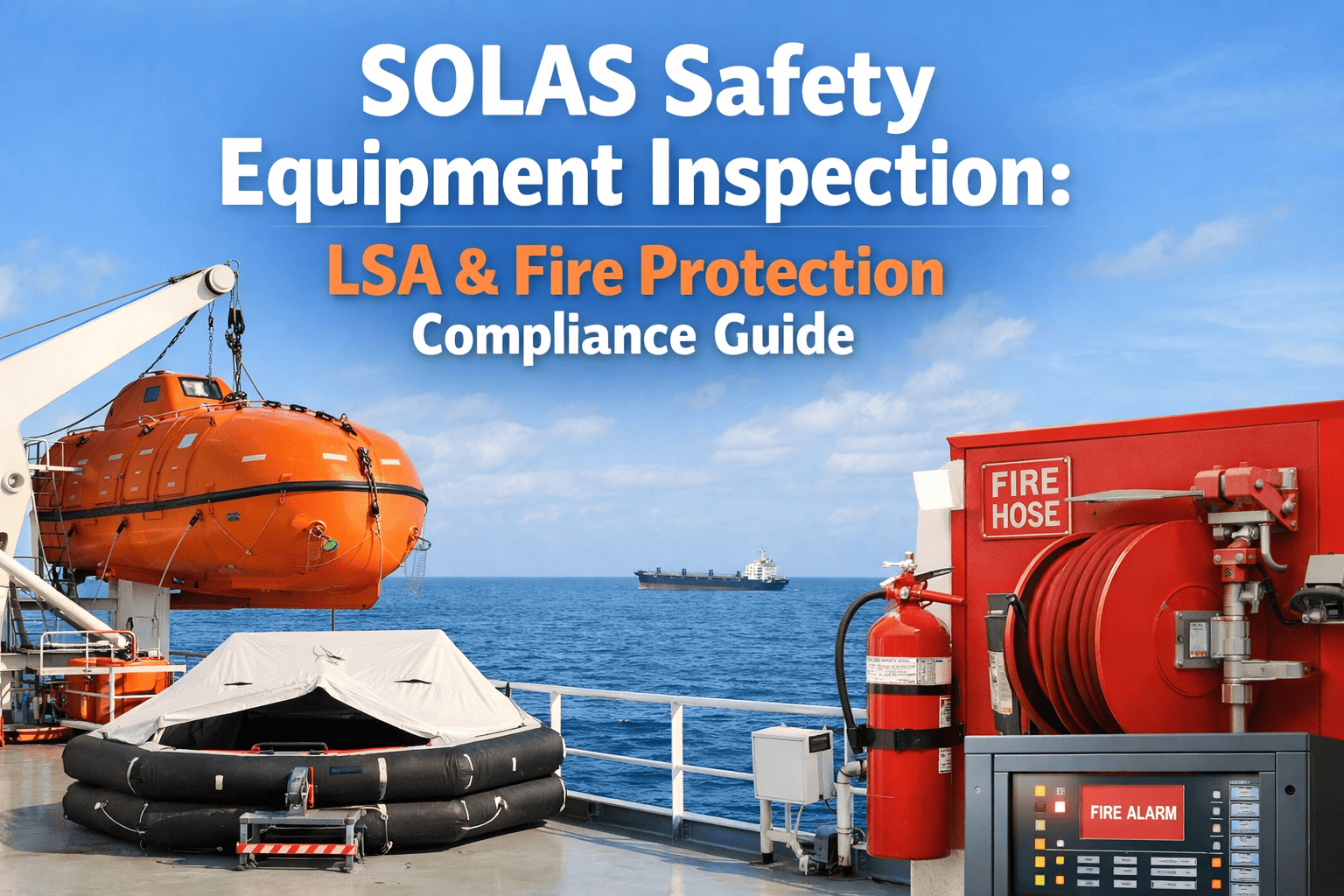
SOLAS Chapter III Regulation 20 is unambiguous: lifesaving appliances must be in working order and ready for immediate use at all times — before the ship departs from port and throughout every voyage. The 2026 amendments tightened the standard substantially. Resolution MSC.554(108) effective January 1, 2026 updates lifeboat release mechanisms, launching appliance lowering speeds, and personal lifesaving appliance standards for equipment installed on or after the cutover date. MSC.559(108) adds ventilation system checks to the annual thorough examination. MSC.535(107) introduces ventilation requirements for totally enclosed lifeboats. Port State Control treats LSA findings with zero tolerance — an on-load release hook that has not been tested, a life raft with an expired Hydrostatic Release Unit (HRU), an EPIRB with a dead battery, expired pyrotechnics — any one of these triggers a serious deficiency notice and can detain the vessel. Expired pyrotechnics is the most common detention cause across the fleet. LSA Code Chapters III and IV plus MSC.402(96), MSC.81(70), and MSC.1/Circ.1612 layer the detailed technical specifications. Lifesaving appliance inspection software runs LSA Code-aligned digital checklists, automated expiry tracking per equipment item, photo evidence capture, and PSC-ready audit trails. Start a free trial of Marine Inspection to keep every lifeboat, raft, jacket, suit, EPIRB, and pyrotechnic compliant against the 2026 LSA standard.
Lifesaving Appliance Inspection Software · 2026
Lifeboats. Rafts. Jackets. Suits. EPIRBs. Pyrotechnics. Every Expiry Tracked. Every Date Defended.
LSA Code Chapter III/IV digital checklists, MSC.554/559/535 2026 amendments built in, automated expiry tracking, HRU and pyrotechnic alerts, PSC-ready audit pack.
M/V Pacific Star · LSA Expiry Tracker
28 May Live
Life Raft #1 Service
142d
OK
Pyrotechnics Set A
18d
ALERT
The Six LSA Equipment Categories Every Inspection Covers
SOLAS Chapter III, the LSA Code Chapters III and IV, and the 2026 MSC amendments converge on six LSA equipment categories that every vessel must inspect, maintain, and document. Each category has its own service intervals, certificate requirements, and PSC verification expectations.
01
Lifeboats & Rescue Boats
Totally enclosed, partially enclosed, open, and free-fall variants. Structural examination, engine 3-minute weekly run test, on-load release hook condition, fuel system, fittings inventory. MSC.554(108) lowering speeds and release mechanisms for installations on or after 1 January 2026.
02
Life Rafts & HRUs
Inflatable life rafts serviced at approved stations at intervals not exceeding 12 months. Hydrostatic Release Units replaced at maximum 2-year intervals regardless of condition. Container, lashing, painter line, SOLAS certificate, packing list — all verified.
03
Life Jackets & Immersion Suits
Personal LSA per LSA Code Chapter II. Inflation cylinder weight check, light battery, whistle, retro-reflective tape. Immersion suits inspected for seal integrity, zip function, attached light. MSC.554(108) personal LSA standards effective 1 January 2026.
04
EPIRBs & SARTs
406 MHz float-free EPIRB registered with national authority, annual functional test, battery replacement per manufacturer schedule (typically every 5 years). Two Search and Rescue Transponders or AIS-SARTs — one per side. HRU on EPIRB verified.
05
Pyrotechnics
Parachute rockets, hand flares, buoyant smoke signals — 3-4 year shelf life from manufacture date. Expiry dates checked monthly. Replace before expiry without exception. Stowed in cool, dry, secure locker accessible in emergency. Most common PSC detention cause when expired.
06
Launching Appliances & Davits
Davit structure, winch brake, wire falls (5-year renewal), limit switches, hydraulic system, lowering speed control per MSC.554(108). Annual thorough examination with dynamic winch brake test at maximum lowering speed.
The LSA Servicing & Inspection Interval Matrix
The matrix below maps every LSA equipment item to its required servicing interval, responsible party, and evidence the PSC inspector expects to see. The intervals are not aspirational — they are SOLAS-mandated, and missed intervals are the leading source of detention findings. Scroll horizontally on mobile for the full view. Book a servicing-interval walkthrough to map your fleet against the regulatory baseline.
| Equipment |
Interval |
Responsible Party |
Evidence Required |
| Lifeboat visual inspection |
Weekly |
Officer of the watch |
Inspection log + photo |
| Lifeboat engine run test |
Weekly · 3 minutes minimum |
Chief officer or engineer |
Engine log + run time record |
| Lifeboat lowering to water |
Quarterly · at least one |
Master + chief officer |
Drill record + photo + signatures |
| Lifeboat thorough examination |
Annual |
Authorised service provider |
Service certificate + report |
| Davit dynamic winch brake test |
Annual at max lowering speed |
Authorised service provider |
Test certificate + load data |
| Davit wire fall renewal |
Every 5 years |
Authorised service provider |
Renewal certificate + photo |
| Life raft service |
12 months max (17m exceptional) |
Approved service station |
Service certificate + packing list |
| HRU replacement |
2 years max (some models annual) |
Approved service station |
Replacement certificate + photo |
| Pyrotechnics expiry check |
Monthly inspection |
Chief officer or safety officer |
Expiry log + dates of all flares |
| EPIRB functional test |
Annual + monthly self-test |
Radio officer or master |
Test certificate + battery date |
| Life jacket inspection |
Quarterly visual + annual |
Safety officer |
Inventory log + cylinder weights |
| Abandon ship drill |
Monthly cargo · weekly passenger |
Master |
Drill record + crew participation |
The Six Top PSC LSA Deficiencies The Software Prevents
Port State Control LSA deficiency data is unambiguous about where the failures recur. Six top failure points generate the substantial majority of LSA detentions across global MOUs. Each prevention pathway is structurally built into the inspection software workflow.
01
Expired Pyrotechnics
Most common LSA detention cause. 3-4 year shelf life from manufacture date. Monthly expiry check missed, replacement deferred past expiry, expired flares retained on board. Software tracks every flare individually with countdown to expiry and replacement alert at 90 days.
02
Untested On-Load Release Hooks
Stiff, corroded, or improperly reset on-load release hooks. PSC treats untested hooks as grounds for serious deficiency or detention. Software runs the test workflow with photo evidence at each test and timestamp against the test schedule.
03
Expired HRU On Life Rafts
A life raft with valid service but an expired Hydrostatic Release Unit is non-compliant regardless of the raft's own service date. PSC inspectors check both dates independently. Software tracks raft service certificate and HRU date as separate items with independent alerts.
04
EPIRB Battery / Test Lapses
EPIRB battery expiry past due, missing annual test certificate, or unregistered EPIRB. Software tracks battery installation date with countdown to manufacturer-specified expiry (typically 5 years), monthly self-test record, and annual test certificate validity.
05
Davit Wire Falls Beyond Renewal
5-year wire fall renewal interval missed. Wire degradation in marine environments progresses internally — visual checks alone are insufficient. Software tracks renewal date per davit with 12-month and 6-month alerts before expiry.
06
Lifeboat Engines That Won't Start
Engine fails to start during PSC observation. 3-minute weekly run test missed, fuel system degraded, battery aged. Software enforces weekly engine start workflow with run-time recording, photo of fuel level, and battery condition log.
The 2026 LSA Code Amendments Impact Matrix
Three MSC resolutions reshape LSA inspection requirements through 2026 and beyond. The matrix below maps each resolution to its scope, effective date, and the actions operators must take to remain compliant. Mobile users scroll horizontally for the full view.
| Resolution |
Scope |
Effective Date |
Required Action |
| MSC.554(108) |
Lifeboat release mechanisms |
1 January 2026 |
Identify on-load vs off-load systems |
| MSC.554(108) |
Launching appliance lowering speeds |
1 January 2026 |
Speed-limiting device for new installs |
| MSC.554(108) |
Personal LSA standards |
1 January 2026 |
Apply to new installations from cutover |
| MSC.554(108) |
Lifeboat fittings |
1 January 2026 |
Updated fitting specifications |
| MSC.559(108) |
Ventilation in annual examination |
1 January 2026 |
Add ventilation test to annual scope |
| MSC.559(108) |
2020 maintenance regime update |
1 January 2026 |
Operational test of ventilation |
| MSC.535(107) |
Ventilation requirements TELB |
1 January 2026 (force) |
Applies to TELB installed 1 Jan 2029+ |
| MSC.535(107) |
Free-fall lifeboat simulation |
1 January 2026 |
Simulation device for routine drills |
| MSC.535(107) |
Ventilation capacity standard |
1 January 2026 |
≥5 m³/hour per person · 24h operation |
| MSC.81(70) revisions |
Testing of LSA |
1 January 2026 |
Updated testing procedures |
LSA Inspection Demo · 30 Minutes
See LSA Expiry Tracking And 2026 Amendments On Your Fleet
A 30-minute session with a Marine Inspection product expert. Bring a current LSA register from one of your vessels. Walk through six-category coverage, twelve-row servicing interval matrix, ten-row 2026 amendments matrix, and PSC defence pack generation on real LSA data.
The Six Workflows LSA Inspection Software Should Cover
Beyond the basic checklist, six workflows separate a credible LSA inspection platform from a static PDF library. Each addresses a recurring operational pattern that paper checklists or generic apps cannot match for safety officers and masters.
A
Automated Expiry Tracking Per Item
Every flare, every HRU, every battery, every wire fall, every service certificate tracked as an individual item with its own countdown. Alerts at 90 days, 30 days, expiry. No manual spreadsheet drift.
B
Weekly & Monthly Inspection Workflow
SOLAS III/20 weekly inspections and monthly drills structured as guided workflows. Officer of the watch and chief officer assigned automatically. Engine 3-minute run test timer built in.
C
Quarterly Drill Documentation
Quarterly lifeboat lowering to water captured with photos, time-stamps, crew participation, master signature. SOLAS III/19 drill records assembled automatically rather than reconstructed.
D
Annual Service Coordination
Approved service station booking aligned to ship's port rotation. Service certificates uploaded by service provider directly. Packing lists, HRU certificates, davit test results consolidated.
E
2026 Amendments Compliance Pack
MSC.554/559/535 amendments mapped to fleet equipment with installation dates. Pre-cutover gap analysis. Post-cutover compliance evidence assembled for class society and PSC review.
F
PSC LSA Defence Pack
PSC inspector arrives. Master pulls LSA defence pack — expiry tracker, weekly inspection log, drill records, service certificates, HRU dates, pyrotechnic register — in a single export. Defence assembled in minutes.
Why Marine Inspection For LSA Inspection Software
Marine Inspection delivers a safety-officer-first LSA inspection platform on the six-equipment-category framework, twelve-row servicing interval matrix, six-deficiency prevention focus, ten-row 2026 amendments coverage, and six workflow capabilities. Start a free trial or book a 30-minute demo to see LSA inspection on your fleet.
LSA Code Chapter III/IV Aligned
Survival craft, personal LSA, pyrotechnics, EPIRB, SART all mapped to LSA Code requirements. SOLAS III/20 working order standard enforced. MSC.402(96), MSC.81(70), MSC.1/Circ.1612 technical specs built in.
2026 Amendments Pre-Loaded
MSC.554(108) release mechanisms and lowering speeds, MSC.559(108) ventilation in annual examination, MSC.535(107) TELB ventilation — all amendments mapped to fleet equipment with installation-date logic.
Per-Item Expiry Tracking
Every flare, every HRU, every EPIRB battery, every wire fall tracked individually with countdown. Alerts at 90, 30 days. No manual spreadsheet drift, no surprise PSC deficiencies on expired items.
Mobile-First Offline Capture
Lifeboat deck, raft cradle, bridge wing, accommodation locker all supported offline. Auto-sync on connectivity. Photo evidence per inspection with GPS coordinates and timestamp.
Service Provider Integration
Approved service stations upload certificates directly. Packing lists, HRU certificates, davit test results consolidated. Annual service coordination aligned to port rotation rather than crisis-driven.
PSC & Class Defence Pack
PSC inspector or class surveyor arrives. Master pulls LSA defence pack — expiry tracker, weekly logs, drill records, service certificates — in a single export. Defence assembled in minutes rather than reconstructed in hours.
Frequently Asked Questions
What does lifesaving appliance inspection software do?
Lifesaving appliance inspection software runs LSA Code-aligned digital checklists across the six SOLAS Chapter III equipment categories — lifeboats and rescue boats, life rafts and HRUs, life jackets and immersion suits, EPIRBs and SARTs, pyrotechnics, and launching appliances and davits. Per-item expiry tracking covers every flare, every HRU, every EPIRB battery, every wire fall as an individual tracked item with countdown to expiry and alerts at 90 and 30 days. Weekly, monthly, quarterly, and annual workflows guide officers of the watch, chief officers, masters, and approved service stations through their respective SOLAS Chapter III duties. 2026 amendments coverage includes MSC.554(108) release mechanisms and lowering speeds effective 1 January 2026, MSC.559(108) ventilation in annual thorough examination, MSC.535(107) totally enclosed lifeboat ventilation requirements. PSC defence pack assembled in single export with expiry tracker, weekly logs, drill records, service certificates, HRU dates, and pyrotechnic register.
What did the 2026 LSA Code amendments change?
Three MSC resolutions reshape LSA inspection requirements effective 1 January 2026. MSC.554(108) updates lifeboat release mechanisms (clear identification of on-load versus off-load release systems with different operational and testing requirements), launching appliance lowering speeds (new formula S = 0.4 + 0.02H with minimum 1.0 m/s and maximum 1.3 m/s plus mandatory speed-limiting device), personal lifesaving appliance standards, and lifeboat fittings — all applying to equipment installed on or after 1 January 2026. MSC.559(108) enhances the 2020 maintenance regime under MSC.402(96) by requiring ventilation systems to be included in annual thorough examinations and operational tests for lifeboats. MSC.535(107) updates the LSA Code with ventilation requirements for totally enclosed lifeboats (minimum 5 m³/hour per person, functional for at least 24 hours, operable from inside, watertight under submerged conditions) effective 1 January 2026 in force but applying to TELB installed 1 January 2029 and after. MSC.81(70) Revised recommendations on testing of LSA also updated.
What are the top PSC LSA deficiencies the software prevents?
Six top failure points generate the substantial majority of LSA detentions across global MOUs. Expired Pyrotechnics is the most common LSA detention cause — 3-4 year shelf life from manufacture date with monthly expiry check missed, replacement deferred past expiry, expired flares retained on board, prevented by individual tracking of every flare with countdown and replacement alert at 90 days. Untested On-Load Release Hooks — stiff, corroded, or improperly reset hooks treated as grounds for serious deficiency or detention, prevented by test workflow with photo evidence and timestamp. Expired HRU On Life Rafts — a life raft with valid service but expired Hydrostatic Release Unit is non-compliant regardless of raft service date, prevented by tracking raft service certificate and HRU date as separate items with independent alerts. EPIRB Battery or Test Lapses — battery expiry past due, missing annual test certificate, unregistered EPIRB. Davit Wire Falls Beyond Renewal — 5-year wire fall renewal interval missed with wire degradation progressing internally invisible to visual checks. Lifeboat Engines That Won't Start — 3-minute weekly run test missed, fuel system degraded, battery aged.
What are the LSA servicing intervals?
SOLAS Chapter III and the LSA Code define a hierarchy of servicing and inspection intervals. Weekly — lifeboat visual inspection by officer of the watch, lifeboat engine 3-minute run test by chief officer or engineer. Monthly — pyrotechnic expiry check by chief officer or safety officer, abandon ship drill (weekly for passenger vessels). Quarterly — lowering at least one lifeboat to the water with master and chief officer signatures, life jacket visual inspection. Annual — lifeboat thorough examination by authorised service provider with service certificate, davit dynamic winch brake test at maximum lowering speed by authorised service provider, EPIRB functional test plus monthly self-test, life jacket inflation cylinder weight verification. 12 months maximum — life raft service at approved service station (17 months exceptional with flag state approval). 2 years maximum — HRU replacement at approved service station regardless of condition (some models require annual replacement). 5 years — davit wire fall renewal because wire degradation in marine environments progresses internally and visual checks alone are insufficient.
How are HRUs different from raft service certificates?
Hydrostatic Release Units and life raft service certificates are independent compliance items that PSC inspectors check separately. The life raft itself is serviced at intervals not exceeding 12 months at flag-state-approved service stations — the raft is fully inflated, inspected for damage to fabric and seams, all equipment verified against the SOLAS packing list, expired pyrotechnics and rations replaced, mechanical components (inflation cylinders, relief valves, boarding ramps) tested. The service station issues a 12-month certificate that must be on board for PSC inspection. The HRU is the mechanism that automatically releases the raft from its cradle if the vessel sinks before manual release. HRUs must be replaced at maximum 2-year intervals regardless of apparent condition, with some manufacturers requiring annual replacement depending on model specifications. A life raft with valid 12-month service but an expired HRU is considered non-compliant regardless of the raft's service date. Both dates tracked separately in the software with independent alerts at 90 and 30 days before expiry.
How does the software handle 2026 release mechanism changes?
MSC.554(108) effective 1 January 2026 requires clear identification of whether the lifeboat hook system is on-load or off-load release. Each type is subject to different operational requirements, maintenance procedures, and inspection criteria under the LSA Code and MSC.402(96). For single-fall hook arrangements without on-load release capability, the release may only be possible when the boat is fully waterborne (off-load release) — such hooks are therefore not subject to all the detailed design and testing requirements applicable to on-load release mechanisms. Launching systems must incorporate a speed-limiting control device that complies with the new standard, ensuring safe and controlled descent in all sea and loading conditions. The new lowering speed formula is S = 0.4 + 0.02H where H is height from davit head to waterline in light condition, with minimum speed 1.0 m/s and maximum 1.3 m/s for fully loaded boats. The software enforces release mechanism identification at equipment register set-up, applies the appropriate testing protocol per type, and generates the lowering speed verification record per launching appliance.
How does Marine Inspection handle LSA inspection?
Marine Inspection delivers a safety-officer-first LSA inspection platform on the six-equipment-category framework (lifeboats and rescue boats, life rafts and HRUs, life jackets and immersion suits, EPIRBs and SARTs, pyrotechnics, launching appliances and davits), twelve-row servicing interval matrix mapped to SOLAS Chapter III requirements, six-deficiency prevention focus on the recurring PSC failure points, ten-row 2026 amendments matrix covering MSC.554(108), MSC.559(108), and MSC.535(107), and six workflow capabilities. Per-item expiry tracking with countdown and alerts at 90 and 30 days. Service provider integration with approved stations uploading certificates directly. Mobile-first offline capture for lifeboat deck and raft cradle environments. PSC defence pack assembled in a single export. 6-12 week deployment for typical mid-size fleets with free trial available before any commitment.
Ready When You Are
Every Item Tracked. Every Date Defended. Every Lifesaving Appliance Ready For Use.
Six LSA equipment categories, twelve-row servicing interval matrix, six-deficiency prevention focus, ten-row 2026 amendments matrix, per-item expiry tracking, service provider integration, PSC defence pack — all in one safety-officer-first platform built for the 2026 LSA Code reality.