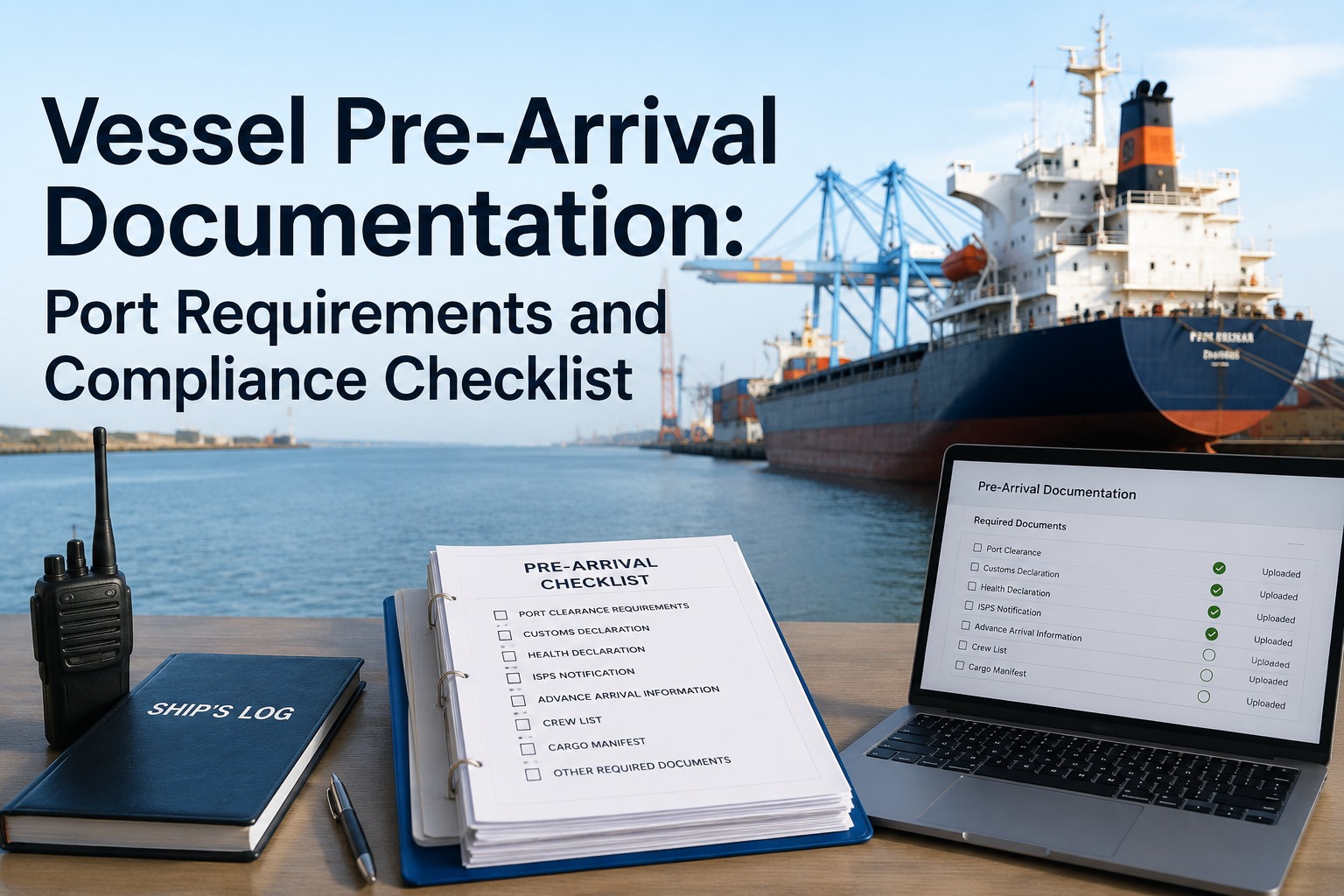
A port call is won or lost days before the vessel arrives. By the time the ship is off the pilot station, the documentation that determines whether it berths on schedule or waits at anchor has already been submitted, accepted, or flagged for a problem. For the ship agent coordinating the call and the deck officer preparing the declarations on board, pre-arrival documentation is the quiet, unglamorous work that keeps a vessel moving through the global system of customs, immigration, security, health and port authorities that every arrival must satisfy. Get it right and clearance is a formality; get it wrong and the consequences range from a few hours of delay to a refused berth, a health inspection, or a port state control examination triggered by a mismatch nobody caught. The rules governing this are more standardised than they have ever been, following the mandatory shift to electronic single-window reporting, but standardisation has not made them simple: the same voyage still touches multiple authorities, each with its own dataset, its own deadline, and its own reasons to reject an incomplete submission. This guide is a practical map of that terrain. It explains the framework that now governs pre-arrival reporting, walks through the core document set authority by authority, sets out the timeline that dictates when each piece must be submitted, addresses the country-specific variations that catch crews out, and closes with a working compliance checklist. To manage pre-arrival documentation, deadlines and evidence across every port call in your fleet from one place, start a free trial or book a demo.
INDUSTRY GUIDE · PORT CLEARANCE
Vessel Pre-Arrival Documentation: Port Requirements and Compliance Checklist
A practical guide for ship agents and deck officers to the documents, deadlines and authorities behind every port call — the FAL framework, customs and health declarations, ISPS security notification, country-specific variations, and a working checklist that keeps clearance a formality.
What this guide covers
1 The FAL framework and single window
2 The core FAL declarations
3 Customs and cargo documentation
4 Health declarations
5 ISPS security notification
6 The submission timeline
7 Country-specific requirements
8 The compliance checklist
1. The Framework: FAL and the Maritime Single Window
Every piece of pre-arrival documentation sits within one international framework, and understanding it makes the rest of the picture coherent rather than a scattered list of forms. The framework is the IMO Convention on Facilitation of International Maritime Traffic, universally shortened to FAL, which standardises the formalities, documentary requirements and procedures for ships on arrival, stay and departure.
FAL exists to solve a specific problem. When a ship enters a port, vital information has to be exchanged with a range of authorities ashore — port authorities, customs, immigration, health, police, agriculture and maritime administrations all need data about the vessel, its cargo, dangerous goods, crew and passengers, for safety, security and environmental reasons. Without a common approach, each authority would demand its own forms in its own format, and a single call would generate a mountain of duplicated paperwork. FAL standardises that information into a defined set of declarations and, crucially, limits the number of required declarations at a port, so that non-essential documents and duplication are avoided.
The most important recent change is the move to electronic single-window reporting. Since April 2019, the electronic exchange of FAL data between ship and shore has been mandatory, and from 1 January 2024 the use of a Maritime Single Window became mandatory in all ports. Under this model, each port state operates one digital entry point through which all the agencies and authorities involved exchange data via a single point of contact, replacing fragmented paper submissions and multiple reporting channels with one electronic submission per port state. The shift is so complete that references to paper-based forms have been removed from the FAL Convention entirely.
i
Mandatory does not mean uniform
The single window is mandatory everywhere, but its maturity varies sharply. Leading systems — Singapore's digitalPORT@SG, Rotterdam's Portbase, Antwerp-Bruges, and others — offer mature interfaces with automated agent submissions. Many emerging-market ports operate their single window as a portal into which the agent still re-keys each submission by hand. So while the legal requirement is uniform, the practical experience of submitting is not, and knowing which kind of system a port runs is part of preparing the call. The data requirements are the same; the ease of meeting them is not.
2. The Core FAL Declarations
At the heart of pre-arrival documentation are the standardised FAL declarations. The convention limits the required declarations at a port to nine — the seven classic FAL forms plus two health-related documents — and these are the backbone of every port call worldwide. Knowing what each one carries and who relies on it is the foundation of the whole process.
Alongside these seven, the FAL framework accommodates three further documents that the shore authorities may require: security-related information as required under SOLAS regulation XI-2, advance electronic cargo information for customs risk-assessment purposes as set out in the World Customs Organization SAFE Framework, and an advance notification for waste delivery to port reception facilities. These are the additional documents introduced for ship's clearance in the modern amendments, and they sit at the seam between the classic declarations and the specialised streams — security, customs and environmental — covered next.
3. Customs and Cargo Documentation
The customs stream is where cargo data becomes a clearance decision, and it extends beyond the FAL cargo declaration into advance information that authorities use to assess risk before the ship arrives. For the agent, this stream is where accuracy has the most direct financial consequence.
Advance cargo information
Under the WCO SAFE Framework of Standards, advance electronic cargo information is provided to customs for risk-assessment purposes before arrival. This lets customs identify high-risk consignments in advance rather than at the berth, which is what allows low-risk cargo to clear quickly — but it means the data has to be accurate and submitted in time to be assessed.
Cargo manifest and commodity detail
The cargo declaration's commodity, weight and packaging detail drives the customs assessment and the port's wharfage calculation. Discrepancies between the declared cargo and the actual cargo, or between the manifest and the bills of lading, are exactly what customs inspections are designed to surface.
Ship's stores and bonded goods
The bonded stores declaration lets customs seal and control dutiable goods aboard — alcohol, tobacco and the rest — for the duration of the stay. Under-declaring stores is treated as a serious matter, so the declaration must reflect what is genuinely aboard.
Import and export permits where applicable
Depending on the cargo and the country, import or export permits may be required as part of clearance. These are cargo-specific and country-specific, and identifying them early is part of the agent's pre-arrival preparation rather than a berth-side surprise.
4. Health Declarations
The health stream protects the port from communicable disease entering aboard the vessel, and it is governed by the International Health Regulations. Two documents anchor it, and the lessons of recent pandemics have sharpened the attention authorities pay to both.
01
Maritime Declaration of Health
Required under the International Health Regulations, this is the master's declaration of the health status of everyone aboard — reporting illness, deaths, and conditions that could indicate a communicable disease. It is one of the nine core FAL declarations and, for passenger vessels especially, is central to health pre-clearance. Health authorities increasingly cross-reference it with other digital submissions, so it cannot be treated as a formality.
02
Ship Sanitation Certificate
Also under the International Health Regulations, the vessel carries either a Ship Sanitation Control Exemption Certificate or a Ship Sanitation Control Certificate, or an extension of one. It evidences that the ship has been inspected for sanitation and, where necessary, controlled for vectors of disease. It has a validity period, so its expiry has to be tracked like any other statutory certificate, and an expired one can hold up clearance.
i
Health data is going digital and standardised
The direction of travel is toward harmonised electronic reporting of health information. Recent IMO facilitation work has approved standardised datasets relating to Ship Sanitation Certificates and supported improved interoperability between ships, public health authorities and Maritime Single Window systems. The framework also now requires authorities to keep ships and ports operational during a public health emergency, a lesson carried directly from the pandemic. For the agent, the practical implication is that health documents are becoming part of the same electronic single-window flow as everything else, cross-referenced against the crew list and the general declaration.
One place for every port call's documents and deadlines
Pre-arrival documentation fails at the seams — a certificate that expired between calls, an ETA that was updated in one system but not another, a crew change that never reached the list. Marine Inspection keeps certificates, crew records and port-call documentation current and tracked across the fleet, with deadline alerts and a complete evidence trail, so each arrival is prepared from live data rather than reassembled by hand. See how it keeps every call clearance-ready.
5. ISPS Security Notification
The security stream is the one with the tightest, most consistent pre-arrival deadline, and it flows from the International Ship and Port Facility Security Code under SOLAS chapter XI-2. Before a ship enters port, it must provide pre-arrival security information so the port can assess it against the security regime rather than imposing control measures on arrival.
The core deadline is well established: security pre-arrival information should be submitted at least 24 hours prior to arrival. Where the voyage from the last port is shorter than 24 hours, the information must be submitted no later than the time the ship leaves the previous port, and if the port of call is not yet known or changes during the voyage, it must be sent as soon as the destination is known. This is a deadline the agent and the ship security officer coordinate closely, because a late security submission can hold the vessel outside the port.
The last ten port facilities
The mandatory dataset requires a list of the last ten port facilities the ship has visited, in chronological order with the most recent first, each identified by its IMO port facility number. Accuracy here is scrutinised, because the security assessment depends on the ship's recent movements.
Security level and measures taken
The ship reports the security level at which it operated at each of those facilities and whether it took any special or additional security measures beyond its approved Ship Security Plan. This tells the receiving port how the vessel has been operating and whether anything warrants closer attention.
Ship-to-ship activities
Any ship-to-ship activities carried out during the period of those last ten calls must be listed, in chronological order. Transfers at sea are a security-sensitive event, so they form part of the picture the port assesses before granting entry.
The IMO port facility number
Facilities are identified by the IMO port facility number from the GISIS database — the port's UN/LOCODE plus a four-figure number, so a facility in Rotterdam appears as NLRTM followed by four digits. Using the correct identifier is what lets the receiving authority match the ship's history precisely.
How the security information is submitted depends on the region. In the European Union, the mandatory dataset is established in regulation and the agent submits the ship security pre-arrival information via a Port Community System such as Portbase, or an equivalent security pre-arrival form. Dangerous goods aboard must generally be reported separately from the security submission. Where a port operates at a heightened security level, or where a Declaration of Security is required, additional steps follow — but the 24-hour pre-arrival information is the consistent baseline that every ISPS port call is built around.
6. The Submission Timeline
Pre-arrival documentation is as much about timing as content, because a perfect submission sent late is still a late submission. The various streams have different deadlines, and the agent's job is to sequence them so each authority receives what it needs when it needs it. The exact windows vary by country, but the shape of the timeline is consistent.
96 hours before
The earliest window. Some jurisdictions require notice of arrival well ahead — the United States operates a 96-hour electronic Notice of Arrival for many vessels, and the Panama Canal requires pre-arrival notification 96 hours ahead. Long-lead notifications and any required permits are identified and set in motion here.
72 to 48 hours before
The main preparation window. The agent confirms the berth and the port's single-window requirements, the ship prepares its FAL declarations, certificates are checked for validity, and the crew and cargo data are finalised so the core submissions can go in complete rather than provisional.
At least 24 hours before
The security deadline. The ISPS pre-arrival security information must be submitted at least 24 hours before arrival, and many ports also expect the core FAL declarations and health declaration in this window. For voyages shorter than 24 hours, the security information goes in when the ship leaves the last port instead.
On approach and updates
Final ETA confirmation and any updates. Single-window systems often require synchronised ETA updates, and a vessel that fails to update a change can create discrepancies across port authority systems that flag the call. Keeping the ETA current across every system is the last, easily overlooked step.
i
The rejection causes to design against
Under single-window frameworks, the common reasons a submission is rejected or a call is flagged are consistent and avoidable: ETA discrepancies where an update reached some systems but not others; incomplete or mismatched crew information, one of the most frequent rejection causes; dangerous goods reporting that does not align precisely with international codes and classifications; and waste quantities inconsistent with the vessel's declared storage capacity. Each of these is a data-quality failure, not a rules failure — which means each is preventable by preparing from accurate, current records rather than reassembling data under time pressure before every call.
7. Country-Specific Requirements
The FAL framework harmonises the data, but it does not erase national variation. Individual countries and ports layer their own timelines, systems and additional requirements on top of the common dataset, and the agent's local knowledge is precisely the value of managing these differences. A few illustrative examples show the shape of the variation without substituting for checking each specific port.
United States
Vessels submit an electronic Notice of Arrival and Departure through the Coast Guard's National Vessel Movement Center, generally 96 hours in advance, covering vessel, crew and cargo information. The security and arrival regime is built on domestic maritime security regulations alongside the international ISPS baseline.
European Union
Reporting flows through national single windows and Port Community Systems such as Portbase, with the security pre-arrival dataset established in EU regulation. The 24-hour security pre-arrival information is submitted via the Port Community System, and facilities are identified by their IMO port facility number.
Hong Kong and regional variations
Ports set their own pre-arrival notification requirements — Hong Kong, for instance, requires a pre-arrival notification at least 24 hours before entering its waters, with the security information on a separate page. Many ports across Asia and elsewhere follow the 24-hour baseline with local submission channels.
Canal and waterway transits
Transits such as the Panama Canal carry their own pre-arrival notification regimes — the Panama Canal Authority requires notification 96 hours ahead, and failure to submit timely and complete notifications carries consequences. A canal transit is a separate documentation event from the port call at either end.
The practical rule is that the FAL dataset tells you what information you will need, but the specific port tells you when, how and to whom it must be submitted, and whether anything additional is required. This is why an experienced agent confirms the requirements for the specific port and berth well in advance rather than assuming the last call's process applies to the next one. The data is harmonised; the procedures are local.
8. The Pre-Arrival Compliance Checklist
Bringing it together, the following checklist organises pre-arrival documentation by stream so that nothing is missed. It is a working structure to adapt to each specific port rather than an exhaustive legal list, and the discipline it encodes is simple: prepare each stream from current, accurate records, and submit each to its deadline.
Core FAL declarations
General Declaration prepared with correct vessel, voyage and ETA data
Cargo Declaration reconciled against the bills of lading
Ship's Stores Declaration reflecting bonded goods genuinely aboard
Crew's Effects Declaration consistent with the crew list
Crew List complete and matching passports and documents
Passenger List prepared, or nil return confirmed
Dangerous Goods Manifest aligned precisely with IMDG codes
Customs and cargo
Advance cargo information submitted for customs risk assessment
Commodity, weight and packaging detail verified against actual cargo
Any required import or export permits identified and in hand
Waste delivery advance notification prepared where applicable
Health
Maritime Declaration of Health completed by the master
Ship Sanitation Certificate valid and not expired
Any illness or health events aboard reported accurately
Security (ISPS)
Pre-arrival security information submitted at least 24 hours ahead
Last ten port facilities listed with correct IMO port facility numbers
Security levels and any additional measures recorded
Ship-to-ship activities during the last ten calls declared
Declaration of Security prepared if required by the port
Timing and coordination
Country-specific deadlines confirmed for the specific port and berth
Long-lead notices (96-hour, canal transits) submitted on time
Submissions made through the correct single-window or community system
ETA kept synchronised across every system as it changes
Pre-arrival documentation rewards preparation and punishes improvisation. The framework behind it is now more unified than at any point in the history of shipping — one convention, one dataset, one electronic entry point per port state — and yet the work of getting a vessel cleared still comes down to the same disciplines it always did: knowing which authorities need what, preparing each declaration from accurate and current records, meeting every deadline in the right sequence, and confirming that what was submitted was actually received and accepted. The agents and officers who make port calls look effortless are not the ones who work fastest at the last minute; they are the ones for whom the documentation was ready days out, drawn from records that were already current, so the arrival is a confirmation rather than a scramble. When the certificates are tracked, the crew and cargo data are live, and the deadlines are visible, clearance becomes what FAL always intended it to be — a formality that lets the ship get on with the voyage. To keep the documents, certificates and deadlines behind every port call current and tracked across your fleet, start a free trial or book a demo.
Frequently Asked Questions
What documents does a vessel need before arriving at a port?
At minimum, the core FAL declarations: the General Declaration, Cargo Declaration, Ship's Stores Declaration, Crew's Effects Declaration, Crew List, Passenger List and Dangerous Goods Manifest, plus the two health documents — the Maritime Declaration of Health and the Ship Sanitation Certificate. Alongside these are the ISPS pre-arrival security information, advance cargo information for customs, and a waste-delivery notification where applicable. The FAL Convention limits the required declarations at a port to nine, but individual countries add their own timelines and channels on top.
What is the FAL Convention?
The IMO Convention on Facilitation of International Maritime Traffic standardises the formalities, documentary requirements and procedures for ships on arrival, stay and departure. It defines the standard set of declarations that authorities can require and limits their number to avoid duplication. Since April 2019 the electronic exchange of FAL data has been mandatory, and since 1 January 2024 every port must operate a Maritime Single Window — one digital entry point through which all the authorities involved exchange information with the ship.
What is a Maritime Single Window?
It is a single digital platform through which a ship submits all its pre-arrival and departure information once, and every relevant authority — customs, immigration, health, security, port — draws from that one submission. It replaces fragmented paper forms and multiple reporting channels with one electronic entry point per port state, and it has been mandatory in all ports since 1 January 2024. Maturity varies: some systems offer automated interfaces, while others are portals into which an agent still re-keys data manually, but the underlying data requirements are the same.
How far in advance must ISPS security information be submitted?
The pre-arrival security information required under SOLAS chapter XI-2 should be submitted at least 24 hours before arrival. If the voyage from the last port is shorter than 24 hours, the information must be submitted no later than the time the ship leaves that previous port, and if the destination is not yet known or changes during the voyage, it must be sent as soon as the port of call is known. The dataset includes the last ten port facilities visited, the security levels operated, and any ship-to-ship activities.
What health documents are required on arrival?
Two documents under the International Health Regulations: the Maritime Declaration of Health, in which the master reports the health status of those aboard including any illness or deaths, and the Ship Sanitation Certificate — either a control certificate or an exemption certificate, or an extension of one — evidencing that the ship has been inspected for sanitation. The sanitation certificate has a validity period that must be tracked, since an expired one can delay clearance, and health data is increasingly submitted and cross-referenced through the single window.
Why do pre-arrival submissions get rejected?
The most common causes are data-quality failures rather than rule failures: an ETA updated in some systems but not others, creating discrepancies across port authority systems; incomplete or mismatched crew information, one of the most frequent rejection causes; dangerous goods reporting that does not align exactly with international codes and classifications; and waste quantities inconsistent with the vessel's declared storage capacity. Because these are data problems, they are prevented by preparing from accurate, current records rather than assembling data under time pressure before each call.
Do requirements differ by country?
Yes. The FAL framework harmonises the data, but countries and ports set their own timelines, submission channels and additional requirements on top of it. The United States uses a 96-hour electronic Notice of Arrival through the National Vessel Movement Center; the European Union works through national single windows and Port Community Systems with the security dataset set in EU regulation; ports such as Hong Kong require a 24-hour pre-arrival notification; and canal transits like Panama carry their own 96-hour notification. The dataset is common, but the procedures are local, so each specific port should be confirmed in advance.
Who is responsible for submitting pre-arrival documentation?
Responsibility is shared. The master and deck officers prepare the ship-side declarations — the FAL forms, the health declaration and the security information — from the vessel's records, while the ship agent coordinates submission through the port's single window or community system and manages the local requirements and timelines. Under the FAL framework the reporting parties include the master, the ship agent and the shipowner, and clean clearance depends on the ship and shore sides working from the same accurate, current data.
Make Every Port Call Clearance-Ready
Marine Inspection keeps the certificates, crew records and documentation behind every port call current and tracked across your fleet, with deadline alerts, synchronised data and a complete evidence trail — so each pre-arrival submission is drawn from live records rather than rebuilt by hand, and clearance stays the formality FAL intended it to be.