Of all six MARPOL annexes, Annex VI is the one that follows your ship into every port, watches the fuel in every tank, and reads the rating on your hull like a credit score. Air emission compliance is no longer a once-a-year survey item — it is a continuous data obligation. Every bunker stem needs a Bunker Delivery Note retained for three years, every ECA crossing needs a logged fuel changeover, every engine needs a valid NOx Tier certificate, and every voyage feeds a Carbon Intensity Indicator rating that charterers, financiers, and insurers now read before they fix your vessel. In 2026 the pressure stepped up again: two new Arctic Emission Control Areas, enhanced SEEMP fuel data collection, an updated NOx Technical Code, and a global Net-Zero Framework moving toward adoption. The vessels that stay compliant are not the ones with the most paperwork — they are the ones that turned scattered spreadsheets, BDN scans, and fuel logs into one live system. Start a free trial of Marine Inspection to put NOx, SOx, EEXI, EEDI, and CII tracking on autopilot across your fleet.
The Four Pillars of Annex VI Compliance
Every air emission obligation falls under one of these. Miss the data on any one and Port State Control has grounds for a deficiency.
SOx
Sulphur Cap & Fuel
0.50% global, 0.10% inside ECAs. Tracked through Bunker Delivery Notes, fuel samples, and logged changeovers.
NOx
Engine Tier Limits
Tier I/II/III by build date and ECA. Every engine over 130 kW needs a valid EIAPP certificate on file.
EEXI / EEDI
Design Efficiency
EEDI for new builds, EEXI for existing ships 400 GT+. One-time pass/fail, certified in the IEE Certificate.
CII
Operational Rating
Annual A-to-E rating on ships 5,000 GT+. Tightens every year and now drives chartering and finance decisions.
Why Annex VI Is the Hardest Annex to Track by Hand
The other MARPOL annexes are largely event-driven — a discharge happens, you record it. Annex VI is different: it is a continuous stream of data points from fuel procurement, engine certification, voyage logging, and annual reporting, all of which must reconcile against each other. A single mismatch between a Bunker Delivery Note and an Oil Record Book entry, or a fuel changeover logged at the wrong position, becomes an instant Port State Control finding. Book a Marine Inspection demo to see how every data point connects in one audit-ready timeline.
3 yrs
BDN retention
Every Bunker Delivery Note plus its representative fuel sample must be kept and produced on demand for three years.
~33%
Fleet rated D or E
Clarksons estimates roughly a third of vessels would fall to a D or E CII rating on current operating behaviour.
7
Active ECAs
Each with its own entry and exit points where a fuel changeover must be logged with time, position, and tank quantities.
2 regimes
IMO + EU overlap
Operators now run parallel datasets for IMO DCS and EU MRV/FuelEU — the same ship, two reporting frameworks.
What a MARPOL Annex VI Tracking Tool Actually Does
Compliance software is not about replacing the chief engineer's judgment — it is about removing the manual reconciliation that causes deficiencies. A purpose-built tracker watches certificate expiries, ties every fuel record together, and surfaces a problem before a PSC officer does.
1
Capture at the source
Photograph the BDN and fuel sample seal at the bunker barge. The tool reads sulphur content, quantity, and supplier, and timestamps the stem against vessel position.
2
Reconcile automatically
Fuel changeover logs for ECA entry and exit are matched to GPS position and engine data, so the record book and the route always agree.
3
Calculate continuously
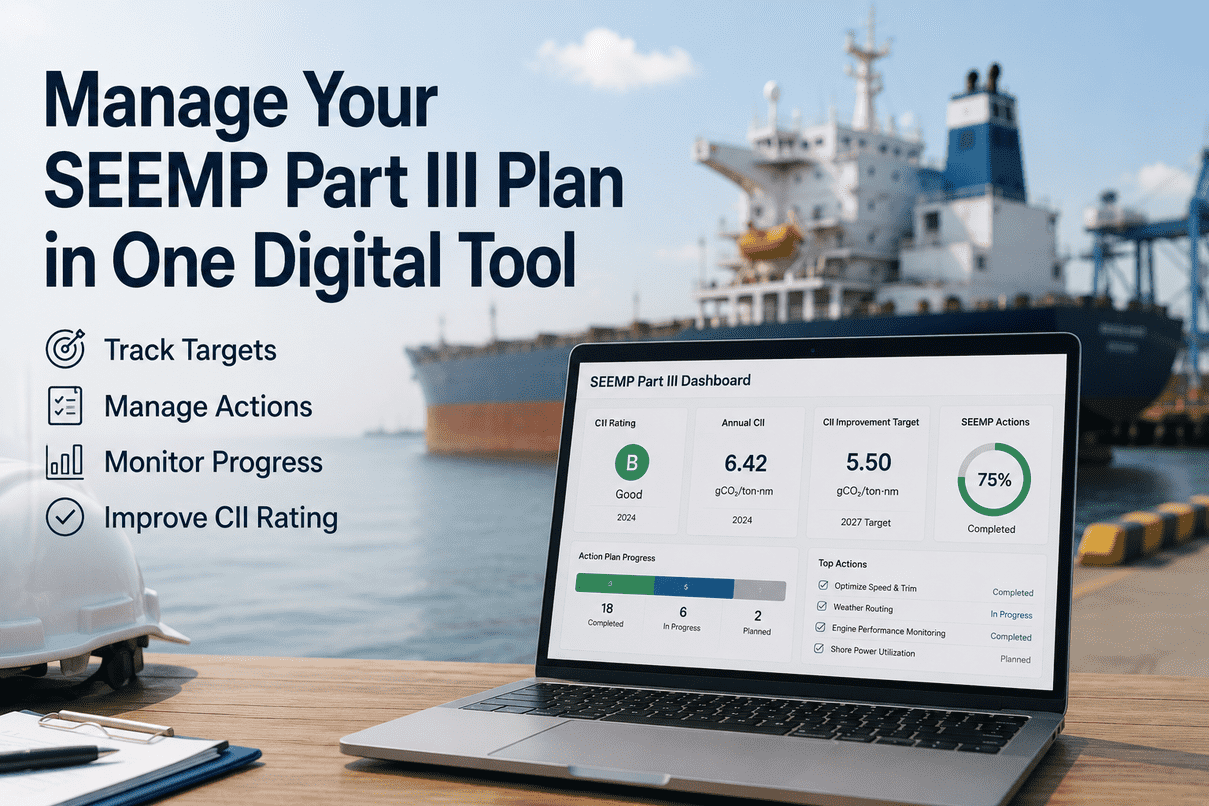
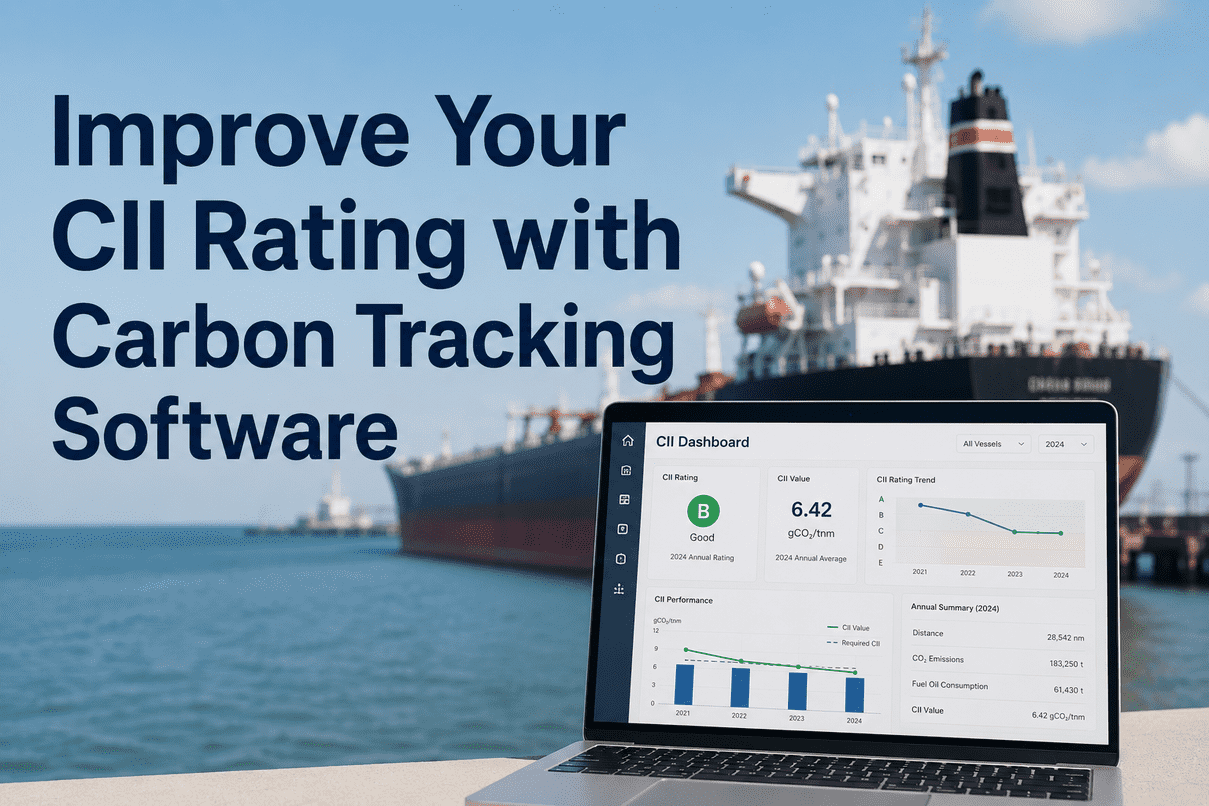
Fuel consumption rolls into a live CII estimate so you see the projected year-end rating in real time — not in a surprise report next March.
4
Alert before expiry
IAPP, IEE, and EIAPP certificate windows are flagged weeks ahead, and SEEMP Part II/III updates are tracked against the August 2025 data rules.
See Your Fleet's Live CII Rating Before Year-End
Marine Inspection turns BDNs, fuel logs, engine certificates, and voyage data into one continuously updated Annex VI dashboard — with automated alerts and PSC-ready evidence trails for every vessel.
EEDI, EEXI and CII — How the Three Efficiency Measures Differ
These three acronyms get used interchangeably, but they govern different things and trip up different ships. Understanding which applies to your vessel — and when — is the first step in not failing a survey or a charter vetting.
EEDI
Energy Efficiency Design Index
Applies toNew-build ships
TypeDesign-stage, one-time
MeasuresBuilt-in CO2 per transport work
Fix if failingRedesign before delivery
EEXI
Energy Efficiency Existing Ship Index
Applies toExisting ships 400 GT+
TypeOne-time pass / fail
MeasuresTechnical design efficiency
Fix if failingEPL / ShaPoLi, ESDs, fuels
CII
Carbon Intensity Indicator
Applies toShips 5,000 GT+
TypeAnnual A–E rating, ongoing
MeasuresActual emissions per voyage
Fix if failingCorrective Action Plan in SEEMP
CII Rating Scale — and the Cliff at D
A / B — Incentive territory. Flag states and charterers may reward superior performers with preferential terms.
C — The required minimum. The line every ship must stay above as targets tighten each year.
D (3 years) or E (1 year) — Mandatory Corrective Action Plan in the SEEMP, now a focal point of 2026 PSC inspections, plus charter and finance exposure.
The 2026 Annex VI Changes That Reset the Goalposts
Annex VI is the most actively amended part of MARPOL, and 2026 brought a cluster of changes that touch fuel grades, engine certification, and reporting. If your tracking still relies on last year's assumptions, these are the items most likely to catch you out.
MAR 2026
Two new ECAs in force. The Canadian Arctic and Norwegian Sea became Emission Control Areas on 1 March 2026. NOx Tier III applies to new-build engines immediately; SOx and PM compliance at 0.10% fuel is enforced from 1 March 2027 after a 12-month grace period.
AUG 2025
Enhanced SEEMP data collection. The IMO Data Collection System now requires fuel consumption reported by engine type, shore-power use recorded, and cargo-distance data captured. Existing ships must align SEEMP Part II and III to the new requirements.
SEP 2026
NOx Technical Code update. Revised engine certification procedures support multiple engine operational profiles and re-certification after retrofits and dual-fuel conversions — a step often overlooked during repower projects.
NOV 2026
Net-Zero Framework decision. The adjourned MEPC session reconvenes to decide on a new Chapter 5 of Annex VI — a global fuel intensity standard and GHG pricing mechanism — plus a proposed North-East Atlantic ECA that would become the world's largest.
What Non-Compliance Actually Costs
MARPOL itself sets no universal fine schedule, which is exactly why Annex VI exposure is so unpredictable. Fuel sulphur and changeover evidence are easy for Port State Control to test and detain on, and the fix is immediate and expensive: debunker, stem compliant fuel, re-sample, re-inspect, and lose charter time.
Where Annex VI Costs Hit — and What Drives Them
Annex VI Pre-Inspection Checklist
Run this before every PSC arrival and annual survey. These items map to the deficiencies most commonly raised against air emission compliance. Schedule a demo to see how Marine Inspection automates every line below.
Annex VI — Air Emission Readiness Check
Fuel & Sulphur
Bunker Delivery Notes on file for the last 3 years, sulphur content documented per delivery
Representative fuel samples retained and sealed for each stem
Fuel changeover logged with time, position, and tank quantities for every ECA entry and exit
FONAR procedure understood and documented for any non-availability event
Engines & NOx
EIAPP certificate available for every engine over 130 kW
Engine Tier status confirmed against build date and operating ECA
New or modified engines re-certified after retrofit or repower
Certificates
IAPP Certificate valid with endorsements current
IEE Certificate held, reflecting attained EEXI at or below the required value
ODS Record Book current if vessel carries ODS-containing equipment
Efficiency & Reporting
SEEMP Part I, II, and III onboard and aligned to August 2025 data rules
CII rating documented; Corrective Action Plan in place if rated D or E
IMO DCS fuel data submitted to flag state for the prior operational year
EU MRV / FuelEU dataset reconciled for EU and EEA voyages
Frequently Asked Questions
What does MARPOL Annex VI software actually track?
A purpose-built Annex VI tool tracks fuel sulphur content from Bunker Delivery Notes, fuel changeover logs for ECA transit, engine NOx Tier and EIAPP certificate status, IAPP and IEE certificate validity, EEXI compliance, and a live CII rating built from voyage fuel consumption. It connects these so every record reconciles and PSC-ready evidence is always available.
What is the difference between EEXI, EEDI, and CII?
EEDI is a design-stage standard for new-build ships. EEXI is a one-time, pass/fail technical calculation for existing ships of 400 GT and above. CII is an annual operational rating from A to E for ships of 5,000 GT and above, based on actual emissions per transport work, and it tightens each year. EEXI proves your design is efficient enough; CII proves you are operating efficiently.
What happens if my vessel gets a CII rating of D or E?
A D rating for three consecutive years, or an E rating in any single year, requires a Corrective Action Plan submitted within the SEEMP and approved by the flag state. In 2026 these plans are a focal point of PSC inspections. Commercially, charterers with CII clauses may exclude poorly rated vessels, and finance and insurance terms can be affected under the Poseidon Principles.
How long must Bunker Delivery Notes be kept onboard?
BDNs must be retained for three years, and the representative fuel sample for each delivery must be kept until that fuel is substantially consumed. Both are primary PSC inspection items, since fuel sulphur is one of the easiest things for an officer to test and detain a vessel on.
What changed in MARPOL Annex VI for 2026?
The Canadian Arctic and Norwegian Sea became ECAs on 1 March 2026 with NOx Tier III for new engines and 0.10% SOx fuel from March 2027. Enhanced SEEMP fuel data collection took effect from August 2025, the NOx Technical Code was updated for retrofits and dual-fuel conversions, and the IMO Net-Zero Framework is set for a decision at the reconvened MEPC session in late 2026.
Can one tool cover both IMO and EU emission reporting?
Yes. Because IMO DCS and EU MRV / FuelEU draw on the same underlying voyage and fuel-consumption data, a single tracking system can maintain both datasets from one capture point. This avoids running parallel spreadsheets and reduces exposure to two separate penalty regimes for the same ship.
One Dashboard for Every Annex VI Obligation
NOx Tier status, SOx fuel records, BDN archive, EEXI compliance, and a live CII rating — Marine Inspection connects them into one audit-ready system with automated certificate alerts and photo evidence, so your next survey is a formality, not a fire drill.