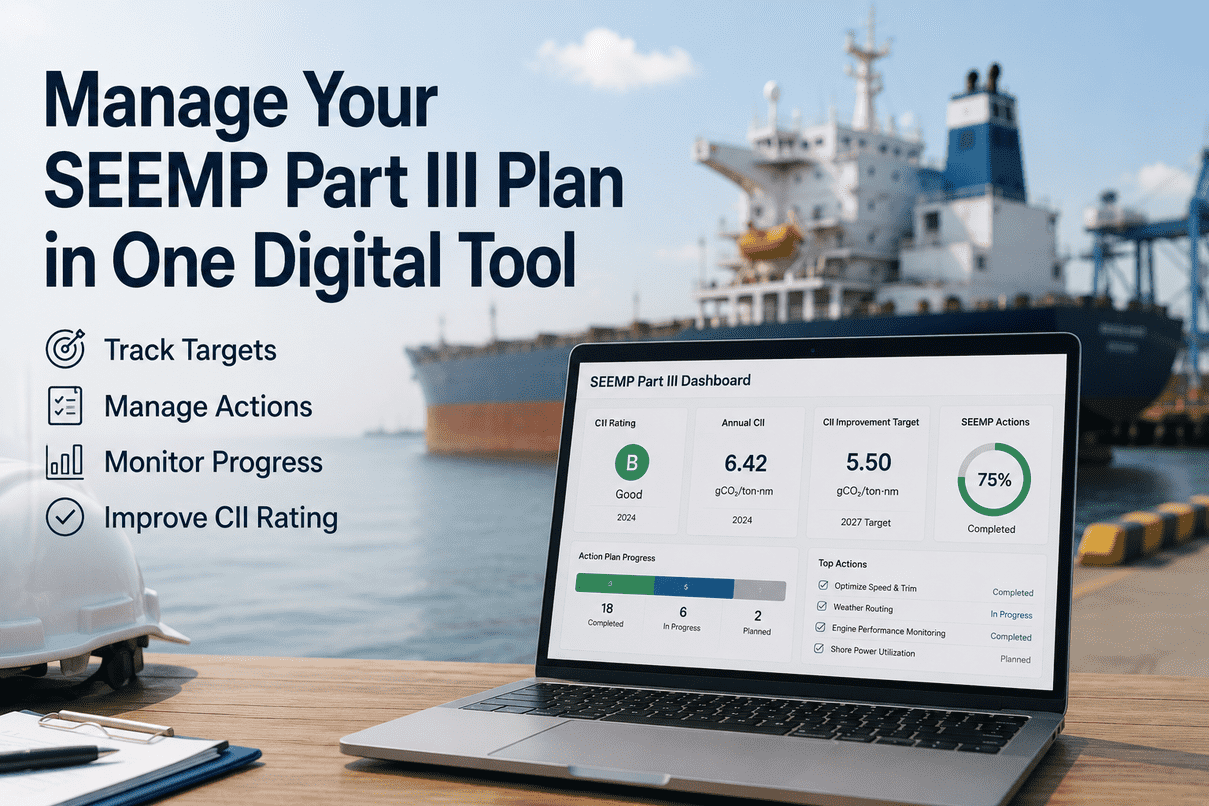
The SEEMP Part III enforcement reality of 2026 is no longer about whether the plan exists — it is about whether the plan is being implemented. From 1 January 2026, existing ships must have onboard the new Confirmation of Compliance for SEEMP Part II and III aligned to IMO Resolution MEPC.395(82) and the MEPC.400(83) reduction factors for the 2026-2028 implementation period. Enhanced level of granularity data collection began 1 January 2026 with first submission due by 31 March 2027 for Statement of Compliance issuance. MARPOL Annex VI Regulation 26.3.3 requires SEEMP company audits by the Flag Administration or Recognized Organization per Resolution MEPC.347(78) Guidelines for the Verification and Company Audits — typically combined with ISM company audits at three-year frequency, with optional annual SEEMP audits available from major ROs. DNV, Lloyd's Register, Bureau Veritas, ClassNK, and ABS all run distinct SEEMP Part III audit programmes. The auditor is no longer satisfied with the plan being on board — the auditor verifies measure-level progress, self-assessment cadence, and responsibility assignment across the implementation timeline. Operators running 24-vessel fleets with measure execution scattered across spreadsheets, shared drives, and ship-shore emails cannot pass this audit standard. SEEMP Part III compliance software replaces document storage with measure-level implementation tracking, verifier-ready evidence assembly, and cross-fleet rollout coordination. Book a 30-minute SEEMP Part III demo to see your fleet's implementation status mapped to MEPC.347(78) verification expectations.
SEEMP Part III · 2026-2028 Cycle Active
Track Implementation. Pass Verification. One Lifecycle Dashboard.
M/V Pacific Star · SEEMP III Lifecycle Track
On Track
Initial Verified
Dec 2025
50% measures complete · 124 days to Year 1 Review · CoC valid through Dec 2028
The Three Parts Of SEEMP And Why Part III Is Fundamentally Different
SEEMP is a three-part operational measure. Each part operates on a different cadence with a different verification regime. Conflating the three parts is the most common source of audit findings. The cards below clarify the boundaries. Book a three-parts walkthrough demo to see how Marine Inspection separates and integrates the parts on real fleet data.
Part I
Operational Energy Efficiency Plan
Ship-specific operational energy efficiency measures. Mandatory for every ship. Not subject to verification. Document onboard. Foundation layer for energy efficiency culture and operational practices.
Part II
Fuel Consumption Data Collection
IMO Data Collection System methodology for ships 5,000 GT and above. Verified by RO. Confirmation of Compliance issued. From 1 January 2026 enhanced level of granularity. Data submitted by 31 March each year.
Part III
Operational Carbon Intensity Plan
Three-year implementation plan for achieving the required CII. Dynamic document amended and revised based on effectiveness. Verified initially, periodically every three years, and through company audits per MEPC.347(78). Re-verification triggered by D x 3 or E rating.
The SEEMP Part III Lifecycle From Development To Re-Verification
SEEMP Part III is not a one-time document — it operates on a continuous lifecycle that runs across three-year implementation periods. Five lifecycle stages define the workflow every operator must run. Understanding the stages is the difference between proactive readiness and audit-triggered scrambling.
Stage 01
Development
SEEMP Part III drafted per MEPC.395(82) 2024 SEEMP Guidelines with six mandatory elements — required CII, target CII, implementation plan detail, methodology, monitoring procedures, CAP if applicable. Aligned to vessel particulars and MEPC.400(83) reduction factors.
Stage 02
Initial Verification
Submitted to Administration or RO for initial verification. Plan content checked against MEPC.347(78) Verification Guidelines. Confirmation of Compliance issued if satisfactory. Must be onboard for existing ships by 1 January 2026, for new ships from delivery date if delivered after 1 August 2025.
Stage 03
Implementation Tracking
Three-year implementation tracked at measure level. Monthly progress monitoring. Quarterly self-assessment per documented procedure. Responsibility assignment per measure. Evidence captured for verifier review. Implementation gaps flagged before audit.
Stage 04
Company Audit
Per MARPOL Annex VI Regulation 26.3.3, company audit conducted by Flag Administration or RO every three years (typically combined with ISM audit) with optional annual SEEMP audits. Within 6 months after Statement of Compliance issuance for first audit. Sampled vessel implementation verified.
Stage 05
Periodical Re-Verification
SEEMP Part III revised before the end of the last year of the three-year period for the next three-year cycle. Re-verification by Administration or RO. New Confirmation of Compliance issued. Re-verification also triggered by D x 3 years or E rating requiring CAP per Regulation 28.7 + 28.8.
The SEEMP Part III Three-Year Cycle Matrix
The three-year implementation cycle aligns with the MEPC.400(83) reduction factor steps. Each cycle has its own development, verification, and audit milestones. The matrix below maps the current and upcoming cycles to their key deadlines. Mobile users scroll horizontally for the full view.
| Cycle Period |
Reduction Factor |
Development Deadline |
Verification Status |
Current Phase |
| 2023-2025 |
5% / 7% / 9% |
Pre-1 Jan 2023 |
Closed |
Lessons learned captured |
| 2026-2028 |
11% / 12.5% / 14.5% |
Pre-1 Jan 2026 |
Active |
Year 1 implementation |
| 2029-2031 |
18% / TBD / TBD |
Pre-1 Jan 2029 |
Planning |
Forward-look scenarios |
| 2032-2034 |
TBD per MEPC |
Pre-1 Jan 2032 |
Future |
Mid-term GHG measures parallel |
| 2026 enhanced DCS |
Enhanced granularity |
1 Jan 2026 start |
Active |
Data collection Q1 |
| First enhanced submission |
2026 data |
31 Mar 2027 |
Pending |
Q4 2026 preparation |
| Mid-cycle company audit |
Implementation check |
6 months post-CoC |
Active |
RO audit scheduling |
| End-of-cycle revision |
2026-2028 close |
Before end-2028 |
Planning |
2029-2031 drafting |
The Six Implementation Tracking Disciplines
The single greatest predictor of SEEMP Part III audit outcome is the implementation tracking discipline. Operators who run all six disciplines pass audit cleanly. Operators who skip any one find that gap surfaced in audit findings. Book an implementation tracking demo to see all six disciplines operating live.
D1
Measure-Level Status
Each measure in the three-year plan tracked individually with status — Planned, In Progress, Verified. Owner assigned per measure. Target date and actual date captured. Roll-up to overall implementation completion percentage.
D2
Monthly Progress Monitoring
Monthly review cadence on measure progress. Implementation milestones tracked. Slippage flagged. Resource conflicts surfaced. Cross-measure dependencies managed. Monthly progress feeds quarterly self-assessment.
D3
Quarterly Self-Assessment
Documented quarterly self-assessment per MEPC.395(82) procedure. Attained CII to date compared to target CII. Variance analysis. Measure effectiveness evaluation. Self-assessment record retained for verifier review.
D4
Responsibility Assignment
Each measure has a named owner with authority to implement. Master, Chief Engineer, DPA, Technical Superintendent, Crewing Manager, or Marine Superintendent as appropriate. Diffuse ownership fails audit. One name, one accountability.
D5
Evidence Capture Per Measure
Each measure verified with evidence — installation certificate, crew training record, fuel consumption baseline-vs-after, drydock report, software activation confirmation. Evidence pack assembled for verifier. Cross-referenced to measure ID.
D6
Cross-Vessel Reconciliation
For fleet operators, sister vessels' SEEMP Part III plans reconciled. Common measures identified. Best practices propagated. Per-vessel particulars respected — required CII differs per ship. Fleet-wide rollout coordinated.
The Three Measure Categories That Define Implementation
SEEMP Part III implementation measures fall into three categories per MEPC.395(82). Each category has different implementation characteristics, evidence requirements, and effectiveness profiles. A balanced SEEMP Part III plan includes measures across all three categories.
Operational
Operational Measures
Speed optimisation, weather routing, trim and draft optimisation, just-in-time arrival, voyage planning enhancements. Low cost, fast implementation, charter-party-dependent. Effectiveness scales with crew discipline and shore support. Primary lever for Year 1 of cycle.
Technical
Technical Measures
Hull cleaning, propeller polish, engine tuning, engine power limitation, shaft power limitation, air lubrication, energy-saving devices, alternative fuel readiness. Mid-to-high capex. Drydock or in-water installation. Verified through installation certificates and class survey.
Management
Management Measures
Crew training on energy efficiency, performance monitoring systems, KPI dashboards, fleet-wide best practice sharing, charter party clauses, fuel quality monitoring. Cultural and procedural. Verified through training records, system configuration, and procedure documentation.
The SEEMP Part III Company Audit Findings Pattern Matrix
SEEMP Part III company audits surface recurring patterns of findings regardless of operator size or fleet composition. Recognized Organization auditors at DNV, Lloyd's Register, Bureau Veritas, ClassNK, and ABS find similar patterns in 2026 audit programmes. The matrix below maps each finding pattern to its root cause and the corrective discipline that closes it. Mobile users scroll horizontally for the full view.
| Audit Finding |
Root Cause |
Common Operator Response |
Verifier-Accepted Response |
| Implementation plan exists but no measure status |
No measure-level tracking system |
Verbal status to auditor |
Measure-level status with evidence |
| Self-assessment not conducted |
Self-assessment treated as ad-hoc |
Reconstruct after audit |
Documented quarterly self-assessment |
| Responsibility unclear per measure |
Diffuse ownership in document |
Add Master to all measures |
Named owner with authority + escalation |
| Slow steaming claimed without evidence |
Speed reduction in policy, not log |
Verbal claim to auditor |
Voyage logs + fuel consumption baseline |
| SEEMP III misaligned with MEPC.400(83) |
Plan not revised for 2026-2028 |
Annotate document at audit |
Revised plan with new factors verified |
| Measure effectiveness not measured |
No baseline-vs-after comparison |
General improvement claim |
Quantified CII impact per measure |
| Crew training not documented |
Training conducted, records weak |
Reissue training certificates |
Training records cross-referenced |
| CAP not submitted within 1 month |
No trigger detection on D x 3 / E |
Submit retrospectively |
Trigger detection + workflow |
| Confirmation of Compliance expired |
No periodical re-verification scheduled |
Schedule audit reactively |
Calendar-driven re-verification |
| Sister vessels SEEMP misaligned |
No fleet-wide reconciliation |
Argue per-vessel uniqueness |
Fleet-wide measure rollout discipline |
SEEMP Part III Demo · Two Ways To Start
Talk To A Specialist Or Explore The Platform First
Whichever path fits your timeline. Schedule a 30-minute demo with a product expert to walk through your fleet's SEEMP III implementation on real data — or create a free account and explore the lifecycle dashboard on a sample vessel before booking any call.
No credit card · No sales pressure · Both paths are 100% free
What The Verifier Actually Checks During SEEMP Part III Company Audit
The MEPC.347(78) Guidelines for Verification and Company Audits set the audit standard but do not prescribe the inspector's specific verification path. In practice, six verification dimensions consistently appear in DNV, Lloyd's Register, Bureau Veritas, ClassNK, and ABS company audit reports. Operators preparing for the next audit should align evidence to these dimensions. Book a verifier-readiness demo to see Marine Inspection's audit pack assembly.
V1
SEEMP Part III Document Currency
Verifier confirms SEEMP Part III aligned to MEPC.395(82) 2024 Guidelines, incorporating MEPC.400(83) reduction factors for 2026-2028 period, with valid Confirmation of Compliance on board. Outdated documents fail immediately.
V2
Measure-Level Implementation Evidence
Verifier samples 3-5 measures from the implementation plan and requests evidence of execution. Installation certificates, training records, voyage logs, drydock reports, fuel baseline comparisons. Measures verified or implementation gap identified.
V3
Self-Assessment Records
Verifier reviews quarterly self-assessment records since last audit. Attained CII versus target comparison, variance analysis, corrective adjustments. Missing self-assessment records produce major finding regardless of vessel performance.
V4
Responsibility Matrix Verification
Verifier checks responsibility assignment per measure against actual implementation. Interviews with named owners. Authority and accountability verified in practice, not just documented. Diffuse ownership patterns surfaced as finding.
V5
CII Calculation Methodology
Verifier confirms CII calculation methodology aligned to IMO standards. Correction factor application per MEPC.355(78). Voyage adjustment procedures. DCS data integrity from source to submission. Methodology gaps invalidate CII rating.
V6
Corrective Action Plan Status
For vessels rated D x 3 years or E, verifier confirms CAP submitted within 1 month, integrated into SEEMP Part III revision, measures being executed per timeline, and trajectory toward C rating. Missing or stale CAP triggers non-compliance.
Marine Inspection's SEEMP Part III Architecture
Marine Inspection's SEEMP Part III layer is structured around the four operational realities of running a three-year implementation cycle across a multi-vessel fleet — measure-level tracking, self-assessment cadence, verifier-ready evidence assembly, and three-year cycle management. Four architectural layers handle the complexity. Book the architecture walkthrough demo to apply the platform to your fleet. Start a free trial to evaluate before any contract.
Layer 1
Measure-Level Implementation Engine
Each measure in the three-year plan tracked individually with status Planned, In Progress, Verified. Named owner assigned. Target date and actual date captured. Roll-up to overall completion percentage. Cross-measure dependencies surfaced. Slippage flagged in real time.
Layer 2
Self-Assessment Workflow
Documented quarterly self-assessment per MEPC.395(82) procedure. Attained CII to date compared to target CII. Variance analysis. Measure effectiveness evaluation per category (operational, technical, management). Self-assessment record retained for verifier review.
Layer 3
Verifier-Ready Evidence Pack
Evidence assembled per measure with cross-reference to measure ID. Installation certificates, training records, voyage logs, fuel baseline comparisons, drydock reports. Six verification dimension coverage. Audit pack exportable in MEPC.347(78) format.
Layer 4
Three-Year Cycle Manager
2026-2028 period implementation tracked. End-of-cycle revision triggered before 2028 end. 2029-2031 forward-look scenarios. Periodical re-verification scheduling. CAP trigger detection on D x 3 or E ratings. Cross-vessel fleet rollout coordinated.
Frequently Asked Questions
What is SEEMP Part III and how is it different from Parts I and II?
SEEMP is a three-part operational measure where each part operates on a different cadence with different verification regime. Part I is the Operational Energy Efficiency Plan — ship-specific operational energy efficiency measures, mandatory for every ship, not subject to verification, document onboard as the foundation layer for energy efficiency culture. Part II is the Fuel Consumption Data Collection — IMO Data Collection System methodology for ships 5,000 GT and above, verified by RO, Confirmation of Compliance issued, with enhanced level of granularity from 1 January 2026 and data submitted by 31 March each year. Part III is the Operational Carbon Intensity Plan — three-year implementation plan for achieving the required CII, dynamic document amended and revised based on effectiveness, verified initially, periodically every three years, and through company audits per MEPC.347(78). Re-verification is triggered by D x 3 years or E rating per Regulation 28.7 and 28.8. Part III is fundamentally different because it is the only part with implementation tracking obligations and the only part subject to ongoing company audits.
When does the SEEMP Part III lifecycle run?
SEEMP Part III operates on a five-stage continuous lifecycle across three-year implementation periods. Stage 01 Development — SEEMP Part III drafted per MEPC.395(82) 2024 SEEMP Guidelines with six mandatory elements including required CII, target CII, implementation plan detail, methodology, monitoring procedures, CAP if applicable. Stage 02 Initial Verification — submitted to Administration or RO for initial verification per MEPC.347(78) Guidelines, with Confirmation of Compliance issued if satisfactory. Must be onboard for existing ships by 1 January 2026, for new ships from delivery date if delivered after 1 August 2025. Stage 03 Implementation Tracking — three-year implementation tracked at measure level with monthly progress monitoring and quarterly self-assessment. Stage 04 Company Audit — per MARPOL Annex VI Regulation 26.3.3, company audit conducted by Flag Administration or RO every three years typically combined with ISM audit, within 6 months after Statement of Compliance issuance for first audit. Stage 05 Periodical Re-Verification — SEEMP Part III revised before the end of the last year of the three-year period for the next three-year cycle.
What are the current three-year cycle deadlines?
The current and upcoming SEEMP Part III three-year cycles align with MEPC.400(83) reduction factor steps. 2023-2025 cycle (5%/7%/9% reduction factors) closed pre-1 January 2023 development with lessons learned now captured. 2026-2028 cycle (11%/12.5%/14.5%) is active with pre-1 January 2026 development deadline and Year 1 implementation underway. 2029-2031 cycle (18% then TBD) planning underway with pre-1 January 2029 development deadline. 2032-2034 cycle TBD per MEPC with pre-1 January 2032 development and IMO mid-term GHG measures parallel. Beyond cycle deadlines, 2026 enhanced DCS granularity began 1 January 2026 with first enhanced submission due 31 March 2027 covering 2026 data. Mid-cycle company audit due 6 months post-CoC. End-of-cycle revision required before end-2028 for 2029-2031 drafting. The Confirmation of Compliance must be renewed periodically with re-verification by RO before expiry.
What are the six implementation tracking disciplines?
Six implementation tracking disciplines separate operators who pass SEEMP Part III audit cleanly from those who find gaps surfaced. Measure-Level Status — each measure in the three-year plan tracked individually with status Planned, In Progress, Verified, owner assigned per measure, target date and actual date captured, roll-up to overall implementation completion percentage. Monthly Progress Monitoring — monthly review cadence with implementation milestones tracked, slippage flagged, resource conflicts surfaced, cross-measure dependencies managed. Quarterly Self-Assessment — documented quarterly self-assessment per MEPC.395(82) procedure with attained CII to date compared to target CII, variance analysis, measure effectiveness evaluation, self-assessment record retained. Responsibility Assignment — each measure has a named owner with authority to implement including Master, Chief Engineer, DPA, Technical Superintendent, Crewing Manager. Evidence Capture Per Measure — each measure verified with evidence including installation certificate, crew training record, fuel baseline comparison. Cross-Vessel Reconciliation — sister vessels' SEEMP Part III plans reconciled with common measures identified and best practices propagated.
What does the verifier check during company audit?
Six verification dimensions consistently appear in DNV, Lloyd's Register, Bureau Veritas, ClassNK, and ABS company audit reports. SEEMP Part III Document Currency — verifier confirms alignment to MEPC.395(82) 2024 Guidelines, incorporation of MEPC.400(83) reduction factors for 2026-2028 period, with valid Confirmation of Compliance on board. Measure-Level Implementation Evidence — verifier samples 3-5 measures from the implementation plan and requests evidence of execution including installation certificates, training records, voyage logs, drydock reports, fuel baseline comparisons. Self-Assessment Records — verifier reviews quarterly self-assessment records since last audit including attained CII versus target comparison, variance analysis, corrective adjustments. Responsibility Matrix Verification — verifier checks responsibility assignment per measure against actual implementation including interviews with named owners. CII Calculation Methodology — verifier confirms methodology aligned to IMO standards including correction factor application per MEPC.355(78), voyage adjustment procedures, DCS data integrity. Corrective Action Plan Status — for vessels rated D x 3 or E, verifier confirms CAP submitted within 1 month, integrated into SEEMP Part III revision, measures being executed per timeline.
What are the most common SEEMP Part III audit findings?
Ten recurring audit findings appear across operators of all sizes. Implementation plan exists but no measure status — root cause no measure-level tracking system, verifier-accepted response requires measure-level status with evidence. Self-assessment not conducted — treated as ad-hoc rather than quarterly, requires documented quarterly self-assessment per procedure. Responsibility unclear per measure — diffuse ownership in document, requires named owner with authority and escalation. Slow steaming claimed without evidence — speed reduction in policy not in log, requires voyage logs and fuel consumption baseline. SEEMP III misaligned with MEPC.400(83) — plan not revised for 2026-2028 factors, requires revised plan with new factors verified. Measure effectiveness not measured — no baseline-versus-after comparison, requires quantified CII impact per measure. Crew training not documented — training conducted but records weak, requires training records cross-referenced. CAP not submitted within 1 month — no trigger detection on D x 3 or E, requires trigger detection plus workflow. Confirmation of Compliance expired — no periodical re-verification scheduled, requires calendar-driven re-verification. Sister vessels SEEMP misaligned — no fleet-wide reconciliation, requires fleet-wide measure rollout discipline.
How does Marine Inspection's SEEMP Part III platform work?
Marine Inspection's SEEMP Part III layer combines four architectural primitives. Layer 1 Measure-Level Implementation Engine — each measure in the three-year plan tracked individually with status Planned, In Progress, Verified, named owner assigned, target date and actual date captured, roll-up to overall completion percentage, cross-measure dependencies surfaced, slippage flagged in real time. Layer 2 Self-Assessment Workflow — documented quarterly self-assessment per MEPC.395(82) procedure with attained CII to date compared to target CII, variance analysis, measure effectiveness evaluation per category (operational, technical, management), self-assessment record retained for verifier review. Layer 3 Verifier-Ready Evidence Pack — evidence assembled per measure with cross-reference to measure ID including installation certificates, training records, voyage logs, fuel baseline comparisons, drydock reports, six verification dimension coverage, audit pack exportable in MEPC.347(78) format. Layer 4 Three-Year Cycle Manager — 2026-2028 period implementation tracked, end-of-cycle revision triggered before 2028 end, 2029-2031 forward-look scenarios, periodical re-verification scheduling, CAP trigger detection on D x 3 or E ratings, cross-vessel fleet rollout coordinated. 6-12 week deployment with free trial available before any commitment.
2026-2028 Cycle Active · Choose Your Path
Plan On Board Is Not Enough. Pick The Path That Fits Your Timeline.
Three-parts SEEMP architecture, five-stage Part III lifecycle, eight-row three-year cycle matrix, six implementation tracking disciplines, three measure categories, ten-row audit findings pattern matrix, six verifier dimensions checked, four-layer SEEMP Part III architecture — all in one MEPC.347(78) aligned platform built for the 2026-2028 implementation cycle. Two ways to start: demo with a specialist or free account exploration.
30-min demo with SEEMP specialist · or self-serve free trial · no credit card required