A classification survey is only as good as the surveyor's ability to physically reach the steel. When a close-up survey requires structural details to be examined within arm's reach, and thickness measurements to be taken high inside a cargo hold or deep in a ballast tank, someone has to get a person and a gauge to that exact spot, safely, at height, in a confined space. That is the entire purpose of means of access, and it is one of the more consequential and expensive parts of preparing a ship for survey. Get it right and the survey proceeds efficiently, the surveyor reaches every required location, and the vessel comes out of dock on schedule. Get it wrong — inadequate staging, unsafe rigging, areas that cannot be reached — and the survey stalls, findings go unconfirmed, and the ship waits while access is rebuilt at a cost that dwarfs the planning that would have prevented it. Means of access sits at the intersection of class requirements, survey planning and confined-space safety, and it is governed by a clear framework that every superintendent and surveyor should command. This guide sets out that framework: why close-up survey drives the access requirement, the recognised means of access and where each fits, how access is planned through the survey programme, and the safety provisions that make working at height in tanks and holds survivable. To plan survey access, record the arrangements and keep the survey-preparation evidence organised across your fleet, start a free trial or book a demo.
INDUSTRY GUIDE · SURVEY PREPARATION
Means of Access on Ships: Scaffolding, Staging and Inspection Requirements
A guide for superintendents and surveyors to providing safe access for close-up survey — why hand-reach examination drives the requirement, the recognised means of access from staging to rafting, how access is planned through the survey programme, and the safety provisions that protect the survey party.
Why Close-Up Survey Drives the Requirement
The whole subject of means of access follows from one definition. A close-up survey is an examination where the details of structural components are within the close visual inspection range of the surveyor — normally within reach of hand. That phrase, within reach of hand, is what generates the entire access challenge, because a surveyor standing on a tank bottom cannot examine, by hand, a deck transverse or an upper shell frame many metres above. Something has to bring them together.
Under the Enhanced Survey Programme for bulk carriers and oil tankers, close-up survey of internal structure is required at renewal and intermediate surveys, meaning each critical part of the hold or tank must be brought within hand's reach of the surveyor, along with the ability to take representative thickness measurements. The overall survey, by contrast, assesses general condition and can often be done from the deck or bottom, and its role is partly to identify where the close-up effort must concentrate. It is the close-up requirement, and the thickness measurement that accompanies it, that makes staging, rafting and the other means of access necessary — and it is the owner's responsibility to provide access that is acceptable to the attending surveyor.
i
Acceptable to the surveyor is the operative test
The framework lists the recognised means of access, but every one of them carries the same qualifier: it must be acceptable to the attending surveyor. The surveyor judges whether the arrangement genuinely brings the required structure within safe hand's reach and whether it is safe to use. This matters because it makes access a matter of the surveyor's professional satisfaction, not a box ticked — staging that stops short of the structure, or a raft that cannot reach the deckhead, does not meet the requirement however substantial it looks. Agreeing the intended means for each area with the surveyor in advance, through the survey programme, is what avoids a dispute at the ship.
The Recognised Means of Access
The Enhanced Survey Programme Code sets out the means of access that may be provided for close-up survey and thickness measurement, and in practice a survey uses a combination chosen to suit each space. Each has its place, its advantages and its limits.
01
Permanent staging and passages
Built into the structure
Fixed platforms and walkways designed into the ship that give repeated access to structure at every survey without rigging. Where fitted, they are the most convenient means, always available and needing no build time, and they are increasingly designed into modern tonnage for exactly this reason.
02
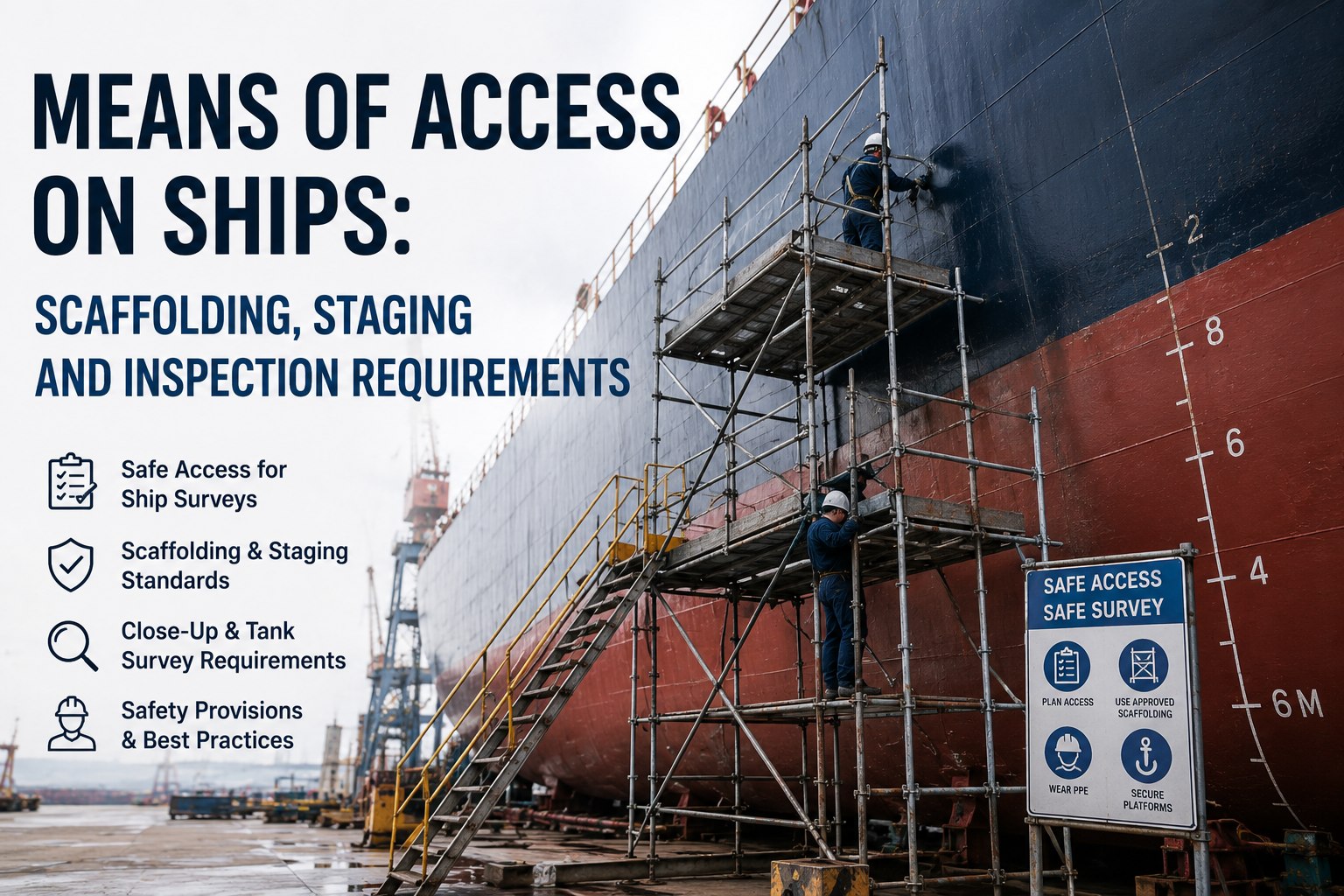
Temporary staging (scaffolding)
The workhorse for full close-up
Scaffolding rigged inside a tank or hold to bring the survey party to the structure, panel by panel. It gives comprehensive, stable hand's-reach access to large areas and is the default where a full close-up of a space is required, but it is time-consuming and costly to erect and dismantle, which is why its extent is planned carefully.
03
Portable ladders
Limited to lower structure
A portable ladder, restricted to not more than five metres in length, may be accepted for surveying the lower section of a shell frame including its bracket. It is quick and simple but strictly limited in reach and application, suited to low-level spot access rather than examining structure at height.
04
Hydraulic arm vehicles
Cherry pickers, lifts, platforms
Conventional cherry pickers, lifts and movable platforms position the survey party at height quickly and flexibly, reaching under-deck, side-shell and transverse structure without full scaffolding. They need adequate clear floor and headroom, specialist operators, and are often supplied by shore contractors rather than kept aboard.
05
Boats or rafts (rafting)
Conditional on structural capacity
Flooding a tank partway and using a boat or raft to float the survey party up to upper structure — but only where the structural capacity of the space is sufficient to withstand the static loads at all water levels, and under strict conditions. Rafting reaches deckhead structure without scaffolding, yet the safety conditions around it are demanding.
06
Other equivalent means
Including remote techniques
The framework allows other equivalent means acceptable to the surveyor, a category that increasingly includes wire-lift platforms and remote inspection techniques such as drones, now recognised for close-up work, which can reduce the need to put people at height for parts of a survey.
A raft or boat may be used to inspect upper structure only where the structural capacity of the hold is sufficient to withstand the static loads at all levels of water — rafting is a conditional means, not a default one.
Reflecting the ESP Code conditions on rafting access
Plan access per space, agree it once, record it
The access provision for every tank and hold belongs in the survey plan, agreed with class before the ship arrives. Marine Inspection holds the survey-preparation record per vessel — the access method per space, the safety provisions, and the evidence — so the plan is set once and shared, not reinvented at the dock.
Planning Access Through the Survey Programme
Means of access is not improvised at the ship — it is planned in advance through the survey programme, the document worked out between owner and class before a renewal survey and submitted for approval. Access is a core part of that plan.
The survey programme, built on the survey planning questionnaire, identifies the tanks, holds and structural elements to be examined and, critically, specifies the means of access for each area subject to close-up survey and thickness measurement. In practice this takes the form of a table listing every space against the intended access — permanent or temporary staging, rafts, ladders, direct access, cherry picker, or other means — so that both owner and surveyor know before arrival exactly how each location will be reached. Alongside access, proper preparation of the spaces is planned: cleaning, descaling and gas-freeing so structure is visible and the atmosphere is safe, and adequate illumination so it can be examined. A survey planning meeting brings the crew, the surveyor and the owner's representative together to confirm the arrangements and the order of work, so the survey runs efficiently rather than stalling while access is reconsidered. The recurring lesson is that access decided late is access decided expensively: the time to work out how a surveyor will reach an upper wing-tank transverse is during planning, not when the surveyor is standing on the tank bottom looking up at it.
The Safety Provisions Around Access
Providing access is inseparable from providing it safely, because every close-up survey of a tank or hold is work at height in a confined space — two of the most hazardous activities aboard combined. The framework and good practice wrap a set of safety provisions around the access itself.
Confined-space entry procedures
Tanks and holds are enclosed spaces requiring atmospheric testing, ventilation and controlled entry before anyone goes in. The space must be gas-free and the atmosphere verified safe, and for oil and chemical tankers an explosimeter is provided to confirm it stays that way.
Communication with the deck
A communication system is arranged between the survey party inside the tank and the responsible officer on deck, so the party can be monitored and help summoned instantly. No one surveys a tank out of contact with the surface.
Adequate illumination
Sufficient lighting is provided so structure can actually be examined and defects seen, and so the access itself can be used safely. Poor lighting compromises both the survey's quality and the party's safety at height.
Fall protection and sound rigging
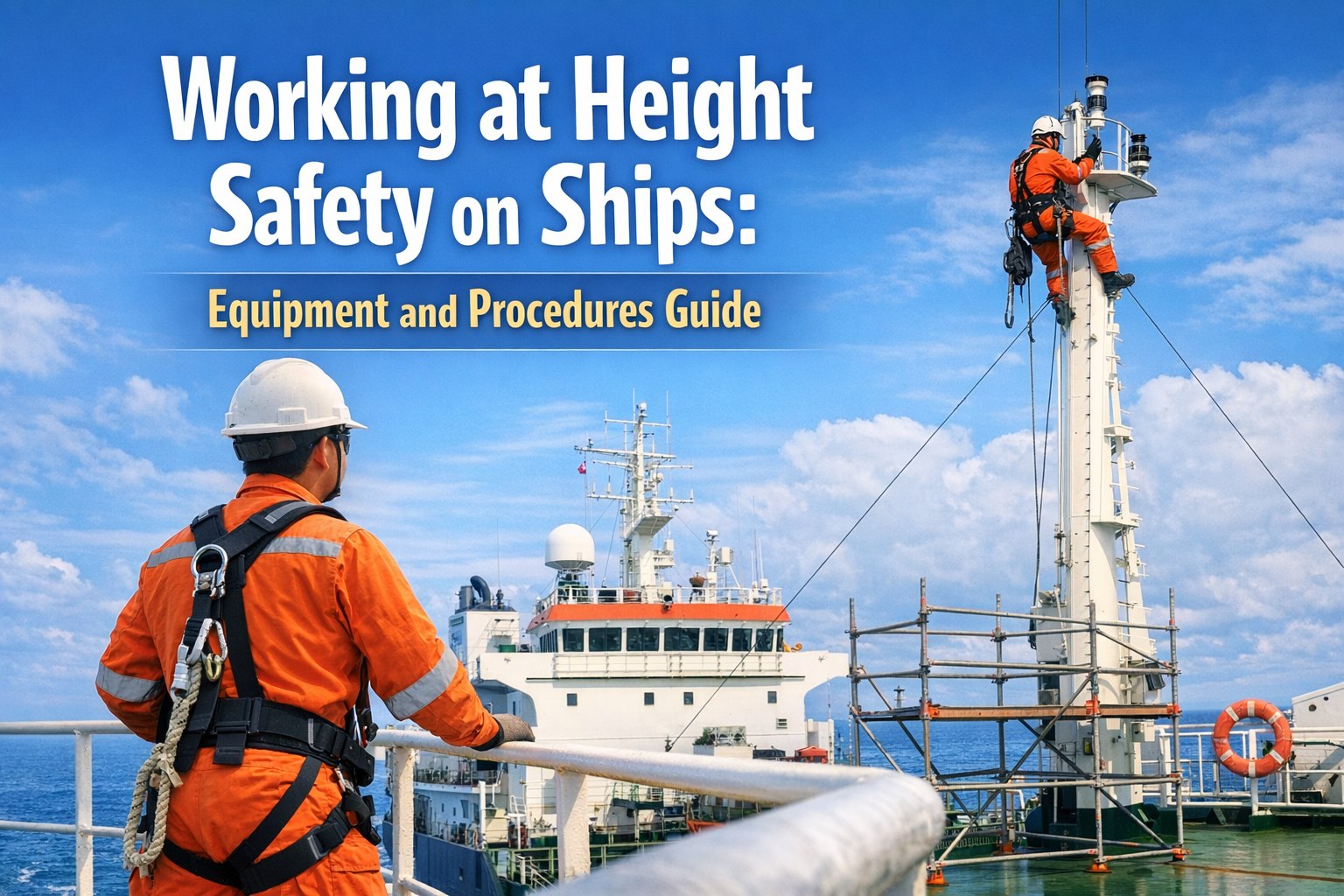
Staging, platforms and walkways carry guard rails and are rigged to hold the loads placed on them, with rafting used only where the structure can bear the water load. Access that is not structurally sound is not access — it is a hazard.
Competent operators for powered access
Cherry pickers, lifts and wire-lift systems need specialist operators and maintained equipment, with suitability and operator competency documented before deployment. Powered access is only as safe as the person running it.
Emergency and rescue planning
Every entry begins with hazard identification, equipment verification and a plan for emergency response and rescue specific to the space and the access method, so a person in difficulty at height in a tank can be recovered quickly.
Taken together, means of access is a discipline that binds three things that cannot be separated: the class requirement to examine structure by hand, the planning that arranges how each location will be reached, and the safety regime that protects the people doing it. The vessels whose surveys run smoothly are the ones where access was planned space by space through the survey programme, agreed with the surveyor before arrival, provided to a standard the surveyor accepts, and rigged and used under proper confined-space and work-at-height controls. The alternative — access worked out on the day — costs time the ship does not have and puts people at risk it does not need to. To hold the survey access plan, the safety provisions and the preparation evidence together per vessel and share them with class before the ship arrives, start a free trial or book a demo.
Frequently Asked Questions
What are means of access on a ship survey?
Means of access are the arrangements that bring a surveyor and thickness-measurement equipment physically to the structure being examined during a close-up survey — within reach of hand. Because a close-up survey requires structural details to be within the surveyor's close visual range, and that structure is often high inside tanks and holds, means of access such as staging, ladders, cherry pickers and rafting are provided to reach it. The Enhanced Survey Programme Code lists the recognised means, and the owner is responsible for providing access that is acceptable to the attending surveyor for every area subject to close-up survey.
What is the difference between overall and close-up survey?
An overall survey assesses the general condition of a tank, hold or structure and reports on it, often carried out from the deck or tank bottom, and it helps identify where closer examination is needed. A close-up survey is a detailed examination where structural components are within the surveyor's close visual range — normally within reach of hand — so fine cracks, pitting and corrosion can be seen directly. It is the close-up requirement, required at renewal and intermediate surveys under the Enhanced Survey Programme, that drives the need for means of access, because the surveyor must physically reach structure that may be many metres above the floor.
What means of access are acceptable for close-up survey?
The Enhanced Survey Programme Code recognises permanent staging and passages through structures; temporary staging and passages; portable ladders restricted to not more than five metres for the lower section of a shell frame; hydraulic arm vehicles such as cherry pickers, lifts and movable platforms; boats or rafts, provided the structure can withstand the static water loads; and other equivalent means acceptable to the surveyor, which increasingly includes remote inspection techniques such as drones. A survey typically combines several of these, chosen per space, with each subject to being acceptable to the attending surveyor.
When can rafting be used to survey a tank?
Rafting — floating a survey party on a boat or raft to reach upper structure — may be used only where the structural capacity of the space is sufficient to withstand the static loads at all levels of water, and under strict safety conditions. It allows deckhead and upper structure to be reached without full scaffolding, but the conditions are demanding, including confined-space and communication provisions, and it must be acceptable to the surveyor. Because it depends on the structure bearing the water load and on tight safety control, rafting is a conditional means of access, agreed in advance through the survey programme rather than assumed.
Who is responsible for providing survey access?
The owner is responsible for providing means of access that is acceptable to the attending surveyor, along with proper preparation of the spaces — cleaning, descaling, gas-freeing and adequate illumination. This is planned in advance through the survey programme, agreed between owner and class before a renewal survey, with the access method specified for each space subject to close-up survey and thickness measurement. Large-scale access equipment such as cherry pickers and rafting systems is often arranged through shore contractors rather than kept aboard, but arranging it, and ensuring it is safe and acceptable, remains the owner's responsibility.
What safety provisions are required for tank surveys?
Because surveying a tank or hold combines work at height with confined-space entry, the space must be gas-free with its atmosphere tested and verified safe, ventilated and entered under controlled procedures, with an explosimeter provided on oil and chemical tankers. A communication system is arranged between the survey party in the tank and the responsible officer on deck, adequate illumination is provided, staging and platforms carry fall protection and are soundly rigged, powered access needs competent operators, and every entry is preceded by hazard identification and emergency and rescue planning specific to the space and access method.
Plan Access Once. Survey Without Surprises.
Marine Inspection holds the survey-preparation record per vessel — the means of access planned for each tank and hold, the safety provisions, the space preparation and the evidence — so the access plan is agreed with class before arrival and shared with everyone who needs it, rather than reinvented at the dock. Turn survey access from a last-minute scramble into a planned, documented, repeatable part of every survey across the fleet.