A secondhand ship is one of the few multi-million-dollar assets routinely bought after a few days of walking around it. The buyer's superintendent boards in a port somewhere, spends perhaps two or three days going through the vessel and her records while she works cargo, and on the strength of that produces the report on which tens of millions of dollars will be committed. There is rarely a drydock, rarely an opening-up of machinery, rarely a second visit. And the contract the buyer signs is, in its standard form, considerably less protective than instinct suggests: under the Norwegian Saleform, the buyer's core entitlements are that the vessel is delivered in the same condition as inspected, with class maintained and free of average damage — and, traditionally, not much more. That asymmetry is precisely why the pre-purchase survey matters so much. It is not a formality that confirms a price already agreed; it is the single opportunity to discover what is actually being bought, to quantify what it will cost to run, and to establish the factual basis for both the valuation and the negotiation. This guide covers the survey types and what each delivers, the physical inspection and the class-records review that often matters more, the three recognised valuation methodologies and how condition feeds them, the defects that move price and the ones that do not, the contractual mechanics of Saleform inspection and drydocking clauses, and how to turn survey findings into negotiating leverage. Book a Marine Inspection demo to see how structured inspection and records management supports vessel due diligence.
Commercial & operations · sale and purchase
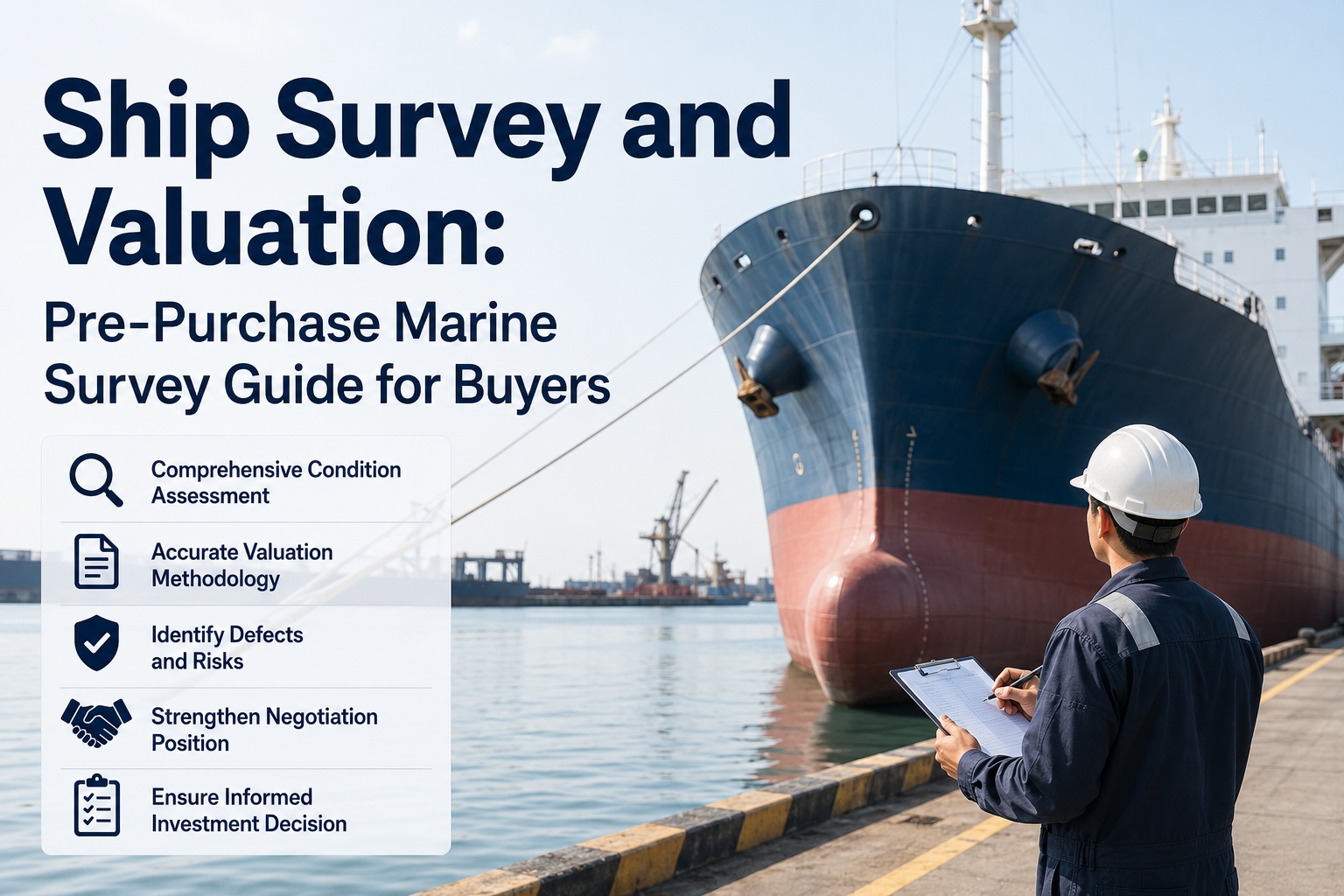
Ship Survey and Valuation: Pre-Purchase Marine Survey Guide for Buyers
A guide for buyers and brokers — survey types and scope, the class-records review, the three valuation approaches, which defects move price, Saleform inspection and drydocking mechanics, and converting findings into leverage.
Inspect
Physical condition and the class records behind it
Quantify
Defects, deferred maintenance, and upcoming survey costs
Value
Market, cost, and income approaches adjusted for condition
Negotiate
Price, deductions, and MOA terms grounded in evidence
Survey and Valuation Are Not the Same Thing
The first distinction to get right is one buyers frequently blur. A survey tells you whether the ship is sound and functional; an appraisal tells you what she is worth. They answer different questions and are often produced by different specialists — though in practice they converge in the combined Condition and Valuation report that lenders and buyers commonly commission.
Pre-purchase condition survey
The buyer's own technical inspection of the vessel and her records, usually conducted by a superintendent or independent surveyor over a few days while the ship trades. The output is a condition report identifying defects, deferred maintenance, and risk.
Valuation or appraisal
A determination of market worth, produced by a broker or accredited appraiser using recognised methodologies. It may be desktop-based or informed by inspection, and is what a lender relies on for financing.
Condition and Valuation (C&V) report
The combined product: an inspection-informed valuation that goes beyond simple market comparison to incorporate the vessel's actual technical state, class history, and forecast running costs. Widely used for financing and considered more defensible than comparison alone.
Class and statutory surveys
Not the buyer's survey at all — the classification society's own periodic regime. But their records are the single richest source of evidence about the vessel's real history, and reviewing them is a core part of due diligence.
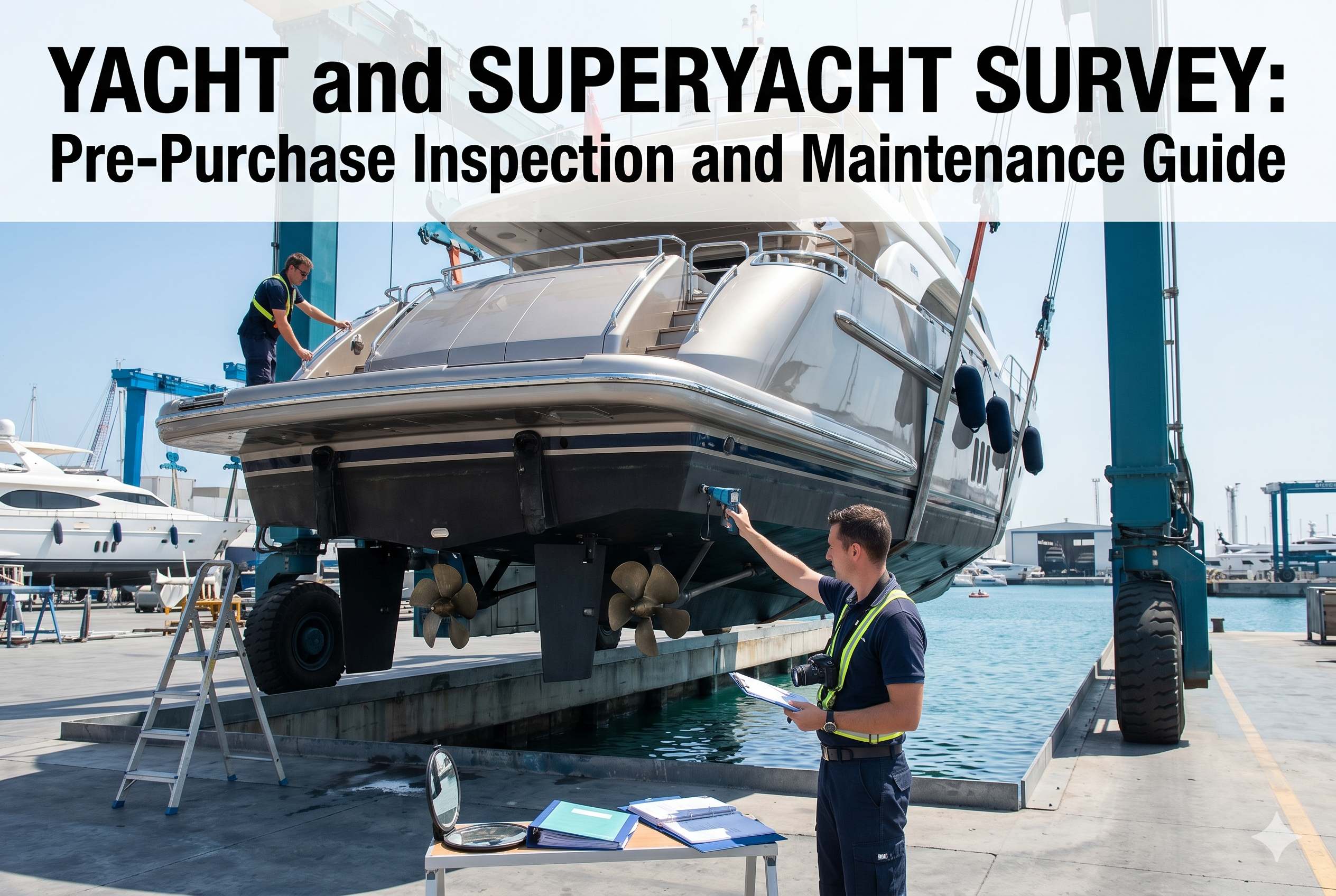
Underwater or diver's inspection
Conducted at delivery under the contract, covering rudder, propeller, bottom, and other underwater parts. In modern practice most vessels are delivered afloat with a diver's inspection rather than a drydocking.
The practical consequence is that a buyer relying only on a market-comparison valuation is pricing a ship type, not a ship. Two sister vessels of the same age and size can differ materially in value because one has been maintained and the other has been run to the edge of her class requirements — and only the survey and the records reveal which is which.
What the Pre-Purchase Survey Actually Covers
The inspection itself is broad but shallow by necessity: the ship is trading, the machinery is running, and nothing is opened up. A good superintendent knows what can be established in those conditions and what cannot. See structured inspection reporting in a demo.
Hull and structure
General condition of the hull, decks, and cargo holds or tanks. Corrosion, coating breakdown, cracking, and previous repairs. Hold and tank condition is often where the significant money hides — cargo-hold corrosion alone can run to six figures.
Machinery and automation
Main engine, auxiliaries, and their running hours and maintenance history. Automation and control systems, which are a recurring source of dispute because faults may only surface once the buyer's people are aboard.
Cargo systems and equipment
Cranes, hatch covers, pumps, and cargo-handling gear — the equipment that determines whether the ship can actually earn. Loading equipment is a recognised secondary factor in valuation.
Class and statutory status
Outstanding conditions of class and recommendations, survey due dates, and any overdue items — the clearest formal indicator of the vessel's regulatory standing.
Certificates and documentation
The full certificate suite, PSC inspection and detention history, and the safety management records that reveal how the ship has actually been operated rather than how she presents.
Regulatory compliance horizon
What upcoming regulation will demand — ballast water treatment, emissions and efficiency requirements, and retrofits. Economic obsolescence from regulatory change is a real and quantifiable value factor.
The honest limitation must be stated plainly: this is a superficial inspection. Machinery is not dismantled, the underwater body is not seen until delivery, and steel thickness is generally read from the last class gauging report rather than measured afresh. The survey's power comes less from what the surveyor personally touches than from what the records disclose when read properly.
The Class Records Review
This is the part of due diligence that separates a professional buyer from an optimistic one, and it is where the real history of a ship lives. A vessel presents well on a two-day visit; her class file does not lie so easily. See records and history tracking in a demo.
1
Damage and repair history
Previous groundings, contacts, structural damage, and how the repairs were carried out and approved. A repaired grounding is not disqualifying; an undisclosed one is a serious problem.
2
Recurring defects
The same item appearing across successive annual and intermediate surveys is the signature of a chronic problem the seller has been managing rather than solving — and it will become the buyer's problem.
3
Thickness measurement trends
Corrosion, cracks, and gauging results across surveys reveal the trajectory of the steel — not just where it stands today, but how fast it is going, which drives the forecast of future steel renewal cost.
4
Conditions and recommendations
Outstanding class conditions and their deadlines, which are both a direct cost and a signal about how the vessel has been managed.
5
Survey status and the drydock clock
Where the vessel sits in her special survey and drydocking cycle. A ship due for special survey shortly after delivery carries a large, near-certain cost that must come off the price.
6
PSC and detention record
Port state control history exposes the operating culture behind the paintwork. A pattern of deficiencies or a detention says more about the seller's standards than any presentation.
Read together, these records let a buyer forecast rather than merely observe. The condition and valuation discipline treats class technical reports precisely this way — mining them for existing and past damage, recurring problems, corrosion, cracks, and thickness so as to estimate short and long-term expenses. That forecast, not the walkaround, is what actually informs the price.
The records tell the story the walkaround cannot
Inspection Data That Holds Its Value After the Deal
Recurring defects, damage history, survey status, and deficiency patterns are what reveal a vessel's real condition — for the buyer doing diligence, and for the owner who wants that history intact and defensible on their own fleet. Marine Inspection structures inspection reporting, tracks defects and corrective actions to closure, holds certificate and survey due dates with alerts, and keeps the timestamped record that makes a vessel's condition provable rather than asserted. Book a 30-minute demo, or start a free trial today.
The Three Valuation Approaches
Vessel valuation is both art and science, and it is unusual among asset classes: while most assets depreciate steadily over their useful life, a ship's value can rise over time, driven primarily by freight rates and the state of the market. Three recognised methodologies exist, and professional valuers typically apply several and weight the results by ship type and market conditions.
Market
The market comparable approach — "last done"
Compares recent sales of similar vessels to establish a price range. The dominant method in S&P. Primary factors are age, size, and condition; secondary factors that materially move value include main engine type, attached charter contracts, loading equipment, building yard, and the vessel's location at the time of sale. Its weakness is thin comparable data in illiquid segments and its blindness to the individual ship's technical state.
Cost
The replacement cost approach
Takes the cost of an equivalent newbuilding and deducts depreciation. It rests on the principle of substitution — a prudent buyer will not pay more than the cost of acquiring an equivalent substitute. Straight-line depreciation over a 25–30 year economic life is the usual arithmetic: newbuild cost minus scrap value, divided by useful life. The challenge is quantifying the deductions properly, because physical deterioration, functional obsolescence from newer technology, and economic obsolescence from regulation all apply.
Income
The income approach
Calculates the present value of projected net earnings over the vessel's remaining commercial life, typically via a discounted cash flow. It captures what the asset can actually generate — and directly reflects an attached charter, which is a genuine value driver. Its limitation is that without a charter in place, the earnings forecast becomes speculative. The Hamburg Shipbrokers' Association's long-term asset value method formalised a DCF-and-WACC approach for exactly this reason.
A worked illustration of the cost approach shows why it must never be used alone. A tanker with a newbuilding replacement cost of USD 60 million and an estimated scrap value of USD 8 million over 25 years depreciates theoretically at about USD 2.08 million a year, implying roughly USD 39.2 million of remaining book value at ten years old. Actual market value can deviate materially from that figure depending on where the market cycle sits, the vessel's survey status, and any regulatory retrofit she needs. The arithmetic is a starting point, not an answer.
How Condition Feeds the Price
The survey's commercial purpose is to adjust a market-derived number for the specific ship. Every finding falls into one of a few buckets, and knowing which is which is the core negotiating skill. See defect tracking in a demo.
Class-affecting defects
The strongest position. Under Saleform, if underwater parts are found broken, damaged, or defective so as to affect class, the sellers must drydock at their expense, make good the defects to class's satisfaction, and pay for the inspection and class attendance.
Deferrable defects
Where class does not require rectification before the next drydocking survey, the sellers may deliver with the defect against a deduction from the price of the estimated direct cost of labour and materials — after which the buyer has no further right in respect of those defects or repairs.
Quantified deferred maintenance
Not class items but real cost — corrosion, coating breakdown, tired equipment. Priced and negotiated into the number. A buyer's inspection finding significant hold corrosion estimated at around USD 200,000 to repair is the kind of item that gets written into an amended MOA.
Imminent survey and drydock cost
Survey status is a recognised pricing factor. A vessel delivered just before a special survey carries a near-certain, large, and forecastable cost that belongs in the price discussion.
Regulatory retrofit exposure
Ballast water, emissions, and efficiency compliance are economic obsolescence in valuation terms. A ship needing expensive retrofit to keep trading is worth less than her comparables suggest.
Cosmetic and operational wear
Expected in a secondhand vessel and generally priced into the market comparable already. Pressing hard on these while missing a structural trend is how buyers lose credibility and leverage at once.
The discipline is to separate what class will force the seller to fix, what the contract lets the seller pay you to accept, and what you are simply buying. Those are three different conversations, and conflating them weakens all three.
The Contractual Mechanics
The survey does not exist in a vacuum — it operates inside the Memorandum of Agreement, and the form chosen shapes what the survey can achieve. The Norwegian Saleform 2012 is the most widely used standard, alongside Nipponsale, the Singapore Ship Sale Form, and BIMCO's SHIPSALE 22, published in 2022. It is usually the seller who picks the form.
The inspection clause and its two options
Saleform offers pre-contract inspection, where the contract proceeds with condition known, or post-contract inspection, with a right to reject and terminate. In practice the pre-contract option dominates — meaning buyers commit on the basis of limited inspection knowledge, which is exactly why the quality of that inspection matters so much.
Inspecting the records
It is common practice for buyers to inspect the vessel and her class records before signing, and the MOA typically obliges the seller to arrange a mutually agreed time for the buyer to inspect and view those records without disrupting the vessel's operation.
Drydocking and diver's inspection
In reality vessels are delivered afloat, with the buyer entitled at delivery to an underwater inspection by a qualified diver with a closed-circuit camera and a class representative present. The buyer's representative may attend as observer only, without interfering with the surveyor's work or decisions.
Who pays for what
Diver and class attendance costs are typically for the buyer's account — unless damage is found that affects class, in which case they shift to the seller. The tailshaft survey follows the same logic: buyer's cost unless class requires it or parts are condemned or found defective so as to affect class.
The limits of buyer protection
Successive Saleform versions have become more seller-favourable, and the 2012 form's entire-agreement clause explicitly excludes reliance on pre-contract representations, sharply limiting misrepresentation claims. English law has partially cut against this — The Union Power established that "as she was" does not automatically exclude statutory implied terms as to satisfactory quality — but the prudent assumption remains that the buyer's protection is what the survey found and what the MOA says.
Timing deserves particular attention. Notice of readiness cannot be tendered before the underwater inspection is complete, and where diving conditions at the delivery port are unsuitable, Saleform 2012 extends the cancelling date by the time needed to reposition the vessel and bring her back. These are not trivia — they are the levers that determine whether a late-discovered defect is the seller's problem or the buyer's.
Turning Findings Into Leverage
A survey report that merely lists observations is a wasted opportunity. The report earns its fee when every finding is converted into either a cost, a contract term, or a decision to walk.
Price the finding, don't just note it
A defect described qualitatively invites argument; a defect quantified in labour and materials becomes a number on the table. The Saleform deduction mechanism itself works on estimated direct cost — so estimate it.
Separate class items from commercial ones
Class-affecting defects are the seller's obligation, not a negotiation. Spending goodwill arguing about items class will force anyway is a waste of a limited resource.
Amend the MOA, don't rely on goodwill
Where a significant finding is accepted, it belongs in the agreement — as a deduction, a rectification obligation, or a delivery condition. A verbal understanding is worth nothing against an entire-agreement clause.
Build the forecast, not just the snapshot
Upcoming drydock and special survey cost, steel renewal trajectory, and retrofit exposure over the intended holding period turn a condition list into an ownership cost model — which is what actually determines whether the price is right.
Weigh methods against each other
Where the market comparable, the depreciated cost, and the income approach diverge sharply, that divergence is itself information — usually about market cycle, survey status, or a charter. Understand the gap before pricing.
Be willing to walk
Undisclosed damage, a class file showing chronic managed defects, or a PSC record revealing a poor operating culture are signals about everything you cannot see. The strongest negotiating position is a genuine willingness to decline.
The through-line of a good acquisition is that condition is evidence, and evidence must be recorded to be useful. That is true on both sides of the table: the buyer needs a structured, quantified report rather than a narrative, and the seller who has maintained a clean, complete, timestamped record of inspections, defects raised and closed, certificates, and survey status commands a better price — because a well-documented vessel is a lower-risk vessel, and the discount a buyer applies to uncertainty is real money. Whichever side of the transaction you sit on, the asset's paperwork is part of the asset. Book a demo to see inspection, defect, and certificate records managed as one system.
Frequently Asked Questions
What is a pre-purchase ship survey?
A buyer's technical inspection of a vessel and her class records before purchase, usually conducted by a superintendent or independent surveyor over a few days while the ship trades. It covers hull and structure, machinery, cargo systems, class and statutory status, certificates, and PSC history, producing a condition report that informs both the valuation and the negotiation.
What is the difference between a survey and a valuation?
A survey establishes whether the vessel is sound and functional; a valuation or appraisal determines her market worth. Buyers and lenders often commission a combined Condition and Valuation report, which incorporates the vessel's actual technical state, class history, and forecast running costs into the valuation rather than relying on market comparison alone.
What are the three vessel valuation methods?
The market comparable approach, which compares recent sales of similar vessels; the replacement cost approach, which deducts depreciation from the cost of an equivalent newbuilding; and the income approach, which discounts projected net earnings over the remaining commercial life. Professional valuers typically apply several and weight the results by ship type and market conditions.
Do ships get drydocked for a pre-purchase survey?
Rarely. In modern practice vessels are delivered afloat, with the buyer entitled at delivery to an underwater inspection by a qualified diver with a closed-circuit camera and a class representative present. Under Saleform, if underwater parts are found defective so as to affect class, the sellers must arrange drydocking at their expense and make the defects good to class's satisfaction.
What happens if the survey finds defects?
It depends on whether they affect class. Class-affecting defects must be made good by the sellers at their expense. Where class does not require rectification before the next drydocking survey, the sellers may deliver with the defect against a deduction from the price of the estimated direct cost of labour and materials — after which the buyer has no further right regarding those defects. Non-class deferred maintenance is negotiated commercially.
Which contract is used for buying a secondhand ship?
The Norwegian Saleform 2012 is the most widely used standard Memorandum of Agreement, alongside Nipponsale, the Singapore Ship Sale Form, and BIMCO's SHIPSALE 22 published in 2022. The seller usually chooses the form, and the differences between them matter — so buyers should understand the form or take legal advice on it.
Why do class records matter more than the walkaround?
Because they reveal history a two-day visit cannot: previous damage and repairs, recurring defects appearing across successive surveys, thickness measurement trends showing how fast the steel is going, outstanding conditions of class, survey and drydock status, and the PSC record. Condition and valuation practice mines exactly this material to forecast short and long-term expense — and that forecast, not the walkaround, drives the price.
A well-documented vessel is a higher-value vessel
Make Your Fleet's Condition Provable, Not Just Asserted
Buyers discount uncertainty, and uncertainty is what a thin record creates. Marine Inspection structures inspection reporting across your fleet, tracks defects and corrective actions through to verified closure, holds certificates and survey due dates with alerts, and builds the timestamped history that stands up in due diligence — whether you are buying, selling, or simply proving your vessel is what you say it is. Book a tailored demo, or start a free trial today.