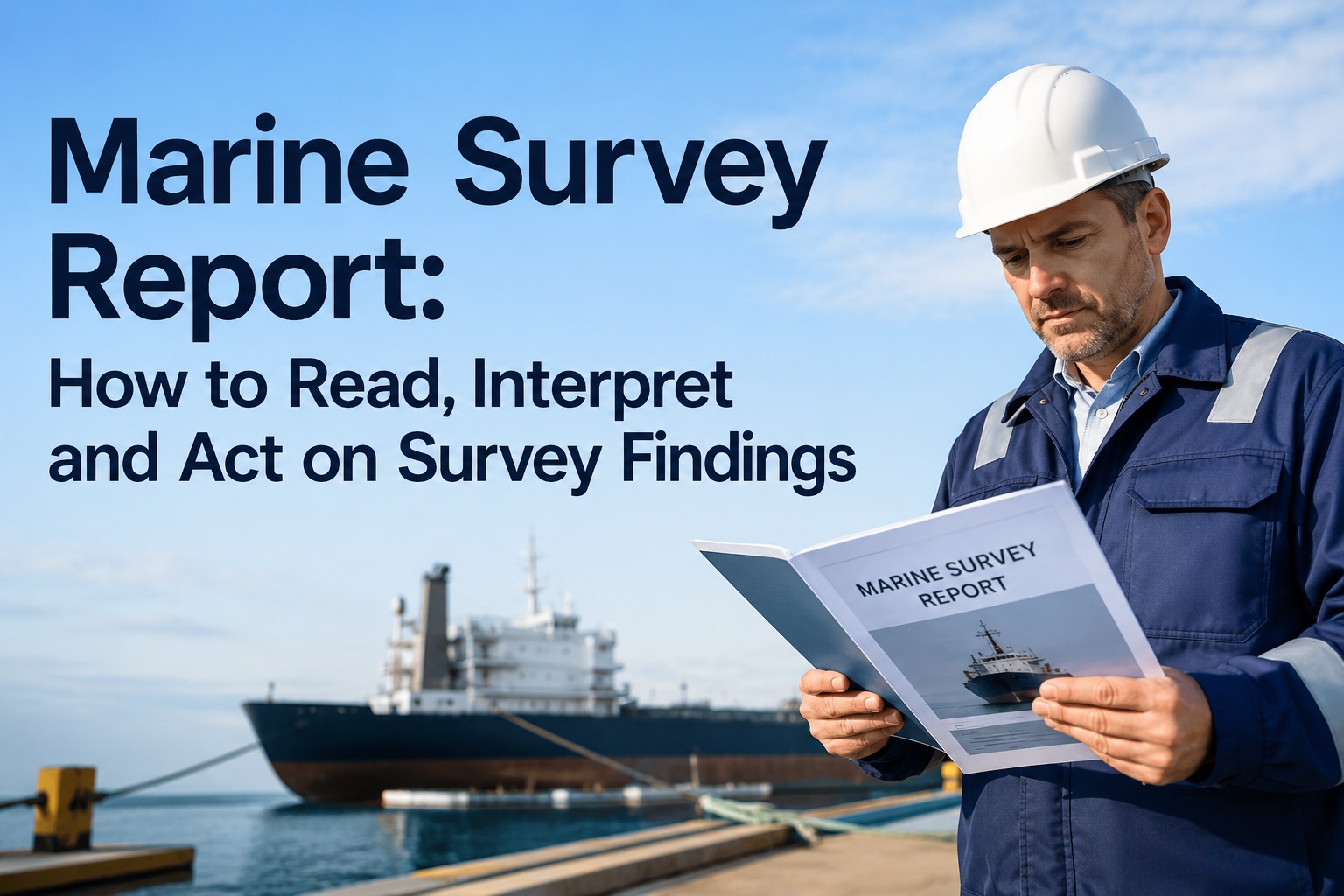
A marine survey report lands in the superintendent's inbox and the clock starts running. Somewhere in that document is the difference between a vessel that keeps trading and one that gets a condition placed on its class certificate, and reading it correctly is a skill the report itself does not teach. The findings are written in the compressed, standardised language of the surveyor, graded by a severity system that varies between societies, and tied to deadlines that are easy to miss and expensive to breach. For a superintendent managing several vessels, or a master handed a report at the end of a long survey day, the practical question is not whether a survey happened but what the report actually requires: which findings must be fixed before the ship sails, which can wait for the next dry dock, which are merely notes for the file, and how each one is cleared so it disappears from the vessel's record. This guide is a working manual for exactly that. It walks through the structure of a marine survey report, how deficiencies are graded and prioritised, what a Condition of Class really means and how it differs from a memorandum, how to build a corrective action plan that closes findings out cleanly, and how to communicate with class so nothing is left hanging. Read it as the interpretation layer that sits between receiving a report and acting on it correctly. To turn survey findings into tracked, closed-out corrective actions across your fleet, start a free trial or book a demo.
INDUSTRY GUIDE · SURVEY REPORTS
Marine Survey Report: How to Read, Interpret and Act on the Findings
A superintendent's and master's working manual for turning a survey report into the right actions in the right order — report structure, deficiency grading, Conditions of Class, corrective action planning, and clean communication with your classification society.
What this guide covers
1 What a survey report is — and is not
2 The anatomy of the report
3 How findings are written
4 Deficiency grading and priority
5 Condition of Class vs memorandum
6 The Class Status Report
7 Building a corrective action plan
8 Closing findings out with class
1. What a Survey Report Is — and What It Is Not
Before interpreting the findings, it helps to be precise about what the document represents. A marine survey report is the surveyor's formal record of a vessel's condition against a defined standard, at a specific point in time, within a defined scope. Each of those qualifiers matters, and misreading any of them leads to the wrong action.
It is a record against a standard, not an opinion. Every finding is measured against a reference — the classification society's rules, a SOLAS or MARPOL requirement, a load line condition, a manufacturer's specification. A good finding names that standard, because the standard is what makes the deficiency a deficiency rather than a preference. When a report says a fire damper is defective, the force behind that statement is the regulation it fails to meet, and the corrective action has to restore compliance with that same regulation.
It is a snapshot in time, not a warranty of future condition. The report describes what the surveyor saw on the day, within the scope examined. The scope of a class survey does not necessarily encompass one hundred per cent of the structure and equipment — it is laid down by convention and rule, and generally increases with the age of the vessel. A clean report is not a guarantee that nothing else is wrong; it is a statement that the items within scope met the standard when examined. This is why an experienced superintendent reads the scope as carefully as the findings.
It is scoped by survey type. An annual survey, an intermediate survey, a special (renewal) survey and a docking survey each carry different scope and different consequences, and the report has to be read in the light of which one produced it. A finding at an annual survey against a five-year cycle sits in a different context from the same finding at a renewal survey. The report is the output of a process, and knowing which process helps you weigh what it says.
i
The distinction that trips people up
Statutory (flag) surveys verify compliance with international conventions — SOLAS, MARPOL, Load Lines, MLC — and lead to statutory certificates. Class surveys verify compliance with the classification society's technical rules for structure, machinery and engineering, and lead to class certificates. In practice, most flag states delegate statutory surveys to classification societies as Recognized Organizations, so both are often done by the same surveyor in the same visit — which means a single report can carry both statutory findings and class findings, each cleared under a different authority. Reading which is which tells you who has to accept the fix.
2. The Anatomy of the Report
Reports vary in format between societies and surveyors, but the underlying structure is consistent. Knowing where to look means you extract what matters in minutes rather than reading linearly and losing the priorities in the detail.
SECTION
Vessel particulars and survey scope
Identifies the vessel, its class notation, the survey type conducted, and — critically — the scope of what was examined. This is the frame for everything below it. Read the scope first: it tells you what the clean areas of the report actually cover and what was not looked at.
SECTION
Survey narrative
The surveyor's account of what was done — spaces entered, equipment tested, thickness measurements taken, demonstrations witnessed. It establishes that the required examinations happened, and it is where you confirm that items due at this survey were actually covered rather than deferred.
SECTION
Findings, deficiencies and recommendations
The section everyone turns to first, and the substance of the report. Each finding describes a deficient condition, its location, the standard it fails, and what is required to restore it. This is where grading and priority live, and where the corrective action plan is born.
SECTION
Conditions of Class and memoranda
The formal outcomes with teeth. Conditions of Class carry deadlines and must be cleared to retain class; memoranda are informational notes. These are the items that follow the vessel on its permanent record until closed, and they deserve the closest reading of all.
SECTION
Supporting evidence
Photographs, thickness measurement reports, test records and certificates referenced by the findings. Modern reports increasingly embed this evidence directly against each finding, which is what makes a finding verifiable rather than a bare assertion.
SECTION
Surveyor conclusion and certificate status
The bottom line: whether certificates were endorsed, issued, or withheld pending action, and what the vessel's class standing is as a result. This tells you immediately whether the ship is clear to trade or whether something must happen first.
3. How Findings Are Written — Reading the Language
The single most useful skill in interpreting a report is reading an individual finding correctly, because a well-written finding contains four distinct pieces of information, and each one drives a different part of your response. Reputable surveyors follow a consistent pattern, and learning to parse it turns a dense paragraph into a clear instruction.
OBSERVATION
What the surveyor found — the deficient, substandard or damaged condition itself, stated as fact. "The number three starboard ballast tank shows heavy scale and coating breakdown over approximately forty per cent of the internal surface."
LOCATION
Exactly where it is, so the finding can be found again and the repair scoped. Precise location — tank, frame, deck, system, side — is what lets the vessel plan access and lets the surveyor re-examine the same spot.
STANDARD
The rule, regulation or specification the condition fails. This is the authority behind the finding and the target the repair must meet — the class rule, the SOLAS regulation, the coating standard, the renewal thickness.
RECOMMENDATION
What is required to restore the item to acceptable condition, and by when. This is the action, the deadline and — if it is a Condition of Class — the thing that must be cleared with class attendance to close the finding.
The value of this pattern becomes obvious when a finding is missing a piece. The most common shortcoming in survey reports is the failure to describe a defect sufficiently — a finding that states a condition but not its location, or names a fault but not the standard it breaches, leaves the vessel guessing about scope and the surveyor unable to verify the fix. When you receive a finding that is vague, the correct response is not to interpret generously but to go back to the surveyor for the missing element. A finding you cannot fully parse is a finding you cannot cleanly close.
Reading well also means reading for consequence. A properly written recommendation includes not just the condition but the potential result of failing to correct it — the reason it matters. That consequence is your guide to urgency when the formal grading is ambiguous, and it is the argument you will use when you brief the master or justify the repair spend to the office. A finding without a stated consequence is one to probe: ask what happens if this is left, because the answer determines where it sits in your plan.
4. Deficiency Grading and Priority Classification
Not all findings are equal, and the report grades them — but the grading systems differ between societies and survey types, so the skill is understanding the logic rather than memorising one scheme. Every system, whatever its labels, is answering the same question: how soon must this be corrected, and what happens if it is not.
PRIORITY 1
Immediate — safety or compliance critical
Conditions affecting the immediate safety or seaworthiness of the vessel, or required for statutory compliance. These must be corrected before the vessel continues in service, and they are the findings that can withhold a certificate or ground the ship. When underwriters and surveyors flag a defect as priority, it is almost always because it affects immediate safety. Treat anything in this tier as sail-blocking until proven otherwise.
PRIORITY 2
Required within a defined period
Deficiencies serious enough to require rectification within a prescribed time — often the population that becomes Conditions of Class. The vessel may continue trading, but the finding carries a deadline and must be cleared within it. These are the items that quietly become emergencies if the deadline is not tracked, because the vessel keeps sailing and the clock keeps running.
PRIORITY 3
Recommended — reliability and maintenance
Items that should be addressed for long-term reliability but do not affect immediate safety or class standing — the maintenance and improvement recommendations. They are real and should be planned into the maintenance system, but they do not carry the same deadline pressure. The risk here is the opposite one: letting a large population of low-priority items accumulate until it signals a poorly maintained vessel.
i
The condition rating scales
Some surveys, particularly condition assessments on older vessels, use a numbered rating scale rather than priority tiers. A common four-level scale runs from "very good condition" with no deficiencies affecting safe operation, through "good" and "satisfactory" — where items may show deficiencies not requiring immediate corrective action or substantial corrosion still above renewal levels — down to "unsatisfactory condition", where a deficiency may affect the ship's potential to remain in class or thicknesses are at or below renewal levels. When you see a numbered rating, read the definition attached to it rather than assuming a mapping to the priority tiers, because the bottom of a condition scale carries the same weight as a top-priority finding.
The practical discipline is to re-sort the report the moment you receive it. Reports are organised the surveyor's way; you need them organised your way — by what blocks the ship from sailing, what carries a deadline, and what feeds the maintenance plan. That re-sort is the first act of interpretation, and it is what turns a document into a plan.
Turn every finding into a tracked, deadline-aware action
A survey report is only as good as what happens after it is read. Marine Inspection captures each finding as a corrective action with its priority, deadline and evidence, tracks Conditions of Class against their clearance dates, and keeps the whole trail auditable through close-out — so no deadline slips and no finding is left hanging. See how survey findings become managed actions across your fleet.
5. Condition of Class vs Memorandum — the Distinction That Matters Most
Two terms in the report carry more weight than any others, and confusing them is one of the costliest mistakes a superintendent can make. A Condition of Class is an obligation with a deadline; a memorandum is a note. Reading them correctly determines what must be actioned and what merely informs.
CONDITION OF CLASS
Also called a Recommendation by some societies — the two terms mean the same thing
A Condition of Class is issued when a defective or damaged survey item is not so serious as to jeopardise class immediately, but is serious enough to require rectification within a prescribed period in order to maintain class. It is, in effect, a formal deferral: the vessel keeps trading on condition that a defined action is completed by a defined date.
Carries a specific deadline — a date, a survey, or a dry dock by which it must be cleared
Must be closed out with the attendance of a surveyor who verifies the corrective action
Remains on the vessel's class record until cleared, visible to charterers, PSC and buyers
If not cleared in time, can lead to suspension or withdrawal of class
MEMORANDUM
Informational — for the assistance of surveyor and owner
A memorandum records other information of assistance to the surveyor and owner — notes concerning materials, arrangements, items to be examined at a future survey, or matters that do not in themselves require corrective action to maintain class. It informs rather than obliges.
Generally carries no clearance deadline of its own
Does not by itself threaten class standing if unaddressed
Often flags something to verify or re-examine at the next survey
Still worth tracking, because a memo today can become a finding tomorrow
A few points of nuance are worth holding. First, a Condition of Class should generally not be agreed to where proper facilities for full and permanent repair are available — meaning if the ship can be fixed properly now, class will usually expect that rather than a deferral. The CoC exists for the situation where a permanent repair cannot reasonably be done at the moment, not as a routine way to postpone work. Second, when a surveyor requires an item to be re-examined after a period of time, that too is covered by an appropriate Condition of Class or recommendation — so some CoCs are about re-inspection, not repair. Third, any doubt about the meaning of a memorandum, recommendation or Condition of Class should be addressed directly to the classification society. Guessing at the intent of a formal notation is exactly the wrong move; the society that wrote it will tell you precisely what it requires.
6. The Class Status Report — the Vessel's True State
Individual survey reports capture moments; the Class Status Report — variously the Class Survey Status Report or CSSR — captures the whole. It is the single document that gives an overview of the status of all statutory surveys and certificates, including the complete list of outstanding memoranda and Conditions of Class. For a superintendent, it is the master reference for where a vessel actually stands.
Two things make it indispensable. First, it is authoritative and current: an updated copy is always available on the classification society's website, so it reflects the live position rather than the snapshot of any one survey. When a Condition of Class is cleared, it comes off the CSSR; when a new one is raised, it appears. The CSSR is therefore the document to check before a charter fixture, a port call into a tight PSC regime, a sale, or a change of management — because it shows every open obligation attached to the vessel in one place.
Second, it is the closing ledger for findings. Every Condition of Class from every survey flows onto the CSSR and stays there until formally cleared. Reading the survey report tells you what was found; reading the CSSR tells you what is still open. An experienced superintendent reconciles the two — checking that each CoC raised in a report has either been cleared or appears correctly as outstanding on the CSSR, with its deadline visible. A finding that is on neither, or a CoC whose deadline has quietly passed, is precisely the kind of gap that becomes a detention or a suspension.
i
What "outstanding" can mean
Not every outstanding item is a failure to act. When the opportunity to examine or test an item was not provided at the survey — a tank that could not be gas-freed and entered, a machine that could not be opened up — the item simply remains outstanding to be dealt with at the next opportunity. Reading a CoC as "outstanding" therefore requires reading why: a deferred examination and an unrepaired defect both sit on the list, but they demand different actions. The status tells you it is open; the wording tells you what closing it requires.
7. Building a Corrective Action Plan That Closes Findings Out
Interpretation is only useful if it produces action. A corrective action plan converts the report's findings into a scheduled, owned, deadline-aware set of tasks — and a good one is built directly from the structure of the findings themselves. The aim is not just to fix things but to fix them in a way class will accept and can verify, so each finding closes cleanly.
1
Extract and re-sort every finding
Pull each finding out of the report and re-sort by your priorities: sail-blocking first, then deadline-bearing Conditions of Class, then maintenance recommendations. Capture the four elements of each — observation, location, standard, required action — so nothing is carried forward as a vague note. This is the point at which the report becomes a task list.
2
Attach the deadline and the authority to each item
For every Condition of Class, record the exact clearance deadline — the date, survey or dry dock by which it must be closed — and who must verify it. A CoC that must be cleared with surveyor attendance at the next dry dock is a different planning problem from one due at the next annual survey, and the plan has to reflect that.
3
Assign ownership and scope the repair to the standard
Give each item an owner — ship or shore — and scope the repair to meet the standard the finding named, not just to make the symptom disappear. A coating breakdown finding closes when the coating is restored to the referenced standard; a thickness finding closes when steel is renewed to the class renewal level. Scoping to the standard is what makes the fix acceptable to class.
4
Capture evidence as the work is done
Photograph the completed repair, retain the test records, keep the material certificates and the measurements. The surveyor who closes the finding needs to verify the corrective action, and evidence gathered at the time of repair is what satisfies that verification without a return visit or a dispute. Evidence captured late, or not at all, is the common reason a closed repair reopens as a question.
5
Verify closure against the record
Once the surveyor has attended and accepted the repair, confirm that the Condition of Class has actually come off the Class Status Report. A repair you believe is done but that still shows as outstanding on the CSSR is not closed in the eyes of class — and the record, not your recollection, is what a PSC officer or a charterer will check.
The strongest position is one where corrective action is not a scramble triggered by a report but a continuous discipline. The operators who consistently pass surveys without Conditions of Class are those whose daily operational systems produce survey evidence as a natural output — maintenance completed with photographic records, corrective actions tracked and closed, certificate expiries flagged before they lapse. That is the difference between survey preparation, which is a project you run before each survey, and survey readiness, which is a state the vessel is kept in continuously. A corrective action plan built on readiness closes findings faster because the evidence already exists and the discipline is already in place.
8. Communicating With Class — Closing the Loop Cleanly
The final skill is communication, because a finding is not closed when the repair is done — it is closed when the classification society accepts that it is done and updates the record. Getting to that point cleanly is a matter of clear, evidenced, well-timed communication with the surveyor and the society.
Ask when the meaning is unclear
Any query or doubt about the meaning of a memorandum, recommendation or Condition of Class should be addressed to the classification society concerned. It is always better to ask what a notation requires than to guess and complete the wrong scope of work. The society wrote the finding and will define exactly what closing it takes.
Submit evidence proactively
Where a society allows digital submission of corrective action reports and supporting evidence, use it — sending photographs, test records and measurements to the surveyor ahead of attendance reduces the administrative burden and can shorten or simplify the verification. A finding arrives at attendance already substantiated rather than starting from scratch.
Time the attendance to the deadline
Arrange surveyor attendance to clear a Condition of Class with margin before its deadline, not on the last available day. Attendance takes coordination, and a repair that is complete but unverified because no surveyor could attend in time still counts as an unmet deadline. Plan the close-out attendance as deliberately as the repair.
Confirm the record is updated
After attendance, verify that the Class Status Report reflects the cleared condition. The loop closes at the record, not at the repair — and confirming the CSSR shows the CoC as cleared is the step that protects the vessel at the next PSC inspection or charter check.
Reading a survey report well, in the end, is a chain that runs from the individual finding to the vessel's live class status and back again. You parse each finding into its observation, location, standard and required action; you grade it by how soon it must be fixed and what happens if it is not; you distinguish the Conditions of Class that carry deadlines from the memoranda that merely inform; you reconcile them against the Class Status Report that holds the vessel's true state; you build a corrective action plan that scopes each repair to the standard and captures the evidence to prove it; and you communicate with class to verify closure and confirm the record. Done well, the report stops being a source of anxiety and becomes what it should be — a precise, actionable picture of a vessel's condition and a clear map of the work required to keep it trading, insured and in class. The superintendents and masters who master this chain are the ones for whom a survey report is not a scramble but a routine, and whose vessels carry the shortest lists of open findings in the fleet. To manage that whole chain — findings, priorities, deadlines, evidence and close-out — in one auditable place, start a free trial or book a demo.
Frequently Asked Questions
What is a marine survey report?
It is the surveyor's formal record of a vessel's condition against a defined standard, at a specific point in time, within a defined scope. It documents what was examined, what deficiencies were found, how serious each is, and what is required to correct them. Depending on the survey, it can carry both statutory findings — against conventions like SOLAS and MARPOL — and class findings against the classification society's technical rules, each cleared under a different authority. It is a snapshot within a scope, not a warranty that everything not examined is sound.
What is the difference between a Condition of Class and a memorandum?
A Condition of Class — called a Recommendation by some societies — is issued when a defect is not serious enough to jeopardise class immediately but is serious enough to require rectification within a prescribed period to maintain class. It carries a deadline, must be cleared with surveyor attendance, and stays on the vessel's record until closed. A memorandum is informational — a note for the assistance of surveyor and owner, often flagging something to re-examine at a future survey — and does not by itself carry a clearance deadline or threaten class standing. The first obliges action; the second informs.
How are survey deficiencies graded?
Grading systems vary between societies and survey types, but they all answer the same question: how soon must this be corrected. In broad terms, top-priority findings affect immediate safety or statutory compliance and must be fixed before the vessel continues in service; middle-priority findings require rectification within a defined period and often become Conditions of Class; lower-priority findings are recommendations for long-term reliability that feed the maintenance plan. Some condition assessments use a numbered rating scale instead, where the definition attached to each level matters more than the number itself.
What is a Class Status Report and why does it matter?
The Class Status Report, or CSSR, gives an overview of the status of all statutory surveys and certificates, including the complete list of outstanding memoranda and Conditions of Class. An updated copy is always available on the classification society's website, so it reflects the vessel's live position rather than any single survey's snapshot. It is the master reference for where a vessel actually stands — the document to check before a charter, a sale, a management change or a port call into a strict PSC regime — because it shows every open obligation attached to the vessel in one place.
How do I close out a Condition of Class?
Scope the repair to meet the standard the finding named, complete it, capture evidence — photographs, test records, measurements — and arrange for a surveyor to attend and verify the corrective action before the deadline. Once the surveyor accepts the repair, confirm that the Condition of Class has actually been cleared from the Class Status Report. The finding is closed only when the record reflects it, not when the physical repair is finished, because the record is what port state control and charterers will check.
What happens if a Condition of Class is not cleared in time?
A Condition of Class that is not rectified within its prescribed period can lead to suspension or withdrawal of the vessel's class. A vessel whose class is suspended or withdrawn faces serious consequences: its insurance may cease to be valid, it may be unable to trade commercially, and it can become a target for port state control detention. This is why tracking each CoC against its exact deadline, and clearing it with margin, is one of the most important disciplines in managing survey findings.
Why is a finding sometimes marked "outstanding" when nothing is wrong?
Because "outstanding" means open, not necessarily unaddressed. When the opportunity to examine or test an item was not provided at the survey — for example a tank that could not be gas-freed and entered, or a machine that could not be opened up — the item remains outstanding to be dealt with at the next opportunity. So an outstanding status can reflect a deferred examination rather than an unrepaired defect. The status tells you the item is open; the wording of the finding tells you what closing it actually requires.
Who should I contact if I do not understand a finding?
The classification society that issued it. Any query or doubt about the meaning of a memorandum, recommendation or Condition of Class should be addressed to the society concerned, which wrote the notation and can define exactly what closing it requires. Guessing at the intent of a formal finding risks completing the wrong scope of work and leaving the item open, so it is always better to ask than to assume — particularly where a finding is vaguely worded or missing its location or the standard it breaches.
From Report Received to Findings Closed
Marine Inspection turns survey reports into managed outcomes: each finding captured with its priority, standard and deadline, every Condition of Class tracked against its clearance date, evidence held against the repair, and the whole trail kept auditable through close-out and reconciled against your class record. Keep your vessels survey-ready year-round so the next report is a routine, not a scramble.