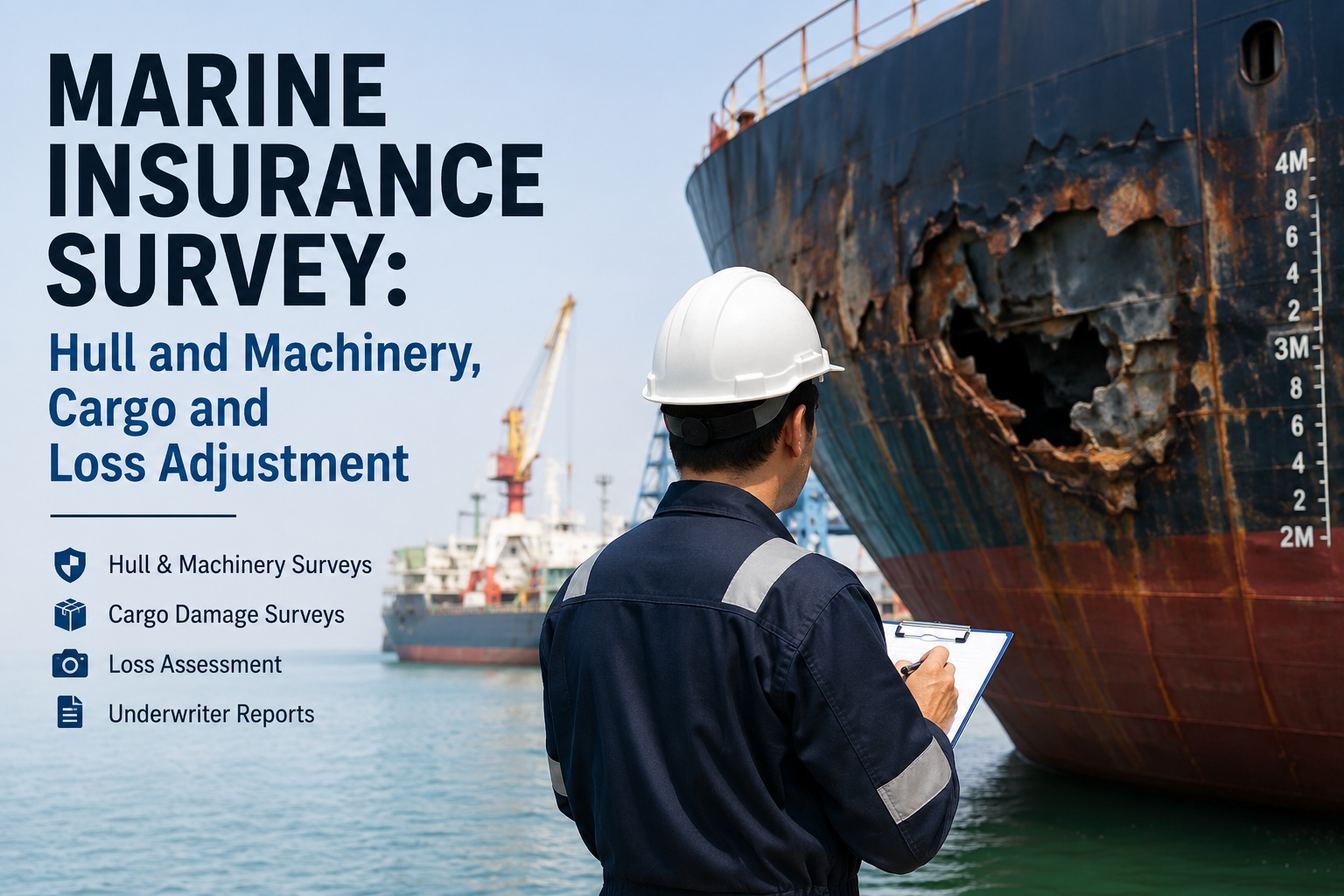
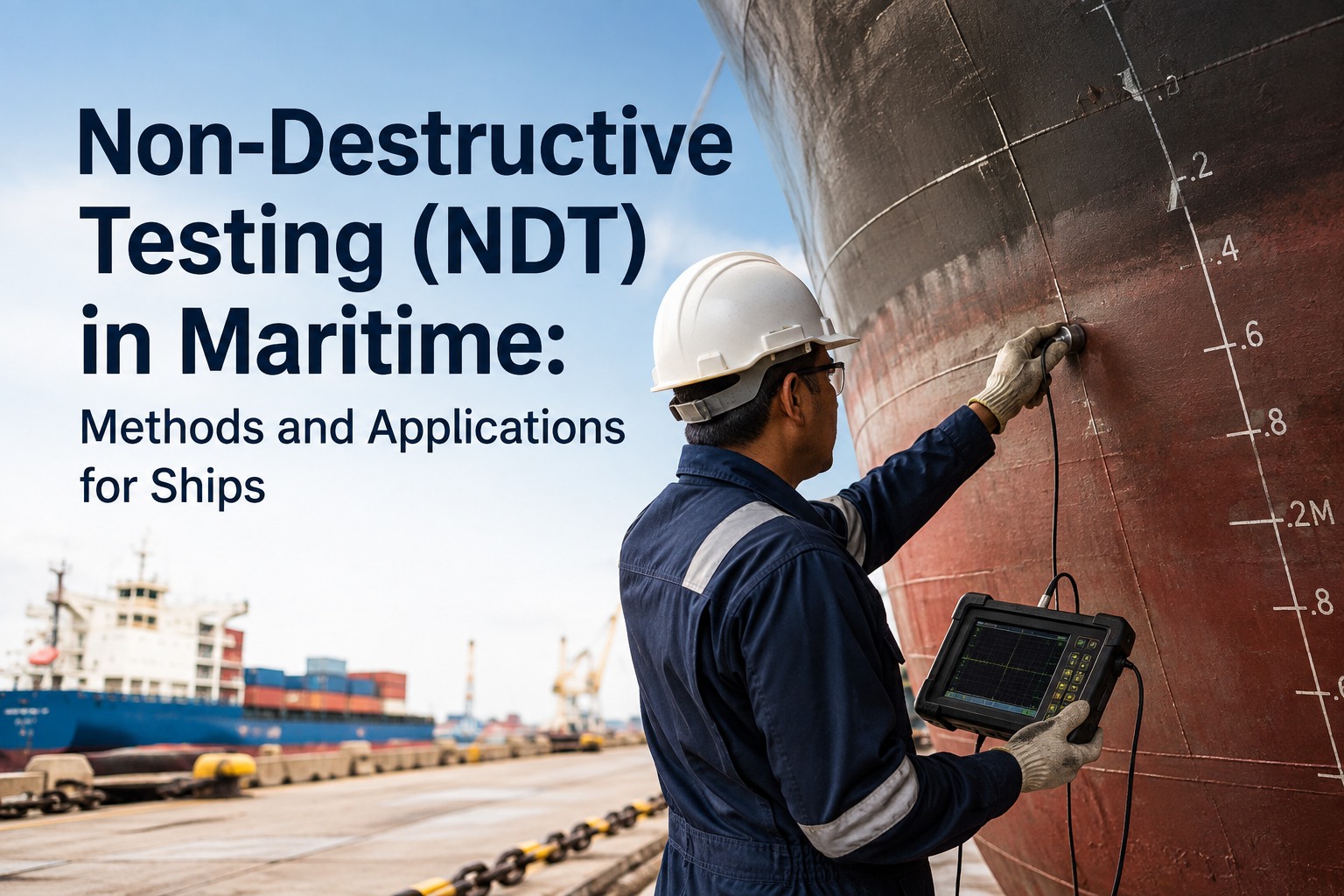
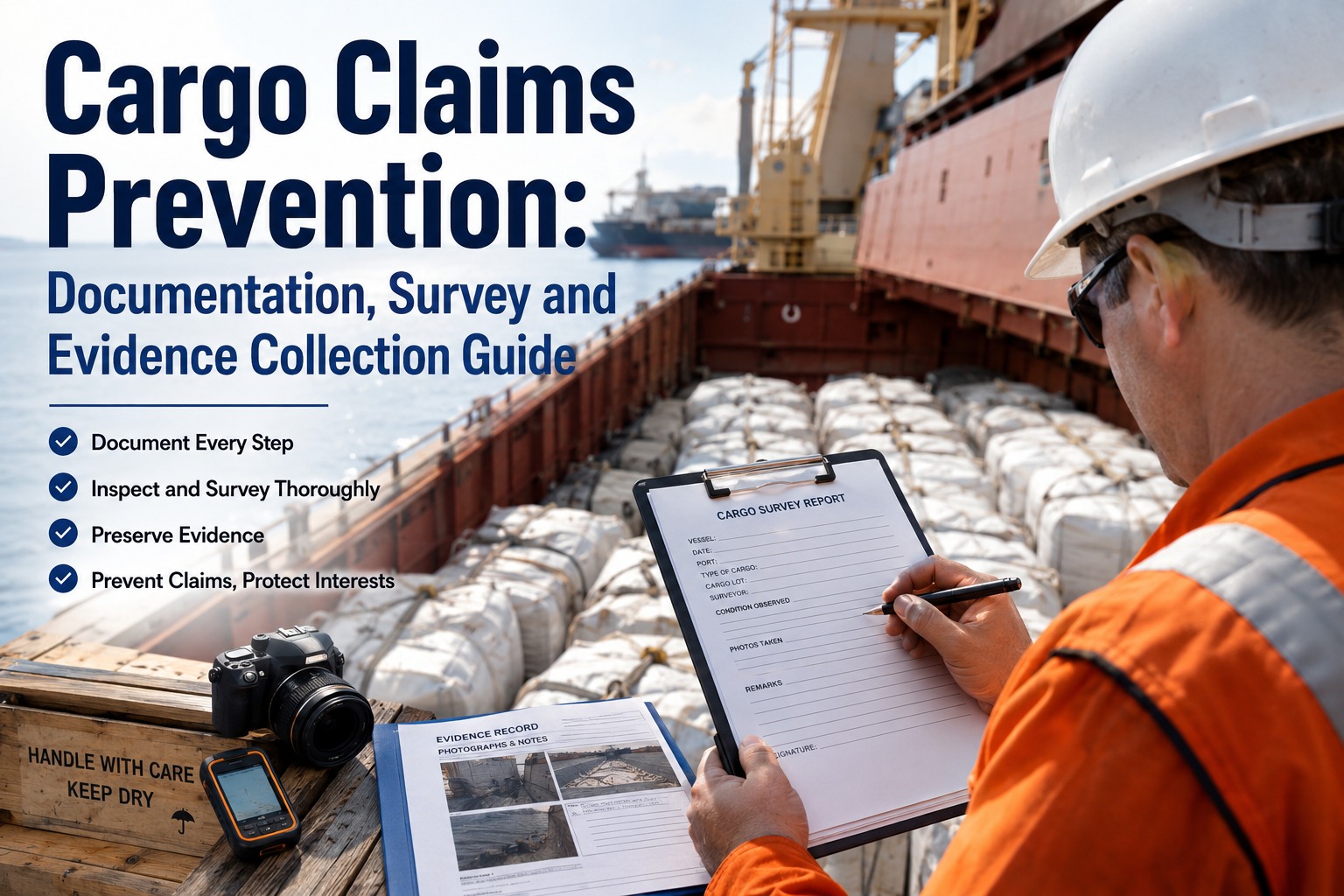
When a ship is damaged, or cargo arrives ruined, or a vessel runs aground and has to jettison containers to save herself, a chain of specialists goes to work that most people outside marine insurance never see. A surveyor establishes what happened and how bad it is. An adjuster decides who pays what. And behind them sits an underwriter who priced the risk in the first place and now has to settle the claim. The marine insurance survey is the hinge the whole thing turns on: it is the independent, evidence-based account of cause, extent, and value that converts a casualty into a claim that can actually be paid. Get the survey right and a complex loss resolves in an orderly way; get it wrong — or fail to preserve the evidence a surveyor needs — and a recoverable loss becomes a disputed one. This guide is a working introduction for surveyors and insurance professionals. It covers the main survey types, hull and machinery damage surveys, cargo surveys, the distinctive world of general average and the York-Antwerp Rules, loss adjustment and total loss, the marine warranty surveyor's separate role, and what underwriters actually need in a report. Throughout, one theme recurs: the claim is only as strong as the contemporaneous record behind it. Start free trial or book a demo to keep the condition, damage, and inspection records every marine claim depends on.
COMMERCIAL & OPERATIONS · MARINE INSURANCE SURVEY
Cause, Extent, Value: The Survey That Turns a Casualty Into a Claim
Behind every marine insurance settlement is a surveyor who established what happened, an adjuster who decided who pays, and a report that made the loss payable. The evidence they work from is created — or lost — in the hours after the incident.
The Surveyor
Establishes cause of loss, extent of damage, and value — the factual foundation of the claim.
The Adjuster
Applies the policy and the rules to decide what is recoverable and how costs are shared.
The Underwriter
Priced the risk and settles the claim — and depends on the survey report to do both fairly.
The Main Survey Types
"Marine insurance survey" is an umbrella over several distinct exercises, each with its own purpose and its own client. Knowing which survey is being asked for — and for whom — shapes everything about how it is conducted and reported.
The unifying purpose across all of them is to give the underwriter what they need to decide fairly. Before a policy is issued, that means fair and equitable terms and premiums; after a loss, it means the cause of the incident, the extent of the damage, the salvage position, and the control of the loss arising. A surveyor's independence is the entire value of the exercise — the report is trusted precisely because the surveyor has no stake in the number.
Hull and Machinery Damage Surveys
The hull and machinery survey deals with damage to the ship herself — and because propulsion machinery often represents a major part of a vessel's value, it deserves particularly careful attention. The classic H&M losses are the dramatic ones: collision, grounding, fire, and flooding.
1
Attend and secure the scene
Early technical input shapes the outcome. When facts are unclear and consequences are immediate, the surveyor investigates the casualty or equipment failure to establish what actually happened — before evidence degrades or is repaired away.
2
Establish causation
The root cause determines whether the loss is even covered, and whose account it falls to. Extent-of-damage, causation, and liability disputes are the heart of contested H&M claims, so causation is documented rigorously, not assumed.
3
Assess extent and define next steps
The surveyor assesses how far the damage runs — including hidden and consequential damage — and defines the repair scope. Machinery losses in particular need engineering judgement to separate the failed component from what it took with it.
4
Report with recommendations
The vessel and machinery are surveyed and a report issued with recommendations, assisting the client's decision-making. The recommendations state facts about any deficient, substandard or dangerous conditions affecting safety and seaworthiness.
i
Hull & machinery and P&I cover different things. Conventional marine insurers such as those at Lloyd's issue policies covering hull and machinery, or cargo, whereas P&I clubs cover third-party risks — a carrier's liability for damage to cargo, pollution, and war risks. A single casualty frequently triggers both: the H&M policy responds to the damage to the ship, while the P&I club handles the liability to cargo interests and third parties. Knowing which policy a given head of loss falls under is half the adjuster's job.
Cargo Surveys
Cargo surveys move fast and across many locations, often with competing commercial priorities pulling in different directions. The surveyor's job is to fix cause, extent, and value before the trail goes cold.
Cause of damage
Finding the root of the damage — wetting, contamination, crushing, temperature, infestation — because the cause determines which policy responds and whether the carrier bears liability. Nobody can know the cause without investigation while the evidence still exists.
Extent of loss
Quantifying the actual damage — how much cargo is affected, and to what degree — separating sound from damaged and salvageable from total loss. Quantity and quality surveys during loading and discharge establish the benchmark.
Value and salvage
Assessing the damaged value, estimating repair or reconditioning cost, and identifying salvage that reduces the net loss. The aim is the true economic loss, not the headline figure — and salvage recovery is part of controlling it.
Prevention for the future
A good damage survey also identifies how the loss could have been prevented and measures the risks to guard against next time — turning a single claim into loss-prevention insight the underwriter values.
The governing discipline is speed of response: the standard advice is to report loss or damage immediately upon taking delivery of the cargo, and to survey while conditions can still be observed. A cargo surveyor acting for underwriters or claimants investigates the damage to certify the root cause, the extent, and the salvage — the three findings that let the claim be adjusted.
The surveyor can only work from evidence that still exists.
Contemporaneous photographs, condition records, and inspection history are what a damage survey is built on. Marine Inspection captures them with timestamps and keeps them retrievable — so when the surveyor arrives, the record is already there.
General Average and the York-Antwerp Rules
General average is the strangest and oldest principle in marine insurance, and it deserves proper explanation because it catches people out. It is a centuries-old rule, unique to shipping, requiring all parties to a maritime adventure to share proportionally in a loss deliberately incurred to save the whole.
The principle in one example
A container vessel carrying mixed cargo worth $10 million suffers an engine fire mid-ocean. The master jettisons $500,000 of containers to stabilise her and incurs $300,000 in emergency port expenses — a total general average sacrifice of $800,000. Even a cargo owner whose goods were never touched must contribute, because the sacrifice benefited all the cargo. That is general average: the party whose property was sacrificed for the common safety is made whole by everyone the sacrifice saved.
The mechanism runs on a defined structure. General average takes the form of a sacrifice — physical loss such as jettisoned cargo, firefighting damage, or machinery damage in refloating — or an expenditure, such as port-of-refuge costs or refloating expenses. The distinction from particular average is sharp and worth memorising: damage to a vessel's machinery from seawater used to fight a fire is general average, shared by all; but damage caused directly by the fire itself, not by the voluntary act of firefighting, is particular average, strictly for the shipowner's account.
Not a convention
The York-Antwerp Rules do not have the force of law on their own. They apply by incorporation by reference into the contract of carriage — the bill of lading or charter party — and into insurance policies.
Periodically revised
Successive versions — 1974, 1994, 2004 and 2016 — have modernised the framework. Different versions carry different claim time limits, so which YAR the contract incorporates matters.
The adjuster apportions
An average adjuster is appointed to calculate each party's contribution over the net arrived values at destination — contributory value being sound arrival value less any particular average.
Security before release
A lien is placed on cargo for its pro-rata share. Cargo is released against security — a general average bond from the receiver plus an average guarantee from the insurer, or a cash deposit.
Fault comes later
The general average mechanism functions irrespective of fault or breach of contract. It distributes the loss first; legal arguments about who caused the casualty are resolved separately, afterwards.
It is slow
Adjustment commonly takes 12 to 24 months, during which cargo may be held as security. In major casualties the sharing of costs can be what prevents outright abandonment of the venture.
The Ever Given grounding in the Suez Canal became one of the most prominent recent general average cases precisely because it showed the scale of what the mechanism has to distribute — refloating a giant containership and settling across thousands of cargo interests. Hull and machinery policies typically cover the general average contribution attaching to the ship; cargo policies cover the contribution attaching to the cargo. The rules are universally accepted, which is exactly why they work.
Loss Adjustment and Total Loss
Where the surveyor establishes facts, the adjuster applies the policy — and the most consequential question an adjuster faces is whether a damaged ship is a total loss.
ACTUAL
Actual Total Loss
The vessel or cargo is destroyed, or so damaged it ceases to be the thing insured, or is irretrievably lost. The insured item no longer meaningfully exists.
CONSTRUCTIVE
Constructive Total Loss
The lost value, repair cost or salvage cost would exceed the insured value, so replacement is more cost-effective than repair. A CTL considers incidental expenses beyond the repair itself.
Total loss triggers subrogation. On a total loss the insurer must indemnify the assured in full, and ownership of the insured item passes to the insurer under the legal process of subrogation — so the insurer can pursue recoveries and dispose of any salvage. This is why a constructive total loss determination is such a pivotal, and contested, adjuster decision: it turns on whether the total of repair, recovery and incidental costs crosses the insured value, and both sides argue the extent of damage and the repair scope that decides it. Total loss claims also carry strict time limits, commonly one to two years depending on jurisdiction.
Loss adjusters and average adjusters bring together the whole picture: investigating casualties and equipment failures, assessing the extent of damage, quantifying what the policy covers, and — in general average — allocating costs fairly among the parties. The disputes cluster predictably around the necessity of repairs and the true extent of damage, which is why the quality and independence of the underlying survey largely determines how cleanly the adjustment resolves.
The Marine Warranty Surveyor
One survey type works in the opposite direction from all the others: instead of assessing a loss that has happened, the marine warranty surveyor approves an operation before it proceeds, so that a loss does not happen. The role is regularly misunderstood, so it is worth stating precisely.
Whose interest
The marine warranty surveyor is appointed to protect the interest of the underwriter, acting as an independent, unbiased entity throughout the operation — not as an advisor to the assured, though clients benefit from involving that experience early.
What they do
Review of all relevant documents, condition surveys of vessels and equipment, and approval of marine operations to ensure best industry practice and correct procedures are followed safely, reliably, and in compliance with regulations.
The ALARP test
The surveyor should only approve operations without considerable risk of damage to property, life or the environment. All marine operations carry some risk; the standard is that risks are kept as low as reasonably practicable (ALARP).
The limits of authority
Marine warranty companies are not contractually tied to the assured's contractors — tug operators, shipyards, riggers — and can issue them no instructions. The experienced surveyor holds final authority to issue the Certificate of Approval and is present during the actual operation.
What the Underwriter Actually Needs
Every survey ultimately produces a report, and a report the underwriter can act on has a recognisable shape. It is not a narrative — it is a decision-support document.
Cause, stated plainly
The probable cause of the loss, established from evidence, because cause determines coverage. Investigation of the causes and circumstances of the incident is the report's spine.
Extent, quantified
The actual extent of damage, with hidden and consequential damage identified, and repair or replacement estimated — so the underwriter can reserve and settle against a real number.
Salvage and mitigation
The salvage position and what was or could be done to control the loss arising. Underwriters need to see the net loss after mitigation, not the gross.
Recommendations of fact
Clear statements about any deficient, substandard or dangerous conditions affecting safety and seaworthiness — factual, not speculative, so they stand up if the claim is contested.
Valuation where needed
Valuation of the vessel, machinery, equipment or cargo as the claim requires — the figures the adjustment and any total-loss determination will rest on.
The supporting evidence
Photographs, measurements, and the documentary trail. A report is only as strong as the contemporaneous evidence behind it, and a contested claim tests exactly that.
The through-line of every marine insurance survey — hull, cargo, salvage, warranty or adjustment — is that the claim is decided on evidence captured at the right moment. The surveyor who arrives after a casualty can only work with what was preserved: the condition of the ship before the incident, the state of the cargo on loading, the maintenance and inspection history that speaks to cause. Owners and managers who keep that record continuously, timestamped and retrievable, hand the surveyor and the underwriter a claim that can be resolved cleanly — and defend themselves against the allegation, in a contested loss, that the damage was pre-existing or the vessel unseaworthy. Scattered across inboxes and local drives, the same evidence is unavailable when it matters most. Book a demo to see condition, damage, and inspection history as one retrievable record.
The Claim Is Only as Strong as the Record Behind It
Marine Inspection captures vessel condition, damage and defects with photographs and timestamps, tracks maintenance and inspection history per vessel, and keeps certificates and survey status current — so when a casualty happens, the surveyor and underwriter have the evidence base a fair, fast settlement depends on. Preserve the record before you need it.
Timestamped condition & damage records
Maintenance & inspection history
Certificate & survey status
Retrievable when the claim lands
Frequently Asked Questions
What is a marine insurance survey?
An independent inspection that establishes the cause of a loss, the extent of the damage, and the value at stake, so an underwriter can decide fairly — on terms and premium before cover, and on settlement after a loss. It spans condition surveys, hull and machinery damage surveys, cargo surveys, salvage surveys, loss adjustment and marine warranty surveys, each with its own purpose and client.
Book a demo.
What is the difference between general average and particular average?
General average is a loss deliberately incurred for the common safety — such as jettisoning cargo or firefighting damage — shared proportionally by all parties to the venture. Particular average is accidental loss that falls on the individual owner of the property affected. The classic distinction: seawater damage to machinery from fighting a fire is general average, but damage caused directly by the fire is particular average, for the shipowner's account.
Book a demo.
What are the York-Antwerp Rules?
The internationally accepted rules governing how general average is adjusted. They are not a convention and have no force of law on their own — they apply by incorporation into contracts of carriage and insurance policies. Revised periodically (1974, 1994, 2004, 2016), with different versions carrying different time limits, they define allowable sacrifices and expenses and how contributions are apportioned over net arrived values.
Book a demo.
What is a constructive total loss?
A situation where the combined repair, recovery and salvage costs would exceed the insured value, making it more economical to treat the property as a total loss than to repair it — considering incidental expenses beyond the repair itself. It differs from an actual total loss, where the property is destroyed or irretrievably lost. On any total loss the insurer indemnifies in full and takes ownership by subrogation.
Book a demo.
What does a marine warranty surveyor do?
Unlike a damage surveyor, a marine warranty surveyor approves a marine operation before it proceeds, to protect the underwriter's interest. Acting as an independent entity, they review documents, survey vessels and equipment, and approve operations only where risk is as low as reasonably practicable (ALARP). They hold final authority to issue the Certificate of Approval but cannot instruct the assured's contractors.
Book a demo.
What is the difference between hull and machinery and P&I cover?
Hull and machinery insurance covers physical loss or damage to the ship herself — collision, grounding, fire, flooding. P&I (protection and indemnity) clubs cover third-party liabilities, including a carrier's liability for cargo damage, pollution and war risks. A single casualty often triggers both, and identifying which policy each head of loss falls under is a core part of the adjuster's work.
Book a demo.
How long does a general average adjustment take?
Commonly 12 to 24 months, during which cargo may be held as security. When general average is declared, an average adjuster calculates each party's proportional contribution over the net arrived values, a lien is placed on cargo for its pro-rata share, and cargo is released against a general average bond plus an insurer's average guarantee or a cash deposit. In major casualties, this cost-sharing can prevent abandonment of the venture.
Book a demo.
Why does evidence preservation matter so much for claims?
Because a surveyor arriving after a casualty can only work with what was preserved — the vessel's condition before the incident, the cargo's state on loading, the maintenance and inspection history that speaks to cause. Contemporaneous, timestamped records let a claim be adjusted cleanly and defend an owner against allegations of pre-existing damage or unseaworthiness. Evidence scattered across inboxes is unavailable when the claim is tested.
Book a demo.
Preserve the Evidence Before the Casualty, Not After.
Every marine insurance survey — hull, cargo, salvage, warranty or adjustment — is decided on evidence captured at the right moment. Marine Inspection keeps vessel condition, damage records, maintenance and inspection history, and certificate status timestamped and retrievable across the fleet, so the surveyor and underwriter have what a fair, fast settlement requires. This guide is an overview, not insurance or legal advice; for a specific claim, take proper professional counsel.
Overview only · Not insurance or legal advice · Records that stand behind every claim