Cargo claims are not really about cargo. They are about proof. When a receiver alleges that four hundred tonnes are missing or that a hold's worth of bags arrived wet, the physical facts of what happened are long gone — the ship has sailed, the cargo has moved into a warehouse, the stevedores have gone home. What remains is a stack of paper, and whichever side's paper is more complete, more contemporaneous, and more specific will win. The burden of proof, moreover, sits substantially on the carrier: the ship must be able to show what she received, what she did with it, and what she delivered. That is why cargo claims prevention is not a legal discipline practised ashore after the fact but an operational discipline practised on deck during four specific windows — before loading, during loading, during the voyage, and at discharge. Each window closes permanently. A hold photographed before the first grab comes aboard cannot be photographed retrospectively; a ventilation decision not logged on day six of a passage cannot be reconstructed on day sixty of a dispute. This guide walks the voyage stage by stage, setting out what a master or cargo officer must establish, record, and protest at each point, and why each item earns its place. Because all of it converges on records created at the right moment and retrievable years later, book a Marine Inspection demo to see cargo inspection and evidence records managed in one place.
Commercial & operations · cargo claims prevention
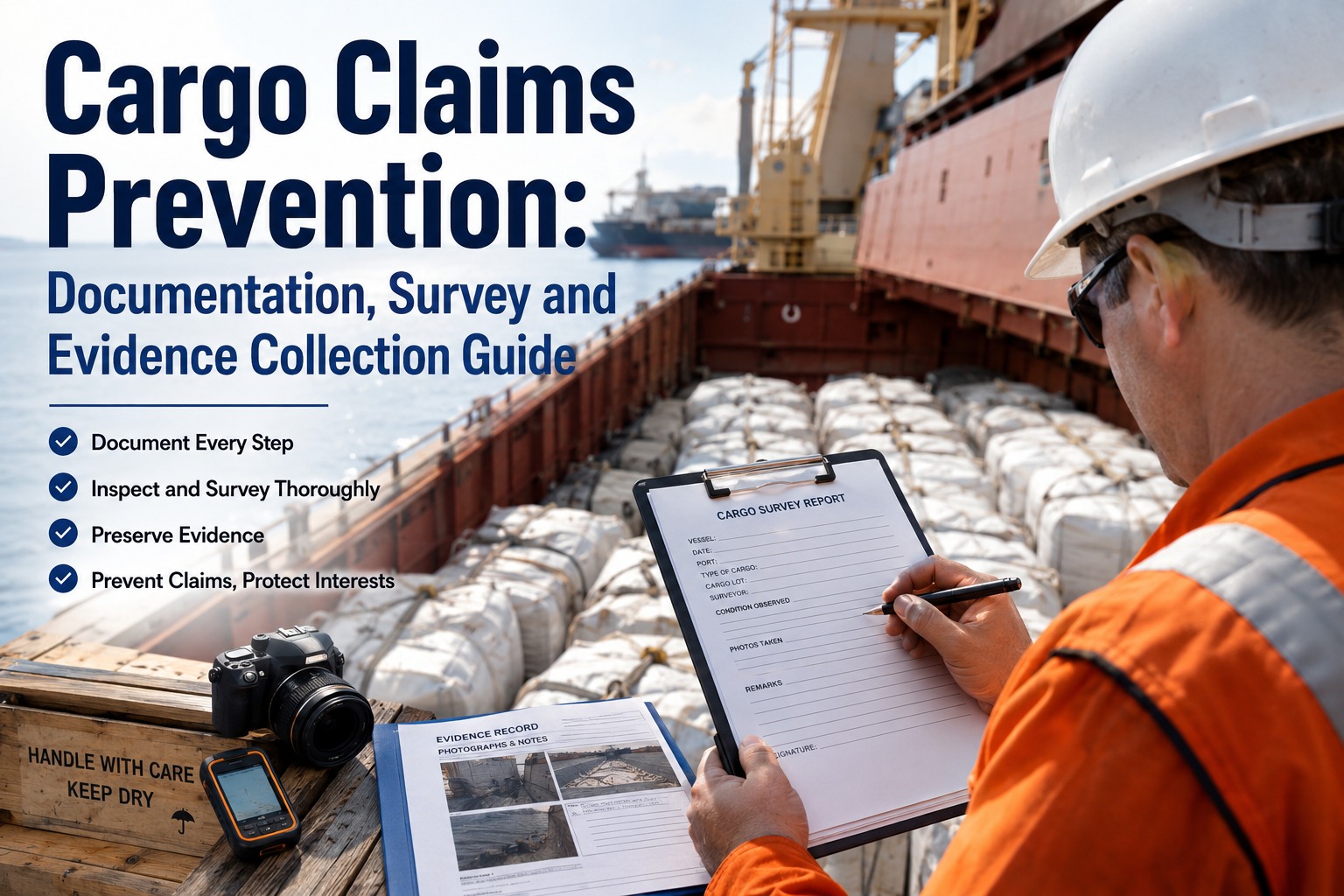
Cargo Claims Prevention: Documentation, Survey and Evidence Collection Guide
A voyage-stage playbook for masters and cargo officers — what to establish before loading, what to record and protest during loading, how to document care at sea, what to capture at discharge, and how to handle stevedore damage.
Before loading
Prove the holds were fit and the cargo's condition on arrival
Loading
Tally, clause, protest, and fix the quantity received
Carriage
Log the care the cargo was given, day by day
Discharge
Record the outturn before the cargo leaves your control
Why the Carrier Carries the Burden
Start with the asymmetry, because it explains every recommendation that follows. When cargo is damaged, the claimant points at the outturn and the carrier must explain it. See structured cargo records in a demo.
The bill of lading is the starting evidence
It is the first evidence of receipt of the cargo it describes — but not the only evidence. It remains open to owners to defeat a claim by showing what the bill states is incorrect, provided they have the material to show it.
The onus sits with the carrier
Where a ship seeks to pass liability on — to stevedores, to charterers — the onus to prove the claim rests on the claimant, which in that posture is the carrier. Ship's officers must therefore collect adequate evidence as soon as possible.
Documentary proof defeats claims
The principle is simple and repeatedly borne out: if the ship's position can be proven by documentary evidence, a claim can be avoided. The corollary is equally true, and more common.
Every stage has its window
Loading and discharge are the most critical, highest-risk moments in a cargo's journey — when goods are most susceptible to physical damage, quantity discrepancies, and mishandling. They are also when evidence is easiest to create and cheapest to obtain.
The recurring failure is not laziness but priority. A cargo officer working a ship on a tight turnaround has twenty things demanding attention, and photographing an empty hold ranks nineteenth. But that photograph costs a minute and is worth six figures eighteen months later, and no other minute in the voyage has that return.
Stage One: Before Loading
Everything the ship can establish before cargo comes aboard is evidence she cannot create afterwards. This stage is about proving two things — that the holds were fit, and what condition the cargo was in when it arrived.
Hold condition and cleanliness
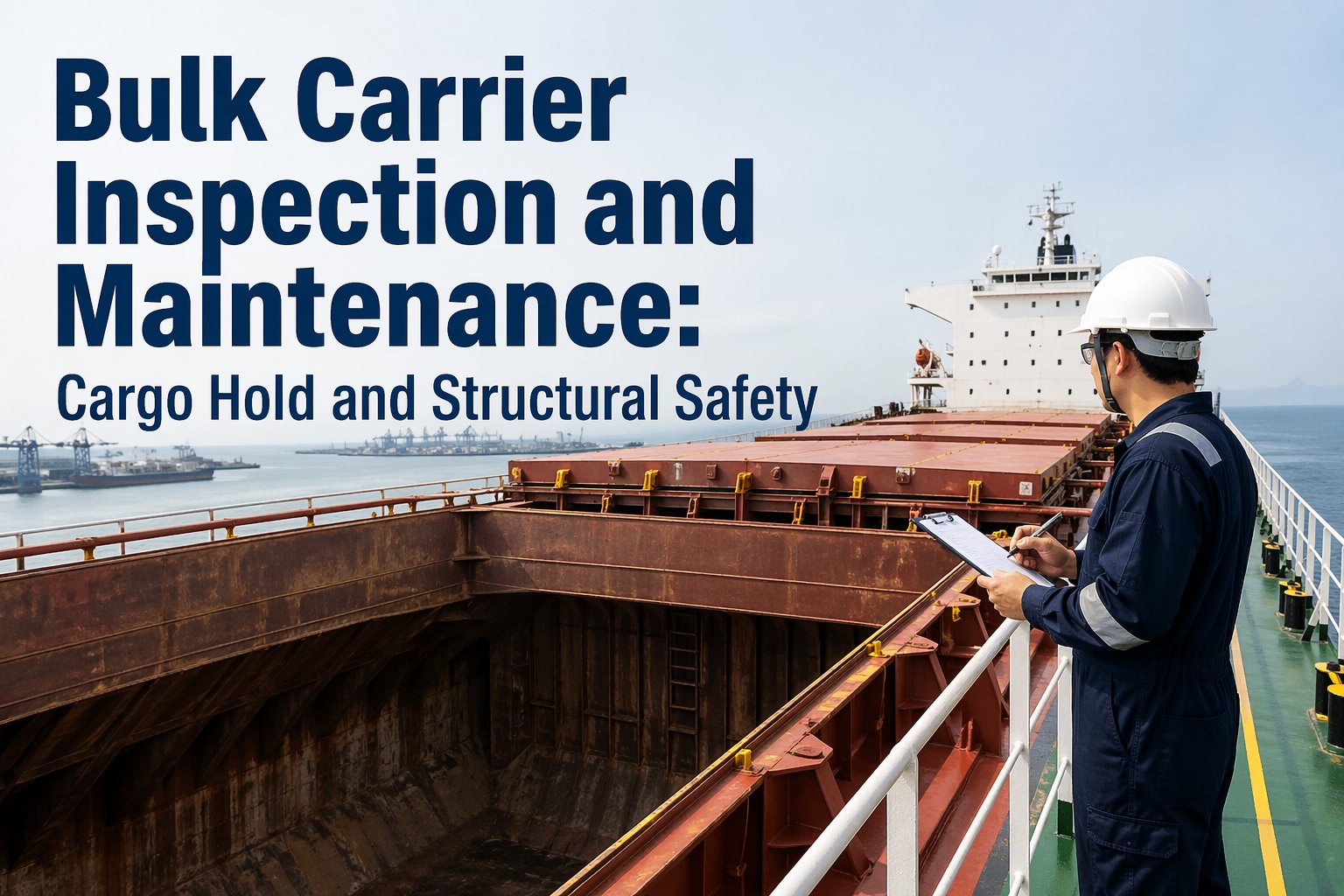
Pre-loading inspection verifying hold cleanliness and structural integrity, photographed comprehensively. This proves the ship did not contribute to contamination or damage — and it is the record you will need if the receiver alleges the previous cargo's residues caused the problem.
Independent pre-loading survey
Always conduct an independent pre-loading survey, including an independent tally of the cargo loaded. The survey cost is trivial against the exposure it defines, and it converts a later argument into a documented fact established by a third party.
Cargo condition on the quay
Visual quality inspection to eliminate the loading of damaged, cut or torn packaging. Continuous pre-loading inspection ensures only sound bags come aboard, and notes of any pre-loading damage become the basis for clausing.
Cargo-specific testing
Moisture tests where the cargo has moisture content limits, sampling where contamination is the risk. Bulk claims often turn on precise measurement and sampling procedures — done before loading, they establish the inbound position.
Know the cargo you are taking
Cargo characteristics, special handling requirements, and stowage needs, communicated clearly. Charterers influence outcomes by providing detailed cargo information and ensuring adequate dunnage is available — but the ship must ask.
Hatch and seal integrity
Weathertightness verified before loading. Damaged or compromised hold seals lead to contamination or loss and to disputes over quantity or condition at discharge — a failure that is cheap to find now and ruinous to discover later.
The theme is that a pre-loading survey is not an expense, it is the purchase of a defence. Inspectors routinely require details of at least the previous three cargoes, and the ship that can produce hold photographs, a cleaning record, a survey report, and an independent tally has already won most of the arguments that a later claim can raise.
The window closes when the first grab swings
Capture the Pre-Loading Record While It Still Exists
Hold condition, cleanliness, photographs, seal checks, survey findings — evidence that takes minutes to create before loading and is impossible to reconstruct in a dispute. Marine Inspection structures pre-loading and hold inspections with photographs and timestamps, tracks findings through to closure, and keeps the whole record retrievable per vessel and per voyage. Book a 30-minute demo, or start a free trial today.
Stage Two: During Loading
This is the stage where the ship's paperwork commits her, and where an hour's carelessness creates a liability that no later diligence can undo. See defect and damage logging in a demo.
1
Tally properly, and by unit
Count cargo as it is loaded and compare against the bill of lading, mate's receipt and manifest. Maintain a tally sheet showing movement by hatch, hold, lot, truck, sling, pallet or barge — recording description, marks, numbers, package type, apparent condition, and any visible irregularity.
2
Report discrepancies without delay
Shortages, excess quantities, damaged packages, mixed cargo, missing marks, torn bags, broken bundles — recorded promptly and reported to the relevant parties before the record becomes difficult to verify. Delay is what destroys a tally's value.
3
Verify quantity independently
Shippers' figures for bulk may be inaccurate through weighing error or deliberate overstatement. The ship's officers conduct their own measurement — draught survey for bulk carriers, ullage readings for tankers — so the ship has a figure of her own to stand on.
4
Clause the mate's receipt, then the bill
Where damage or discrepancy exists, the remark goes on the mate's receipt and must carry through to the bill of lading — describing condition on the mate's receipt alone is not sufficient. Enter the ship's figure on the mate's receipt before signing and give the shipper a copy to acknowledge in writing.
5
Protest in writing when refused
Where the shipper will not accept the endorsement, write a letter of protest setting out the discrepancy and stating the bill is signed under protest, with a copy stapled to each original in the set. Consult the club correspondent before making any remark whose effect is uncertain.
6
Supervise the operation
A designated officer or crew member supervises loading — stevedores' handling technique, appropriate equipment, grab buckets and conveyors used correctly, cargo properly placed, stowage matching the plan, dunnage used correctly, and lashing in accordance with the Cargo Securing Manual.
The pressure at the clausing moment is real and comes from people with commercial interests, not evidential ones. A claused bill can break the shipper's letter of credit, so the push to sign clean on damaged cargo is intense — and a letter of indemnity offered in exchange is not a solution but complicity in fraud, unenforceable and destructive of cover. The professional response is to clause accurately, protest in writing, and let the correspondent handle the wording.
Stage Three: Care During the Voyage
Between the ports, the ship's obligation is care — and the record of that care is the entire defence against a damage allegation at the far end.
Ventilation logs
Ventilation protects cargo from moisture damage such as sweating and rust — critical for hygroscopic cargoes like agricultural goods that absorb moisture and spoil, and relevant even for non-hygroscopic cargo vulnerable to condensation. Logs recording cargo temperature, dew points and ventilation timings are essential to defending damage claims, and many charters mandate ventilation whenever possible.
The two ventilation rules
The Dew Point Rule, requiring precise humidity measurements, and the Three Degree Rule, a simpler approach comparing external and cargo temperatures. Whichever the ship applies, applying it consistently and logging the readings is what makes the decision defensible.
Hold seals and weathertightness
Regular checks of hold seals ensure weathertightness and that cargo stays secure. Where hold access is necessary, record the breaking of seals and their subsequent replacement — an unexplained broken seal is an invitation to allege tampering or ingress.
Weather encountered
Contemporaneous weather records supporting any heavy-weather explanation for shifted or damaged cargo. A heavy weather defence asserted without a log behind it persuades nobody.
Monitoring and inspection
Routine checks on lashings, securing and cargo condition where access allows, logged as they are done. A record of active monitoring is qualitatively different from a record of nothing happening.
The distinguishing feature of a good voyage record is that it shows decisions, not just conditions. "Ventilated 0600 to 1400, dew point outside 12 degrees, cargo 18 degrees" demonstrates a competent officer applying a rule. A blank column demonstrates nothing at all — and a blank column is what the claimant's surveyor is hoping for.
Stage Four: Discharge and Outturn
The last window, and the one most often wasted, because the voyage feels finished. It is not finished until the outturn is recorded. See outturn record tracking in a demo.
Joint draft survey
Outturn quantity for bulk is often calculated on a joint draft survey. If the discharged quantity compares favourably with the bill of lading figure, the ship is unlikely to bear liability — unless cargo interests dispute the survey results, which is precisely why it should be joint.
Discharge tally
Piece-by-piece counting during discharge provides a certified record to defend against shortage claims — particularly for bagged and break bulk, where quantity disputes are common and a count is the only answer.
Outturn condition
A definitive, impartial report on discharge identifying in-transit damage or shortage. It gives receivers and underwriters an account of outturn condition — and gives the ship a contemporaneous position rather than a reaction to someone else's allegation.
Photographs before it leaves
The cargo as discharged, in the hold and on the quay, dated. Once the cargo is in a receiver's warehouse, its condition is no longer a fact you can establish — it is a fact you must accept from someone else.
Protest against handling
Where stevedores are damaging the cargo, note protest at the time with full details of the cargo and damage concerned. A protest lodged at discharge is evidence; a complaint raised in correspondence three months later is an excuse.
Notice deadlines
Where apparent damage exists, the notice regime runs fast — under Hague-Visby the carrier must be notified of visible loss or damage within three days of delivery. Prompt discharge documentation is what makes that window usable.
The joint draft survey deserves particular emphasis for bulk, because it is the closest thing to an agreed number available. A survey the receiver participated in is far harder for the receiver to reject later, which is why the effort of getting them there is worth more than the effort of a better unilateral figure.
Stevedore Damage: A Discipline of Its Own
Stevedore damage sits awkwardly across the whole voyage and deserves separate treatment, because the rules for preserving a claim against them are strict and time-sensitive.
Notify immediately, and in writing
If ship's officers notice damage, they notify the master, who notifies managers, charterers, the P&I club, and the stevedores. A letter is issued to the stevedores holding them responsible for the damage. Any negligence must be brought to the master's attention at once and put in writing.
The clause sets the deadline
Typical stevedore damage clauses make charterers responsible for damage repaired at their expense before redelivery where seaworthiness is affected — but expressly relieve charterers if the master fails to notify. Hidden damage must be notified as soon as discovered, in which case a joint survey is held. Otherwise charterers are not responsible.
The proof burden falls on the ship
Where charterers are usually responsible for stevedore damage, the onus to prove the claim is on the carrier — so officers must collect adequate evidence as soon as possible. The right to recover exists; the ability to recover depends entirely on the file.
Clear words are necessary
Liability for stevedore damage generally rests with the party responsible for loading and discharging, and clear words are needed to shift it. Typewritten rider clauses take precedence over standard provisions, so the fixture's specific wording governs — and where charterers arrange and pay for stevedores, they may still be treated as the owners' servants under the master's direction.
The practical consequence is that a master who watches a grab hit a hatch coaming and says nothing has, by that silence, transferred the cost to his owners. The notification is not bureaucracy; under the standard clause it is the condition precedent to the entire claim.
Making It Systematic
The final point is the only one that changes outcomes at fleet scale. Every recommendation above is individually obvious and collectively impossible to sustain on goodwill alone.
Nobody knows which voyage matters
The cargo officer cannot know on the day which of a hundred routine operations will generate a claim in eighteen months. So the recording cannot be selective — it has to be the default for every hold, every voyage, every port.
Make the record structured
A standard pre-loading inspection with the same fields every time produces comparable evidence and closes the gaps an ad hoc note leaves open. Structure is what turns diligence into defensibility.
Photographs with intact metadata
Timing that can be verified is what makes an image evidence rather than an assertion. Take more than seems necessary, and keep the originals rather than compressed copies pasted into a report.
Close the loop on findings
A pre-loading inspection that finds a defective seal and no record of the repair is worse than useless — it documents your own notice of a problem you cannot show you fixed. Findings must be tracked to closure.
Make it retrievable
A survey report in an inbox on a superintendent's old laptop does not exist. When the correspondent asks for the hold photographs from a voyage two years ago, "we took them" is not an answer.
Notify early
Any incident likely to give rise to a claim goes to the club or local correspondent at once, so a surveyor can attend while the evidence still exists. Claims are usually raised long after the ship has left the port.
The through-line of cargo claims prevention is that the ship is always building a file, whether she means to or not — and the only question is whether that file will be complete when someone finally opens it. A master who photographs holds, tallies honestly, clauses accurately, protests in writing, logs ventilation with the readings, gets a joint draft survey, and puts stevedore damage in a letter the same day has not done paperwork. He has, across four windows that each lasted a few hours, defeated claims that have not been made yet. Scattered across notebooks, inboxes and a dozen spreadsheets, that same material is functionally unavailable when it counts. Held in one structured, timestamped, searchable record, it is the difference between settling and winning. Book a demo to see cargo inspection, defect, and evidence records as one system.
Frequently Asked Questions
What is a pre-loading survey and why does it matter?
An independent survey before cargo is loaded, verifying hold cleanliness and structural integrity and typically including an independent tally of the cargo. It establishes the inbound position objectively — proving the ship did not contribute to contamination or damage, and providing the documented basis for any clausing. Its cost is trivial against the exposure it defines.
What should a tally sheet record?
Cargo movement by hatch, hold, lot, truck, sling, pallet or barge, with the cargo description, marks, numbers, package type, apparent condition and any visible irregularity, compared against the bill of lading, mate's receipt and manifest. Shortages, excess quantities, damaged packages, mixed cargo, missing marks, torn bags and broken bundles must be reported without delay, before the record becomes hard to verify.
Why are ventilation logs so important?
Because they are the defence against moisture damage claims. Ventilation protects cargo from sweating and rust — critical for hygroscopic cargoes such as agricultural goods, and relevant for non-hygroscopic cargo vulnerable to condensation. Logs recording cargo temperature, dew points and ventilation timings demonstrate the ship applied a rule such as the Dew Point Rule or the Three Degree Rule, and many charters mandate ventilation whenever possible.
How is a bulk shortage claim usually resolved?
Outturn quantity is often calculated on a joint draft survey at discharge. If the discharged quantity compares favourably with the bill of lading figure, the ship is unlikely to bear liability unless cargo interests dispute the survey results. The ship should also take her own measurements at loading — draught survey for bulk, ullage for tankers — because shippers' figures may be inaccurate through error or overstatement.
What must a master do about stevedore damage?
Notify immediately — the officers tell the master, who notifies managers, charterers, the P&I club and the stevedores, issuing a letter holding the stevedores responsible. Typical clauses relieve charterers entirely if the master fails to notify, with hidden damage to be notified as soon as discovered and a joint survey held. The onus to prove the claim rests on the carrier, so evidence must be collected at once.
Can a master sign a clean bill for damaged cargo against a letter of indemnity?
No. Shippers offer letters of indemnity because a claused bill breaks their letter of credit, but accepting one in exchange for signing a false bill amounts to complicity in fraud — it is unenforceable and destroys insurance cover. The correct route is to clause the mate's receipt and the bill accurately, protest in writing with a copy stapled to each original, and consult the club correspondent on any remark whose effect is uncertain.
How quickly must cargo damage be notified?
Under the Hague-Visby regime the carrier must be notified of loss or damage within three days of delivery where the damage is apparent, which makes prompt discharge documentation valuable. Separately, any incident likely to give rise to a claim should be reported to the P&I club or its local correspondent immediately, so a surveyor can attend while the evidence still exists.
Which stages of the voyage carry the most cargo claim risk?
Loading and discharge are the most critical and highest-risk moments, when goods are most susceptible to physical damage, quantity discrepancies and mishandling. They are also when evidence is cheapest to create. Bulk operations carry higher contamination risk but fewer handling points; break bulk faces more handling-related damage and more frequent quantity disputes.
Four windows, each of which closes for good
Build the File Before Anyone Asks to See It
Structured pre-loading and hold inspections with photographs and timestamps, damage and stevedore-damage records raised the day they happen, findings tracked to verified closure, and every voyage's cargo evidence retrievable years later when the claim finally lands. Marine Inspection turns cargo claims prevention from scattered notebooks into a record you can produce on demand. Book a tailored demo, or start a free trial today.