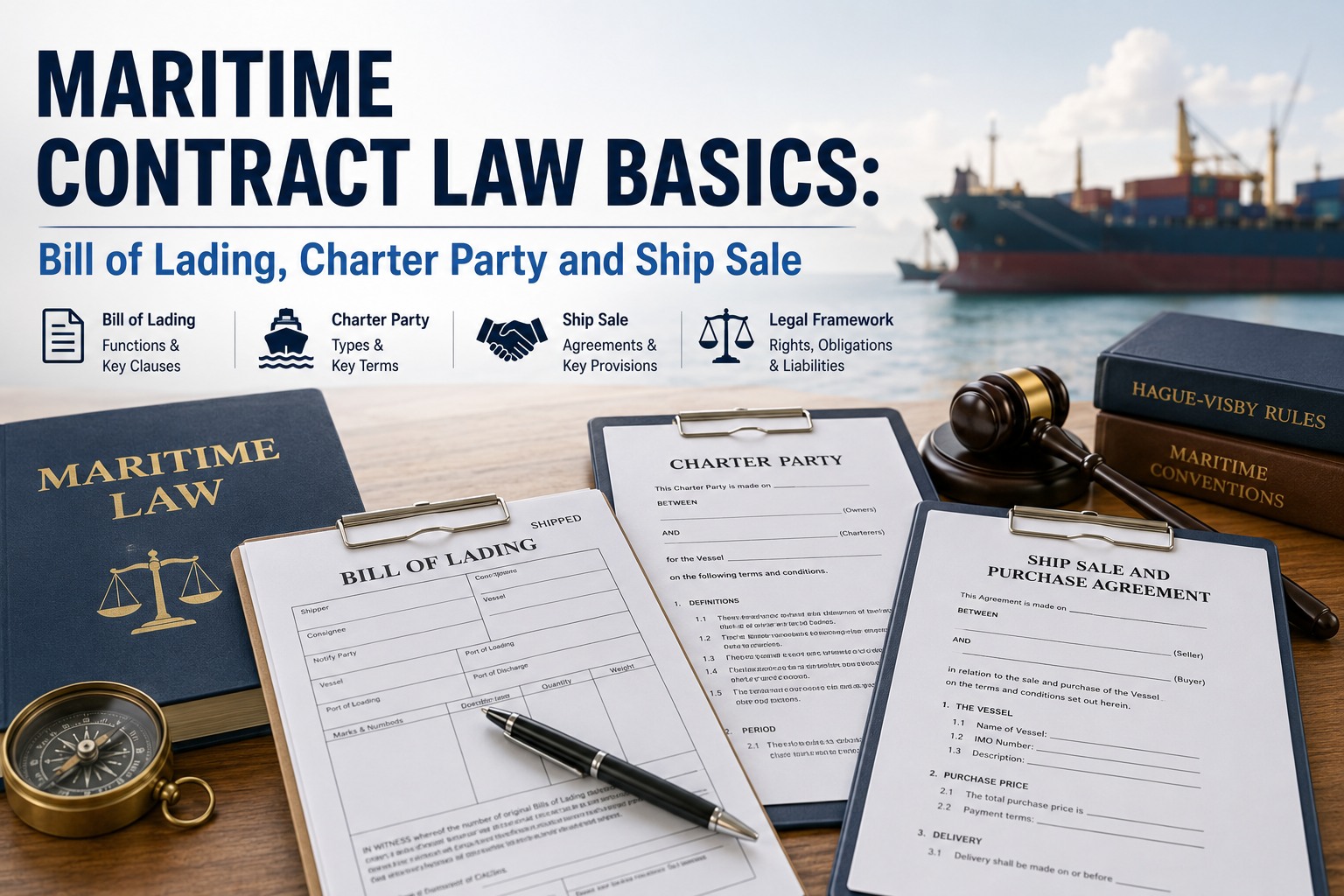
Almost everything that happens to a merchant ship is governed by one of three contracts. The document that travels with the cargo is the bill of lading. The agreement that puts the ship to work is the charter party. And the agreement that changes who owns her is the sale and purchase contract, the memorandum of agreement. A ship operator or in-house legal team does not need to be an Admiralty barrister, but they do need to know which of these three instruments is doing the work in any given situation, what each one actually promises, and where the traps sit — because the difference between a clean voyage and a six-figure dispute is usually a clause someone did not read. This guide is a working introduction to all three. It covers the bill of lading and its three functions, the international liability regimes that sit behind it, the main charter party types and the money mechanics that drive them, the sale and purchase agreement, and the handful of clauses that decide who pays when something goes wrong. It is an overview, not legal advice — the point is to know enough to ask the right question of your lawyer at the right moment, and to keep the records that every one of these contracts ultimately turns on. Start free trial or book a demo to keep the certificates, condition records, and inspection history these contracts depend on.
COMMERCIAL & OPERATIONS · MARITIME CONTRACT LAW
The Three Contracts That Run Every Merchant Ship
The bill of lading moves the cargo. The charter party puts the ship to work. The sale agreement changes who owns her. Know which one is doing the work — and where each one bites.
01
Bill of Lading
Receipt, contract, and title — the document that travels with the goods
02
Charter Party
Voyage, time, or bareboat — the agreement that employs the ship
03
Sale & Purchase
The memorandum of agreement — the contract that transfers ownership
01 The Bill of Lading
The bill of lading is the most remarkable document in trade because it does three jobs at once, and confusing them is the source of most cargo disputes. A single piece of paper is simultaneously a receipt, a contract, and a title deed.
A receipt
An acknowledgement that the carrier received the goods, identifying their nature, quantity, quality and leading marks. A clean bill states the cargo was received in good order with no exceptions noted — which is exactly why clausing it matters so much.
Evidence of the contract
It contains or evidences the terms of the contract of carriage between shipper and carrier. Note "evidences" — where a charter party also exists, the bill is usually secondary to it, and the charter remains the dominant contract.
A document of title
It gives the holder the right to claim the goods, subject to the nemo dat rule, and is transferable by endorsement or lawful transfer of possession. This is what lets cargo be bought and sold while still at sea — the function insurance policies and invoices do not share.
i
Not every shipping document is a true bill of lading. A sea waybill is a receipt and a contract too, but not a document of title — it cannot transfer ownership, which is why it is used where no sale in transit is intended and speed of delivery matters. A "straight" bill names one specific consignee and is non-negotiable; for years it was unclear whether it counted as a document of title, until the House of Lords held in The Rafaela S (2005) that it does, because the consignee must produce it to obtain delivery. If a document is declared "non-negotiable," it is generally treated as a sea waybill rather than a true bill.
The Liability Regimes Behind the Bill
What a carrier is actually liable for is not decided by the bill itself but by the international convention that governs it — and which convention applies depends on the trade. This is the single most important thing to establish about any cargo movement, and the landscape is genuinely fragmented. Swipe the table on mobile.
The reason this fragmentation matters is practical: because different states adopted different rules, the applicable regime can change from port to port, which historically led to disputes and delays. Under the Hague-Visby regime a carrier must, on demand, issue the shipper a bill of lading — though the shipper may agree to a lesser document such as a sea waybill instead. And the paper itself is finally going digital: UNCITRAL's Model Law on Electronic Transferable Records (MLETR), adopted in 2017, provides the legal scaffolding for an electronic bill of lading to be the functional equivalent of a paper document of title.
The bill records what you received — your files prove it.
A clean bill you should have claused, or a receipt you cannot support with hold photographs and tally records, is where cargo claims are won and lost. Marine Inspection keeps the pre-loading, condition, and inspection records behind every bill retrievable when the claim lands.
02 The Charter Party
If the bill of lading governs the cargo, the charter party governs the ship. It is the contract by which a shipowner puts a vessel at a charterer's disposal, and its type determines who controls the ship, who pays for what, and how the money flows. The three main types allocate responsibility along a sliding scale.
The owner carries a cargo between named ports for a price called freight, paid per tonne or as a lump sum. The owner retains full control and pays crew, fuel and most port costs. The charterer is buying a transport service, not a ship. Standard forms include GENCON 1994, SYNACOMEX 2000 and SHELLVOY 6.
The charterer hires the vessel for a defined period, paying a daily hire, and directs her commercial employment — where she trades and what she carries — while the owner keeps technical management, crewing and maintenance. The time charterer supplies and pays for bunkers and port dues. The dominant form is NYPE.
BAREBOAT
Bareboat / Demise Charter
The charterer takes almost complete control — providing the crew, stores and bunkers and paying all operational costs, operating the vessel as if it were their own. The nearest thing to ownership without a sale, often used for financing. The standard form is BARECON. The Astra examined the extent of a demise charterer's control and responsibility.
i
Two more arrangements are worth knowing. A contract of affreightment (COA) is not strictly a charter — the owner agrees to carry a set quantity of cargo over a period, often using more than one ship, with the charterer paying freight whether the goods are ready or not, and typically no laytime or demurrage. A slot charter (standard form SLOTHIRE) leases cargo space rather than the whole ship, common in container shipping, blending features of voyage and time charters. And note the chain: the head charterer hires directly from the owner, and if they sublet, subsequent parties are subcharterers — but the head charterer remains liable to the owner regardless.
Where the Money and the Risk Live
Each charter type has its own financial machinery, and the vocabulary is where operators most often get caught. These are the terms that appear in every dispute.
The structural point is that voyage and time charters handle delay in opposite ways. A voyage charter runs on laytime and demurrage — the owner has priced a certain amount of port time into the freight, and the charterer pays demurrage for exceeding it, or earns despatch for saving it. A time charter has no direct equivalent: hire simply runs continuously from delivery to redelivery, and the charterer's protection is the off-hire clause, which suspends that hire when defined events — breakdown, drydocking, detention — stop the ship earning. Demurrage should not be confused with detention: demurrage is a contractual charge for exceeding laytime, while detention is a legal remedy in damages for delay, examined in cases such as The Tropical.
A few clauses do most of the damage. The owner's core obligation is to provide a seaworthy vessel — a recurring principle across charter law. Non-payment of hire can trigger withdrawal: owners may pull the vessel, generally upheld unless she is loaded, as in The Celeste. Voyage charters give owners a cargo lien and a subfreight lien as security for unpaid freight, while a cesser clause can relieve the charterer of obligations once loading completes, shifting them to the bill of lading holder. And an incorporation clause can bind bill of lading holders to charter terms. Every one of these is a place where careful wording, or careless wording, decides who pays.
03 The Sale and Purchase Agreement
The third contract changes who owns the ship. A secondhand vessel worth tens of millions is bought and sold on a standardised memorandum of agreement (MOA), and the buyer's protection is considerably narrower than instinct suggests.
The standard form
The Norwegian Saleform (NSF 2012) is the most widely used MOA, alongside Nipponsale, the Singapore Ship Sale Form, and BIMCO's SHIPSALE 22. The seller usually chooses the form, and the differences between them matter enough to warrant legal review.
What the buyer gets
Core entitlements are typically that the vessel is delivered in the same condition as inspected, with class maintained and free of average damage — and, traditionally, not much more. Successive Saleform versions have grown more seller-favourable.
Inspection and delivery
The buyer inspects the vessel and her class records, usually pre-contract, and takes an underwater inspection by diver at delivery — vessels are now generally delivered afloat rather than drydocked. Class-affecting defects found underwater are the seller's cost.
Transfer of title
The vessel is deleted from her outgoing register and entered on the new one, with a deletion certificate proving clear title and no outstanding mortgages. The financing structure usually drives the timing of the whole transaction.
The critical point for a buyer is that the survey and the MOA together define the protection — the entire-agreement clause in Saleform 2012 explicitly limits reliance on pre-contract representations, so what the buyer found on inspection and what the contract says are, in practice, the extent of the cover. The transaction is where the sale and purchase contract meets the condition survey and the class records, which is why the two disciplines are inseparable.
Every One of These Contracts Turns on Records
A bill of lading is only as good as the receipt behind it. A charter dispute is decided on condition, drill, and off-hire records. A sale hinges on class records, survey findings, and certificate status. Marine Inspection keeps inspection reports, defect and maintenance history, certificates and survey due dates timestamped and retrievable across the fleet — the evidence base under all three contracts.
Condition & inspection records
Certificate & survey tracking
Defect & maintenance history
Retrievable years later
The Clauses That Decide Who Pays
Across all three contracts, a small vocabulary of clauses does the heavy lifting. Knowing them is the difference between reading a contract and understanding it.
Seaworthiness
The owner's recurring obligation to provide a vessel fit for the service — under Hague-Visby, a duty of due diligence before and at the beginning of the voyage.
Off-hire
Suspends hire under a time charter when defined events stop the ship earning. Its exact wording decides whether a given event actually suspends payment.
Laytime & demurrage
The voyage-charter clock. Minor wording differences change how time is counted and who bears delay from weather, congestion or strikes.
Withdrawal
The owner's right to pull the vessel for non-payment of hire — a powerful remedy, generally upheld unless the ship is already loaded.
Lien
Security for unpaid sums — a cargo lien to detain cargo, a subfreight lien to intercept payments from subcharterers.
Cesser
Relieves the charterer of liability once cargo is loaded, transferring responsibility to the bill of lading holder — usually paired with a lien.
Incorporation
Binds bill of lading holders to charter party terms, creating a contractual link between owner and cargo holder.
Force majeure
Frees parties from liability where performance is prevented by events beyond control — war, disaster, strikes — usually on notice and proof.
Entire agreement
Limits reliance on anything said before signing — central to Saleform 2012, and the reason pre-contract assurances rarely help a buyer later.
Frequently Asked Questions
What are the three functions of a bill of lading?
A receipt acknowledging the carrier received the goods, evidence of the contract of carriage between shipper and carrier, and a document of title giving the holder the right to claim the goods and enabling them to be bought and sold in transit. A sea waybill performs the first two functions but is not a document of title.
Book a demo.
Which liability regime applies to my cargo?
It depends on the trade and the states involved. The Hague-Visby Rules (Hague 1924 as amended by the Visby Protocols) are the practical global default. The Hamburg Rules, in force since 1992 with around 36 state parties by mid-2025, push more liability onto carriers and are met on specific lanes. The Rotterdam Rules, adopted in 2008, are not in force as they lack the required 20 ratifications. Plan around Hague-Visby unless advised otherwise.
Book a demo.
What is the difference between a voyage charter and a time charter?
In a voyage charter the owner carries cargo between named ports for freight, keeping control and paying crew and fuel, with delay handled through laytime and demurrage. In a time charter the charterer hires the vessel for a period at a daily hire and directs her employment, while the owner keeps technical management; there is no laytime, and hire runs continuously subject to off-hire suspensions.
Book a demo.
What is a bareboat charter?
Also called a demise charter, it is the arrangement closest to ownership without a sale. The charterer takes almost complete control of the vessel — providing the crew, stores and bunkers and paying all operational costs — and operates her as if their own. It is frequently used for financing, and the standard form is BARECON.
Book a demo.
What is the difference between demurrage and detention?
Demurrage is a contractual charge the charterer pays for exceeding the agreed laytime for loading or discharging in a voyage charter. Detention is a legal remedy in the form of damages available to the owner for delay beyond the contractual scheme. They are distinct concepts, and courts have differentiated them in cases such as The Tropical.
Book a demo.
What is a memorandum of agreement in ship sale?
The MOA is the contract for buying and selling a secondhand vessel. The most widely used standard form is the Norwegian Saleform 2012, alongside Nipponsale, the Singapore Ship Sale Form and BIMCO's SHIPSALE 22. It sets inspection rights, the delivery mechanism including an underwater inspection, condition warranties, and the transfer of title via deletion from the outgoing register.
Book a demo.
Is a sea waybill a bill of lading?
No. A sea waybill is a receipt and a contract of carriage, but it is not a document of title, so it cannot transfer ownership of the goods in transit. It is used where no sale in transit is intended and faster delivery is wanted. A bill declared "non-negotiable" is generally treated as a sea waybill rather than a true bill of lading.
Book a demo.
Are electronic bills of lading legally valid?
Increasingly, yes. UNCITRAL's Model Law on Electronic Transferable Records (MLETR), adopted in 2017, provides the legal foundation for an electronic record to be the functional equivalent of a paper document of title. Adoption varies by jurisdiction, so the validity of an eB/L in any given transaction depends on the governing law and the parties' systems.
Book a demo.
Know Which Contract Is Working — and Keep the Records It Needs.
Bills of lading, charter parties and sale agreements all ultimately turn on what you can prove: the condition on receipt, the state of the ship, the class and certificate history. Marine Inspection keeps inspection reports, defect and maintenance records, certificates and survey status timestamped and retrievable across the fleet — the evidence base beneath every maritime contract. This guide is an overview, not legal advice; for a specific contract, take proper legal counsel.
Overview only · Not legal advice · Records that stand behind every contract