Liberian Maritime Authority Notice 003/2026 launched a Concentrated Inspection Campaign on Machinery and Electrical Failures — the latest signal that 2026 PSC focus is squarely on the engine room. SOLAS Chapter II-1 Regulation 26.7 mandates adequate provisions for cleaning, inspection, and maintenance of main propulsion and auxiliary machinery including boilers and pressure vessels. MARPOL Annex I Oil Record Book Part I requirements govern every machinery space operation involving oil. IMO Resolution A.1021(26) UMS Code structures unattended machinery space transitions. 46 CFR Part 58 carries the US parallel framework. And the inspection items that recur in PSC findings are unambiguous: lube oil pressure and temperature, cooling water flow and temperature, fuel system pressure and quality, turbocharger operation, exhaust gas temperatures, hydraulic steering pressure, bilge levels and alarms, fire detection, emergency shutdown systems, 15ppm Oily Water Separator alarm, and Oil Record Book currency. A credible engine room inspection app gives marine engineers a tablet-first workflow covering all of it — main engines, auxiliaries, boilers, pumps, purifiers, separators — with structured capture, electronic Oil Record Book integration, and PSC-ready evidence packs. Start a free trial of Marine Inspection to inspect every machinery space system with the rigor the 2026 PSC environment expects.
Engine Room Inspection App · 2026
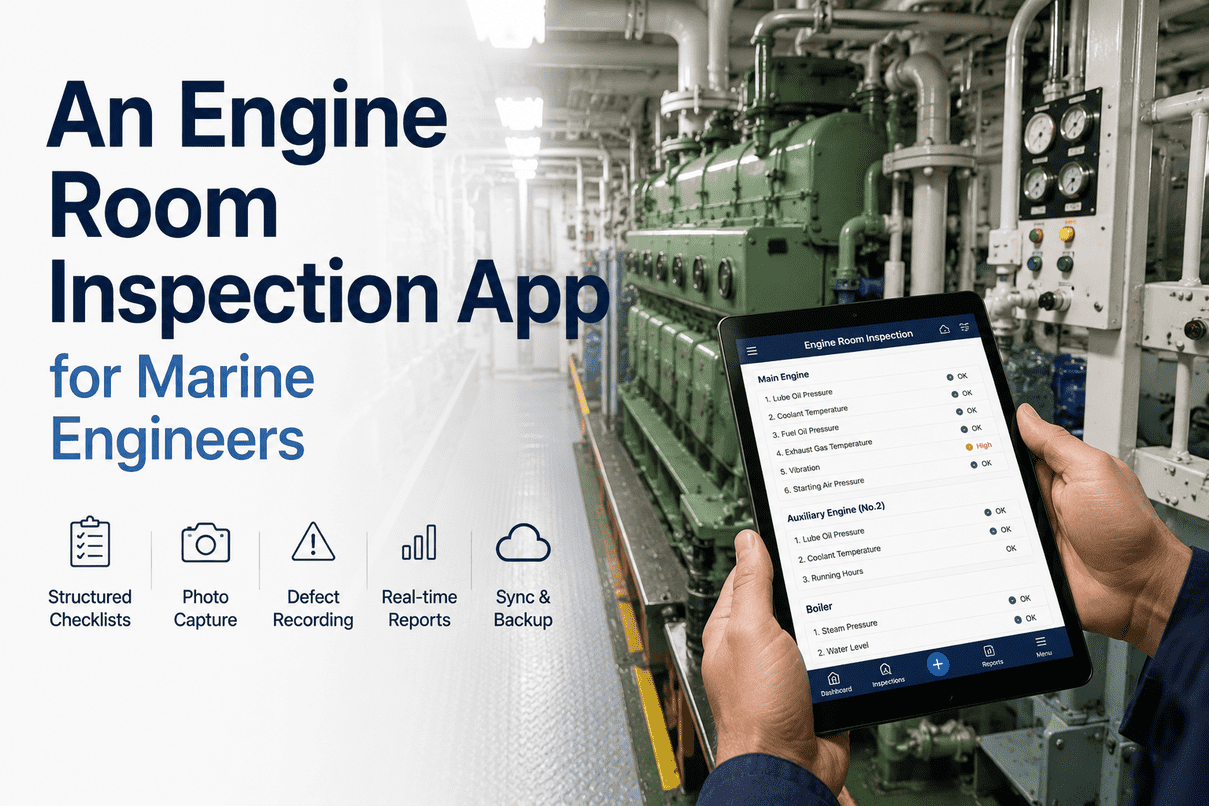
Main Engines. Auxiliaries. Boilers. Pumps. Separators. Every Parameter Captured Live.
Chief-engineer-first tablet workflow with structured parameter capture, electronic Oil Record Book entries, UMS-mode transitions, and PSC-ready evidence packs.
M/V Pacific Star · Engine Room Live Readout
Live · 14:32 UTC
ME Lube Oil Pressure
4.2 bar
NORMAL
ME Cooling Water Temp
78°C
NORMAL
T/C Exhaust Gas Temp
412°C
WATCH
Aux Engine 1
Online
NORMAL
Aux Boiler
Standby
NORMAL
15ppm OWS Alarm
Normal
NORMAL
The Eight Machinery Categories Every Engine Room Inspection Must Cover
SOLAS Chapter II-1, MARPOL Annexes I and VI, IMO UMS Code, and classification society rules converge on eight machinery categories that every engine room inspection must verify. Skip a category and the vessel sails with a gap that will surface as a PSC machinery-and-electrical finding or worse — an at-sea casualty.
01
Main Propulsion Engine
Lube oil pressure and temperature, jacket cooling water, sea water cooling, fuel injection system, turbocharger operation, exhaust gas temperatures balanced across cylinders, crankcase oil mist detector for engines 2250 kW+ or bore 300mm+.
02
Auxiliary Engines & Generators
Diesel generators online plus standby, electrical load distribution, exciter and AVR function, parallel operation logic, automatic start-up sequence verified, emergency generator weekly test, fuel transfer pumps operational.
03
Auxiliary Boilers & Steam System
Oil-fired auxiliary boiler safety valves, water level controls, automatic start systems, exhaust gas boiler operation under main engine load, steam line condensate traps, feed water quality, blow-down records.
04
Pumps & Hydraulic Systems
Main sea water cooling pumps, fresh water cooling, fuel transfer, lube oil, ballast, bilge, fire pumps verified at duty and standby. Hydraulic steering gear pressure tested per SOLAS V/26. Cargo pumps inspected for tanker variants.
05
Purifiers & Separators
Lube oil purifier function, fuel oil purifier, sludge tank levels, 15ppm Oily Water Separator operational with alarm function, bilge well sensors verified, sludge transfer records cross-referenced to Oil Record Book Part I.
06
Air Compressors & Starting Air
Main air compressors at duty and standby, starting air receivers at pressure, automatic start controls, safety valves tested, drain trap function verified, control air system pressure stable, instrument air dryers operational.
07
Fire Detection & Suppression
Engine room fire detection panel clear, no isolated zones, CO2 fixed system seals and pressure indicators intact, local foam application systems, water mist systems, no fuel or lube oil leaks onto hot surfaces, portable extinguishers serviceable.
08
Emergency & Safety Systems
Emergency generator automatic start tested, emergency fire pump function verified, emergency stop circuits, quick-closing valves on oil tanks, bilge alarms, ventilation shutdowns, oil mist detector trip function, all UMS alarms annunciated to bridge.
The Critical Engine Room Parameters Matrix
The matrix below maps each critical parameter to its normal operating range, governing regulation, and required inspection frequency. Marine engineers reference this matrix every watch; PSC inspectors verify it against the Engine Room Abstract Log. Scroll horizontally on mobile for the full view. Book a parameter-matrix walkthrough to see live capture on your fleet's machinery.
| Parameter |
Normal Range |
Regulation |
Inspection Frequency |
| Main engine lube oil pressure |
3.5 - 5.0 bar |
SOLAS II-1/26 · Class Rules |
Every watch + alarm |
| Main engine lube oil temperature |
40 - 55°C inlet |
SOLAS II-1/26 · Class Rules |
Every watch + alarm |
| Jacket cooling water temp |
75 - 85°C outlet |
SOLAS II-1/26 · Class Rules |
Every watch + alarm |
| Exhaust gas T/C inlet |
Per maker manual |
SOLAS II-1/26 · NOX Code |
Every watch + alarm |
| Fuel oil injection pressure |
Per maker manual |
SOLAS II-1/26 · Class Rules |
Every watch |
| Auxiliary engine output |
Per load demand |
SOLAS II-1/41 |
Every watch + load swap |
| Steering gear hydraulic pressure |
Per system spec |
SOLAS V/26 · II-1/29 |
Every watch + pre-departure |
| 15ppm OWS bilge effluent |
Below 15 ppm |
MARPOL Annex I Reg 14 |
Per discharge + alarm |
| Bilge well levels |
Below alarm threshold |
SOLAS II-1/35-1 |
Continuous + UMS alarm |
| Starting air receiver pressure |
25 - 30 bar typical |
SOLAS II-1/26 |
Every watch |
| Emergency generator status |
Standby + weekly test |
SOLAS II-1/43 |
Weekly test + monthly load |
| Crankcase oil mist (2250 kW+) |
Detector active |
SOLAS II-1/47 |
Continuous + test |
The Six-Phase Watch-Cycle Engine Room Inspection Pattern
A credible engine room inspection runs six phases tied to the watch cycle rather than as a single end-of-day clipboard exercise. Each phase handles a recurring engineering pattern that paper checklists miss.
Phase 1
Watch Handover Verification
Incoming engineer reviews outgoing watch's running parameters, alarms during the watch, work in progress, defects raised. Handover signed in the engine room logbook with both engineers identified.
Phase 2
Machinery Round & Parameter Capture
Engineer walks the engine room with tablet, capturing live readings against the parameter matrix. Photos taken of gauges where required. Abnormal readings trigger immediate flag rather than end-of-watch retroactive entry.
Phase 3
Oil Record Book Entries
Operations involving oil — bunkering, internal transfers, sludge disposal, OWS discharges, bilge handling — entered into electronic Oil Record Book Part I per MARPOL Annex I with chief engineer counter-signature.
Phase 4
UMS Transition Checks
Before switching to unattended mode, verify all UMS alarms annunciated to bridge, oil mist detectors operational, bilge alarms armed, fire detection clear, standby pumps ready for automatic start, emergency generator on standby.
Phase 5
Defect Escalation
Abnormal readings or finding raised during the round trigger defect workflow — work order generated, parts checked, chief engineer notified, severity assigned. No silent ignored finding waiting to surface in PSC.
Phase 6
Engine Room Abstract Log
End of watch generates the Engine Room Abstract Log entry per ISM Code requirements with all captured parameters, defects raised, work completed, signed by the watch engineer and chief engineer.
PSC Engine Room Deficiency Hot Zones
Paris MOU and Tokyo MOU detention data identifies the engine room deficiency categories that recur in PSC findings. The table below maps eight hot zones with their typical risk weight and the inspection check that prevents each. Mobile users scroll horizontally for the full view.
| Hot Zone |
Deficiency Code |
Risk Weight |
Inspection Check That Prevents It |
| Main propulsion machinery |
13101 |
Critical |
Lube oil + cooling + fuel parameter capture every watch |
| Auxiliary engines |
13103 |
Critical |
Generator load + standby + parallel logic verified |
| Engine room cleanliness |
13102 |
High |
No leaks onto hot surfaces + bilge zones clean |
| Oily Water Separator |
14702 |
Critical |
15ppm alarm tested + ORB Part I current |
| Fixed fire-extinguishing |
07117 |
Critical |
CO2 system pressure + seals + activation circuit |
| Fire detection in machinery |
07105 |
Critical |
Detection panel clear + zones tested + bridge annunciation |
| Emergency generator |
13107 |
High |
Weekly start + monthly load + automatic transfer |
| Oil Record Book |
14704 |
High |
ORB Part I entries + chief engineer signature + master sign-off |
Engine Room App Demo · 30 Minutes
See Live Parameter Capture On A Real Engine Room Watch
A 30-minute session with a Marine Inspection product expert. Bring a recent engine room round from your fleet. Walk through the 8-category framework, 12-parameter matrix, six-phase watch cycle, UMS transition, and PSC defence pack assembly on real machinery data.
The Six Workflows Engine Room Inspection Software Should Cover
Beyond the basic checklist, six workflows separate a credible engine room inspection app from a glorified PDF. Each addresses an operational pattern that paper or generic checklist apps miss for chief engineers and marine engineering teams.
A
UMS-Mode Transition Pack
Switching to unattended machinery space mode requires verification of every alarm, every standby system, every automatic start. The platform enforces the IMO A.1021(26) UMS Code checklist before allowing mode transition.
B
Electronic Oil Record Book
MARPOL Annex I Oil Record Book Part I integrated rather than separate. Bunkering, internal transfers, sludge disposal, OWS discharges all logged with chief engineer signature and master sign-off per MEPC.187(59).
C
Defect-To-Action Hand-Off
Abnormal parameter or finding raised during the round triggers defect workflow — work order generated, parts requisitioned, chief engineer notified, severity assigned. Linked to PMS and procurement.
D
Sister-Vessel Trend Detection
Same exhaust gas temperature drift on sister vessels, recurring purifier issues across the class, fuel injection patterns repeating — fleet-wide trends surface across vessels rather than dying in individual engine room logs.
E
Class Survey Pre-Pack
Approaching class machinery survey triggers pre-pack assembly — last 12 months of parameter trends, defects closed, work orders completed, ORB extracts. Surveyor pack ready before the attendance.
F
Concentrated Inspection Campaign Readiness
Liberian Maritime Authority 003/2026 CIC on Machinery and Electrical Failures, Paris MOU campaigns, Tokyo MOU focus areas — platform aligns evidence packs to active campaigns before vessels enter targeted ports.
Why Marine Inspection For Engine Room Inspection
Marine Inspection delivers a chief-engineer-first engine room inspection app on the eight-machinery-category framework, twelve-parameter matrix, six-phase watch cycle, eight PSC hot-zone coverage, and six workflow capabilities — built for SOLAS Chapter II-1, MARPOL Annexes I and VI, IMO UMS Code, and classification society compliance. Start a free trial or book a 30-minute demo to see engine room inspection on your fleet.
Eight-Category Coverage
Main propulsion, auxiliary engines, boilers, pumps, purifiers and separators, air compressors, fire systems, emergency systems — every machinery category captured with structured parameter inputs.
Twelve-Parameter Matrix
Lube oil, cooling water, exhaust gas, fuel injection, generators, steering hydraulics, OWS, bilge, starting air, emergency generator, crankcase mist — all mapped to regulation and frequency.
Electronic Oil Record Book
MARPOL Annex I Part I integrated. Bunkering, transfers, sludge, OWS discharges logged with chief engineer signature and master sign-off. MEPC.187(59) compliant electronic format.
UMS-Mode Transition Discipline
IMO Resolution A.1021(26) UMS Code checklist enforced before mode transition. All alarms annunciated to bridge, standby systems ready, automatic starts verified.
Mobile-First Offline Capture
Engine room, purifier room, steering gear flat all supported offline. Auto-sync on connectivity. App built for the actual environment where marine engineers work.
CIC & PSC Defence Pack
Concentrated Inspection Campaign alignment, Paris MOU and Tokyo MOU focus areas, USCG 46 CFR Part 58 requirements — evidence pack assembled in minutes for any PSC inspection or class survey.
Frequently Asked Questions
What does an engine room inspection app do?
An engine room inspection app gives marine engineers a tablet-first workflow covering eight machinery categories — main propulsion engine, auxiliary engines and generators, auxiliary boilers and steam system, pumps and hydraulic systems, purifiers and separators, air compressors and starting air, fire detection and suppression, emergency and safety systems. The app captures live parameters against the regulatory matrix (lube oil pressure 3.5 to 5.0 bar, jacket cooling 75 to 85 degrees Celsius, exhaust gas T/C inlet per maker manual, 15ppm OWS effluent below 15 ppm, bilge well levels, starting air 25 to 30 bar, emergency generator status, crankcase oil mist for engines 2250 kW and above), structures the six-phase watch cycle from handover through Engine Room Abstract Log, integrates with the electronic Oil Record Book Part I, enforces IMO UMS Code transitions, and produces PSC-ready evidence packs for Concentrated Inspection Campaigns. SOLAS Chapter II-1, MARPOL Annexes I and VI, and classification society rules all map to specific inspection items in the platform.
What does SOLAS II-1 Regulation 26 require for machinery inspections?
SOLAS Chapter II-1 Regulation 26.7 mandates adequate provisions for cleaning, inspection, and maintenance of main propulsion and auxiliary machinery including boilers and pressure vessels. The regulation emphasizes that machinery accessibility requires maintaining clean working environments free from oil accumulation and debris. SOLAS Chapter II-1 Regulation 47 mandates oil mist detectors for crankcases on engines 2250 kW and above or with cylinder bore exceeding 300mm — alternatively bearing temperature monitors. SOLAS Chapter II-2 covers machinery space fire protection with Category A spaces (containing oil-fired boilers, oil fuel units, or internal-combustion machinery for main propulsion) requiring fixed fire-extinguishing systems. Classification societies (DNV, Lloyd's, ABS, Bureau Veritas, ClassNK, RINA) layer additional machinery survey requirements on top. US vessels also follow 46 CFR Part 58 which mandates duplicate auxiliary machinery vital to main propulsion unless duplicate independence is otherwise provided.
What are the eight machinery categories every engine room inspection covers?
Eight machinery categories converge across SOLAS Chapter II-1, MARPOL, IMO UMS Code, and classification society rules. Main Propulsion Engine — lube oil pressure and temperature, jacket cooling water, sea water cooling, fuel injection, turbocharger, exhaust gas temperatures balanced across cylinders, crankcase oil mist detector for engines 2250 kW or 300mm bore. Auxiliary Engines and Generators — diesel generators online plus standby, load distribution, exciter and AVR function, parallel operation, automatic start sequence, emergency generator weekly test. Auxiliary Boilers and Steam System — oil-fired boiler safety valves, water level controls, exhaust gas boiler under main engine load, condensate traps, feed water quality, blow-down records. Pumps and Hydraulic Systems — sea water cooling, fresh water cooling, fuel transfer, lube oil, ballast, bilge, fire pumps verified at duty and standby. Purifiers and Separators — LO purifier, FO purifier, sludge tank levels, 15ppm OWS operational with alarm, bilge sensors verified. Air Compressors and Starting Air — main compressors at duty and standby, starting air receivers at pressure, automatic start, safety valves tested. Fire Detection and Suppression — engine room detection panel clear, CO2 fixed system seals and pressure indicators, local foam, water mist, no leaks onto hot surfaces. Emergency and Safety Systems — emergency generator automatic start, emergency fire pump, quick-closing valves, bilge alarms, UMS alarms annunciated to bridge.
What is the UMS Code and how does the app handle UMS transitions?
IMO Resolution A.1021(26) UMS Code structures Unattended Machinery Space operations. UMS-class vessels have no engineer officers on watch in the engine room during certain periods (typically 1700 to 0700 hours) with automated systems monitoring and controlling machinery while a duty engineer remains on call. Before switching from manned to unmanned, a series of checks must be completed and recorded — Main engine operational parameters within normal ranges with no abnormal conditions, Auxiliary engines and generators operating normally with standby units ready, Auxiliary boiler on standby with automatic start and control systems functional, Steering gear tested and operational with emergency steering procedures reviewed, All standby pumps verified ready for automatic start operation, Air compressors maintaining adequate pressure with automatic start, Emergency generator on standby with automatic start tested, Ventilation systems maintaining engine room positive pressure. The app enforces every UMS transition check before allowing mode transition, captures the responsible engineer's identity and timestamp, and produces the audit-grade record that PSC and class society inspectors require.
How does the electronic Oil Record Book work?
MARPOL Annex I Oil Record Book Part I (Machinery Space) requirements govern every operation involving oil — bunkering, internal transfers, sludge disposal, OWS discharges, bilge handling, maintenance on OWS, sewage treatment, or incinerator. The IMO and most flag states now accept electronic record books per MEPC.187(59) as an alternative method to hard copy. The app captures every operation with date, time, location, quantity, retention tank used, BDN (Bunker Delivery Note) reference, sludge disposal certificate, OWS run time, and accompanying IOPP Certificate references. Chief engineer counter-signature applied to each entry. Master signs off at end of every page. Approved electronic systems require certification documents that vessels must carry to demonstrate compliance during PSC inspections and regulatory surveys. The integrated approach eliminates the parallel-records problem where the green paper book and the inspection app drift out of sync — surfacing as the 14704 PSC deficiency code that detains vessels for ORB irregularities.
What PSC deficiency areas does engine room inspection prevent?
Paris MOU and Tokyo MOU detention data identifies eight engine room hot zones where inspection failures recur. Main propulsion machinery (code 13101, Critical) prevented by lube oil plus cooling plus fuel parameter capture every watch. Auxiliary engines (code 13103, Critical) prevented by generator load plus standby plus parallel logic verified. Engine room cleanliness (code 13102, High) prevented by no leaks onto hot surfaces plus bilge zones clean. Oily Water Separator (code 14702, Critical) prevented by 15ppm alarm tested plus ORB Part I current. Fixed fire-extinguishing (code 07117, Critical) prevented by CO2 system pressure plus seals plus activation circuit. Fire detection in machinery (code 07105, Critical) prevented by detection panel clear plus zones tested plus bridge annunciation. Emergency generator (code 13107, High) prevented by weekly start plus monthly load plus automatic transfer. Oil Record Book (code 14704, High) prevented by ORB Part I entries plus chief engineer signature plus master sign-off. The Liberian Maritime Authority Notice 003/2026 Concentrated Inspection Campaign on Machinery and Electrical Failures focuses targeted PSC attention on exactly these categories.
How does Marine Inspection handle engine room inspection?
Marine Inspection delivers a chief-engineer-first engine room inspection app on the eight-machinery-category framework (main propulsion, auxiliary engines, boilers, pumps, purifiers, air compressors, fire systems, emergency systems), twelve-parameter matrix mapped to regulation and frequency, six-phase watch cycle from handover through Engine Room Abstract Log, eight PSC hot-zone coverage, and six workflow capabilities. Electronic Oil Record Book Part I integrated per MEPC.187(59) with chief engineer signature and master sign-off. IMO Resolution A.1021(26) UMS Code transition discipline enforced. Mobile-first offline capture for engine room, purifier room, and steering gear flat where WiFi does not reach. Sister-vessel trend detection surfaces patterns across the fleet. Class survey pre-pack assembly with last 12 months of parameter trends. Concentrated Inspection Campaign alignment for Liberian Maritime Authority 003/2026 and other active campaigns. 6-12 week deployment for typical mid-size fleets with free trial available before any commitment.
Ready When You Are
Every Parameter Captured. Every Regulation Mapped. Every Watch Defensible.
Eight machinery categories, twelve-parameter matrix, six-phase watch cycle, electronic Oil Record Book, UMS-mode transition discipline, mobile-first offline capture, CIC and PSC defence pack — all in one chief-engineer-first app built for the 2026 engine room inspection reality.