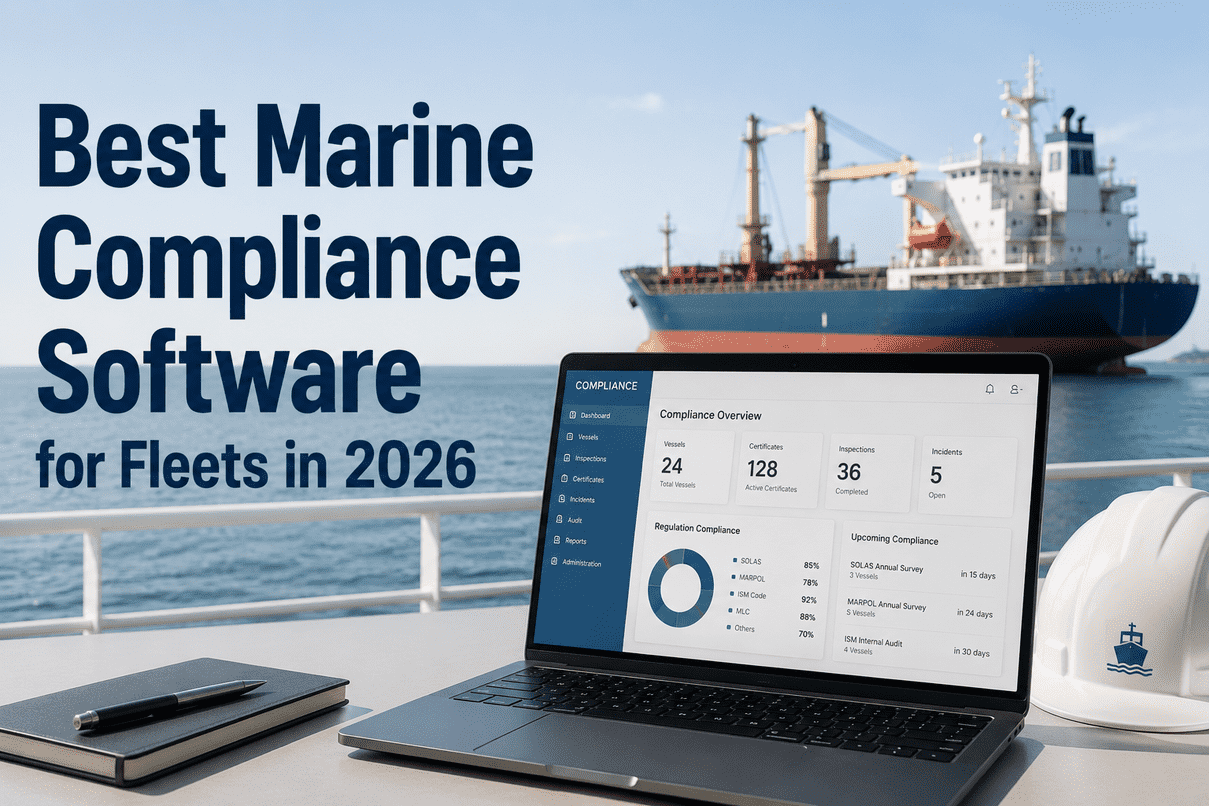
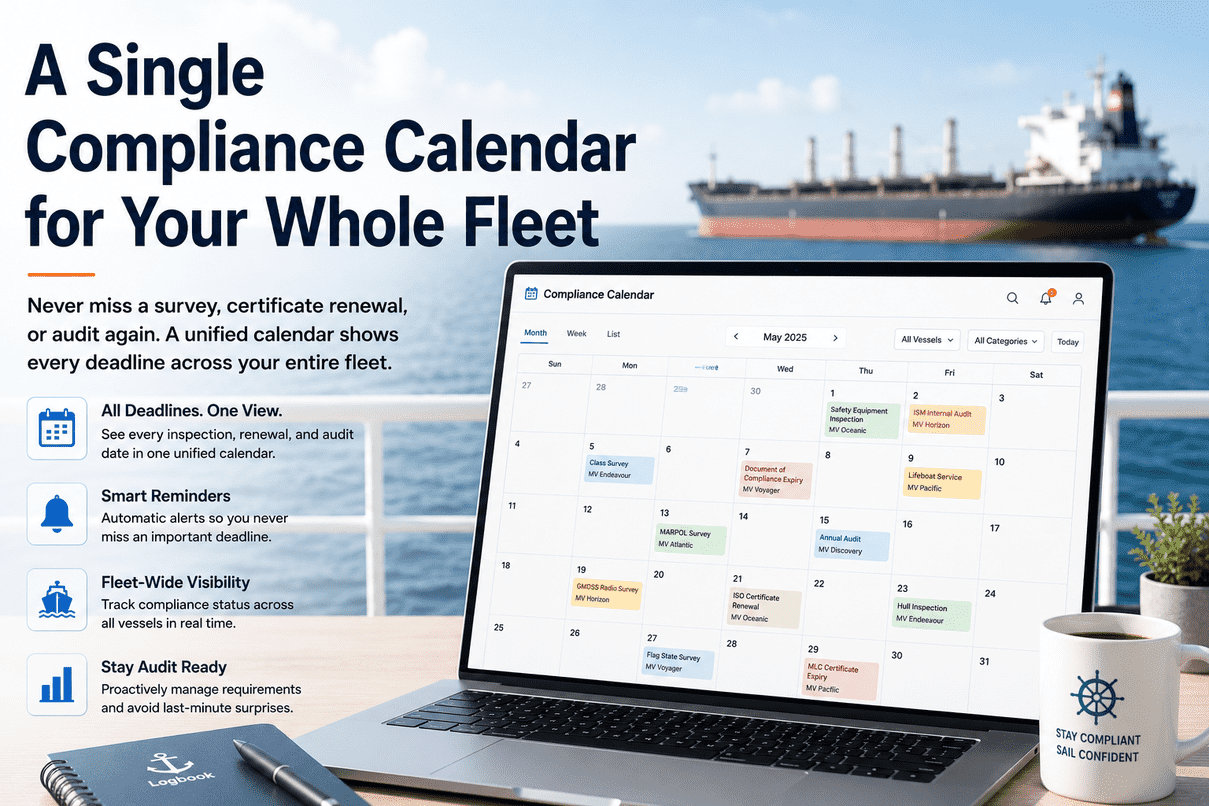
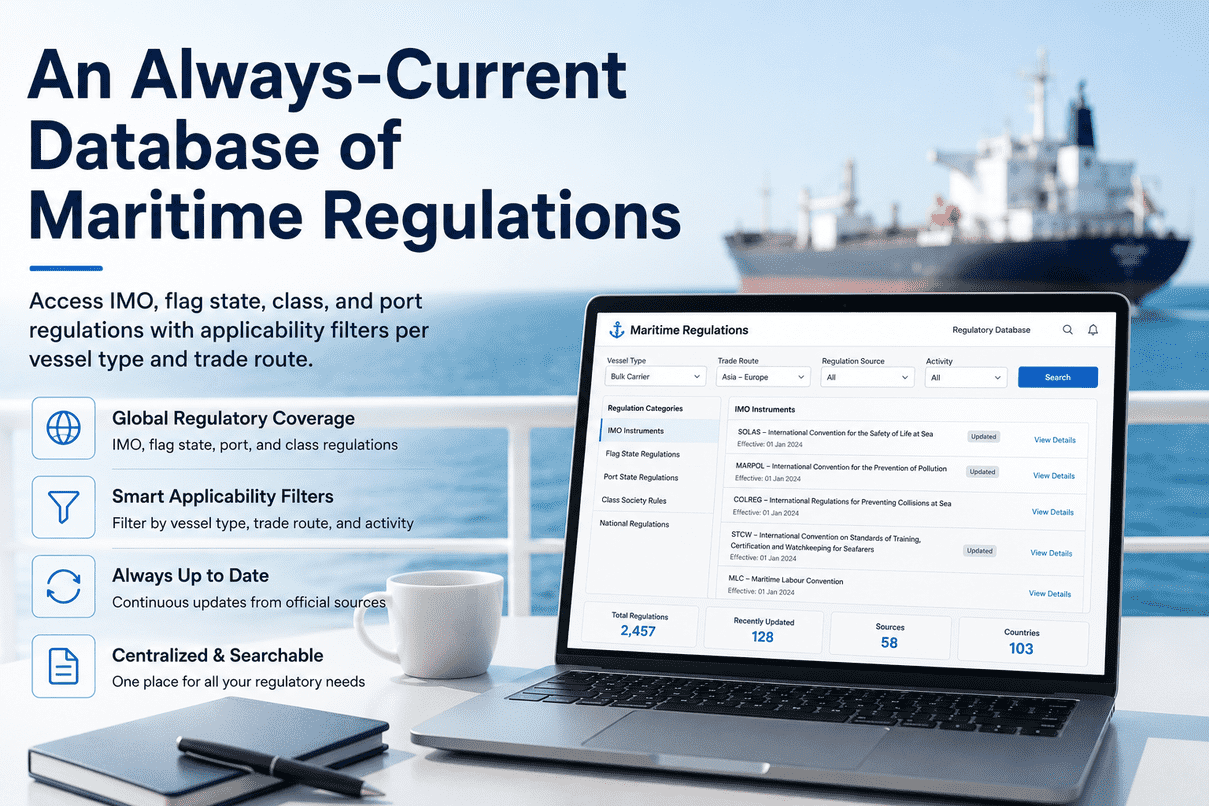
The compliance gap is not a tooling gap — it is a maturity gap. A 2026 fleet running paper checklists, certificate spreadsheets, and email-circular regulatory updates is two operating-model generations behind a fleet running native SOLAS/MARPOL/ISM modules, automated CII tracking, and tamper-evident audit packs. Both fleets sit under the same regulatory ceiling: SOLAS Chapter II-2 fire safety amendments effective January 1, 2026, MSC.554(108) lifeboat release mechanisms, CII ratings A through E driving commercial decisions, EU ETS for vessels over 5,000 GT at EU ports, FuelEU Maritime, MARPOL Annex VI Revised, MASS Code formal adoption May 2026. Both face the same PSC reality where over 60 percent of inspected vessels receive deficiencies. But one fleet absorbs change continuously while the other compounds deficiencies until detention. The right way to evaluate marine compliance software in 2026 is not feature-by-feature against an abstract scorecard — it is to position your fleet on a maturity ladder, identify the next achievable tier, and select the platform that gets you there in a defined timeline. This guide presents the five-stage maturity model, the vessel-segment capability requirements, the 12-week deployment roadmap, the implementation risk matrix, and the vendor question set that turn the buying decision from a feature comparison into an operating-model transformation. Book a 30-minute maturity assessment or start a free trial to apply the framework on your fleet.
Best Marine Compliance Software · 2026 Maturity Guide
Position Your Fleet On The Maturity Ladder. Pick The Platform That Gets You Up The Next Tier.
A five-stage maturity model for marine compliance operations — from paper-and-spreadsheets reactive baseline to AI-driven predictive best-in-class. Most fleets sit at Stage 2 today.
Marine Compliance Maturity Ladder
Most Fleets Today
The Five-Stage Marine Compliance Maturity Model
Compliance maturity is observable, measurable, and predictive of audit outcomes. Five stages separate fleets running paper logs at one end from fleets running predictive compliance analytics at the other. The stage a fleet sits at determines its PSC detention probability, its charter vetting performance, and its capacity to absorb regulatory amendments without operational disruption.
Stage 01
Paper & Spreadsheets
Reactive · 80%+ deficiency exposure
Certificate expiry tracked in Excel. Inspection findings emailed and lost. Drill records in paper logbooks. Regulatory amendments arrive as IMO circular emails to one inbox. The shore office and the vessel SMS operate from different versions of truth. Detention is a matter of when, not if.
Stage 02
Hybrid Digital
Catching Up · Most fleets today
Some processes digitized — usually planned maintenance and certificate registry. Inspections still paper-based with photos in WhatsApp. CII calculations in one spreadsheet, fuel consumption in another. Tooling chosen vessel-by-vessel rather than fleet-wide. Audit prep is reconstruction.
Stage 03
Centralized Compliance
Modern Baseline · Target tier
Native SOLAS, MARPOL, ISM, MLC modules. Single source of truth for certificates, inspections, drills, defects. Mobile-first offline capture. Tamper-evident audit trail. Approved service providers upload certificates directly. Audit pack on demand within minutes.
Stage 04
Integrated Operations
Connected Fleet · Operator advantage
Compliance platform integrated with PMS, ERP, port systems, classification society portals, flag state submissions. CII automation from noon reports. EU ETS pack generation. SIRE 2.0 Photo Repository. Fleet-wide trend detection across sister vessels. Cross-stack data flow without manual rekeying.
Stage 05
AI-Driven Predictive
Best-In-Class · Industry leaders
Predictive analytics flagging compliance drift before audit. Risk-scored vessel-by-vessel ranking. Anomaly detection on parameter trends. Pre-PSC defence packs assembled automatically. Recommended corrective actions ranked by risk-and-cost. Compliance becomes operational intelligence rather than audit prep.
Where Most Operators Sit On The Maturity Ladder Today
Industry data on maturity distribution tells the story of the marine compliance software market. Most fleets cluster at Stage 2 — partially digitized, structurally exposed. Moving up tiers is the buying case. Book a positioning conversation to map your fleet on the maturity ladder.
12%
Stage 1
Paper & Spreadsheets
Small operators, owner-managed fleets, vessels under 500 GT, older tonnage operating in less-regulated trades. Compliance treated as inspection-day exercise rather than continuous operation.
48%
Stage 2
Hybrid Digital
Most mid-size and many large fleets sit here. Patchwork of tools — PMS in one system, certificates in another, inspections in a third. Integration gaps drive detention findings and audit non-conformities.
28%
Stage 3
Centralized Compliance
Operators who have completed a digital transformation in the last three years. Native modules covering SOLAS, MARPOL, ISM. Mobile-first capture. The modern baseline that 2026 PSC and SIRE 2.0 reality demands.
10%
Stage 4
Integrated Operations
Large tanker operators, premium container lines, sophisticated offshore players. Compliance platform integrated with the operator stack. Cross-fleet trend analysis. EU ETS and CII automated.
2%
Stage 5
AI-Driven Predictive
Industry leaders running compliance as operational intelligence. Risk-scored fleets, predictive anomaly detection, automated defence pack generation. Where the market is heading by 2028.
The Capability Requirements Matrix By Vessel Segment
Compliance software requirements vary substantially by vessel segment. A tanker operator's needs are not a bulker operator's needs are not an offshore operator's needs. The matrix below maps the capability priorities by segment so the buying conversation focuses on what matters for the specific fleet rather than a generic feature list. Scroll horizontally on mobile for the full view.
| Capability |
Tanker |
Bulker |
Container |
Offshore |
Passenger |
| SIRE 2.0 Photo Repository |
Critical |
Optional |
Optional |
Useful |
Optional |
| CDI Chemical Vetting |
Critical |
Not Required |
Not Required |
Not Required |
Not Required |
| Hold Cleaning Records |
Required |
Critical |
Useful |
Not Required |
Not Required |
| Hatch & Cargo Securing |
Useful |
Critical |
Critical |
Required |
Optional |
| CII / EU ETS Automation |
Critical |
Critical |
Critical |
Required |
Critical |
| Reefer Container Tracking |
Not Required |
Not Required |
Critical |
Optional |
Useful |
| DP System Compliance |
Not Required |
Not Required |
Not Required |
Critical |
Optional |
| Passenger Drill Records |
Not Required |
Not Required |
Not Required |
Optional |
Critical |
| ISPS Code Documentation |
Required |
Required |
Required |
Critical |
Critical |
| MLC 2006 Crew Management |
Required |
Required |
Required |
Critical |
Critical |
The 12-Week Compliance Software Deployment Roadmap
Buying decisions stall not on capability comparison but on deployment risk. Operators have seen too many 18-month implementations and abandoned rollouts. The 12-week roadmap below maps the credible deployment path from contract signature to operational baseline — the timeline a 2026 platform should be able to deliver against.
Weeks 1-2
Setup & Configuration
Fleet registered in platform. Vessel particulars, equipment registers, certificate inventories imported. User accounts provisioned with role-based access. ISM Code SMS structure mapped to platform workflows.
Weeks 3-4
Pilot Vessel Onboarding
Single pilot vessel selected for live deployment. Master, chief officer, chief engineer trained. First inspections captured. First defects raised. First certificate uploads from approved service providers verified.
Weeks 5-6
Workflow Validation
Pilot vessel runs full inspection cycle — weekly checks, monthly drills, quarterly compliance reviews. Workflow gaps identified and configured. Custom checklists adapted to vessel specifics. PSC defence pack assembled and validated.
Weeks 7-8
Fleet Expansion Wave 1
Next batch of 5-10 vessels onboarded. Pilot vessel masters or chief officers become trainers for the wave. Shore office DPA and superintendents trained on fleet-wide views. Integration with PMS and certificate systems initiated.
Weeks 9-10
Integration Layer
REST API connections to PMS, ERP, port systems established. Classification society portals linked. Flag state submission workflows configured. Environmental data flowing from noon reports into CII and EU ETS modules.
Weeks 11-12
Full Fleet Operational
All vessels operational on platform. Fleet-wide reporting active. Audit pack generation tested across multiple vessels. First post-deployment PSC inspection navigated using the platform. Operational baseline established for ongoing operation.
The Implementation Risk Matrix
Every compliance software deployment carries identifiable risks. The matrix below maps the recurring risks to their likelihood, impact severity, and the mitigation that a credible vendor and operator should jointly own. Mobile users scroll horizontally for the full view.
| Implementation Risk |
Likelihood |
Impact |
Mitigation |
| Master / officer resistance to new tool |
High |
Severe |
Pilot vessel champions + train-the-trainer model |
| Data migration loses historical records |
Medium |
Severe |
Parallel-run period + reconciliation report |
| Connectivity gaps disrupt sync |
High |
Medium |
Offline-first architecture + tested auto-sync |
| Custom checklists delayed |
Medium |
Medium |
Pre-built templates + 48-hour customization SLA |
| Integration with PMS / ERP fails |
Medium |
High |
API documentation review pre-contract + pilot integration |
| Approved service providers refuse adoption |
Low |
Medium |
Service provider portal + parallel certificate upload |
| Charter vetting downgrades during transition |
Low |
Severe |
Old + new systems maintained during transition window |
| Cyber incident during deployment |
Low |
Severe |
MSC.428(98) cyber risk plan + penetration test before go-live |
| Vendor disappears or pivots away from marine |
Low |
Severe |
Contractual data portability + open-format exports |
| 2026 regulatory amendment missed |
Medium |
Severe |
Vendor regulatory update commitment + change logs |
Maturity Assessment Demo · 30 Minutes
Position Your Fleet On The Ladder. See The Tier-Up Path On Real Data.
A 30-minute session with a Marine Inspection product expert. Bring your current toolset, your fleet composition, and your recent PSC findings. Walk through the maturity model, vessel segment requirements, 12-week deployment roadmap, and the implementation risk matrix against your specific fleet.
The Question Set Every Shortlisted Vendor Should Answer
Procurement teams spend hours in vendor demos and walk away with feature impressions rather than evaluation evidence. The question set below converts demo time into decision-grade evidence. Each question is direct, testable in the demo session, and exposes the gap between marketing and reality.
Q1
Show me the SOLAS Chapter II-2 PFOS foam ban workflow live.
Tests native 2026 amendment coverage versus generic-checklist substitute. A vendor with native modules can show the workflow in 60 seconds. A vendor with generic checklists improvises.
Q2
Put the device in airplane mode and capture an inspection.
Tests genuine offline capability versus form-caching gimmick. Genuine offline platforms validate required fields, enforce regulation references, and capture photos without internet.
Q3
Modify a captured inspection entry and show the audit trail.
Tests tamper-evident audit trail versus editable plain log. Real audit trails log every modification with timestamp, identity, and original-versus-modified value comparison.
Q4
Show me a live CII projection from my last 90 days of noon reports.
Tests CII automation versus manual spreadsheet import. Real CII automation calculates projection in seconds with rating band visualization and improvement-path scenarios.
Q5
Generate a PSC defence pack for a specific vessel right now.
Tests audit pack on demand versus paper-folder reconstruction. Real platforms assemble the defence pack in minutes with weekly logs, certificates, drill records, and photo evidence consolidated.
Q6
Walk me through your REST API documentation and authentication.
Tests real integration capability versus CSV-export-only. Real REST APIs are documented, OAuth-secured, with sample calls available for live demo.
Q7
Show me the customer reference at my fleet size and segment.
Tests vendor maturity in the specific segment. A 24-vessel tanker fleet reference is materially different from a 5-vessel offshore reference. Segment-specific references predict deployment outcome.
Q8
Give me the deployment timeline with specific milestones for my fleet.
Tests vendor execution credibility. A vendor giving vague timelines is a vendor with no implementation methodology. The 12-week roadmap is achievable with credible vendors and credible scope.
Marine Inspection's Position On The Maturity Model
The fair test of the maturity model is to map the platform writing the guide against the framework. Marine Inspection is positioned to deliver Stage 3 Centralized Compliance as the entry tier, with native pathways to Stage 4 Integrated Operations through the REST API and integration partner network, and Stage 5 AI-Driven Predictive through the analytics layer in active rollout. Start a free trial or book a 30-minute maturity assessment to position your fleet and see the tier-up path on real data.
Stage 03
Centralized Compliance · Entry Tier
Native SOLAS, MARPOL, ISM, MLC modules. Mobile-first offline capture. Tamper-evident audit trail with SHA-256 document hashing and eIDAS Article 26 signatures. Approved service provider portal. Audit pack on demand within minutes. Per-item certificate tracking with 90 / 30 / expiry alerts.
Stage 04
Integrated Operations · API-Native Path
REST API with OAuth 2.0 authentication. Native connectors for major PMS systems, ERPs, classification society portals, flag state submission systems. CII live projection from noon reports. EU ETS allowance management. FuelEU well-to-wake intensity reporting.
Stage 05
AI-Driven Predictive · Analytics Layer
Fleet-wide trend detection across sister vessels. Parameter drift anomaly flagging. Risk-scored vessel ranking. Pre-PSC defence pack assembly recommendations. Active rollout to production fleet customers through 2026 and 2027.
Frequently Asked Questions
What is the marine compliance maturity model?
The marine compliance maturity model is a five-stage framework for evaluating where a fleet sits operationally and where the next achievable tier lies. Stage 1 Paper and Spreadsheets is reactive baseline with 80 percent or more deficiency exposure — certificate expiry tracked in Excel, inspection findings emailed and lost, drill records in paper logbooks, regulatory amendments arriving as IMO circular emails to one inbox. Stage 2 Hybrid Digital is catching-up state where most fleets sit today — patchwork of tools with PMS in one system, certificates in another, inspections in a third. Stage 3 Centralized Compliance is the modern 2026 baseline — native SOLAS, MARPOL, ISM, MLC modules, single source of truth, mobile-first offline capture, tamper-evident audit trail. Stage 4 Integrated Operations is the connected fleet tier — compliance platform integrated with PMS, ERP, port systems, classification society portals, flag state submissions, CII automation, EU ETS pack generation. Stage 5 AI-Driven Predictive is best-in-class with predictive analytics, risk-scored vessel ranking, anomaly detection, and pre-PSC defence pack automation.
Where do most operators sit on the maturity ladder?
Industry maturity distribution tells the story of the marine compliance software market. Approximately 12 percent of operators sit at Stage 1 Paper and Spreadsheets — small operators, owner-managed fleets, vessels under 500 GT, older tonnage in less-regulated trades. Approximately 48 percent sit at Stage 2 Hybrid Digital — most mid-size and many large fleets, patchwork of tools driving integration gaps that produce detention findings and audit non-conformities. Approximately 28 percent at Stage 3 Centralized Compliance — operators who completed digital transformation in the last three years with native modules covering SOLAS, MARPOL, ISM, and mobile-first capture, the modern baseline 2026 PSC and SIRE 2.0 reality demands. Approximately 10 percent at Stage 4 Integrated Operations — large tanker operators, premium container lines, sophisticated offshore players running compliance integrated with the operator stack. Approximately 2 percent at Stage 5 AI-Driven Predictive — industry leaders running compliance as operational intelligence with risk scoring and predictive anomaly detection.
How do compliance software requirements vary by vessel segment?
Compliance software requirements vary substantially by vessel segment. Tanker operators need SIRE 2.0 Photo Repository (critical), CDI chemical vetting for chemical tankers (critical), CII / EU ETS automation (critical), and ISPS Code documentation (required). Bulk carrier operators prioritize hold cleaning records (critical), hatch and cargo securing (critical), CII / EU ETS automation (critical), and ISPS Code (required). Container operators need hatch and cargo securing (critical), reefer container tracking (critical), CII / EU ETS automation (critical), and ISPS Code (required). Offshore operators require DP system compliance (critical), MLC 2006 crew management (critical), ISPS Code (critical), and hatch and cargo securing (required). Passenger vessel operators prioritize passenger drill records (critical), MLC 2006 crew management (critical), ISPS Code (critical), and CII / EU ETS automation (critical). CII / EU ETS automation is critical across every segment — emissions compliance is universal. The buying conversation should focus on segment-specific priorities rather than a generic feature checklist.
What does a credible 12-week deployment look like?
A credible 12-week deployment runs six two-week phases. Weeks 1-2 Setup and Configuration — fleet registered, vessel particulars and equipment registers and certificate inventories imported, user accounts provisioned, ISM SMS structure mapped to platform workflows. Weeks 3-4 Pilot Vessel Onboarding — single pilot vessel deployed live, master and chief officer and chief engineer trained, first inspections captured, first certificate uploads verified. Weeks 5-6 Workflow Validation — pilot runs full inspection cycle, workflow gaps configured, custom checklists adapted, PSC defence pack assembled and validated. Weeks 7-8 Fleet Expansion Wave 1 — 5-10 vessels onboarded, pilot masters become trainers, shore office DPA and superintendents trained on fleet-wide views, integration with PMS initiated. Weeks 9-10 Integration Layer — REST API connections to PMS, ERP, port systems established, classification society portals linked, flag state submission workflows configured, environmental data flowing into CII and EU ETS modules. Weeks 11-12 Full Fleet Operational — all vessels active, fleet-wide reporting, audit pack generation tested across multiple vessels, first post-deployment PSC inspection navigated using the platform.
What are the biggest implementation risks?
Ten recurring implementation risks must be jointly owned by vendor and operator. Master and officer resistance to new tool — high likelihood with severe impact, mitigated by pilot vessel champions plus train-the-trainer model. Data migration loses historical records — medium likelihood with severe impact, mitigated by parallel-run period plus reconciliation report. Connectivity gaps disrupt sync — high likelihood with medium impact, mitigated by offline-first architecture plus tested auto-sync. Custom checklists delayed — medium likelihood with medium impact, mitigated by pre-built templates plus 48-hour customization SLA. Integration with PMS / ERP fails — medium likelihood with high impact, mitigated by API documentation review pre-contract plus pilot integration. Approved service providers refuse adoption — low likelihood with medium impact, mitigated by service provider portal plus parallel certificate upload. Charter vetting downgrades during transition — low likelihood with severe impact, mitigated by old and new systems maintained during transition window. Cyber incident during deployment — low likelihood with severe impact, mitigated by MSC.428(98) cyber risk plan plus penetration test before go-live. Vendor disappears or pivots away — low likelihood with severe impact, mitigated by contractual data portability plus open-format exports. 2026 regulatory amendment missed — medium likelihood with severe impact, mitigated by vendor regulatory update commitment plus change logs.
What questions should every shortlisted vendor answer?
Eight questions convert demo time into decision-grade evidence. Show me the SOLAS Chapter II-2 PFOS foam ban workflow live — tests native 2026 amendment coverage versus generic-checklist substitute. Put the device in airplane mode and capture an inspection — tests genuine offline capability. Modify a captured inspection entry and show the audit trail — tests tamper-evident audit trail. Show me a live CII projection from my last 90 days of noon reports — tests CII automation versus manual import. Generate a PSC defence pack for a specific vessel right now — tests audit pack on demand. Walk me through your REST API documentation and authentication — tests real integration capability. Show me the customer reference at my fleet size and segment — tests segment-specific vendor maturity. Give me the deployment timeline with specific milestones for my fleet — tests vendor execution credibility. Each question is direct, testable in the demo session, and exposes the gap between marketing and reality. Vendors who cannot answer in real time on real data are vendors whose marketing exceeds capability.
How does Marine Inspection position on the maturity model?
Marine Inspection delivers Stage 3 Centralized Compliance as the entry tier — native SOLAS, MARPOL, ISM, MLC modules, mobile-first offline capture, tamper-evident audit trail with SHA-256 document hashing and eIDAS Article 26 signatures, approved service provider portal, audit pack on demand within minutes, per-item certificate tracking with 90 / 30 / expiry alerts. Stage 4 Integrated Operations through the API-native path — REST API with OAuth 2.0 authentication, native connectors for major PMS systems and ERPs and classification society portals and flag state submission systems, CII live projection from noon reports, EU ETS allowance management, FuelEU well-to-wake intensity reporting. Stage 5 AI-Driven Predictive through the analytics layer — fleet-wide trend detection across sister vessels, parameter drift anomaly flagging, risk-scored vessel ranking, pre-PSC defence pack assembly recommendations, active rollout to production fleet customers through 2026 and 2027. 6-12 week deployment for typical mid-size fleets with free trial available before any commitment.
Ready When You Are
Position Your Fleet. Pick The Platform. Tier Up.
Five-stage maturity model, vessel segment capability matrix, 12-week deployment roadmap, ten-row implementation risk matrix, eight-question vendor evaluation set, Marine Inspection's positioning at Stages 3-5 — all in one buyer's guide framework for the 2026 marine compliance software decision. Book a 30-minute maturity assessment and apply the framework on your real fleet.