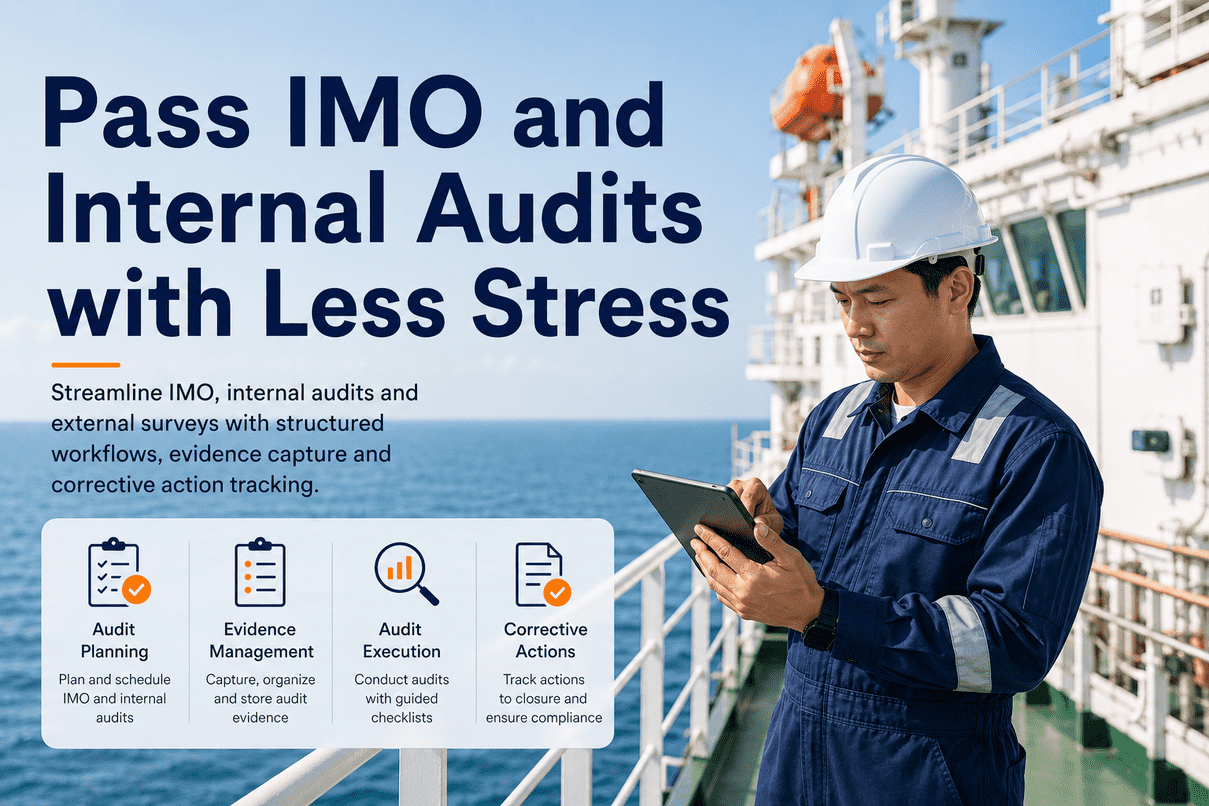
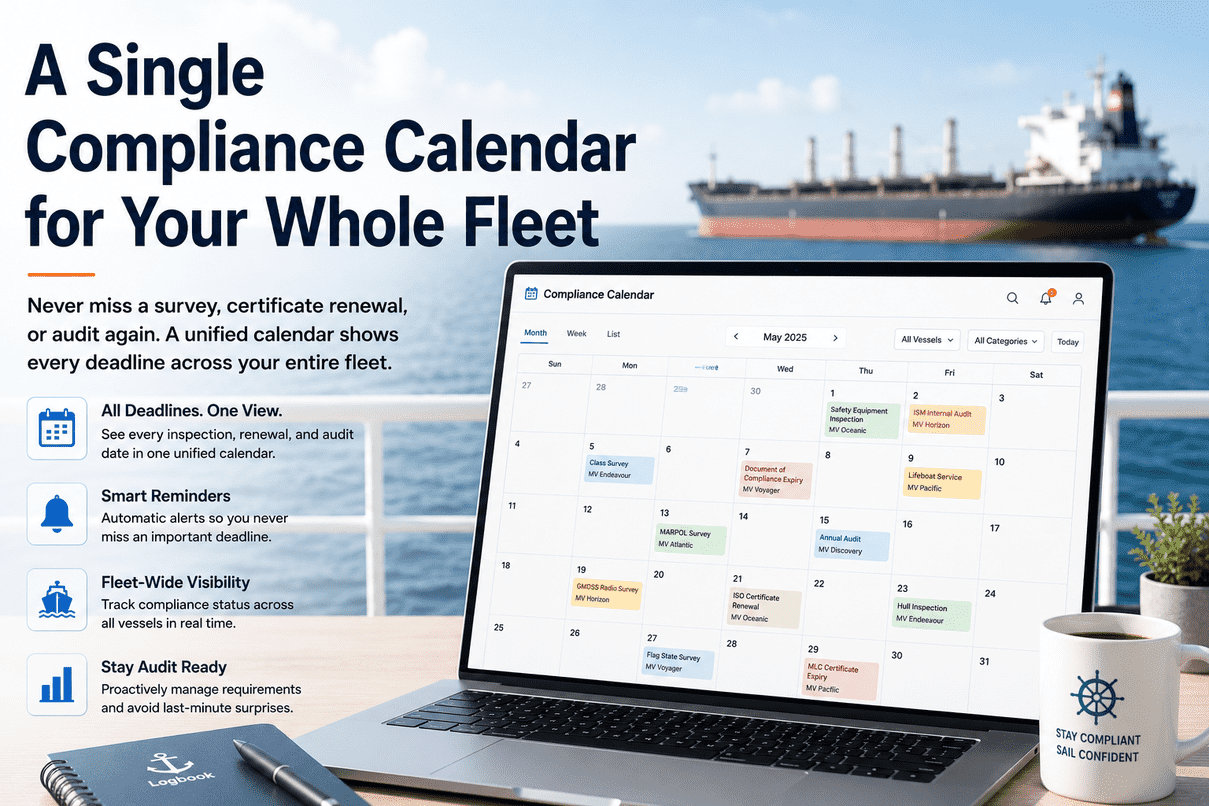
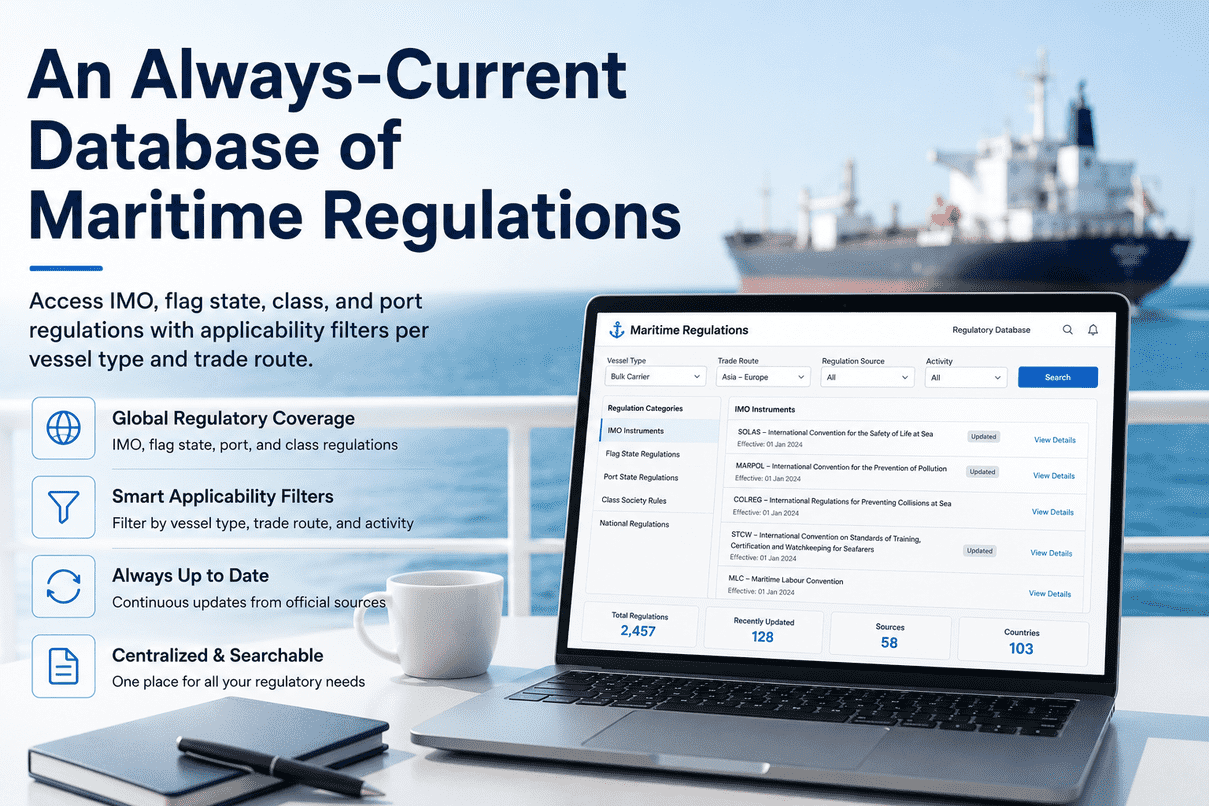
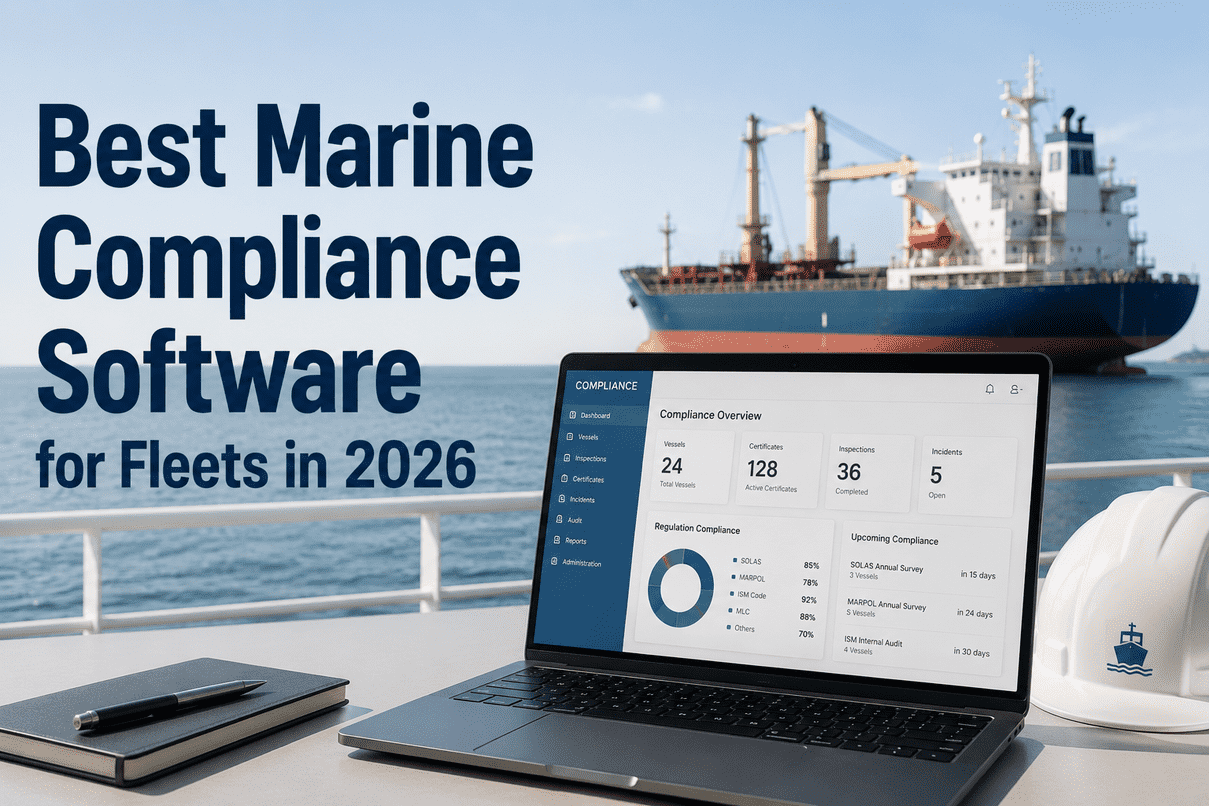
IMO audit management is no longer the quiet operational task of preparing a paper folder for a once-a-year flag state visit. The IMO Member State Audit Scheme (IMSAS) has been mandatory since 1 January 2016 under the III Code (Resolution A.1070(28)) with over 130 Member State audits completed to date. The IMSAS Continuous Monitoring Mechanism (ICMM) currently in development will replace the static 7-year cycle with continuous performance monitoring. Flag states audited under IMSAS push their findings downward as fresh requirements on shipping companies. ISM Code Element 12 mandates internal audits at intervals not exceeding 12 months. SIRE 2.0, CDI, and RightShip vetting inspectors operate against documented evidence standards as rigorous as any external audit. P&I clubs increasingly require evidence packs aligned to their own loss prevention frameworks. The 2026 operator faces five parallel audit streams — internal audits, flag state audits, Recognized Organization surveys, charterer vetting, and insurance loss prevention reviews — each generating its own findings, requiring its own Corrective and Preventive Action (CAPA) cycle, and converging on the same vessel and crew. Spreadsheets cannot run five audit streams. IMO audit management software replaces audit-prep panic with native finding lifecycle workflow, evidence chain capture, CAPA tracking, and audit pack assembly. Book a 30-minute audit management demo to see all five streams orchestrated on real fleet data.
IMO Audit Management Software · 2026
Every Finding Tracked From Raise To Verified Closure. Five Audit Streams. One Platform.
IMSAS-aligned audit management for the modern operator — internal audits, flag state audits, RO surveys, charterer vetting, insurance reviews orchestrated through one finding lifecycle pipeline.
M/V Pacific Star · Audit Performance · Q1-Q2 2026
46 Findings · 5 Streams
8
Investigation
Root cause analysis
5
CAPA Assigned
In progress
3
Verification
Pending close
The Five Audit Streams Every Modern Operator Manages
The 2026 operator runs five parallel audit streams that converge on the same vessel, crew, and SMS documentation. Each stream has its own auditor, scope, frequency, and finding categorization. Spreadsheet-based audit prep cannot keep five streams reconciled. Book an audit-streams demo to see how Marine Inspection orchestrates all five on a single fleet view.
01
Internal Audits
ISM Code Element 12 · 12-month max interval
Conducted by company internal auditor against the SMS. Verifies SMS implementation effectiveness. Findings feed Management Review. Pre-empts the external audit cycle. The single audit stream the operator fully controls.
02
Flag State Audits
DOC + SMC verification · Annual + 5-yr renewal
Flag state administration or Recognized Organization on its behalf. ISM DOC annual verification. SMC intermediate verification between 2nd and 3rd anniversary. ISMAS cascading requirements push downward.
03
RO + Class Surveys
SOLAS surveys · Statutory + class
Recognized Organization for flag state on statutory work. Classification society on class survey. Initial, Annual, Intermediate, Renewal cycles per SOLAS Chapter I. Hull, machinery, equipment scope.
04
Charterer Vetting
SIRE 2.0 · CDI · RightShip
OCIMF SIRE 2.0 for tankers. CDI for chemical tankers. RightShip across fleet. Vetting findings drive commercial decisions — failed vetting means lost charter revenue measured in hundreds of thousands of dollars.
05
Insurance Audits
P&I + H&M loss prevention
P&I clubs and Hull and Machinery underwriters conduct condition surveys and loss prevention reviews. Risk profile affects premium. Findings drive recommendations that operators implement before renewal or face premium impact.
The III Code Audit Standard That Sets The Ceiling
The IMO Instruments Implementation Code (III Code, Resolution A.1070(28)) is the audit standard used by IMSAS to assess Member State performance. Flag states audited against the III Code then push their findings down to operators as fresh requirements. Understanding the III Code is understanding the regulatory ceiling that ultimately reaches every vessel. Book a III Code walkthrough demo to see your compliance mapped against the framework.
Part 1
Common Obligations
Obligations all Member States share — implementing IMO instruments into national law, ensuring instruments apply, communicating updates, providing personnel and resources for implementation, working with industry.
Part 2
Flag State Obligations
Surveys and certifications for ships flying the flag, ISM DOC and SMC issuance, manning of ships, casualty investigation, evaluation and review of flag state performance, port state and coastal state coordination.
Part 3
Coastal State Obligations
Navigation safety in territorial waters, response to maritime casualties, marine environment protection, coordination with neighbouring coastal states, search and rescue obligations.
Part 4
Port State Obligations
PSC inspection obligations, MOU participation, harmonization with regional inspection regimes, port reception facilities, port security per ISPS Code.
The Audit Finding Lifecycle Every Operator Must Run
Whether the audit is internal, flag state, RO survey, vetting, or insurance, the finding follows the same lifecycle from raise to verified closure. Operators who run the lifecycle as a structured workflow close findings faster, prevent recurrence, and pass subsequent audits cleaner. The five-stage lifecycle below is the foundation of every audit management platform.
Stage 01
Raised
Finding identified by auditor, captured with reference, classification (Major NC / NC / Observation), evidence supporting the finding, and corrective action expectation. Master and DPA notified within 24 hours.
Stage 02
Investigation
Root cause analysis conducted by DPA or designated investigator. 5 Whys, Fishbone, or Failure Mode analysis applied. Findings categorised by root cause type — system, training, equipment, procedural, human error.
Stage 03
CAPA Assigned
Corrective Action addresses the immediate non-conformity. Preventive Action addresses the root cause to prevent recurrence. Owner, deadline, success criteria documented. Major NC carries 3-month closure maximum.
Stage 04
Verification
CAPA implementation verified through evidence — photo, signed record, updated procedure, retrained crew certification, system fix confirmed. Verifier different from CAPA implementer. Pending audit close-out.
Stage 05
Closed
Auditor accepts the verification evidence. Finding closed in audit register. Lessons learned captured and disseminated fleet-wide. Pattern detection across sister vessels. Future audit cycle informed.
The Audit Types And Frequencies Matrix
The matrix below maps every audit type operators face to its scope, frequency, auditor, and typical finding categories. Scroll horizontally on mobile for the full view.
| Audit Type |
Frequency |
Auditor |
Scope |
Finding Categories |
| Internal Audit |
≤12 months |
Company internal auditor |
Full SMS per ISM Element 12 |
NC + Observation |
| Management Review |
Annual |
Senior management |
SMS effectiveness assessment |
Improvement actions |
| ISM DOC Annual Verification |
±3 months anniversary |
Flag state or RO |
Company-level SMS |
Major NC / NC / Observation |
| ISM DOC Renewal |
5 years |
Flag state or RO |
Full SMS audit |
Major NC / NC / Observation |
| SMC Intermediate |
2nd-3rd anniv year |
Flag state or RO |
Vessel-level SMS |
Major NC / NC / Observation |
| SMC Renewal |
5 years |
Flag state or RO |
Full vessel SMS |
Major NC / NC / Observation |
| Class Annual Survey |
±3 months anniversary |
Classification society |
Class certificate endorsement |
Condition + deficiency |
| Class Intermediate / Renewal |
2.5 / 5 years |
Classification society |
Hull + machinery scope |
Condition + survey item |
| SIRE 2.0 Inspection |
6 months photo refresh |
OCIMF SIRE 2.0 inspector |
Tanker operations |
Negative + positive observations |
| CDI Inspection |
Per charter cycle |
CDI inspector |
Chemical tanker operations |
NC + observation |
| RightShip Inspection |
Per platform trigger |
RightShip inspector |
Multi-vessel-type scope |
Score + recommendations |
| P&I Condition Survey |
Per club requirement |
P&I surveyor |
Loss prevention focus |
Recommendations + warranties |
The Evidence Standards That Survive External Audit
The single greatest predictor of audit outcome is the quality of evidence supporting compliance claims. Auditors do not assess intent — they verify documented evidence. Six evidence standards separate audit-grade documentation from spreadsheet-grade documentation. Book an evidence-standards demo to see how the platform produces audit-grade output by default.
E1
Timestamped At Source
Every entry timestamped against authoritative time source (NTP-synced server, GPS) at the moment of capture. Editable timestamps fail audit. Backdating detectable. Auditor can verify when an entry was actually made.
E2
Identity-Bound
Every entry attributed to a specific named individual through authenticated user account or electronic signature. Anonymous entries fail audit. Signature claims must trace to verifiable identity.
E3
Photo Evidence With Metadata
Photographic evidence with embedded EXIF data — GPS coordinates, timestamp, device, original-pixel hash. Stripped photos fail audit. The photo must be verifiable as captured at claimed location and time.
E4
Tamper-Evident Audit Trail
Modifications to original entries logged with timestamp, identity, original value, new value, reason. Detectable subsequent changes. eIDAS Article 26 Advanced Electronic Signature standard or equivalent.
E5
Cross-Referenced
Evidence linked across documents — inspection record references the procedure, the procedure references the SMS Manual section, the SMS Manual references the III Code clause. Auditor can traverse the chain.
E6
Exportable In Auditor Format
Audit pack exportable in the format auditors actually use — structured PDF, indexed, searchable, with cross-references intact. CSV dumps fail at audit. The pack must be navigable by the auditor in real time.
The Recurring Audit Findings Pattern Matrix
Audit findings cluster around six recurring patterns regardless of operator size, fleet composition, or audit type. Recognized Organization auditors find similar patterns at external verification. The matrix below maps each finding pattern to its typical root cause and the CAPA approach that actually closes it. Mobile users scroll horizontally for the full view.
| Recurring Finding |
Typical Root Cause |
Common Mis-CAPA |
Correct CAPA |
| SMS document drift |
No version control on circulation |
Reissue latest version once |
Document control + acknowledgment capture |
| Drill records without substance |
Drill performed for record, not training |
Add date to drill log |
Restructure drill with scenario + debrief |
| NCs past closure window |
No tracking system for NC clock |
Close NC retrospectively |
NC lifecycle workflow + alert system |
| Critical equipment list outdated |
List frozen at last revision |
Update list once at audit |
Recurring review cycle in PMS integration |
| Familiarisation gaps |
New joiner assumed duties early |
Sign familiarisation retroactively |
Block duty assumption until completion |
| Rest hours non-compliance |
Watch system + drills compress rest |
Reconstruct rest hours record |
Continuous rest hours capture per duty |
| Certificate expiry surprise |
No alert system on per-item validity |
Renew certificate after expiry |
90 / 30 day alerts per certificate |
| Master-DPA channel gap |
Master concerns not surfaced to DPA |
Add comment box to monthly report |
Direct dedicated channel with audit trail |
Audit Management Demo · 30 Minutes
See Five Audit Streams Orchestrated Through One Pipeline
A 30-minute walkthrough with a Marine Inspection product expert. Bring your last external audit report, your current open NC log, and your internal audit schedule. Walk through five-stream audit management, finding lifecycle, evidence standards, CAPA workflow, and audit pack assembly on your real fleet data.
The CAPA Discipline That Actually Closes Findings
Corrective and Preventive Action is the most misunderstood discipline in marine audit. Most operators conflate Corrective Action (fix the immediate non-conformity) with Preventive Action (address the root cause to prevent recurrence). Auditors find the difference. Six CAPA disciplines below separate findings that stay closed from findings that recur at the next audit. Book a CAPA discipline demo to see Marine Inspection's workflow on your fleet's open findings.
D1
Distinguish Corrective From Preventive
Corrective Action addresses the immediate non-conformity — replace expired certificate, fix broken equipment. Preventive Action addresses the root cause — fix the alert system that should have flagged the certificate. Both required.
D2
Root Cause Goes Three Levels Deep
5 Whys analysis until cause is structural — process gap, training gap, system gap. Surface-level root causes ("crew forgot") fail audit. The cause must be at the level the platform or process can address.
D3
Owner Named With Authority
CAPA owner has authority to implement and budget to execute. Diffuse ownership fails — "Master and DPA together" closes nothing. One name, one accountability, with clear escalation path.
D4
Deadline With Major NC Clock Visible
Major NC: 3-month closure maximum or DOC/SMC withdrawn. Visible clock counting down. CAPA owner sees the clock. Escalation triggers automatic when clock approaches threshold.
D5
Verification Independent From Implementation
CAPA verifier is different from CAPA implementer. Same person cannot verify their own work. Independent verification with evidence chain is the audit close-out standard.
D6
Lessons Learned Disseminated Fleet-Wide
A finding raised on one vessel becomes a preventive lesson for all sister vessels. Pattern detection. Fleet-wide circulation with acknowledgment capture. The finding pays dividends.
Marine Inspection's Audit Architecture
Marine Inspection's audit layer is structured around the four operational realities of running five parallel audit streams — finding lifecycle orchestration, evidence chain capture, CAPA workflow, and audit pack assembly. Four architectural layers handle the complexity. Book the audit architecture walkthrough demo to apply the platform to your fleet. Start a free trial to evaluate before any contract.
Layer 1
Finding Lifecycle Pipeline
Every finding tracked through Raised, Investigation, CAPA Assigned, Verification, Closed stages with stage-specific workflow. Major NC 3-month clock visible. Owner accountability. Stream-source preserved across the lifecycle.
Layer 2
Evidence Chain Engine
Six evidence standards enforced by default — timestamped at source, identity-bound, photo with EXIF metadata, tamper-evident audit trail, cross-referenced, exportable in auditor format. eIDAS Article 26 signatures available.
Layer 3
CAPA Workflow
Six CAPA disciplines enforced — corrective versus preventive distinction, three-level root cause analysis, named ownership, deadline with Major NC clock, independent verification, fleet-wide lessons disseminated. Workflow blocks shortcut closures.
Layer 4
Audit Pack Assembly Engine
Audit pack assembled in minutes for any audit stream — internal, flag state, RO survey, vetting, insurance. Format aligned to auditor expectations. All five streams reconcile to the same evidence base.
Frequently Asked Questions
What does IMO audit management software actually do?
IMO audit management software orchestrates the five parallel audit streams every modern operator faces and handles the finding lifecycle from raise to verified closure. Five audit streams covered — Internal Audits per ISM Code Element 12 with 12-month max interval, Flag State Audits including ISM DOC annual verification and SMC intermediate verification, Recognized Organization and Class Surveys per SOLAS Chapter I survey types, Charterer Vetting including SIRE 2.0, CDI, and RightShip, and Insurance Audits including P&I condition surveys and Hull and Machinery loss prevention reviews. Finding lifecycle pipeline runs five stages — Raised, Investigation, CAPA Assigned, Verification, Closed. Evidence chain engine enforces six audit-grade standards including timestamped at source, identity-bound, photo with EXIF metadata, tamper-evident audit trail, cross-referenced, and exportable in auditor format. CAPA workflow enforces six disciplines including corrective versus preventive distinction, three-level root cause analysis, named ownership, deadline with Major NC 3-month clock, independent verification, and fleet-wide lessons learned dissemination.
What is IMSAS and how does it affect operators?
The IMO Member State Audit Scheme (IMSAS) is the mandatory IMO audit scheme that verifies Member State performance against the III Code (Resolution A.1070(28)). IMSAS became mandatory on 1 January 2016 with over 130 audits completed to date and a typical 7-year cycle per Member State. The IMSAS Continuous Monitoring Mechanism (ICMM) currently in development will replace the static cycle with continuous performance monitoring with audits prioritized based on each Member State's progress in addressing previously identified findings. IMSAS does not directly audit shipping operators — it audits Member States in their roles as flag state, port state, and coastal state. The indirect effect on operators is substantial. Flag states audited under IMSAS push their findings downward as fresh requirements on shipping companies. Recurring IMSAS findings on flag states include insufficient training of case-handlers, lack of coordination among key agencies, unclear role responsibilities, and reporting gaps. Operators receive cascading requirements through new flag state circulars, updated SMS expectations, and tighter ISM verification.
What is the III Code?
The IMO Instruments Implementation Code (III Code) is the audit standard used by IMSAS to assess Member State performance, adopted as Resolution A.1070(28). The III Code is structured in four parts. Part 1 Common Obligations covers obligations all Member States share — implementing IMO instruments into national law, ensuring instruments apply, communicating updates, providing personnel and resources for implementation, working with industry. Part 2 Flag State Obligations covers surveys and certifications for ships flying the flag, ISM DOC and SMC issuance, manning of ships, casualty investigation, evaluation and review of flag state performance, port state and coastal state coordination. Part 3 Coastal State Obligations covers navigation safety in territorial waters, response to maritime casualties, marine environment protection, coordination with neighbouring coastal states, search and rescue obligations. Part 4 Port State Obligations covers PSC inspection obligations, MOU participation, harmonization with regional inspection regimes, port reception facilities, port security per ISPS Code.
What audit streams does an operator need to manage?
Five parallel audit streams converge on the modern operator. Internal Audits under ISM Code Element 12 conducted by company internal auditor at intervals not exceeding 12 months — verifies SMS implementation effectiveness with findings feeding Management Review. Flag State Audits with DOC and SMC verification — flag state administration or Recognized Organization on its behalf with ISM DOC annual verification and SMC intermediate verification between 2nd and 3rd anniversary. RO and Class Surveys covering SOLAS statutory surveys — Recognized Organization for flag state on statutory work, classification society on class survey, Initial, Annual, Intermediate, Renewal cycles per SOLAS Chapter I covering hull, machinery, equipment scope. Charterer Vetting including OCIMF SIRE 2.0 for tankers with 6-month Photo Repository refresh, CDI for chemical tankers, and RightShip across fleet types — failed vetting means lost charter revenue measured in hundreds of thousands of dollars. Insurance Audits including P&I clubs and Hull and Machinery underwriters conducting condition surveys and loss prevention reviews.
How does the audit finding lifecycle work?
The finding lifecycle runs five sequential stages regardless of audit type. Stage 01 Raised — finding identified by auditor with reference, classification (Major NC, NC, Observation), evidence supporting the finding, and corrective action expectation, with Master and DPA notified within 24 hours. Stage 02 Investigation — root cause analysis conducted by DPA or designated investigator using 5 Whys, Fishbone, or Failure Mode analysis, with findings categorised by root cause type including system, training, equipment, procedural, human error. Stage 03 CAPA Assigned — Corrective Action addresses the immediate non-conformity, Preventive Action addresses the root cause to prevent recurrence, with owner, deadline, success criteria documented and Major NC carrying 3-month closure maximum. Stage 04 Verification — CAPA implementation verified through evidence (photo, signed record, updated procedure, retrained crew certification, system fix confirmed) with verifier different from CAPA implementer. Stage 05 Closed — auditor accepts verification evidence, finding closed in audit register, lessons learned captured and disseminated fleet-wide with pattern detection across sister vessels.
What evidence standards survive an external audit?
Six evidence standards separate audit-grade documentation from spreadsheet-grade documentation. Timestamped At Source — every entry timestamped against authoritative time source (NTP-synced server, GPS) at moment of capture, with editable timestamps failing audit and backdating detectable. Identity-Bound — every entry attributed to specific named individual through authenticated user account or electronic signature, with anonymous entries failing audit. Photo Evidence With Metadata — photographic evidence with embedded EXIF data including GPS coordinates, timestamp, device, original-pixel hash, with stripped photos failing audit. Tamper-Evident Audit Trail — modifications to original entries logged with timestamp, identity, original value, new value, reason, with detectable subsequent changes per eIDAS Article 26 Advanced Electronic Signature standard or equivalent. Cross-Referenced — evidence linked across documents with inspection record referencing the procedure, procedure referencing the SMS Manual section, SMS Manual referencing the III Code clause. Exportable In Auditor Format — audit pack exportable as structured PDF, indexed, searchable, with cross-references intact, with CSV dumps failing at audit.
How should CAPA actually work?
Six CAPA disciplines separate findings that stay closed from findings that recur at the next audit. Distinguish Corrective From Preventive — Corrective Action addresses the immediate non-conformity (replace expired certificate, fix broken equipment), Preventive Action addresses the root cause (fix the alert system that should have flagged the certificate). Both required. Root Cause Goes Three Levels Deep — 5 Whys analysis until cause is structural with surface-level root causes failing audit, the cause must be at the level the platform or process can address. Owner Named With Authority — CAPA owner has authority to implement and budget to execute, with diffuse ownership failing — one name, one accountability. Deadline With Major NC Clock Visible — Major NC 3-month closure maximum or DOC/SMC withdrawn, visible clock counting down, escalation triggers automatic. Verification Independent From Implementation — CAPA verifier different from CAPA implementer, same person cannot verify their own work, independent verification with evidence chain is the audit close-out standard. Lessons Learned Disseminated Fleet-Wide — a finding raised on one vessel becomes a preventive lesson for all sister vessels with pattern detection and fleet-wide circulation with acknowledgment capture.
Ready When You Are
Five Audit Streams. One Pipeline. Every Finding Closed Right The First Time.
Five audit streams orchestrated, III Code-aligned framework, five-stage finding lifecycle, twelve-row audit types matrix, six evidence standards enforced, eight-row recurring findings pattern matrix, six CAPA disciplines applied, four-layer audit architecture — all in one IMO-aligned audit management platform built for the 2026 audit reality. Book a 30-minute audit demo on your actual fleet.