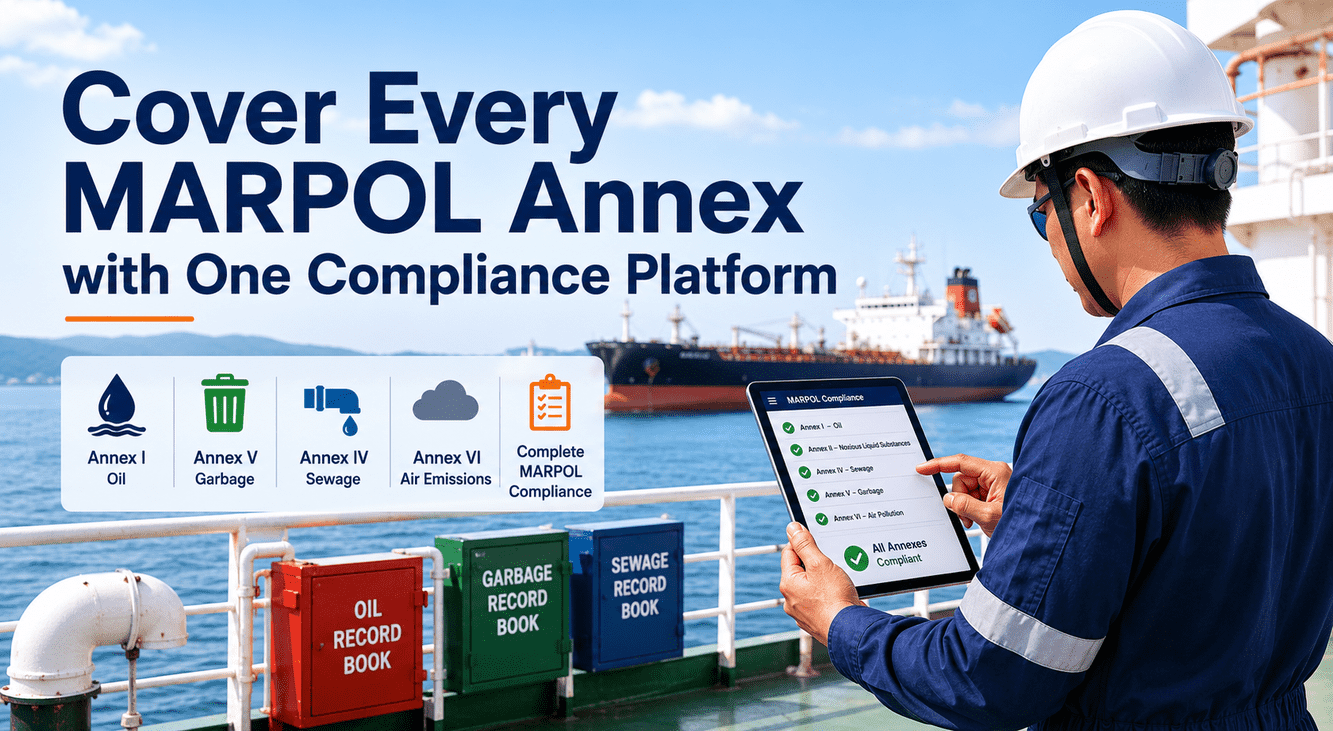
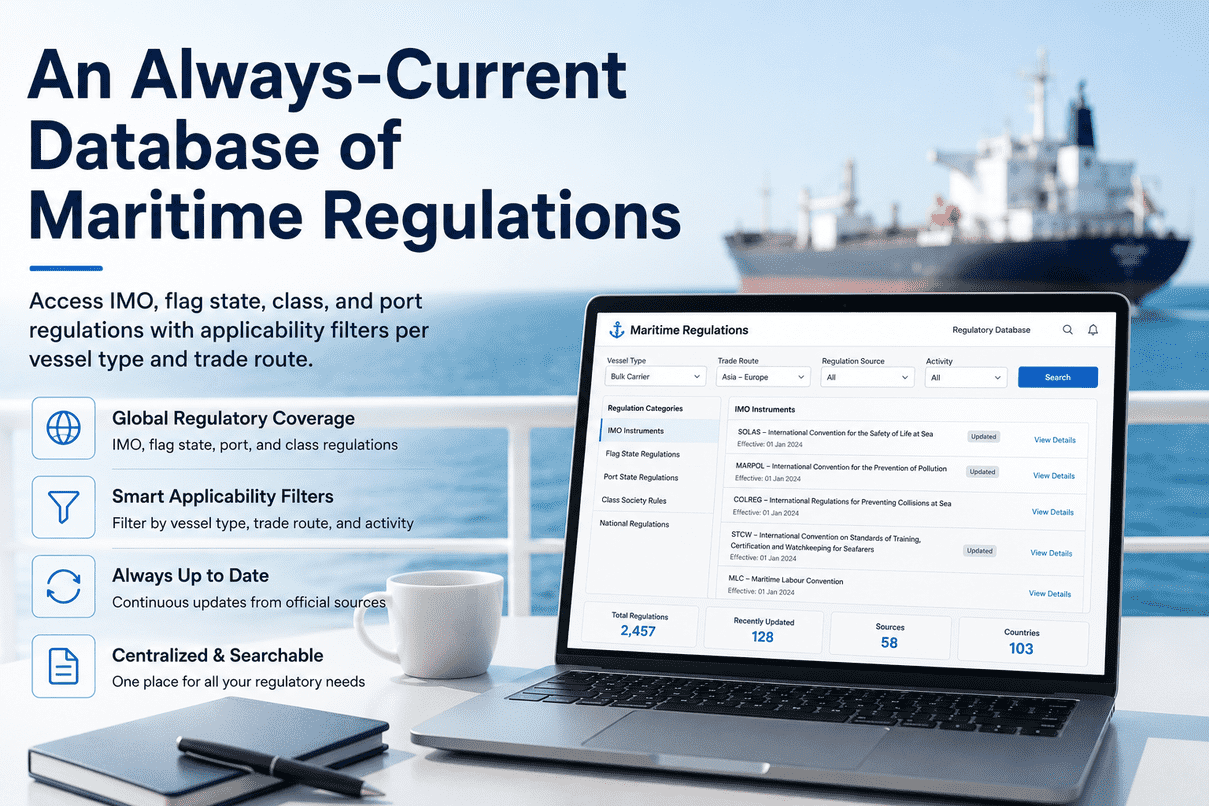
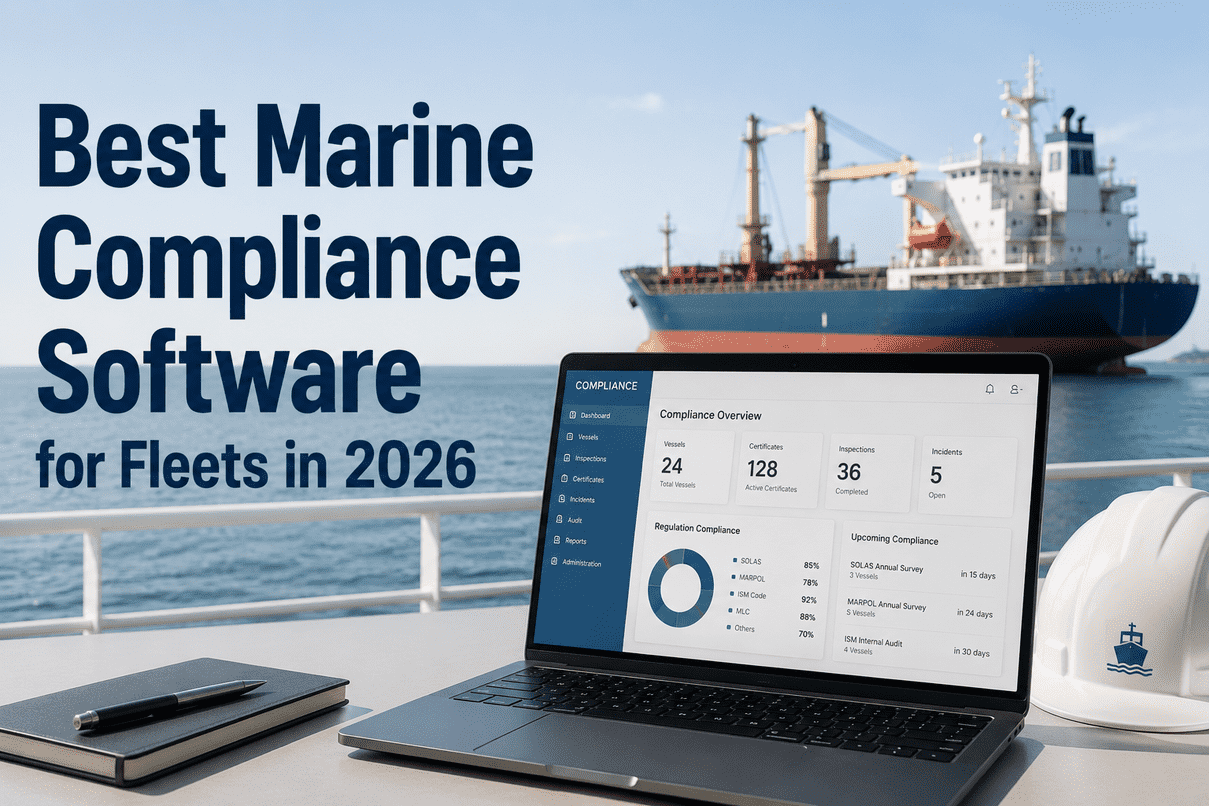
MARPOL is six independent regulatory regimes running in parallel under one convention. Annex I governs oil. Annex II governs noxious liquid substances in bulk. Annex III governs harmful substances in packaged form. Annex IV governs sewage. Annex V governs garbage. Annex VI governs air pollution and is the most actively evolving annex in the convention. Each annex generates its own mandatory record book, certificate, equipment requirements, and discharge restrictions. The 2026 regulatory burden is uncomfortable. Enhanced IMO Data Collection System reporting becomes mandatory from 1 January 2026 for existing ships of 5,000 GT and above with granular fuel consumption per consumer group required. SEEMP Parts II and III must be on board by 1 January 2026. The Mediterranean Sea Emission Control Area entered SOx enforcement in May 2025 — bringing the total to seven active ECAs alongside the Baltic, North Sea, North American area, US Caribbean, Canadian Arctic, and Norwegian Sea. The Garbage Record Book threshold dropped from 400 GT to 100 GT in 2024, capturing a much wider fleet. The IMO Net-Zero Framework MEPC vote in 2026 will reshape the entire Annex VI regime. Each vessel must hold IOPP, ISPP, IAPP, EIAPP certificates simultaneously and reconcile six different record books to the same operational reality. Marine Inspection's MARPOL compliance software connects every annex into one tracking layer. Book a 30-minute MARPOL demo to see annex-connected tracking on your fleet or start a free trial to evaluate against your current setup.
MARPOL Compliance Software · 2026
Six Annexes. One Compliance Layer. Every Discharge Logged. Every Emission Tracked.
MARPOL Annexes I through VI in one tracking platform — oil record book, garbage record book, sewage records, air emissions, CII, EU ETS, ECA discharge tracking, IAPP/EIAPP/IOPP/ISPP certificate registry.
M/V Pacific Star · MARPOL Live
28 May 2026
I
Oil
COMPLIANT
ORB current · OWS OK
II
NLS Bulk
COMPLIANT
No NLS · Cert valid
III
Packaged
COMPLIANT
IMDG declared
IV
Sewage
WATCH
STP service due 18d
V
Garbage
COMPLIANT
GRB current
VI
Air
ACTION
DCS Q1 due · CII C
The Six MARPOL Annexes At A Glance
MARPOL is structured into six annexes covering oil, noxious liquid substances in bulk, harmful substances in packaged form, sewage, garbage, and air pollution. Each annex carries its own record-keeping, equipment, certification, and discharge restrictions. A credible compliance platform tracks all six annexes as connected workflows. Book an annex walkthrough demo to see your fleet mapped to all six annexes.
I
Oil
Prevention of pollution by oil. Oil Record Book Part I (machinery), Part II (cargo for tankers). IOPP Certificate. 15ppm Oily Water Separator. Sludge tank capacity. Eleven Special Areas with stricter discharge limits.
II
Noxious Liquid Substances
Prevention of pollution by NLS carried in bulk. Cargo Record Book. NLS Certificate of Fitness. IBC Code reference. Four pollution categories X, Y, Z, OS with category-specific discharge limits.
III
Harmful Substances Packaged
Prevention of pollution by harmful substances in packaged form. IMDG Code reference. Cargo declaration, marking, labelling, stowage, segregation, and reporting requirements per IMDG.
IV
Sewage
Prevention of pollution by sewage. International Sewage Pollution Prevention Certificate (ISPP). Sewage treatment plant or holding tank. Discharge distance and concentration limits per location.
V
Garbage
Prevention of pollution by garbage. Garbage Record Book (now 100 GT and above per 2024 amendment). Garbage Management Plan. Placards. Eight Special Areas with stricter discharge restrictions.
VI
Air Pollution
Prevention of air pollution from ships. IAPP and EIAPP Certificates. SOx and NOx limits. Seven Emission Control Areas. EEXI, CII, SEEMP Parts II and III, IMO DCS enhanced reporting from January 2026.
The Mandatory Record Books Every Vessel Maintains
MARPOL produces a documentation stack with multiple record books per vessel, each tied to a specific annex and subject to PSC inspection. The records are retained for two years from the date of last entry. Book a record-book walkthrough demo to see electronic record book integration on your fleet.
Annex I
Oil Record Book · Part I & II
Part I (Machinery Space Operations) — bunkering, internal transfers, sludge disposal, OWS discharges, bilge handling. Part II (Cargo Operations) for tankers — loading, transfer, washing, ballast. Master signs every page. Electronic ORB approved per MEPC.187(59).
Annex II
Cargo Record Book · NLS Vessels
Cargo operations for vessels carrying noxious liquid substances in bulk per IBC Code. Loading, unloading, transfer, tank washing, residue handling. Category X, Y, Z, OS-specific requirements. Master countersignature on every operation.
Annex V
Garbage Record Book
All garbage disposal, incineration, and shore-reception operations. MEPC.360(79) amendment effective 1 May 2024 lowered the threshold from 400 GT to 100 GT — capturing a much wider vessel base. Categories A through K per MARPOL Annex V appendix II.
Annex VI
Ozone-Depleting Substances Record Book
Records of all operations involving ozone-depleting substances — installation, repair, maintenance, and disposal of refrigerants, fire extinguishing agents, and other ODS. Applies to all vessels with ODS-containing equipment.
Annex VI
Fuel Oil Changeover Record
Mandatory log of fuel changeover when entering or leaving Emission Control Areas. Time, position, fuel type, volume changeover record. SOx compliance verification per ECA entry. Bunker Delivery Note records retained 3 years.
The Discharge Limits Matrix By Annex
Each annex specifies precise discharge conditions — concentration limits, distance from coast, vessel speed, in-service equipment requirements, and reception facility receipt obligations. The matrix below maps the key discharge conditions PSC inspectors verify. Scroll horizontally on mobile for the full view. Book a discharge-limits walkthrough demo to see how the platform enforces every limit at the moment of capture.
| Annex / Type |
Discharge Type |
Concentration Limit |
Distance / Speed |
Receipt Required |
| Annex I · Machinery |
Oily bilge water |
Below 15 ppm |
En route only |
OWS log + ORB entry |
| Annex I · Tanker |
Cargo oil residues |
30 L/nautical mile |
En route + 50 nm from land |
ORB Part II entry |
| Annex I · Special Areas |
Any oily mixture |
Generally prohibited |
Discharge to reception only |
Receipt + ORB entry |
| Annex II · Cat X |
NLS residues |
Pre-wash required |
Reception facility only |
Receipt + Cargo Record |
| Annex II · Cat Y/Z |
NLS residues |
Below specified PPM |
En route + 12 nm from land |
Cargo Record Book entry |
| Annex IV · Treated sewage |
Treated through STP |
STP approved standard |
3 nm or more from land |
ISPP cert + treatment log |
| Annex IV · Untreated |
Raw sewage |
Comminuted + disinfected |
12 nm + 4 knots min |
STP log + ISPP cert |
| Annex V · Food waste |
Comminuted food waste |
Through 25mm mesh |
3 nm + en route |
GRB entry |
| Annex V · Food (Special) |
Comminuted food waste |
Through 25mm mesh |
12 nm + en route |
GRB entry |
| Annex V · Cargo residues |
Non-harmful per Annex V |
Per cargo classification |
12 nm + en route |
GRB entry + classification |
| Annex V · Plastics |
Any form |
Discharge prohibited |
Anywhere |
Reception only + GRB |
| Annex VI · SOx (Global) |
Fuel sulfur content |
0.50% m/m max |
Outside ECAs |
BDN + fuel sample retained |
| Annex VI · SOx (ECA) |
Fuel sulfur content |
0.10% m/m max |
Inside ECA |
BDN + fuel changeover log |
The Seven Emission Control Areas And Eleven Special Areas
MARPOL designates restricted-discharge geographies in two parallel systems. Emission Control Areas under Annex VI govern air emissions with stricter SOx and NOx limits. Special Areas under Annexes I, II, IV, and V govern liquid and solid discharge with stricter or zero-discharge restrictions. As of March 2026 seven ECAs operate globally with Mediterranean SOx in force from May 2025. Book a geographic-compliance demo to see how the platform tracks position-based discharge restrictions.
ECA
Baltic Sea
SOx + NOx Tier III for ships keel-laid 1 January 2021 and after. Original ECA dating from 2006.
ECA
North Sea
SOx + NOx Tier III for ships keel-laid 1 January 2021 and after. Active from 2007.
ECA
North American Area
SOx + NOx Tier III. US + Canada coastal waters out to 200 nautical miles. Active 2012.
ECA
US Caribbean Sea
SOx + NOx. Around Puerto Rico and US Virgin Islands. Active 2014.
ECA
Mediterranean Sea
SOx in force from 1 May 2025. NOx provisions phased. Latest active ECA addition.
ECA
Canadian Arctic
SOx + NOx in force from March 2026. Newest ECA designation aligned with Polar Code.
ECA
Norwegian Sea
SOx + NOx in force from March 2026. Newest ECA designation aligned with Arctic operations.
Special Area
Annex I Special Areas
Mediterranean, Baltic, Black, Red, Gulfs area, Gulf of Aden, North-West European, Antarctic, North American, Oman Sea, Southern South African Waters.
The Annex VI Emissions Stack For 2026
Annex VI is the most actively evolving annex with overlapping emissions regimes. The stack below maps each emissions layer from sulfur to greenhouse gas with limit, effective date, scope, and required tracking action per vessel. Mobile users scroll horizontally for the full view.
| Pollutant / Regime |
Limit |
Effective |
Scope |
Tracking Action |
| SOx · Global cap |
0.50% m/m sulfur |
1 January 2020 |
Outside ECAs |
BDN + fuel sample retained |
| SOx · ECA |
0.10% m/m sulfur |
2015 + ECA-by-ECA |
Inside ECAs |
Fuel changeover log per ECA |
| NOx · Tier I |
17.0 g/kWh max |
2000+ ships |
Pre-2011 keel-laid |
EIAPP cert + survey |
| NOx · Tier II |
14.4 g/kWh max |
2011 onwards |
Global |
EIAPP cert + survey |
| NOx · Tier III |
3.4 g/kWh max |
2016 onwards |
Inside designated ECAs |
Tier III certificate per engine |
| EEXI |
Per ship-type formula |
1 January 2023 |
Existing ships 400 GT+ |
EEXI certificate at first survey |
| CII rating A-E |
Reduction factor annual |
1 January 2023 |
Ships 5,000 GT+ |
CII calculation + DCS data |
| SEEMP Part II |
DCS implementation plan |
1 January 2026 |
Ships 5,000 GT+ |
SEEMP Part II on board |
| SEEMP Part III |
CII implementation plan |
1 January 2026 |
Ships 5,000 GT+ |
SEEMP Part III on board |
| IMO DCS · Enhanced |
Per consumer group |
1 January 2026 |
Ships 5,000 GT+ |
Fuel data per ME / Aux / Boiler |
| EU ETS |
Allowances + surrender |
Phased 2024-2026 |
Ships 5,000 GT+ at EU ports |
Verified emissions + allowance |
| FuelEU Maritime |
GHG intensity reduction |
1 January 2025 |
Ships 5,000 GT+ EU ports |
Well-to-wake intensity reporting |
MARPOL Demo · 30 Minutes · No Commitment
See All Six Annexes Tracked Live On Your Fleet
A 30-minute session with a Marine Inspection product expert. Bring your current Oil Record Book, Garbage Record Book, and recent fuel records. Walk through the six-annex coverage, mandatory record book stack, discharge limits matrix, ECA tracking, Annex VI emissions stack, and PSC defence pack on real fleet data.
No sales pressure · Free trial available after the demo · Bring your own data
What PSC Inspectors Verify Per Annex
Port State Control verifies MARPOL compliance through an annex-by-annex checklist. The checks below capture what every PSC officer is trained to find — and what compliance software must surface on demand. Each item is a recurring detention cause across global MOUs.
Annex I
PSC Verifies On Oil
Oil Record Book entries current and consistent with vessel operations · IOPP Certificate valid · 15ppm Oily Water Separator alarm tested · Sludge tank capacity vs voyage length · Reception facility receipts matched to ORB entries · No unexplained gaps in machinery space operations log.
Annex IV
PSC Verifies On Sewage
ISPP Certificate valid · Sewage treatment plant in operation per approval certificate · Discharge log against distance-from-land and speed minimums · Holding tank capacity vs voyage profile · Comminution and disinfection records for untreated discharge route.
Annex V
PSC Verifies On Garbage
Garbage Record Book current (100 GT+ threshold) · Garbage Management Plan approved · Placards displayed · Categorization per appendix II · Reception facility receipts retained · No plastic discharge in any zone · Special Area distance compliance.
Annex VI
PSC Verifies On Air
IAPP and EIAPP Certificates valid · Bunker Delivery Notes retained 3 years with fuel samples · Fuel changeover record per ECA entry · ODS Record Book · SEEMP Parts II and III on board · CII rating documentation · DCS reporting current · IMO DCS enhanced data from 1 January 2026.
Marine Inspection's Annex-Connected MARPOL Architecture
Marine Inspection's MARPOL layer is structured to connect all six annexes into one tracking platform rather than running parallel disconnected modules. Four architectural layers handle the regulatory complexity. Book the architecture walkthrough demo to see the platform on your fleet. Start a free trial to evaluate before any contract.
Layer 1
Annex-Connected Record Books
ORB Part I and II, Cargo Record Book, Garbage Record Book, ODS Record Book, Fuel Changeover Record all native within the platform. MEPC.187(59) approved electronic format. Chief engineer and master signatures captured per entry. Cross-reference automatic between records.
Layer 2
Position-Aware Discharge Engine
GPS-aware platform recognizes vessel position against ECA boundaries, Special Areas, and territorial distance limits. Discharge attempts validated against the regulation applicable to the position at the moment of capture. ECA entry and exit logged automatically.
Layer 3
Emissions Stack Integration
CII calculation live from noon reports. EEXI certificate registry. SEEMP Parts II and III maintained. IMO DCS enhanced data collection per consumer group. EU ETS allowance management and surrender certificate generation. FuelEU Maritime well-to-wake intensity reporting.
Layer 4
MARPOL Audit Pack Engine
PSC inspector arrives. Master pulls complete MARPOL defence pack — six annexes coverage, all record books, IOPP and ISPP and IAPP and EIAPP certificates, fuel samples and BDN records, ECA logs, CII and DCS submission evidence — in a single export in minutes.
Frequently Asked Questions
What does MARPOL compliance software do?
MARPOL compliance software connects all six MARPOL annexes into one tracking layer rather than running parallel disconnected modules. Annex I Oil with Oil Record Book Part I machinery operations and Part II tanker cargo operations, IOPP Certificate, 15ppm Oily Water Separator, sludge tank capacity, eleven Special Areas. Annex II NLS with Cargo Record Book, NLS Certificate of Fitness, IBC Code reference, four pollution categories X, Y, Z, OS. Annex III Packaged with IMDG Code reference and packaging requirements. Annex IV Sewage with ISPP Certificate, sewage treatment plant, discharge distance and concentration limits. Annex V Garbage with Garbage Record Book (now 100 GT+ per 2024 MEPC.360(79) amendment), Garbage Management Plan, eight Special Areas. Annex VI Air with IAPP and EIAPP Certificates, SOx and NOx limits, seven Emission Control Areas, EEXI, CII, SEEMP Parts II and III, IMO DCS enhanced reporting from January 2026. Position-aware discharge engine validates against vessel position. MARPOL audit pack assembled in minutes for PSC defence.
What are the six MARPOL annexes?
MARPOL is structured into six annexes each governing a different pollution source. Annex I governs oil — Oil Record Book Part I for machinery space operations and Part II for cargo operations on tankers, IOPP Certificate, 15ppm Oily Water Separator, sludge tank capacity, eleven Special Areas with stricter limits. Annex II governs noxious liquid substances carried in bulk — Cargo Record Book, NLS Certificate of Fitness, IBC Code reference, four pollution categories X Y Z OS. Annex III governs harmful substances in packaged form — IMDG Code reference for declaration, marking, labelling, stowage, segregation, and reporting. Annex IV governs sewage — International Sewage Pollution Prevention Certificate (ISPP), sewage treatment plant or holding tank, discharge distance and concentration limits. Annex V governs garbage — Garbage Record Book (now applies from 100 GT and above per 2024 amendment MEPC.360(79)), Garbage Management Plan, placards, eight Special Areas. Annex VI governs air pollution — IAPP and EIAPP Certificates, SOx limits 0.50 percent global and 0.10 percent ECA, NOx Tiers I II III, seven Emission Control Areas, EEXI, CII, SEEMP Parts II and III, IMO DCS enhanced reporting.
Which record books must each vessel maintain?
MARPOL produces a documentation stack with multiple record books per vessel each tied to a specific annex. Oil Record Book Part I (Machinery Space Operations) covers bunkering, internal transfers, sludge disposal, OWS discharges, bilge handling — every vessel. Oil Record Book Part II (Cargo Operations) covers loading, transfer, washing, ballast — tankers only. Cargo Record Book under Annex II covers NLS cargo operations for IBC Code vessels carrying X, Y, Z, OS category cargoes. Garbage Record Book under Annex V covers all garbage disposal, incineration, and shore reception with MEPC.360(79) effective 1 May 2024 lowering the threshold from 400 GT to 100 GT and categories A through K per appendix II. Ozone-Depleting Substances Record Book under Annex VI covers installation, repair, maintenance, and disposal of refrigerants and ODS. Fuel Oil Changeover Record under Annex VI mandatory at every ECA entry and exit with time, position, fuel type, volume changeover. Bunker Delivery Notes retained 3 years with fuel samples. All records retained 2 years from last entry per Annex V.
What are the discharge limits across the annexes?
Each annex specifies precise discharge conditions verified by PSC. Annex I machinery space oily bilge water below 15 ppm with vessel en route and Oily Water Separator log plus ORB entry. Annex I tanker cargo oil residues 30 litres per nautical mile with vessel en route 50 nautical miles or more from land plus ORB Part II entry. Annex I Special Areas — eleven designated areas — any oily mixture generally prohibited with discharge to reception facility only and receipt plus ORB entry required. Annex II Category X residues pre-wash mandatory with reception facility only. Annex II Category Y and Z residues below specified PPM en route 12 nautical miles from land minimum with Cargo Record Book entry. Annex IV treated sewage through approved STP at 3 nautical miles or more from land with ISPP certificate and treatment log. Annex IV untreated sewage comminuted and disinfected at 12 nautical miles plus 4 knots minimum speed. Annex V food waste through 25mm mesh 3 nautical miles minimum (12 nautical miles in Special Areas). Annex V plastics discharge prohibited anywhere. Annex VI fuel SOx 0.50 percent global maximum, 0.10 percent inside ECA.
How many Emission Control Areas are active in 2026?
Seven Emission Control Areas operate under MARPOL Annex VI as of March 2026 with the Mediterranean ECA recently added. Baltic Sea original ECA from 2006 with SOx plus NOx Tier III for ships keel-laid 1 January 2021 and after. North Sea active from 2007 with SOx plus NOx Tier III. North American Area active 2012 covering US and Canada coastal waters out to 200 nautical miles with SOx plus NOx Tier III. US Caribbean Sea active 2014 around Puerto Rico and US Virgin Islands. Mediterranean Sea with SOx in force from 1 May 2025 and NOx provisions phased. Canadian Arctic with SOx plus NOx in force from March 2026 aligned with Polar Code. Norwegian Sea with SOx plus NOx in force from March 2026. Eleven Special Areas operate under Annexes I, II, IV, and V — Mediterranean, Baltic, Black, Red, Gulfs area, Gulf of Aden, North-West European, Antarctic, North American, Oman Sea, Southern South African Waters. Position-aware compliance software validates discharge attempts against the ECA or Special Area applicable to vessel position at the moment of capture.
What are the 2026 Annex VI emissions requirements?
Annex VI 2026 brings multiple overlapping emissions requirements. Enhanced IMO Data Collection System reporting mandatory from 1 January 2026 for existing ships of 5,000 GT and above with granular fuel consumption per consumer group (main engine, auxiliary engines, boilers) replacing prior aggregate-only reporting. SEEMP Part II Ship Energy Efficiency Management Plan with DCS implementation plan mandatory on board by 1 January 2026. SEEMP Part III CII implementation plan mandatory on board by 1 January 2026. CII rating A through E in force from 2023 with annual reduction factors tightening through the decade — vessels rated D or E facing mandatory corrective action plans. EEXI certificate at first survey after 1 January 2023 for existing ships of 400 GT and above. EU ETS for ships of 5,000 GT and above calling EU ports — verified emissions plus allowances plus surrender certificates phased through 2024-2026. FuelEU Maritime well-to-wake greenhouse gas intensity reporting from 1 January 2025. IMO Net-Zero Framework MEPC vote in 2026 reshaping the entire regime.
How does Marine Inspection handle MARPOL compliance?
Marine Inspection's MARPOL architecture connects all six annexes through four layers. Layer 1 Annex-Connected Record Books — ORB Part I and II, Cargo Record Book, Garbage Record Book, ODS Record Book, Fuel Changeover Record all native within the platform per MEPC.187(59) approved electronic format with chief engineer and master signatures and automatic cross-reference between records. Layer 2 Position-Aware Discharge Engine — GPS-aware platform recognizes vessel position against ECA boundaries, Special Areas, and territorial distance limits with discharge attempts validated against the regulation applicable to position at the moment of capture and ECA entry-exit logged automatically. Layer 3 Emissions Stack Integration — CII live calculation from noon reports, EEXI certificate registry, SEEMP Parts II and III maintained, IMO DCS enhanced data collection per consumer group, EU ETS allowance management and surrender certificate generation, FuelEU Maritime well-to-wake intensity. Layer 4 MARPOL Audit Pack Engine — PSC inspector arrives and master pulls complete defence pack with all six annexes coverage in single export in minutes. 6-12 week deployment with free trial available before any commitment.
Ready When You Are
Six Annexes Connected. Every Discharge Validated. Every Emission Tracked.
Six MARPOL annexes connected, five record books unified, thirteen-row discharge limits matrix, seven Emission Control Areas plus eleven Special Areas geographic tracking, twelve-row Annex VI emissions stack, PSC verification per annex, four-layer architecture — all in one MARPOL platform built for the 2026 environmental compliance reality. Book a 30-minute MARPOL demo on your real fleet.