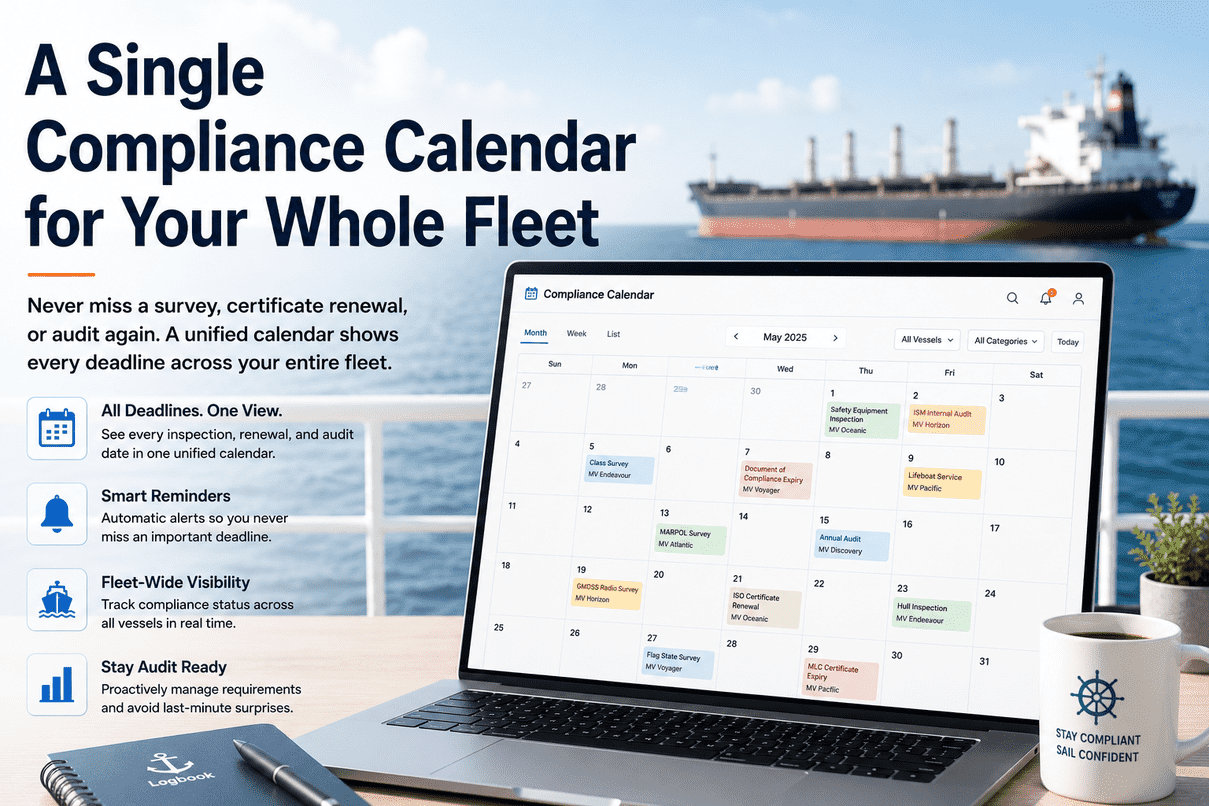
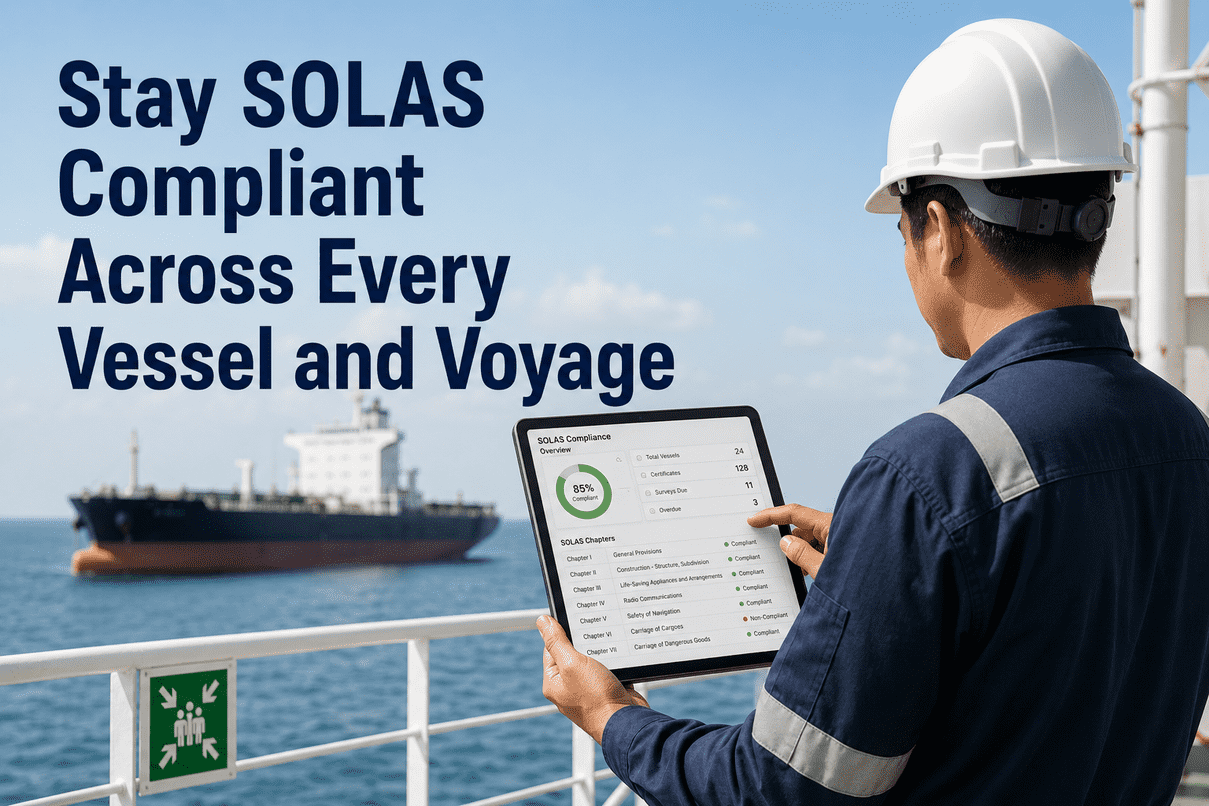
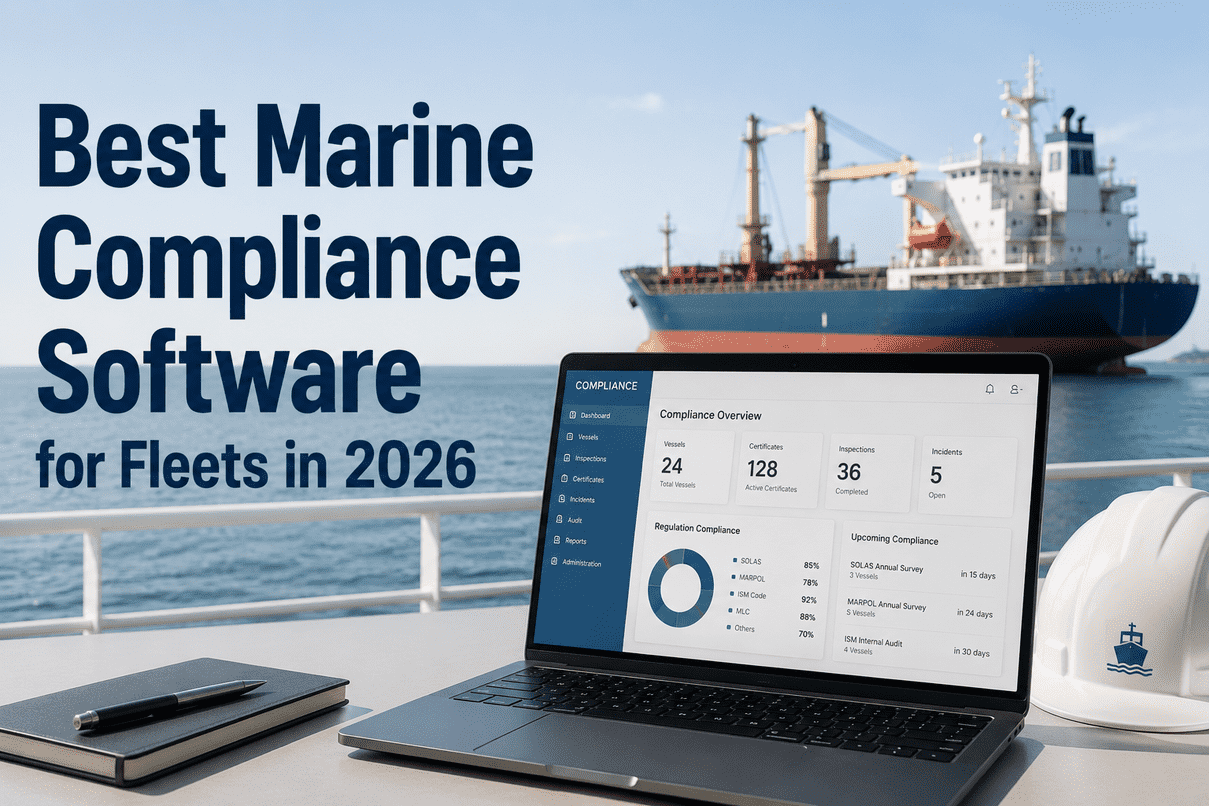
Maritime regulation in 2026 moves faster than any operator's spreadsheet can track. IMO MSC and MEPC committees adopt amendments at every session. IACS publishes Unified Requirements and Unified Interpretations quarterly. Each of 160+ flag administrations issues circulars, marine notices, and technical advisories. Classification societies publish quarterly regulatory framework updates — Russian Maritime Register Q1 2026 update, Indian Register technical circular, DNV PSC Planner, Lloyd's Register guidance, Bureau Veritas Navigating Statutory Requirements. January 2026 alone brought MSC.560(108) anti-harassment training, IMDG Code 42-24 entry into force, Grain Code amendments, IGF Code amendments, SOLAS V Regulation 31 container loss reporting, MSC.1/Circ.1662 anchor handling winches, MSC.1/Circ.1663 lifting appliances, PFAS fire extinguisher provisions, two new ECAs (Canadian Arctic, Norwegian Sea), and CII enforcement tightening to PSC scrutiny for vessels rated D for three consecutive years or E for one year. The reality is uncomfortable. A 24-vessel fleet trading internationally must reconcile updates from approximately 12 IMO instruments, IACS members representing the vessel's RO, 4-6 flag states across the fleet, 50+ port states, and a half-dozen industry voluntary frameworks. Spreadsheets and email circulars cannot do this. Book a 30-minute regulation database demo to see your fleet's regulatory exposure mapped to 2026 reality on real vessel data.
Maritime Regulation Database Software · 2026
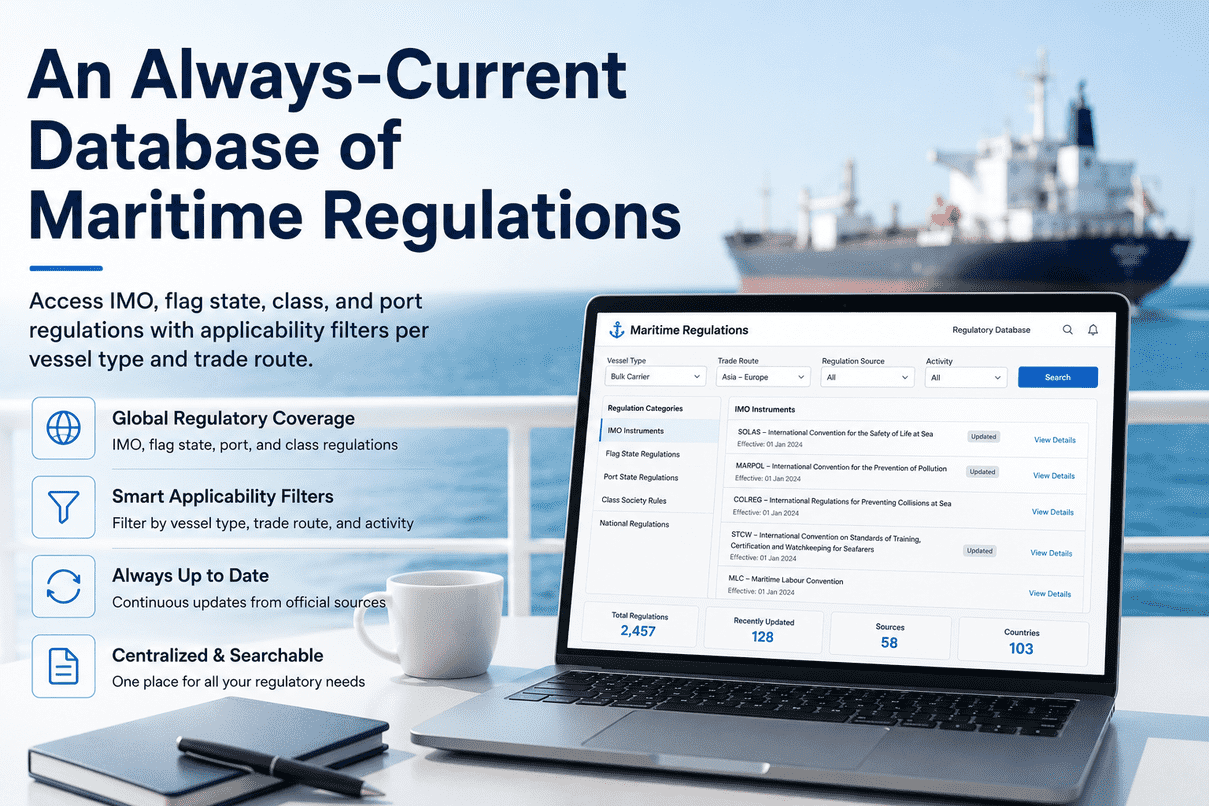
An Always-Current Library Of Every Regulation That Touches Your Fleet
IMO amendments, IACS Unified Requirements, flag state circulars, class society rules, port regulations — all filtered to applicability per vessel type, age, flag, and trade route.
Marine Inspection Regulation Database · Live 2026
847 Items · Updated 2hr ago
Search
PFOS foam ban + tanker + Liberia
Vessel: Tanker
Flag: Liberia
Effective: 2026
Category: Fire Safety
SOLAS · II-2
MSC.532(107) PFOS Foam Ban
Effective: First survey after 1 Jan 2026 · Applies: All vessels · Tracking: Foam replacement
IACS · UR
UR F46 Fire Detection Systems
Effective: Q1 2026 · Applies: New constructions · Tracking: Class approval
Liberia · Marine Notice
MN-08-2026 PFAS Equipment Inventory
Effective: 15 Feb 2026 · Applies: Liberian-flag · Tracking: Inventory submission
The Six Regulation Sources Every Operator Must Track
Maritime regulation is not one stream — it is six parallel streams that flow at different velocities from different authorities into operational reality. A regulation database that tracks only one stream is structurally incomplete. Book a regulation-sources demo to see all six streams reconciled on your fleet.
01
IMO Instruments
Treaty conventions, codes, resolutions, circulars
SOLAS, MARPOL, STCW, MLC, COLREG, Load Line, BWM, Polar Code, IMSBC Code, IMDG Code, IGF Code, IGC Code, FSS Code, LSA Code, FTP Code. MSC and MEPC resolutions per session. MSC.1 and MEPC.1 circulars between sessions.
02
IACS Requirements
Unified Requirements + Unified Interpretations
International Association of Classification Societies publishes Unified Requirements (UR) and Unified Interpretations (UI). Q1 2026 framework updates from RS, IRS, DNV, LR. Quarterly publication cycle. Technical enforcement mechanisms aligned with IMO instruments.
03
Flag State Rules
National laws, marine notices, technical circulars
160+ flag administrations publish national laws transposing IMO instruments, marine notices, technical advisories, ISMAS corrective action communications. Multi-flag fleets reconcile multiple sources.
04
Class Society Rules
Individual class rules + technical notices
Each classification society — DNV, ABS, LR, BV, ClassNK, RINA, KR, RS, IRS, CCS, CRS — publishes its own rules, technical notices, and statutory updates. RO delegation from flag state.
05
Port Regulations
Local port and coastal state requirements
Port state regulations beyond MOU inspection schemes — local discharge restrictions, bunker rules, cargo handling, security requirements, ECA enforcement. Vary by port within the same flag.
06
Industry Voluntary
OCIMF, CDI, RightShip, P&I, industry codes
OCIMF SIRE 2.0, TMSA 3 self-assessment, CDI for chemical tankers, RightShip risk rating, OCIMF MEG-4 mooring, P&I club requirements. Voluntary but commercially non-negotiable for charter access.
The Update Cascade From IMO Adoption To Operational Reality
An IMO amendment does not become operational reality the moment it is adopted. It cascades through five distinct stages over months or years before reaching the vessel. Understanding where each amendment sits in the cascade is the difference between proactive compliance and reactive panic. The five stages below define the regulation database's most consequential tracking function.
Stage 01
Adoption
IMO MSC or MEPC committee adopts amendment by resolution. Published in IMO meeting reports. Adoption date locked. Database captures resolution number, committee, date, and amendment text.
Stage 02
Tacit Acceptance Window
Member States have a tacit acceptance window — typically 16-18 months — to object. Objections rare. Most amendments enter into force on the scheduled date. Database tracks objection deadline and entry-into-force date.
Stage 03
Entry Into Force
Amendment enters international force on scheduled date. Triggers flag state transposition obligations. Begins the practical countdown to operational compliance per vessel.
Stage 04
Flag State Transposition
Flag administrations transpose amendment into national law and issue marine notices or technical circulars. Multi-flag fleets reconcile multiple transposition timelines. Database tracks per-flag implementation.
Stage 05
First Survey Application
Many amendments apply at the first survey after entry-into-force. Per-vessel deadline varies based on each vessel's survey schedule. Database calculates per-vessel deadline from amendment + vessel survey calendar.
The Regulation Type Tracking Matrix
Different regulation types update at different velocities, originate from different authorities, and require different tracking actions. The matrix below maps each regulation type to its source, update frequency, and the tracking action operators must take. Scroll horizontally on mobile for the full view.
| Regulation Type |
Source |
Update Frequency |
Tracking Action |
| SOLAS amendments |
IMO MSC |
2x year per session |
Track adoption + first-survey deadline |
| MARPOL amendments |
IMO MEPC |
2x year per session |
Track adoption + first-survey deadline |
| STCW amendments |
IMO MSC |
Per session |
Update training + crew certificate refresh |
| MSC.1 circulars |
IMO MSC Secretariat |
Continuous |
Update guidance documents on board |
| MEPC.1 circulars |
IMO MEPC Secretariat |
Continuous |
Update environmental procedures |
| IACS Unified Requirements |
IACS members |
Quarterly |
Class society applies at next survey |
| IACS Unified Interpretations |
IACS members |
Quarterly |
Track surveyor interpretation alignment |
| Flag state marine notices |
Flag administration |
Variable per state |
Implement per notice deadline |
| Class society rules |
Individual class society |
Annual main + quarterly notices |
Class applies at next class survey |
| OCIMF SIRE 2.0 updates |
OCIMF |
VIQ revisions periodic |
Pre-vetting inspection alignment |
| Port state local rules |
Port authority |
Variable per port |
Pre-arrival reconciliation |
| EU regulation (ETS, FuelEU) |
European Commission |
Annual + amendments |
EU port-specific compliance |
The Applicability Filters That Decide What Actually Applies
A regulation database without applicability filtering is a regulation list. The applicability filter is what converts the raw text into operational guidance — and the filter must work across six dimensions simultaneously. Bureau Veritas's Navigating Statutory Requirements database filters by ship type, applicability for new/existing ships, and convention. Marine Inspection extends that to six dimensions. Book an applicability filter demo to see your fleet's applicable regulation list per vessel.
Filter 1
Vessel Type
All ships, bulk carrier, oil tanker, chemical tanker, gas tanker, containership, ro-ro passenger, passenger ship, offshore unit, fishing vessel. Many amendments are vessel-type-specific — MSC.532(107) inclinometer applies to containerships and bulkers 3,000 GT+.
Filter 2
New Build vs Existing
Amendments often distinguish ships constructed on or after a date from existing ships. MSC.554(108) lifeboat release mechanisms apply to equipment installed 1 Jan 2026 onwards. Database tracks the keel-laid date per vessel.
Filter 3
Gross Tonnage Threshold
GT thresholds determine applicability — 500 GT, 5,000 GT, 100 GT, 24 metres. IMO DCS enhanced from January 2026 applies 5,000 GT+. Garbage Record Book lowered to 100 GT+ from 1 May 2024. Database tracks GT and length per vessel.
Filter 4
Flag State
Flag state transposition timelines vary. Some flags adopt fast; others lag. Multi-flag fleets must reconcile per-flag implementation per amendment. Database tracks transposition status per flag.
Filter 5
Trade Route
ECAs apply to specific geographic zones — Baltic, North Sea, Mediterranean, North American, Caribbean, Canadian Arctic, Norwegian Sea. Polar Code applies to polar waters. Trade route filter surfaces zone-specific compliance.
Filter 6
Equipment Installed
Some regulations apply only to specific equipment — fixed CO2 systems, S-100 ECDIS, IGF Code fuel systems, scrubbers. Database tracks vessel equipment inventory to surface only relevant amendments.
The 2026 Regulatory Inflow Calendar
2026 brings the heaviest regulatory inflow in a decade. The matrix below maps the major amendments effective in 2026 with their reference, effective date, applicability, and tracking action. Mobile users scroll horizontally for the full view.
| Amendment |
Reference |
Effective |
Applies To |
Tracking Action |
| STCW Anti-Harassment |
MSC.560(108) · A-VI/1-4 |
1 Jan 2026 |
New BST courses |
Updated PSSR module verified |
| SOLAS PFOS Foam Ban |
MSC.532(107) · II-2 |
First survey after 1 Jan 2026 |
All vessels |
Foam replacement per vessel |
| SOLAS Container Loss Reporting |
SOLAS V/31 |
1 Jan 2026 |
All ships |
Master reporting procedure update |
| SOLAS Lifeboat Release |
MSC.554(108) · LSA Code |
1 Jan 2026 |
Equipment installed 1 Jan 2026+ |
Hook system identification |
| SOLAS Inclinometer Carriage |
MSC.532(107) · V/19.2.12 |
1 Jan 2026 |
Containers + bulkers 3,000+ GT |
Electronic inclinometer install |
| IMDG Code 42-24 |
IMO MSC |
1 Jan 2026 |
All packaged DG carriage |
Onboard IMDG Code refresh |
| Grain Code Amendments |
IMO MSC |
1 Jan 2026 |
Bulk carriers carrying grain |
Grain loading manual update |
| IGF Code Amendments |
IMO MSC 108 |
1 Jan 2026 |
IGF Code fuelled ships |
Procedures and training update |
| Anchor Handling Winches |
MSC.1/Circ.1662 |
1 Jan 2026 |
New + existing |
Design, testing, maintenance |
| Lifting Appliances |
MSC.1/Circ.1663 · II-1/3-13 |
1 Jan 2026 |
New + existing |
Certificate per appliance |
| Canadian Arctic + Norwegian Sea ECAs |
MARPOL Annex VI |
1 Mar 2026 |
Ships in zones |
Fuel switching + Tier III engines |
| CII Enforcement Tightening |
MEPC.328(76) practical phase |
Q2 2026 PSC scrutiny |
D rating x3 or E x1 |
Corrective action plan mandatory |
Regulation Database Demo · 30 Minutes
See Every Regulation Touching Your Fleet, Filtered To Applicability
A 30-minute walkthrough with a Marine Inspection product expert. Bring one vessel's particulars — flag, type, GT, equipment, trade routes. Walk through six-source coverage, update cascade, applicability filters, 2026 inflow calendar, and knowledge decay prevention on real vessel data.
The Knowledge Decay Problem Manual Libraries Cannot Solve
A regulation library curated manually has a half-life. The longer it operates, the staler it becomes. Six recurring decay patterns explain why operators repeatedly find themselves out-of-date despite investing in regulation tracking. Each pattern is structurally solved by an always-current database engine.
D1
IMO Resolution Number Drift
Operator references an outdated resolution number after a renumbering or supersession. The cited resolution is still on file but no longer the current version. Auditor finds the reference. The compliance basis is on yesterday's text.
D2
Circular Update Missed
MSC.1/Circ.1395 reaches Revision 7 (Solid Bulk Cargoes exempted from CO2 systems). Operator's onboard guidance still references Rev.5. Three exempted cargoes added in intermediate revisions. Compliance basis stale.
D3
Per-Vessel Deadline Calculation Wrong
PFOS foam ban applies at first survey after 1 Jan 2026. Operator calculates deadline from 1 Jan 2026 generically across the fleet. Different vessels have different first-survey dates. Half the fleet's deadlines are wrong.
D4
Flag State Marine Notice Buried
Flag administration issues marine notice to DPA email. Forwarded to fleet manager. Never reaches master or vessel SMS. Marine notice obligation unmet. Found at next external audit.
D5
IACS UR Adopted Differently Per Class
IACS Unified Requirement adopted on a date. Individual class societies implement at different timelines. Multi-class fleet (sister vessels under different ROs) faces different effective dates from the same UR. Reconciliation fails.
D6
Cross-Reference Broken At Reorganization
SMS Manual references "SOLAS II-2 Regulation 10.2.3" which is renumbered after the next consolidation. Reference now points to wrong text. Audit finds the broken reference. SMS document control discipline questioned.
Marine Inspection's Regulation Database Architecture
Marine Inspection's regulation database is structured to prevent knowledge decay by design. Four architectural layers handle the continuous inflow from six regulation sources, the applicability filtering across six dimensions, and the per-vessel deadline calculation that converts raw text into operational guidance. Book a database architecture walkthrough demo to apply the platform to your fleet. Start a free trial to evaluate the database before any contract.
Layer 1
Six-Source Inflow Engine
Continuous ingestion from IMO MSC and MEPC, IACS UR and UI quarterly publications, 160+ flag state marine notices, 11+ classification society rule updates, port state local regulations, and OCIMF and CDI and RightShip industry frameworks.
Layer 2
Six-Dimension Applicability Filter
Filtering across vessel type, new build versus existing, gross tonnage threshold, flag state, trade route, and equipment installed. Each vessel sees only the regulations that actually apply. No noise. No buried obligations.
Layer 3
Per-Vessel Deadline Calculator
First-survey-after-date amendments calculated per vessel against actual survey schedule. PFOS deadline differs vessel-by-vessel. Inclinometer carriage deadline differs. Database does the calculation rather than the operator.
Layer 4
SMS Cross-Reference Engine
SMS Manual sections referenced to IMO instruments. When the instrument renumbers or amends, the cross-reference updates automatically. No broken references. Document control discipline preserved across decades of regulatory churn.
Frequently Asked Questions
What does a maritime regulation database actually contain?
A maritime regulation database tracks all six parallel streams that flow into operational compliance reality. IMO Instruments including SOLAS, MARPOL, STCW, MLC, COLREG, Load Line, BWM, Polar Code, IMSBC Code, IMDG Code, IGF Code, IGC Code, FSS Code, LSA Code, FTP Code plus MSC and MEPC resolutions per session plus MSC.1 and MEPC.1 circulars between sessions. IACS Requirements including Unified Requirements (UR) and Unified Interpretations (UI) published quarterly with Q1 2026 framework updates from RS, IRS, DNV, LR. Flag State Rules from 160+ flag administrations publishing national laws transposing IMO instruments, marine notices, technical advisories. Class Society Rules from DNV, ABS, LR, BV, ClassNK, RINA, KR, RS, IRS, CCS, CRS. Port Regulations covering local port and coastal state requirements beyond MOU inspection schemes. Industry Voluntary frameworks including OCIMF SIRE 2.0, TMSA 3, CDI for chemical tankers, RightShip, OCIMF MEG-4 mooring, P&I club requirements.
How does an IMO amendment reach operational compliance?
An IMO amendment cascades through five stages from adoption to operational reality. Stage 1 Adoption — IMO MSC or MEPC committee adopts amendment by resolution, published in IMO meeting reports, adoption date locked. Stage 2 Tacit Acceptance Window — Member States have a tacit acceptance window of typically 16-18 months to object with objections rare, most amendments enter into force on the scheduled date. Stage 3 Entry Into Force — amendment enters international force on scheduled date, triggers flag state transposition obligations, begins the practical countdown to operational compliance. Stage 4 Flag State Transposition — flag administrations transpose into national law and issue marine notices or technical circulars, multi-flag fleets reconcile multiple transposition timelines per flag. Stage 5 First Survey Application — many amendments apply at the first survey after entry-into-force with per-vessel deadline varying based on each vessel's survey schedule. A database tracks the amendment through each stage and calculates per-vessel deadlines from amendment plus vessel survey calendar.
What 2026 regulations affect every vessel?
January 2026 brought a heavy inflow of IMO amendments. MSC.560(108) STCW anti-harassment training added to Table A-VI/1-4 for new BST courses. MSC.532(107) SOLAS II-2 PFOS foam ban applies at first survey after 1 January 2026 with vessel-specific deadlines. SOLAS V Regulation 31 container loss reporting for all ships. MSC.554(108) LSA Code lifeboat release mechanisms for equipment installed 1 January 2026 onwards. MSC.532(107) SOLAS V/19.2.12 electronic inclinometer carriage for containerships and bulk carriers 3,000 GT and above. IMDG Code 42-24 entered force for all packaged dangerous goods carriage. Grain Code amendments for bulk carriers carrying grain. IGF Code amendments per MSC 108 for IGF Code fuelled ships. MSC.1/Circ.1662 anchor handling winches design, testing, maintenance standards. MSC.1/Circ.1663 SOLAS II-1/3-13 lifting appliances certificate per appliance. From 1 March 2026 the Canadian Arctic and Norwegian Sea Emission Control Areas entered force. CII enforcement tightening with PSC scrutiny for vessels rated D for three consecutive years or E for one year.
How do applicability filters work?
Applicability filters convert raw regulation text into operational guidance per vessel. Six filters work simultaneously. Filter 1 Vessel Type — all ships, bulk carrier, oil tanker, chemical tanker, gas tanker, containership, ro-ro passenger, passenger, offshore unit, fishing vessel, with many amendments being vessel-type-specific such as MSC.532(107) inclinometer applying to containerships and bulkers 3,000 GT+. Filter 2 New Build vs Existing — amendments often distinguish ships constructed on or after a date from existing ships, with MSC.554(108) lifeboat release mechanisms applying to equipment installed 1 Jan 2026 onwards. Filter 3 Gross Tonnage Threshold — 500 GT, 5,000 GT, 100 GT, 24 metres, with IMO DCS enhanced from January 2026 applying 5,000 GT+ and Garbage Record Book lowered to 100 GT+ from May 2024. Filter 4 Flag State — transposition timelines vary, multi-flag fleets reconcile per-flag implementation. Filter 5 Trade Route — ECAs apply to specific zones, Polar Code applies to polar waters. Filter 6 Equipment Installed — some regulations apply only to specific equipment like fixed CO2 systems, S-100 ECDIS, IGF Code fuel systems.
Why do manual regulation libraries go stale?
Six recurring knowledge decay patterns break manual regulation libraries. IMO Resolution Number Drift — operator references an outdated resolution number after a renumbering or supersession, the cited resolution is still on file but no longer the current version. Circular Update Missed — MSC.1/Circ.1395 reaches Revision 7 with new exempted cargoes added but operator's onboard guidance still references Rev.5. Per-Vessel Deadline Calculation Wrong — PFOS foam ban applies at first survey after 1 January 2026 but operator calculates deadline from 1 January 2026 generically across the fleet when different vessels have different first-survey dates. Flag State Marine Notice Buried — marine notice forwarded to fleet manager but never reaches master or vessel SMS. IACS UR Adopted Differently Per Class — multi-class fleet with sister vessels under different ROs faces different effective dates from the same UR. Cross-Reference Broken At Reorganization — SMS Manual references "SOLAS II-2 Regulation 10.2.3" which is renumbered after the next consolidation, reference now points to wrong text and audit finds the broken reference.
What is IACS and how does it relate to IMO?
The International Association of Classification Societies (IACS) is the global association of major classification societies. IACS publishes Unified Requirements (UR) and Unified Interpretations (UI) that operate as technical enforcement mechanisms aligned with IMO instruments. URs are mandatory for IACS member classification societies (DNV, ABS, LR, BV, ClassNK, RINA, KR, RS, IRS, CCS, CRS, PRS) to apply in their rules. UIs harmonize how IACS members interpret common IMO regulations. The update cycle is typically quarterly with Q1 2026 framework updates already published by RS, IRS, DNV, LR covering amendments to SOLAS, MARPOL, STCW conventions plus IACS classification rules pertaining to bulk carriers, oil tankers, offshore units. For a multi-class fleet (sister vessels under different ROs), the same IACS UR may be implemented at different effective dates by different class societies — creating reconciliation complexity that a regulation database must resolve. IACS membership represents approximately 90% of the world's cargo carrying tonnage by gross tonnage.
How does Marine Inspection's regulation database work?
Marine Inspection's regulation database is structured in four architectural layers. Layer 1 Six-Source Inflow Engine — continuous ingestion from IMO MSC and MEPC, IACS UR and UI quarterly publications, 160+ flag state marine notices, 11+ classification society rule updates, port state local regulations, and OCIMF and CDI and RightShip industry frameworks. Layer 2 Six-Dimension Applicability Filter — filtering across vessel type, new build versus existing, gross tonnage threshold, flag state, trade route, and equipment installed with each vessel seeing only the regulations that actually apply. Layer 3 Per-Vessel Deadline Calculator — first-survey-after-date amendments calculated per vessel against actual survey schedule with PFOS deadline differing vessel-by-vessel and inclinometer carriage deadline differing. Layer 4 SMS Cross-Reference Engine — SMS Manual sections referenced to IMO instruments with cross-reference updating automatically when the instrument renumbers or amends. 6-12 week deployment with free trial available before any commitment.
Always Current. Always Applicable.
Stop Reconciling Six Regulation Streams Manually. Start Filtering To What Applies.
Six-source inflow engine, six-dimension applicability filter, twelve-row regulation type matrix, five-stage update cascade, twelve-row 2026 regulatory inflow calendar, six knowledge decay patterns prevented, four-layer database architecture — all in one always-current regulation database built for the 2026 regulatory inflow reality. Book a 30-minute database demo on your actual fleet.