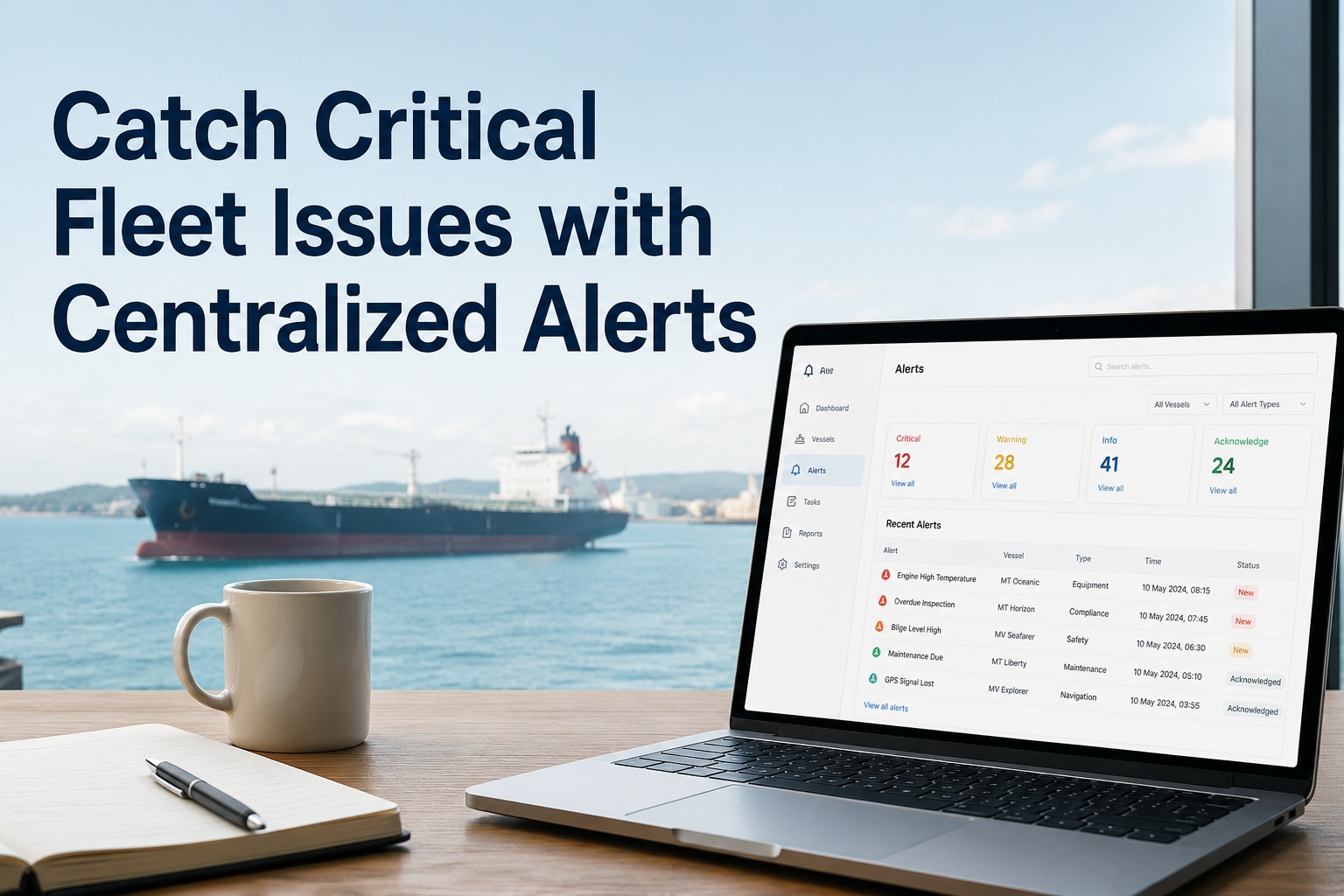
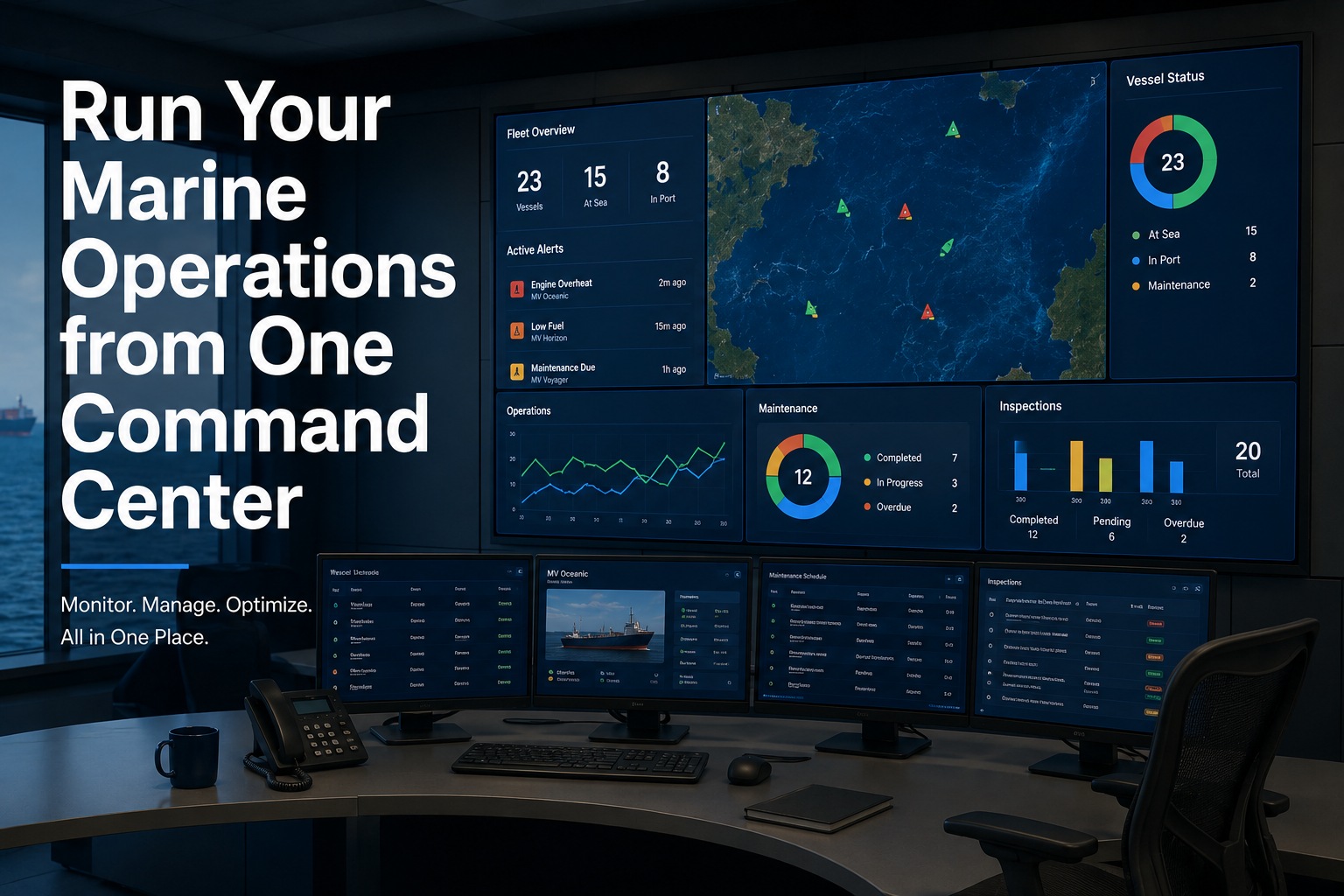
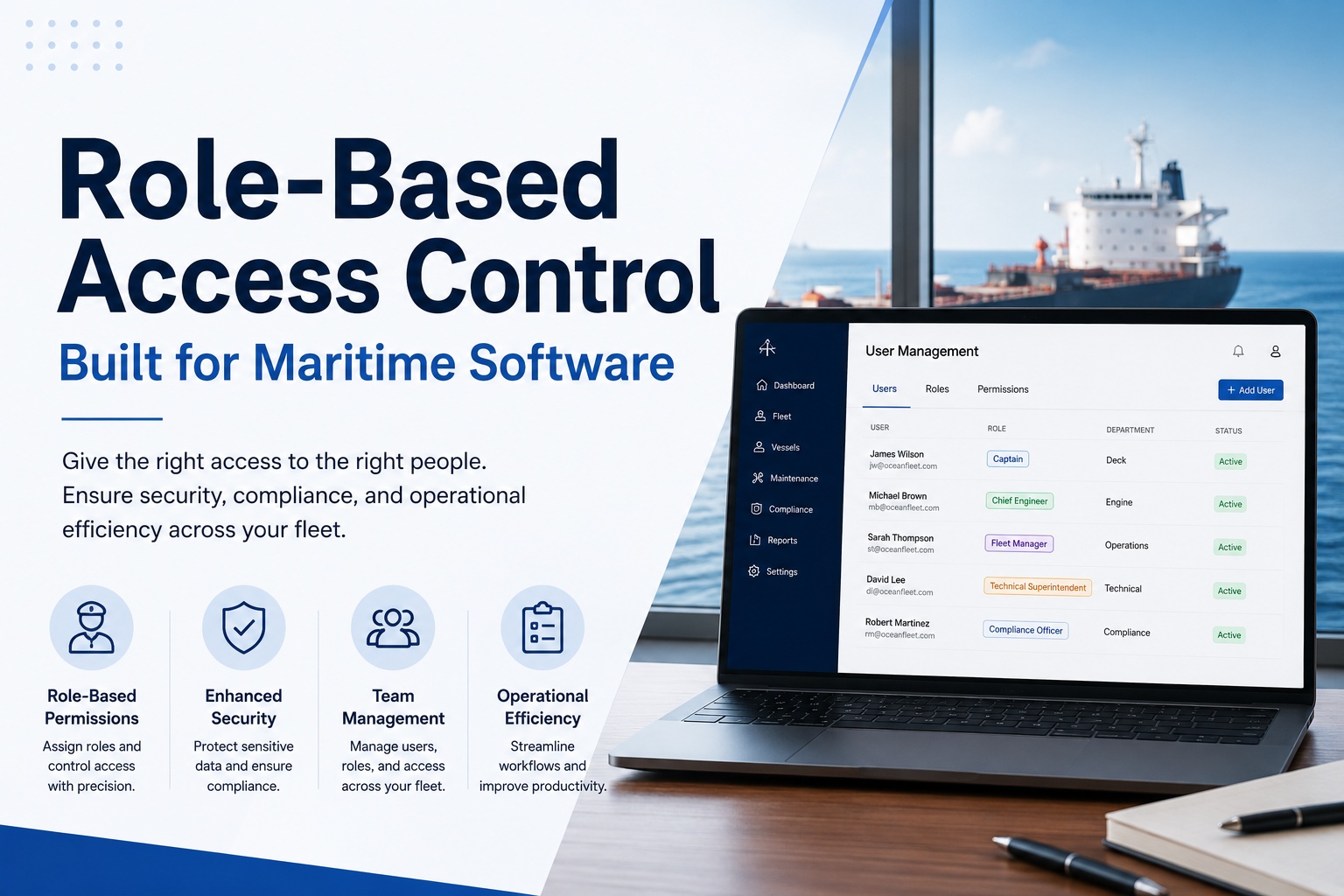
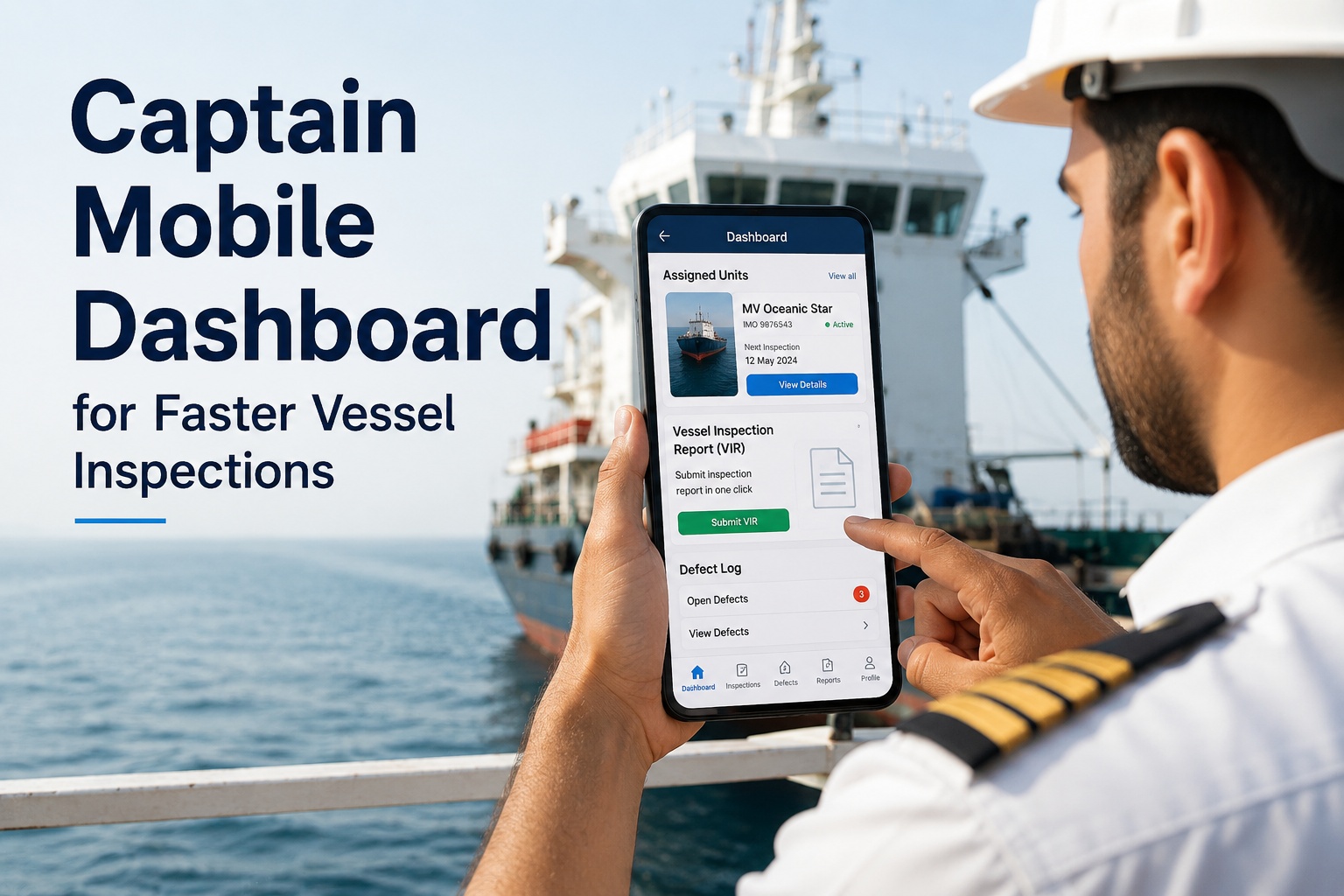
The hardest problem in maritime fleet management in 2026 is not getting more alerts. It is getting fewer, better ones. Lloyd's Register's analysis of more than 40 million alarm-related events showed a 197% increase in shipboard alarms over the past two decades, with bridge teams during coastal navigation receiving up to 74 alarms per hour — most of which carry little operational value, disrupt rest, and push crews toward dangerous workarounds like silencing systems or physically bypassing alarm circuits. The same pattern repeats on the shore side: fleet operations managers wading through inboxes of certificate-expiry reminders, fuel-drift notifications, maintenance overdue tickets, charterer vetting flags, compliance-deadline pings, and cyber-incident escalations — most of which are background noise. By the time the genuinely critical event arrives, it is buried in the same queue as a low-battery warning from a portable gas detector. A centralized fleet alerts system is not a notification firehose with better marketing. It is a structured architecture that classifies every event by severity, routes each one to a named owner, escalates only what merits attention, and produces audit-grade evidence trails — for every fleet, every shift, every event. Start a free trial of Marine Inspection to see what credible alert architecture looks like configured for a commercial fleet.
Centralized Fleet Alerts · 2026
Catch the Critical Events. Filter the Noise. Stop Losing Trust in Your Own Alarms.
A fleet alerts system built around severity classification, named-owner routing, graduated escalation, and audit-grade evidence trails. Certificate expiries, inspection deadlines, maintenance triggers, compliance deadlines, cyber escalations, security threats — every event routed correctly, every owner accountable.
197%
Alarm increase per LR research
74/hr
Bridge alarms during coastal nav
50%
Reduction achievable in 6 months
Fleet Alert Inbox
Watch B · 0600-1400
Critical · 2
High · 5
Medium · 12
CRITICAL
M/V Hormuz Star · SMC Expires 8d
Owner: A. Costa (DPA) · Acknowledged 11min ago
CRITICAL
M/V Aegean Wave · PSC Window 32hr
Owner: Master · Pre-PSC checklist initiated
HIGH
M/V Pacific Star · Fuel Drift +6.2%
Owner: Tech Super · Routed 4min ago
HIGH
M/V Baltic Sun · Aux Eng Vibration
Owner: Tech Super · Photo + voice note attached
MEDIUM
M/V Bosphorus · Drill Due 5 days
Owner: HSEQ · Scheduled for next port
The Alarm-Fatigue Problem That Centralized Fleet Alerts Must Solve
The single most important insight in 2026 maritime alert design comes from Lloyd's Register's recent industry research — and it shapes how credible centralized alert systems must be architected. The findings are stark: an analysis of over 40 million alarm-related events showed shipboard alarms have risen 197% over the past two decades, with bridge teams sometimes receiving 74 alarms per hour during coastal navigation. Most of these alarms offer little operational value. They disrupt crew rest, erode trust in the alarm system itself, and push exhausted crews toward dangerous workarounds — silencing alarms without acknowledgment, physically bypassing alarm circuits, normalizing unsafe practices. The same dynamic on the shore side produces the same outcome: when every notification is "critical," nothing is.
VOLUME
Too Many Alerts, Not Enough Decisions
An ops manager receiving 200 notifications a day cannot triage them all. Critical events sit in the same queue as low-battery warnings. Response time stretches not from indifference but from triage overhead.
FATIGUE
Trust Erodes In The Alarm System
When most alerts turn out to be noise, the human reaction is rational: ignore the next one. The alarm system becomes background. The genuinely critical event is dismissed alongside the trivial.
SILENT
Workarounds Replace Compliance
LR's research documents crew silencing alarms without acknowledgment, physically bypassing alarm circuits, and normalizing unsafe practices. The shore-side equivalent is filter rules that route all alerts to an unread folder.
EVIDENCE
No Audit Trail of What Was Acknowledged
DOC auditors and class society reviewers ask for evidence of alert handling. Email-based notification streams provide no defensible answer. The question "who saw this, when, and what did they do" has no machine-readable response.
CHANNEL
Same Channel For Critical and Trivial
Critical events arriving via the same email channel as fuel-receipt notifications teach the team that all channels are equally interruptive — which usually means none are handled well. Channel-by-severity is non-negotiable.
OWNERSHIP
Alerts With No Owner Go Unanswered
An alert visible to ten people but owned by none gets handled by zero. Named ownership per alert category is the single largest predictor of whether anything actually happens after the notification fires.
The Three Pillars of Credible Fleet Alert Architecture
The 2026 standard for fleet alert systems borrows directly from agentic AI architecture for fleet operations. Three components work together: Monitor, Decide, Act. Each layer fails differently when designed poorly. A credible centralized alerts system delivers all three with marine-specific configuration — not generic enterprise notification plumbing.
PILLAR 1
Monitor
Continuously ingest telemetry, inspection records, certificate calendars, voyage data, compliance deadlines, security feeds, and external data sources. Identify events that require action based on configurable rules and learned patterns.
Configurable rule engine per event type
Pattern recognition for recurring conditions
Cross-source correlation, not single-feed
PILLAR 2
Decide
Evaluate event severity, consider historical context, check resource availability, and determine optimal response. Severity scoring, resource matching, priority ranking — all calibrated against fleet-specific patterns rather than generic defaults.
Severity scoring per event class
Resource matching to available owners
Priority ranking across active queue
PILLAR 3
Act
Route to named owner via the appropriate channel. Apply graduated escalation if no acknowledgment within the SLA window. Capture audit trail of every action — acknowledgment, intervention, resolution — for class society and DOC review.
Channel-by-severity routing
Graduated escalation on SLA breach
Immutable audit trail of acknowledgment
The Four-Tier Severity Model That Filters Noise From Signal
Industry-standard alarm classification under IEC 62682 and EEMUA guidelines maps every event to a severity tier that determines channel, owner, escalation timing, and acknowledgment SLA. Generic enterprise notification platforms treat every event identically. Marine-native fleet alert systems enforce a four-tier model that aligns operational urgency with delivery method — and prevents the dangerous pattern where a fuel-receipt notification arrives in the same channel as a SMC certificate expiring in 48 hours.
CRITICAL
Decision Required In Current Watch
Imminent compliance deadline (certificate expiry under 14 days, PSC window under 48 hours), active safety threat, cyber incident escalation under MSC.428(98). Routes to phone + SMS + console.
SLA: 15 minutes
HIGH
Decision Required Today
Defects flagged by crew, fuel-drift threshold breach, charterer vetting flag, scheduled inspection failure, voyage P&L variance over threshold. Routes to console + email with push notification.
SLA: 4 hours
MEDIUM
Decision Required This Week
Approaching drill cycles, crew rotation handover windows, scheduled maintenance approaching due, charter milestone events, certificate expiries 14-30 days out. Routes to console + daily digest.
SLA: 24 hours
INFO
Awareness Only — No Action Required
Completed inspections, sync confirmations, routine activity logs, voyage milestone confirmations, informational regulatory updates. Routes to weekly digest only.
SLA: None — awareness only
The Six Alert Categories Every Marine Operator Must Cover
A credible centralized alerts system covers six distinct event categories — each with its own data sources, severity scoring logic, named-owner routing, and audit trail granularity. Generic enterprise alerting platforms cover two or three. The six below define the practical operational envelope. Book a Marine Inspection walkthrough to see the category model on your fleet's data.
01
Certificate & Compliance Expiries
SMC, ISSC, IAPP, statutory certificates, class society surveys, flag-state renewals, drug and alcohol testing windows. Graduated alerts at 30, 14, and 7 days. DPA-owned.
02
Inspection & Audit Events
PSC port-call windows, SIRE 2.0 vetting requests, internal ISM audits, charterer audit flags, deficiency closures, scheduled drill compliance. HSEQ-owned.
03
Maintenance & Defect Triggers
Crew-flagged defects, running-hour service triggers, condition-based maintenance alerts, fuel-drift thresholds, vibration anomalies, hull performance degradation. Tech Superintendent-owned.
04
Commercial & Voyage Events
Charter party milestone events, demurrage exposure thresholds, voyage P&L variance, EU ETS allowance burn rate, FuelEU balance trajectory, bunker price anomalies. Commercial Manager-owned.
05
Security & Cyber Escalations
High-risk transit boundaries, security threat indicators, MSC.428(98) cyber incident reports, IACS UR E26/E27 evidence triggers, unauthorized access attempts. Security Officer-owned.
06
Crew & Welfare Indicators
Crew rotation due windows, MLC compliance thresholds, certificate validity per officer, fatigue indicator escalations, training currency expiries, medical certificate renewals. Crewing Manager-owned.
How Centralized Alerts Compare to Email and Ad-Hoc Notification
Most commercial fleets in 2026 still run alerts from a combination of three baseline approaches: email-based notification streams, separate alert tools per data source (one for telemetry, one for compliance, one for procurement), and shared Slack channels where everything goes for "visibility." Each fails differently. Scroll horizontally on mobile to see the full comparison.
| Capability |
Email Notification Streams |
Per-Tool Alert Silos |
Centralized Fleet Alerts |
| Severity classification |
None — all equal weight |
Per-tool scales, incompatible |
Unified four-tier model |
| Named-owner routing |
Email distribution list |
Tool-specific assignments |
Role-based per category |
| Channel-by-severity |
All via email |
Each tool decides separately |
Phone, SMS, console, digest tuned |
| Acknowledgment SLA tracking |
None |
Inconsistent per tool |
SLA per severity, tracked |
| Graduated escalation |
Manual forwarding |
Tool-specific if any |
Auto-escalate on SLA breach |
| Audit trail of acknowledgment |
Email chains, fragile |
Per-tool logs, inconsistent |
Immutable, MSC.428(98)-grade |
| Cross-category correlation |
Manual mental stitching |
Not possible across silos |
Auto-correlated views |
| Alert volume tuning |
Filter rules per recipient |
Per-tool config burden |
Centralized rule engine |
| Watch handover continuity |
Unread email backlog |
Multiple tool logins |
Single inbox handover |
| DOC audit evidence pack |
Manual reconstruction |
Per-tool exports |
One-click evidence pack |
| Alarm fatigue prevention |
None |
Worsened by tool sprawl |
Severity + ownership design |
| Implementation timeline |
Already deployed (broken) |
Multi-quarter integration |
6-8 weeks to live |
Alert Audit Walkthrough
Audit Your Current Alert Load Against the Four-Tier Severity Model
A 30-minute session with a Marine Inspection product expert. Map your current alert volume per category, identify which alerts qualify as Critical, High, Medium, and Info, surface ownership gaps, and produce a sourced reduction plan. Most operators identify 40-60% alert volume reduction in the session itself.
Graduated Escalation — The Pattern That Closes The "No-Owner" Gap
Alerts that fire to a generic distribution list and receive no acknowledgment within their SLA do not disappear — they sit in the queue while the operational consequence continues to develop. Graduated escalation closes the no-owner gap by routing each unacknowledged alert through a predefined chain until someone takes responsibility. The pattern below is the 2026 industry standard for high-stakes operational events.
0 min
Initial Notification
Alert fires to primary named owner via severity-appropriate channel. Console badge, push notification, email or SMS depending on tier. Acknowledgment window begins.
SLA
Acknowledgment Required
Owner acknowledges within SLA window appropriate to severity tier. Acknowledgment logged with timestamp, identity, and initial action note. If acknowledged, the chain stops here.
SLA+50%
Escalate To Deputy
If unacknowledged at SLA expiry, alert escalates to designated deputy with full context. Original owner remains on the chain. Both parties now responsible. Watch officer notified.
SLA+100%
Escalate To Manager
If still unacknowledged, alert escalates to operations manager. Severity may auto-upgrade. SMS and phone delivery activated regardless of original channel. Audit trail captures full chain.
SLA+200%
Executive Visibility
Reserved for Critical-tier alerts only. Operations Director or DPA notified. Documented as an escalation event for DOC audit evidence. Full timeline of who saw the alert and when.
The Eight Workflows Where Centralized Alerts Earn Their Investment
Beyond the regulatory and audit baseline, well-designed centralized alerts pay back through specific workflows that reduce response time, prevent incidents, and eliminate the "we didn't see it in time" failure mode. Each workflow below corresponds to a real operational pattern observed in fleet implementations.
A
Certificate Expiry Before The Detention
SMC, IAPP, or class certificate at risk surfaces 30 days out, escalates at 14 days, becomes Critical at 7 days. DPA acts well before port-state control discovers it. Detention avoided, fines avoided.
B
Defect-To-Work-Order Closure
Crew flags engine room defect with photo and severity. Alert routes to technical superintendent inside 60 seconds with full context. Work order auto-generates. The 4-24 hour paper gap eliminated.
C
Fuel-Drift Mid-Voyage Intervention
Bunker consumption running 6% above baseline triggers High-severity alert to operations. Vessel approached for explanation and intervention while the voyage is still in progress and savings still recoverable.
D
Cyber Incident Escalation Under MSC.428(98)
Suspected cyber event triggers Critical alert to DPA. Escalation chain activates. Evidence capture initiated. Regulatory reporting timer started. Audit-ready trail produced for next DOC verification.
E
PSC Pre-Arrival Readiness
Vessel approaching port of known PSC enforcement priority triggers checklist generation 72 hours pre-arrival. Master alerted, deficiencies surfaced for closure pre-arrival rather than during inspection.
F
Charterer Vetting Flag Triage
Charterer audit produces deficiency flag against a fleet vessel. Alert routes to commercial team with vessel context and history. Response prepared within charter party SLA. Vetting status protected.
G
EU ETS Allowance Burn Trajectory
Allowance consumption ahead of plan triggers Medium-severity alert with projection to year-end. Commercial team adjusts allocation strategy or purchases additional EUAs before the year-end shortfall.
H
Watch Handover With Zero Dropouts
A-watch hands over to B-watch with a documented alert snapshot: open alerts by severity, decisions in flight, acknowledgments pending, escalations active. No verbal stitching, no missed items at 0600.
The ROI Math For Centralized Fleet Alerts
Centralized alert systems deliver measurable returns across multiple operational dimensions. The numbers below come from operator surveys and industry analysis in 2025-2026 and are conservative across mid-size fleet implementations.
40-60%
Alert Volume Reduction
Through severity classification, channel-by-severity routing, and noise filtering. Most operators identify this reduction in the initial audit walkthrough.
90%
Violation Prevention
Industry data shows automated compliance alerts prevent up to 90% of violations that would otherwise reach port-state control or class audit findings.
75%
Faster Audit Preparation
Centralized alert evidence packs collapse audit preparation from days to hours. DOC verification, charterer vetting, and class survey all benefit.
50%
Alarm Reduction Achievable
LR's pilot demonstrated 50% alarm reduction within 6 months through targeted engineering fixes and rationalization. The same principle applies to shore-side alerts.
6-8 wks
Deployment To Live
Most mid-size fleets reach productive use within 6-8 weeks. Severity model configured, owners assigned, escalation chains tested, audit trail validated.
Implementation Roadmap — Live in 6-8 Weeks
Centralized fleet alert deployment is faster than enterprise notification platform rollout because the severity model, role mapping, and escalation patterns are pre-built for maritime operations rather than designed from scratch. Most mid-size fleets reach productive use within 6-8 weeks, with phased onboarding by alert category.
Wk 1
Alert Audit & Severity Mapping
Current alert load audited against four-tier severity model. Volume reduction targets set. Owners identified per category. Existing tools inventoried. Severity thresholds locked.
Wk 2-3
Data Source Integration
Certificate database, CMMS, voyage operations, telemetry, security feeds, and charter contracts all connected. Pilot vessel cohort flowing live with cross-category correlation tested.
Wk 4-5
Escalation Chains & Channels
Channel-by-severity routing configured (phone, SMS, console, email, digest). Graduated escalation chains tested with named owners. Watch handover snapshot validated end-to-end.
Wk 6-8
Fleet Rollout & Audit Evidence
Phased onboarding of remaining fleet. Daily watch routine established. Operations director portfolio review on real-time alerts. First DOC audit run with one-click alert evidence rather than email reconstruction.
Why Marine Inspection Wins on Centralized Alerts
Marine Inspection delivers centralized fleet alert architecture built on the three-pillar Monitor-Decide-Act model, with marine-specific severity classification, named-owner routing, graduated escalation, and audit-grade evidence trails meeting IMO MSC.428(98) and 2026 regulatory expectations. Start a free trial or book an alert audit walkthrough to see what credible alert architecture looks like configured for your fleet.
Four-Tier Severity Classification
Critical, High, Medium, Info — each with appropriate channel, SLA, owner, and escalation chain. Aligned with IEC 62682 and EEMUA principles. Pre-configured for marine events.
Six Alert Categories Pre-Built
Certificate expiry, inspection events, maintenance triggers, commercial events, security escalations, crew welfare — all configured with named-owner routing matching maritime org structure.
Graduated Escalation Chains
Initial notification, deputy escalation at SLA breach, manager escalation at SLA+100%, executive visibility for Critical alerts. Every transition logged with timestamp and audit trail.
Channel-By-Severity Routing
Phone and SMS reserved for Critical. Console + email for High. Console + digest for Medium. Weekly digest for Info. The fuel-receipt notification never arrives in the same channel as the SMC expiry.
MSC.428(98)-Grade Audit Trail
Every acknowledgment, intervention, escalation, and resolution logged immutably. DOC audit evidence pack generated on one click. Charterer and class society reviews shift from reconstruction to review.
6-8 Week Deployment
Alert audit and severity mapping in week 1. Data source integration weeks 2-3. Escalation chains and channels weeks 4-5. Fleet rollout and audit evidence weeks 6-8. No multi-year integration project.
Frequently Asked Questions
What is alarm fatigue and how does it apply to fleet alerts?
Alarm fatigue is the documented phenomenon where humans exposed to high volumes of low-value alerts begin to trust the alarm system less and eventually ignore alerts entirely — including the genuinely critical ones. Lloyd's Register's analysis of more than 40 million alarm-related events showed shipboard alarms increased 197% over the past two decades, with bridge teams during coastal navigation receiving up to 74 alarms per hour. The research documented crews silencing alarms without acknowledgment, physically bypassing alarm circuits, and normalizing unsafe practices. The same dynamic on the shore side produces operations managers wading through inboxes of trivial notifications and missing the genuinely critical events. The cure is not more alerts but fewer, better-classified ones — which is what credible centralized alert systems deliver.
What is the four-tier severity model?
The four-tier severity model classifies every alert into one of four categories based on operational urgency: Critical (decision required in the current watch, SLA 15 minutes, routed via phone + SMS + console — examples include certificate expiry under 14 days, active safety threat, cyber incident escalation), High (decision required today, SLA 4 hours, routed via console + email with push — examples include crew-flagged defects, fuel-drift threshold breach, charterer vetting flag), Medium (decision required this week, SLA 24 hours, routed via console + daily digest — examples include approaching drill cycles, scheduled maintenance approaching due), and Info (awareness only, no action required, routed via weekly digest — examples include completed inspections, sync confirmations, routine activity logs). The model aligns with IEC 62682 and EEMUA principles and prevents the dangerous pattern of all alerts arriving via the same channel.
How does graduated escalation work?
Graduated escalation closes the "no-owner" gap that causes alerts to sit unhandled. The pattern: at time zero, alert fires to primary named owner via severity-appropriate channel; if not acknowledged within the SLA window, escalates to designated deputy at SLA+50% with original owner remaining on the chain; escalates to operations manager at SLA+100% with severity possibly auto-upgraded and SMS/phone delivery activated regardless of original channel; for Critical-tier alerts only, escalates to Operations Director or DPA at SLA+200% with full timeline of who saw the alert and when documented as audit evidence. Every transition logged with timestamp, identity, and acknowledgment state. The chain stops the moment someone takes ownership.
What audit evidence does a centralized alert system produce?
Audit-grade alert systems produce immutable trails covering: every alert fired with timestamp, source data, severity assignment, and routing decision; every acknowledgment with timestamp, identity, and initial action note; every escalation event with the trigger condition, recipient, and outcome; every resolution with timestamp, identity, and closure rationale; every change to severity assignment or routing rule with timestamp and approver; and one-click evidence packs for DOC verification, class society review, charterer audit, and IACS UR E27 cyber compliance. The trail is tamper-proof. The question "who saw this alert, when, and what did they do" has a defensible machine-readable answer for any event in the fleet's history.
How is this different from email notifications we already get?
Email-based notification streams fail on five structural dimensions that centralized alert systems solve. First, severity classification: email treats every notification with equal channel weight; centralized alerts route Critical to phone/SMS and Info to weekly digest. Second, named-owner routing: email distribution lists produce shared-visibility-with-no-ownership; centralized alerts assign each category to a named role. Third, acknowledgment tracking: email has no SLA enforcement; centralized alerts log acknowledgments with timestamps and auto-escalate on breach. Fourth, audit trail: email chains are fragile evidence; centralized alerts produce immutable, exportable evidence packs. Fifth, alarm-fatigue prevention: email notification streams compound the noise problem; centralized alerts solve it through severity discipline. The result is a system the team trusts again — and uses to act on the events that matter.
What categories of events does the system cover?
Six categories covering the practical operational envelope of a commercial fleet. Certificate and compliance expiries (SMC, ISSC, IAPP, statutory certificates, class society surveys, flag-state renewals, with graduated alerts at 30, 14, and 7 days, DPA-owned). Inspection and audit events (PSC port-call windows, SIRE 2.0 vetting requests, internal ISM audits, charterer audit flags, deficiency closures, scheduled drill compliance, HSEQ-owned). Maintenance and defect triggers (crew-flagged defects, running-hour service triggers, condition-based maintenance alerts, fuel-drift thresholds, vibration anomalies, hull performance degradation, Tech Superintendent-owned). Commercial and voyage events (charter party milestone events, demurrage exposure, voyage P&L variance, EU ETS allowance burn rate, FuelEU balance trajectory, Commercial Manager-owned). Security and cyber escalations (high-risk transit boundaries, MSC.428(98) cyber incident reports, IACS UR E26/E27 evidence triggers, Security Officer-owned). Crew and welfare indicators (rotation due windows, MLC compliance, certificate validity per officer, fatigue escalations, training currency, Crewing Manager-owned).
How long does deployment take?
6 to 8 weeks for a typical 10-30 vessel fleet. Week 1 covers alert audit and severity mapping — current alert load audited against the four-tier model, volume reduction targets set, owners identified per category, existing tools inventoried, severity thresholds locked. Weeks 2-3 cover data source integration — certificate database, CMMS, voyage operations, telemetry, security feeds, and charter contracts connected with pilot vessel cohort flowing live. Weeks 4-5 cover escalation chains and channels — channel-by-severity routing configured for phone, SMS, console, email, and digest; graduated escalation chains tested with named owners; watch handover snapshot validated end-to-end. Weeks 6-8 cover fleet rollout and audit evidence — phased onboarding of remaining fleet, daily watch routine established, operations director portfolio review on real-time alerts, first DOC audit run with one-click alert evidence rather than email reconstruction.
What ROI do operators see?
Operators with mature centralized alert systems report measurable returns across multiple dimensions: 40-60% alert volume reduction through severity classification and noise filtering (most operators identify this in the initial audit walkthrough); 90% violation prevention through automated compliance alerts; 75% faster audit preparation through one-click evidence packs; 50% alarm reduction achievable within 6 months through rationalization (LR pilot data). Beyond the direct numbers, the qualitative shift is meaningful — operations managers report that alert acknowledgment moves from a chore to a discipline once the team can trust the system again. DOC audits run in hours rather than days. Charterer vetting questions answered with evidence rather than reconstruction. The "we didn't see it in time" failure mode disappears as a category.
How does Marine Inspection deliver this?
Marine Inspection delivers the complete centralized fleet alerts architecture with the four-tier severity model pre-configured (Critical, High, Medium, Info), six alert categories built in (certificate expiries, inspection events, maintenance triggers, commercial events, security escalations, crew welfare), graduated escalation chains with named-owner routing matching maritime org structure, channel-by-severity routing (phone, SMS, console, email, digest), MSC.428(98)-grade immutable audit trail with one-click evidence pack, watch handover snapshot for zero-dropout shift transitions, and 6-8 week deployment for typical mid-size fleets. Book an alert audit walkthrough with operations or DPA teams to evaluate against your fleet's current alert load, or start a free trial to explore the platform with sample fleet data and the pre-configured severity model.
Ready When You Are
Stop Drowning In Alerts. Start Catching The Ones That Matter.
Four-tier severity classification, six pre-built alert categories, graduated escalation chains, channel-by-severity routing, MSC.428(98)-grade audit trails — all in one platform built for commercial fleet operations. 6-8 week deployment. Most fleets reduce alert volume 40-60% in the first 90 days.