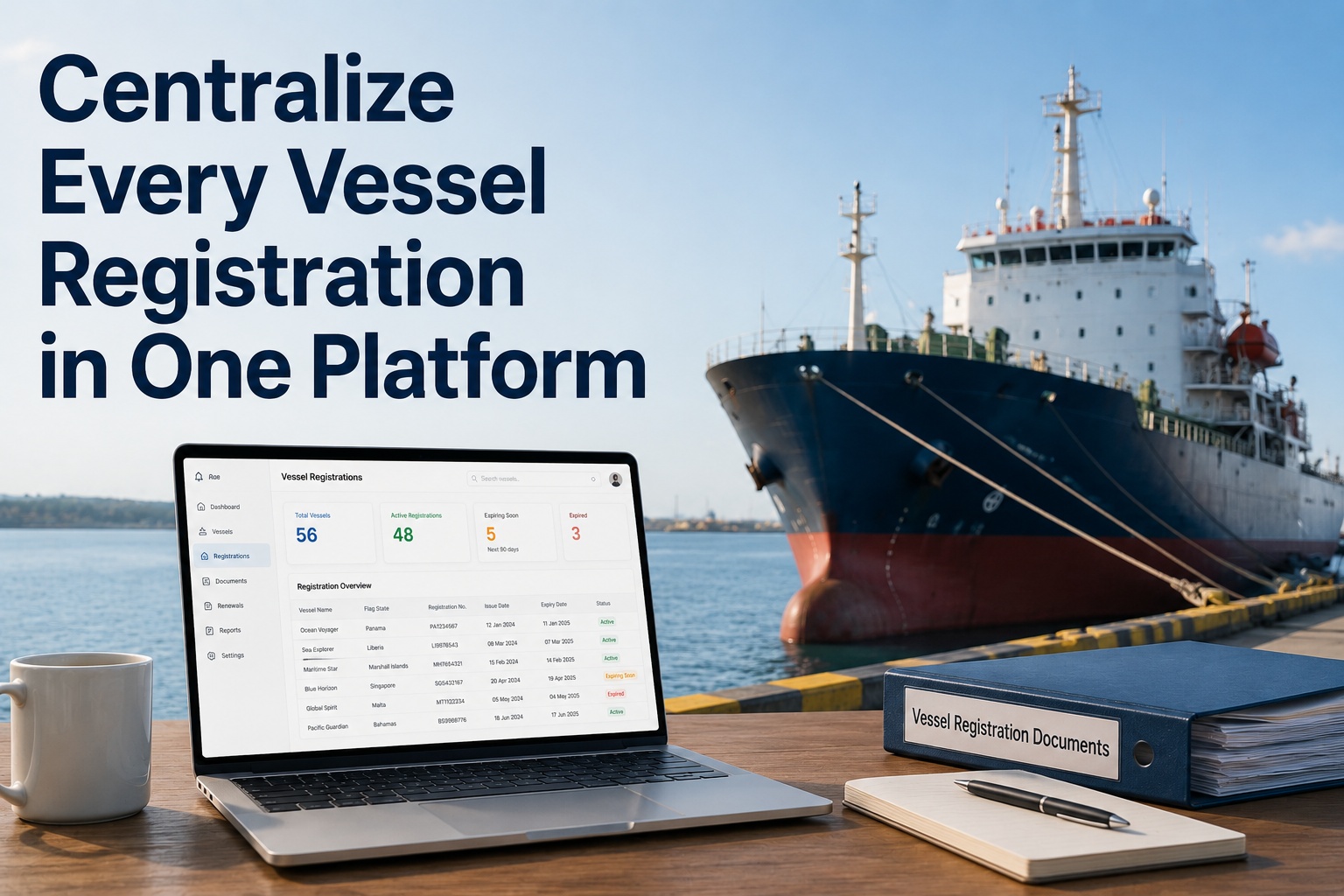
The 2026 flag state landscape is not the one a registry coordinator inherited five years ago. The IMO ship database listed 367 false-flagged tankers as of April 2026, the Follow The Money investigation identified more than 500 false-flagged vessels operating without valid nationality, Windward classified over 1,900 dark fleet vessels in Q3 2025, and the broader shadow fleet exceeded 3,000 vessels — roughly 10% of global tanker capacity now operating outside mainstream compliance frameworks. Panama removed approximately 70 ships from its register, Barbados deflagged 46, Palau removed 29 of 43 identified shadow fleet vessels, and 40+ vessels reflagged to Russia's Maritime Register since June 2025 with 17 joining in December alone. The SHADOW Fleet Sanctions Act of 2026 (S.2904) introduces minimum standards for operating as a flag state registry referencing IMO Resolution A.1192(33). Coast guards from Sweden, Belgium, France, India, and the United States are now boarding vessels whose flag claims cannot be verified — under UNCLOS Article 91, a vessel without a legitimate "genuine link" to its flag state is effectively stateless and boardable by any state. In this environment, the question is no longer whether vessel registration is administrative paperwork. It is whether every vessel in your fleet has documents current enough, organized enough, and audit-defensible enough that no port state, no class auditor, no charterer, and no boarding inspection can find a gap. Start a free trial of Marine Inspection to centralize every vessel registration document on one platform.
Vessel Registration Tracking · 2026
Centralize Every Flag, Every Document, Every Renewal — On One Audit-Defensible Platform.
Multi-flag fleet registration management built for the 2026 enforcement reality. Certificate of Registration, Bill of Sale, Tonnage Certificate, Safety Certificate, IMO Number, MMSI, Call Sign — every document tracked, every renewal scheduled, every audit pack ready in one click.
CERTIFICATE OF REGISTRATION
ACTIVE
VESSEL NAME
M/V Pacific Star
PORT OF REGISTRY
Monrovia
REGISTRATION VALIDITY
Renewal due in 47 days
Why 2026 Changed Vessel Registration From Routine to Strategic
For most of the past three decades, vessel registration was the most predictable administrative function in fleet operations. A vessel chose a flag, paid the registry fees, completed initial documentation, and renewed annually. Documents lived in a filing cabinet in the office. The flag state inspected on its own schedule. Port state controls operated under shared international norms. None of that holds in 2026. Six factors converged to make vessel registration tracking a strategic capability rather than back-office paperwork.
01
Dark Fleet Enforcement Escalation
Coast guards in the US, France, UK, Sweden, Belgium, India, and Norway now physically board vessels whose flag claims cannot be verified. VLCC Skipper seized December 2024 with 1.8M barrels; Bella 1 seized January 2026 by US Coast Guard Cutter Munro; Ethera diverted by Belgian Navy March 1; Sea Owl I boarded by Swedish Coast Guard for Comorian false flag; Indian Coast Guard seized three vessels February 6 2026.
02
Fraudulent Registry Proliferation
Lloyd's List uncovered 21 fraudulent flag and crewing scam operations in July 2025 — fraudulent websites pretending to represent national ship registries without any mandate. The IMO database listed 367 false-flagged tankers as of April 4 2026. Rising fraudulent registries include Gabon, Sierra Leone (85 tankers EU-sanctioned), Eswatini, Comoros, Guinea-Bissau, and Vanuatu.
03
Deflagging Cascade From Major Flags
Panama removed approximately 70 ships from its register. Barbados deflagged 46 Russian shadow fleet vessels. Palau removed 29 of 43 identified shadow fleet vessels from its registry. Liberian and Marshall Islands flags face enforcement-driven outflows. The deflagging cascade makes a flag state's enforcement posture itself a risk factor.
04
SHADOW Fleet Sanctions Act of 2026
S.2904 in the 119th Congress introduces minimum standards for operating as a flag state registry under Section 131, referencing IMO Resolution A.1192(33) of December 6 2023 on dark fleet prevention. Flag states failing minimum standards face strategy responses under Section 132. Registry compliance becomes a US foreign-policy lever, not just an industry norm.
05
Multi-Flag Renewal Complexity
A fleet operating across 5-15 flag states navigates 5-15 distinct rule sets — different renewal cycles, different documentation requirements, different surveyor mandates, different fee structures, different agent dependencies. The complexity compounds geometrically with fleet size. Spreadsheet tracking breaks at scale and produces audit gaps under inspection.
06
Genuine Link Doctrine Under Enforcement
UNCLOS Article 91 and Geneva Convention 1958 Article 5(1) require a genuine link between vessel and flag state. The doctrine sat largely dormant for decades. In 2026 it is actively cited as legal basis for boarding stateless vessels in international waters. Documentation discipline now has direct enforcement consequence.
The Three Registry Types Every Documentation Manager Must Track
Vessel registries fall into three structurally different categories with different rules, costs, and 2026 enforcement profiles. Understanding the type matters because it determines documentation requirements, audit exposure, and renewal complexity. The boundaries are not always clean — some flag states operate hybrid models — but the three-way framework structures most operational decisions.
TYPE I
National / Closed Registers
Open only to vessels owned by residents or entities of that country. Full domestic legal and taxation framework applies. Construction, crewing, and ownership requirements typically restrict registration to national interests.
United States (USCG NVDC)
United Kingdom (Part I MSA 1995)
Germany, Norway, Japan
Domestic ownership required
TYPE II
International Registers
Created by traditional maritime states to offer competitive conditions while retaining strong regulatory frameworks. Tonnage tax systems, flexible crewing rules, but with class society backing and national flag credibility.
Malta, Cyprus, Bahamas
Norwegian International (NIS)
Singapore, Cayman Islands
Premium positioning, fewer PSC issues
TYPE III
Open Registers / Flags of Convenience
Open to foreign owners with fewer regulatory and fiscal constraints. Lower fees, flexible crewing, simplified corporate structures. Panama, Liberia, Marshall Islands account for roughly half the world fleet by deadweight tonnage.
Panama (largest globally)
Liberia, Marshall Islands
St Vincent & Grenadines, Antigua
Enforcement variability is a risk factor
The 2026 Flag State Landscape — Top Registries Compared
The flag state choice shapes operational cost, port state control exposure, charterer acceptance, financing access, and 2026 enforcement risk profile. The table below summarizes the ten registries most commonly used by commercial fleets in 2026 with positioning notes that registry coordinators should weigh against fleet profile. Scroll horizontally on mobile.
| Flag State |
Type |
Positioning |
Initial Cost Range |
2026 Status |
| Panama |
Open |
World's largest registry, low fees, broad acceptance |
$1,500-$3,500 |
~70 ships deflagged from shadow fleet |
| Liberia |
Open |
Major commercial flag, US-aligned governance |
$1,200-$3,000 |
Active sanctions enforcement |
| Marshall Islands |
Open |
Efficient processes, competitive tax structure |
$1,200-$3,000 |
Active sanctions enforcement |
| Malta |
International |
EU benefits, strong PSC reputation |
$2,500-$5,000 |
Stable, low scrutiny |
| Cayman Islands |
International |
Premium yacht and commercial positioning |
$3,000-$5,000+ |
Stable, charterer-favored |
| Bahamas |
International |
Cruise and yacht heritage, strong inspections |
$2,000-$4,500 |
Stable |
| Singapore |
International |
Asia-Pacific premium, financial center alignment |
$2,500-$5,000 |
Stable, low scrutiny |
| Cyprus |
International |
EU benefits, competitive tonnage tax |
€500-€3,000 |
Stable |
| United Kingdom |
National |
British flag credibility, Red Ensign group |
£500-£3,000 |
Stable |
| United States |
National |
US citizen ownership, coastwise trade, NVDC |
$26-$130 multi-year |
Federal Preferred Ship Mortgage available |
The Eight Documents Every Registered Vessel Must Maintain
Each flag state defines its own complete documentation set, but eight document types are universal across virtually every registry in 2026. A credible vessel registration tracking platform manages all eight per vessel with version control, expiry alerting, and audit-ready retrieval. Book a registration audit walkthrough to map your fleet's current documentation against the universal set.
01
Certificate of Registration
The vessel's "passport" — official identity document issued by the flag state proving nationality. US equivalent: Form CG-1270 Certificate of Documentation from NVDC. Must be carried on board.
02
Bill of Sale / Builder's Certificate
Original proof of ownership establishing the legal right to register. Initial registration cannot proceed without it. Updated on every ownership transfer.
03
Tonnage Certificate
Measures internal volume and determines applicable fees and regulations. Issued by surveyor approved by flag state. Foundation for tonnage-tax calculations.
04
Safety Certificate
Demonstrates compliance with international standards for equipment, fire suppression, navigation systems. SOLAS, MARPOL, MLC documentation cascade.
05
Call Sign Assignment
Unique radio identifier assigned during registration. Required for VHF and HF radio communications. Permanent for the life of registration on that flag.
06
MMSI Number
Maritime Mobile Service Identity — 9-digit number enabling Digital Selective Calling for safety communications and AIS broadcast. Issued by flag state.
07
IMO Number
7-digit unique identifier permanent for the life of the vessel regardless of flag changes. Cannot be reissued — making it the strongest defense against identity laundering.
08
Certificate of Ownership / Encumbrance
US equivalent: Form CG-1330 from NVDC showing chain of title and recorded mortgages. Required for financing through Preferred Ship Mortgage. Critical for sale and resale.
The 2026 Registration Renewal Calendar — Five Phases Most Operators Miss
The renewal cycle is not a single date on the calendar. It is a five-phase sequence with distinct lead times, surveyor dependencies, agent coordination, and document gates. Operators tracking only the final expiry date find themselves missing earlier phases that determine whether renewal is achievable on schedule.
T-120d
Pre-Renewal Audit
Internal review of vessel documentation completeness. Surveyor availability checked against renewal window. Agent fees and timeline confirmed. Outstanding deficiencies from last cycle closed.
T-90d
Surveyor Booking
Approved surveyor scheduled within renewal window. For premium registries (Cayman, Malta, Bahamas) approved surveyor lists are short — early booking is essential. Survey scope agreed.
T-60d
Survey Execution
Survey conducted on vessel. Tonnage, safety equipment, structural integrity, regulatory compliance verified. Deficiencies if any recorded with closure timeline.
T-30d
Documentation Submission
Renewal application package submitted via agent or directly to registry. Electronic submission systems process complete applications in 2-6 weeks. Incomplete submissions extend the process to months.
T-0
New Certificate Issued
Renewed Certificate of Registration issued. Multi-year renewal options offered by some registries (US: 1-5 years, $26-$130). Document distributed to vessel and shore. Audit trail updated.
The Cost Reality of Vessel Registration in 2026
Initial registration is the smaller half of total cost of ownership. The full cost structure spans application fees, surveyor fees, notarization and apostille, annual renewal, agent services, and ongoing compliance costs. Budgeting only for the initial application produces material surprises across the renewal cycle.
Initial Registration Fees
€500 - $5,000
Most popular flags $1,200-$3,000. Premium registries (Cayman, Malta) higher. US NVDC multi-year structure $26-$130 for 1-5 years.
Surveyor Fees
$800 - $2,500
Tonnage measurement, safety inspection per renewal cycle. Approved surveyor list varies by flag state. Premium flags have shorter approved surveyor lists.
Notarization / Apostille
$200 - $600
Document authentication, translations if required. Apostille stamps for international document recognition. Cost varies by document count and jurisdiction.
Annual Renewal
€300 - $4,000
Per year, varies by flag and tonnage. Multi-year payment discounts available on some registries. Underpayment triggers automatic deregistration on some flags.
Agent Fees
15% - 25%
Of base registration costs when using professional services. Reduces timelines by ensuring documentation meets requirements on first submission.
Total First-Year
$3,000 - $15,000+
Per vessel typical range. Premium flags higher. Excludes ongoing compliance, class society fees, and tonnage tax liability.
How Centralized Registration Tracking Compares to Spreadsheet Reality
Most fleets in 2026 still track vessel registration through some combination of spreadsheets, email folders, shared drives, and the registry coordinator's personal memory. Each fails differently under audit, under enforcement, and under multi-flag scale. The comparison below maps the practical differences.
SPREADSHEET + EMAIL FOLDERS
Single point of failure on one person's tracker
Renewal phases tracked only at final expiry date
Document versions scattered across folders
No proactive alerts on T-120, T-90, T-60
Audit reconstruction takes days
Multi-flag rules tracked from memory
Agent dependency for status visibility
No defense against fraudulent registry exposure
CENTRALIZED REGISTRATION TRACKING
Multi-user platform with role-based access
Five-phase renewal alerts per flag state
Version control with audit trail per document
Proactive alerts at T-120, T-90, T-60, T-30, T-0
One-click audit pack for class or charterer
Flag-specific rule library pre-loaded
Real-time status independent of agent
IMO number, MMSI, call sign verification trail
The Six Workflows That Make Centralized Registration Pay Off
Beyond the regulatory baseline, well-designed centralized vessel registration tracking earns its place through specific workflows that reduce time, prevent risk, and eliminate the "we missed it" failure mode. Each workflow below corresponds to a real operational pattern observed in fleet implementations.
A
Multi-Flag Renewal Orchestration
A fleet spanning 8 flags has 8 distinct renewal cycles, 8 different surveyor pools, 8 fee schedules, and 8 documentation requirements. The platform orchestrates all 8 in parallel with phase-specific alerts so nothing falls through cycles.
B
PSC Pre-Arrival Documentation Pack
Vessel approaches port of known PSC enforcement priority. Platform generates documentation pack with current Certificate of Registration, tonnage, safety, ownership, and recent class records — Master arrives ready, deficiencies surfaced for closure pre-arrival.
C
Charterer Vetting Document Delivery
Charterer requests current registration documents as part of vetting cycle. Platform delivers a one-click vetting pack with verified, current documents — turnaround in minutes rather than days. Vetting status protected, charter party SLA met.
D
Genuine-Link Defense On Boarding
In a 2026 boarding incident, the question is whether the vessel can produce verifiable current Certificate of Registration, IMO number consistency, MMSI verification, and ownership trail. Centralized tracking produces the defense in minutes; scattered systems produce delay and exposure.
E
Flag-Change Migration Audit Trail
Vessel changes flag — deflagging from current registry, application to new, provisional registration, final certificate issuance. Platform tracks every document, every fee, every milestone with full audit trail for class society notification and financing confirmation.
F
Preferred Ship Mortgage Documentation
US-flagged vessel under financing requires Form CG-1330 Certificate of Ownership and Form CG-1332 Abstract of Title. Platform maintains the chain of title and mortgage encumbrance records — financing renewal becomes documentation retrieval rather than reconstruction.
Registration Audit Walkthrough
Audit Your Fleet's Registration Library Against The 2026 Standard
A 30-minute session with a Marine Inspection product expert. Map your current documentation against the eight universal documents, identify gaps in renewal phase tracking, surface multi-flag complexity risks, and produce a sourced consolidation plan.
Why Marine Inspection For Vessel Registration Tracking
Marine Inspection delivers centralized vessel registration tracking built on the eight-document universal model with multi-flag rule library, five-phase renewal alerting, immutable audit trails, and 2026 regulatory pre-alignment under UNCLOS Article 91 genuine-link doctrine and the IMO A.1192(33) framework. Start a free trial or book a registration audit walkthrough to see what credible registration tracking looks like on your fleet's documents.
Eight-Document Universal Library
Certificate of Registration, Bill of Sale, Tonnage Certificate, Safety Certificate, Call Sign, MMSI, IMO Number, Certificate of Ownership — every document tracked per vessel with version control and audit-ready retrieval.
Multi-Flag Rule Library
Pre-loaded rule sets for Panama, Liberia, Marshall Islands, Malta, Cayman, Bahamas, Singapore, Cyprus, UK, US NVDC, and other major flag states. Renewal cycles, surveyor requirements, fee schedules per flag.
Five-Phase Renewal Alerting
Alerts at T-120, T-90, T-60, T-30, T-0 days — pre-renewal audit, surveyor booking, survey execution, documentation submission, certificate issuance. No phase missed across multi-flag fleets.
UNCLOS Genuine-Link Defense Pack
One-click boarding-defense pack: current Certificate of Registration, IMO number consistency, MMSI verification, ownership chain. The documentation that distinguishes a legitimate vessel from a stateless one in 2026 enforcement.
PSC, Charterer, Class Audit Packs
One-click audit pack generation for port state control pre-arrival, charterer vetting cycles, class society surveys, financing confirmation, and Preferred Ship Mortgage documentation. Hours collapse to minutes.
6-8 Week Deployment
Document audit and rule-set configuration in week 1-2. Existing documentation migrated in weeks 3-4. Renewal alerting validated weeks 5-6. Multi-flag rule library tuned weeks 7-8. Live operations within a fiscal quarter.
Frequently Asked Questions
Why has vessel registration become a strategic capability in 2026?
Six converging factors moved vessel registration from administrative back-office to strategic operational concern. First, dark fleet enforcement escalation — coast guards in the US, France, UK, Sweden, Belgium, India, and Norway now physically board vessels whose flag claims cannot be verified, with seizures from VLCC Skipper through Bella 1 to Ethera demonstrating the new enforcement posture. Second, fraudulent registry proliferation with 367 false-flagged tankers in the IMO database as of April 2026 and 21 fraudulent flag scam operations uncovered by Lloyd's List in July 2025. Third, deflagging cascade with Panama removing approximately 70 ships, Barbados deflagging 46, and Palau removing 29 of 43 identified shadow fleet vessels. Fourth, the SHADOW Fleet Sanctions Act of 2026 (S.2904) introducing minimum standards for flag state registries. Fifth, multi-flag renewal complexity compounding geometrically with fleet size. Sixth, UNCLOS Article 91 genuine-link doctrine now actively cited as legal basis for boarding stateless vessels. Vessel registration discipline is now an operational risk-management capability.
What documents must every registered vessel maintain?
Eight documents are universal across virtually every flag state in 2026: Certificate of Registration (the vessel's "passport" — US equivalent Form CG-1270 from NVDC, must be carried on board), Bill of Sale or Builder's Certificate (original proof of ownership), Tonnage Certificate (measures internal volume, determines fees and regulations), Safety Certificate (SOLAS, MARPOL, MLC compliance cascade), Call Sign assignment (unique radio identifier, permanent for that flag), MMSI number (9-digit Maritime Mobile Service Identity enabling DSC and AIS), IMO number (7-digit unique identifier permanent for vessel life regardless of flag changes), and Certificate of Ownership or Encumbrance (chain of title and mortgages — US equivalent Form CG-1330). Each flag state may require additional documents specific to its regulations, but the universal set defines the documentation baseline for centralized tracking.
What are the three registry types?
Vessel registries fall into three structurally different categories. National or closed registers are open only to vessels owned by residents or entities of that country — full domestic legal and taxation framework applies, with construction, crewing, and ownership requirements restricting registration to national interests. Examples include United States (USCG NVDC), United Kingdom (Part I MSA 1995), Germany, Norway, Japan. International registers were created by traditional maritime states to offer competitive conditions while retaining strong regulatory frameworks — tonnage tax systems, flexible crewing rules, but with class society backing. Examples include Malta, Cyprus, Bahamas, Norwegian International (NIS), Singapore, Cayman Islands. Open registers (often called flags of convenience) are open to foreign owners with fewer regulatory and fiscal constraints — Panama, Liberia, and Marshall Islands account for roughly half the world fleet by deadweight tonnage. The category matters because it determines documentation requirements, audit exposure, and 2026 enforcement risk profile.
How long does vessel registration take?
Electronic submission systems have accelerated registration timelines significantly. Most registries process complete applications within two to six weeks depending on complexity and documentation completeness. Initial USCG documentation typically takes 4-6 weeks. Renewals submitted on time are usually processed within 2-3 weeks. Incomplete submissions or missing surveys can extend the process to several months. Professional agent assistance often reduces timelines by ensuring all documentation meets requirements on first submission — at typical 15-25% agent fees on top of base registration costs. The renewal cycle is not a single date but a five-phase sequence starting at T-120 days (pre-renewal audit) through T-90 (surveyor booking), T-60 (survey execution), T-30 (documentation submission), to T-0 (new certificate issued). Operators tracking only the final expiry date miss earlier phases that determine whether renewal is achievable on schedule.
What does vessel registration cost in 2026?
Total first-year cost typically $3,000-$15,000+ per vessel depending on flag, with several cost components. Initial registration fees range from €500 for budget flags to over $5,000 for premium registries, with most popular options falling between $1,200 and $3,000. Surveyor fees for tonnage measurement and safety inspections run $800-$2,500. Document notarization, apostille stamps, and translations add $200-$600. Annual renewal fees range from €300-$4,000 per year depending on flag and tonnage. Agent fees if using professional services typically 15-25% of base registration costs. US NVDC operates a multi-year structure: $26 for 1 year through $130 for 5 years for recreational vessels under the Frank LoBiondo Coast Guard Authorization Act of 2018. Premium flags (Cayman, Malta, Bahamas) sit at the higher end of the range. Budgeting only for the initial application produces material surprises across the renewal cycle.
What is the genuine link doctrine and why does it matter in 2026?
The genuine link doctrine requires that a real connection exist between a vessel and its flag state — the flag state must effectively exercise jurisdiction and control over the vessel in administrative, technical, and social matters. It is codified in Geneva Convention 1958 Article 5(1) and UNCLOS 1982 Article 91. For decades the doctrine sat largely dormant. In 2026 it is actively cited as legal basis for boarding vessels whose flag claims cannot be verified. Under UNCLOS interpretation, a vessel with no genuine link to its flag state is effectively stateless and can be boarded by any state. Recent enforcement actions cite the doctrine directly — Swedish Coast Guard's boarding of Sea Owl I (suspected Comorian false flag), Belgian Navy's diversion of Ethera (false flag and false documents), and US-UK seizure of Bella 1 in the North Atlantic. The doctrine creates a direct enforcement consequence for documentation discipline — verifiable current registration documents become the practical defense against boarding.
How does Marine Inspection track vessel registration?
Marine Inspection delivers centralized vessel registration tracking on the eight-document universal model — Certificate of Registration, Bill of Sale, Tonnage Certificate, Safety Certificate, Call Sign, MMSI, IMO Number, Certificate of Ownership — with version control and audit-ready retrieval per vessel. Pre-loaded multi-flag rule library covers Panama, Liberia, Marshall Islands, Malta, Cayman, Bahamas, Singapore, Cyprus, UK, US NVDC, and other major flag states with renewal cycles, surveyor requirements, and fee schedules per flag. Five-phase renewal alerting at T-120, T-90, T-60, T-30, T-0 days ensures no phase is missed across multi-flag fleets. One-click audit pack generation for PSC pre-arrival, charterer vetting, class society surveys, financing confirmation, and UNCLOS Article 91 genuine-link defense. Role-based access for registry coordinators, DPAs, master, and shore stakeholders. 6-8 week deployment for mid-size fleets.
How do we get started?
Two paths. Path one: start a free trial directly. The platform loads with sample fleet data including pre-configured documents for major flag states so registry coordinators can explore the eight-document model, multi-flag rule library, and five-phase renewal alerting before any commitment. Path two: book a 30-minute registration audit walkthrough with a Marine Inspection product expert. The walkthrough maps your fleet's current documentation against the universal eight-document standard, identifies gaps in renewal phase tracking, surfaces multi-flag complexity risks, and produces a sourced consolidation plan with deployment timeline. Most operators identify documentation gaps in the session itself. Both paths converge if you decide to implement, with phased onboarding by vessel cohort and flag state. Existing documentation migrated in weeks 3-4, with full multi-flag live operations within 6-8 weeks.
Ready When You Are
Centralize Every Registration. Defend Every Flag. Audit-Ready On Demand.
Eight-document universal library, multi-flag rule library, five-phase renewal alerting, UNCLOS genuine-link defense pack, PSC and charterer audit packs, 6-8 week deployment — all in one platform built for the 2026 vessel registration reality.