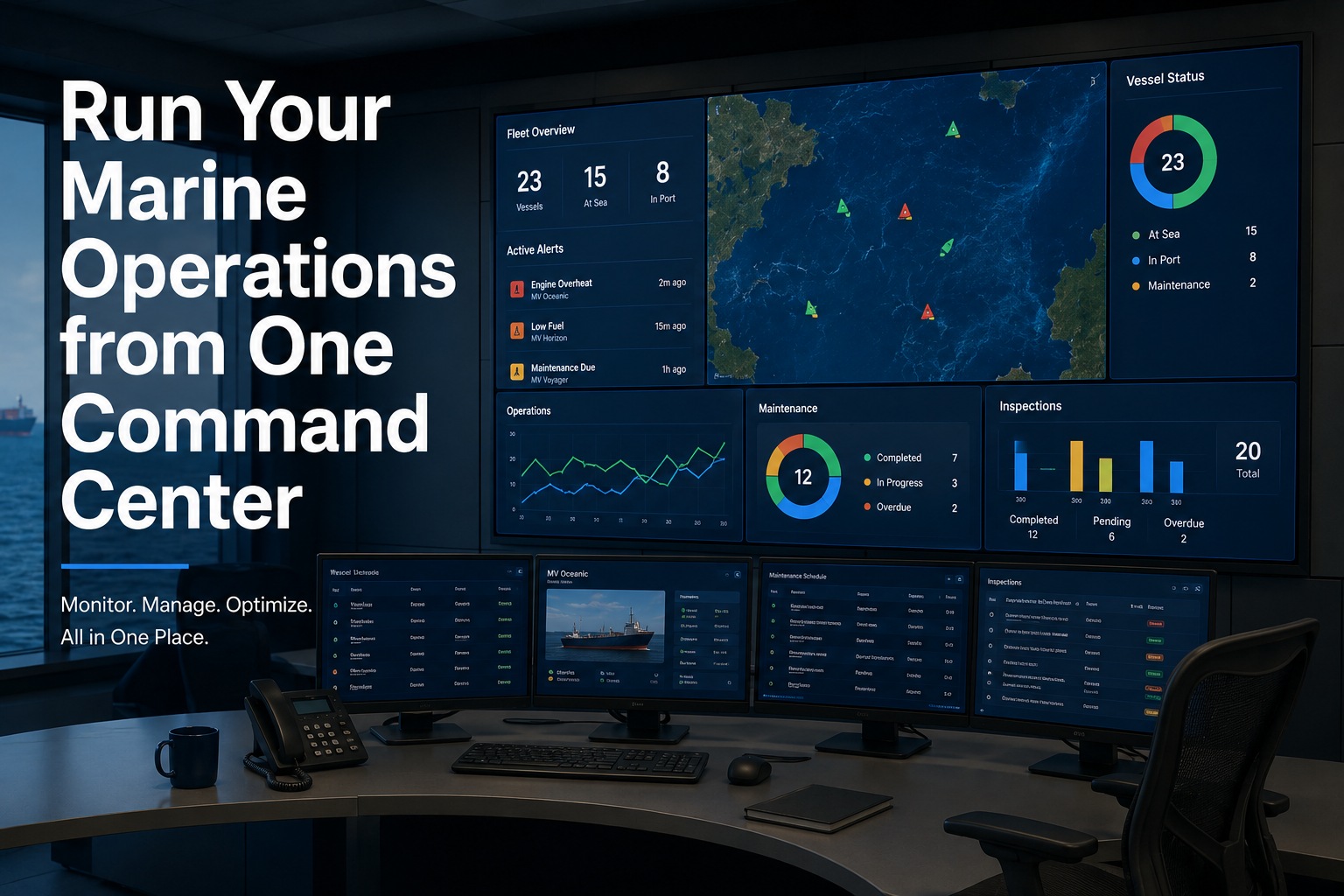
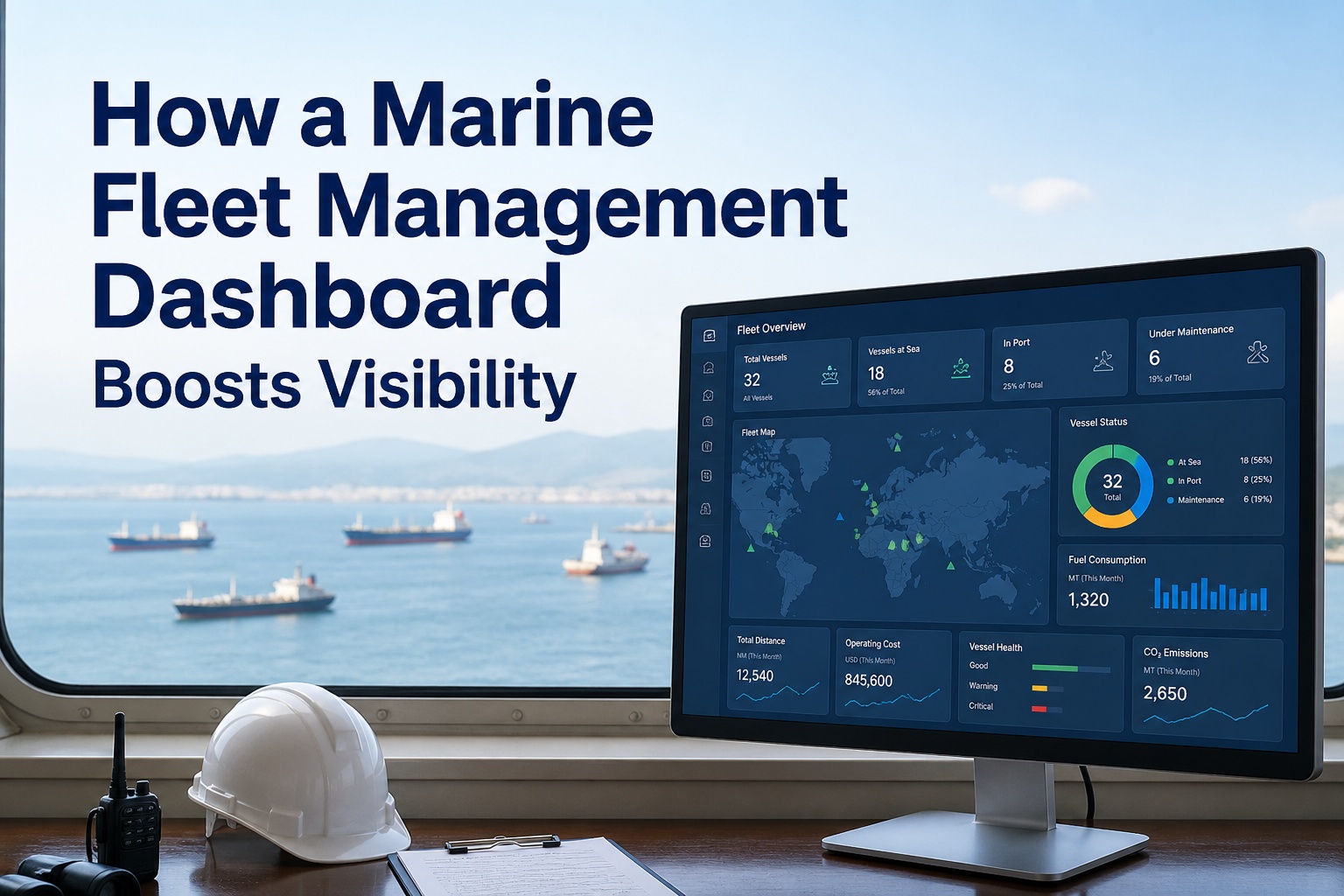
Walk into a credible 2026 marine operations center and the first thing that strikes you is the air of calm — not because nothing is happening, but because everything that should be visible is visible. A single wall of screens carries the fleet's common operating picture: every vessel mapped to position and route, every active alert routed to a named watchstander, every certificate within thirty days of expiry flagged with countdown, every voyage P&L with mid-passage variance, every PSC inspection scheduled in the next port call, every cyber incident under MSC.428(98) escalation. The watch officer running the room can answer three questions in under thirty seconds — which vessels are in normal status, which need a decision today, which need a decision this week — and route the answers to the right party without leaving the console. This is the operating model commercial fleet operators have been quietly adopting since 2024, with the security backdrop of Strait of Hormuz threats, Red Sea high-risk corridors, and the 2026 U.S. National Defense Strategy's call for persistent maritime awareness pushing the timeline forward another twelve months. The tooling has caught up. Start a free trial of Marine Inspection to see what a maritime operations center looks like configured for a commercial fleet.
Maritime Operations Center · Commercial Fleet · 2026
From Scattered Dashboards to a Single Operating Picture. Fleet-Wide. 24/7. Watch-Aware.
Centralize alerts, fleet status, inspections, maintenance, certificates, voyage P&L and security posture in one operations console. Watch-construct ready. Escalation paths configured. Common operating picture across every vessel and every shore stakeholder.
Fleet Map · Common Operating Picture
42 vessels · live
Active Alerts · Triage Queue
3 open
M/V Hormuz Star · Cert Expiry
SMC valid 8 days · DPA owner
M/V Pacific Star · Fuel Drift
+6.2% vs baseline · Ops owner
M/V Aegean Wave · PSC Window
Singapore arrival 32hr · Master
Watch Status · Shore Roster
B watch active
Watch Officer
M. Tanaka · on console
Tech Super
R. Olsen · standby
DPA Escalation
A. Costa · standby
Commercial
L. Pereira · day shift
What Makes a Maritime Operations Center Different From a Dashboard
A dashboard shows data. An operations center supports decisions. The distinction matters because most maritime fleets in 2026 already have dashboards — fuel performance dashboards, maintenance dashboards, compliance dashboards, financial dashboards — and the proliferation has produced a new problem: data is everywhere and decisions are nowhere. The operations center model, borrowed from military C2 doctrine and adapted for commercial fleets, fixes this by enforcing three structural elements that scattered dashboards lack.
PILLAR 1
Common Operating Picture
A single fleet view rather than seven. Every vessel, every alert, every metric on one console — not seven dashboards in seven browser tabs. The military COP concept ported to commercial fleet operations.
PILLAR 2
Watch Construct
24/7 coverage organized into watches with named role assignments per shift. Watch officer on console, technical superintendent on standby, DPA on escalation. Continuity preserved across handover.
PILLAR 3
Defined Escalation Paths
Every alert category has a documented response playbook with named owner. Cert expiry routes to DPA. Fuel drift to ops manager. Cyber incident to designated person under MSC.428(98). No ambiguity.
The Six Operational Layers Every Marine Ops Center Must Cover
An operations center is not a single dashboard but a stack of integrated views, each owned by a different watchstander role and each fed from different data sources. Generic fleet management software covers two or three of the six layers below. A complete operations center delivers all six on one console — with cross-layer correlation when an event touches multiple layers simultaneously. Book a live walkthrough to see the six-layer model on real fleet data.
01
Position & Routing
Live AIS positions, voyage routes, ETAs, weather overlays, traffic separation schemes, high-risk area boundaries. The geographic foundation for everything else.
Watch Officer
02
Vessel Health
Machinery condition, fuel performance, hull integrity, certificate status, defect register, planned maintenance compliance. Composite vessel health score per asset.
Tech Superintendent
03
Compliance & Inspections
Class surveys scheduled, PSC port-call risk windows, SIRE 2.0 vetting prep, ISM internal audit cycle, certificate expiry countdowns, deficiency closure tracking.
DPA / HSEQ
04
Commercial & Voyage P&L
Voyage performance live, charter terms vs delivery, demurrage exposure, bunker spend, EU ETS allowance burn, FuelEU compliance balance, vessel ROI ranking.
Commercial Manager
05
Security & Cyber
High-risk area transits, security threat indicators, MSC.428(98) cyber incident escalation, IACS UR E26/E27 evidence, vessel hardening status, naval coordination logs.
Security / Cyber Officer
06
Crew & Welfare
Crew rotation schedule, MLC compliance, fatigue tracking, training currency, certificate validity per officer, drill compliance, wellbeing indicators.
Crewing Manager
The Three Time Horizons Every Watchstander Should See At Once
Borrowed from military operational planning doctrine, the far/mid/near time horizon framework prevents the most common operations center failure mode: drowning in immediate alerts while losing the longer view. Effective fleet operations centers display all three horizons simultaneously rather than rolling between them. The watch officer sees what is happening right now, what is coming this week, and what is on the planning horizon out to thirty days.
NEAR · 0-24h
Active Watch
Alerts requiring decision in the current shift. Critical defects logged in last hour. Vessels in active port operations. Weather routing decisions. Threat alerts in transit areas. Cyber incident escalations.
Active alarms by severity
Vessels in port operations
Weather diversions
Security threat updates
MID · 1-7 days
This Week
Decisions due in the coming week. Inspection windows, maintenance windows, charter party milestones, certificate expiries within seven days, FuelEU compliance balance trajectory, drydock readiness checks.
PSC port arrivals
Class survey windows
Crew rotation handovers
Charter milestone events
FAR · 7-30 days
Planning Horizon
Strategic decisions on a one-month planning horizon. Drydock scheduling, fleet deployment, charter acceptance pricing, capital allocation, regulatory deadline approaches, vessel ROI ranking review.
Drydock planning
Charter acceptance decisions
Regulatory deadline tracking
Capital allocation review
How a Modern Marine Ops Center Compares to the Status Quo
Most commercial fleets in 2026 still run operations from a combination of three baseline approaches: scattered dashboards in different browser tabs, email-based alert triage, and weekly status meetings. Each fails differently as fleet size grows past a handful of vessels. Scroll horizontally on mobile to see the full comparison.
| Operational Capability |
Scattered Dashboards |
Email + Status Meetings |
Marine Operations Center |
| Common operating picture |
Seven browser tabs |
Verbal stitching at meetings |
Single console |
| 24/7 watch coverage |
Office hours only |
On-call escalation chain |
Watch construct configured |
| Alert escalation routing |
Manual forwarding |
Email reply-all |
Named owner per category |
| Cross-layer correlation |
Mental model only |
Cross-functional meeting |
Auto-correlated views |
| Far / mid / near time horizons |
Single horizon at a time |
Weekly review pattern |
All three concurrent |
| Decision time on critical alert |
30+ minutes to triage |
2-4 hours typical |
Under 5 minutes to action |
| Audit trail of decisions |
Email chains |
Meeting minutes |
Immutable console log |
| Security & cyber posture view |
Separate security tool |
Quarterly review |
Always-on operational layer |
| External stakeholder briefing |
Custom slide build |
Reconstructed timeline |
One-click ops snapshot |
| Implementation timeline |
Already built (limited) |
Already in place |
8-12 weeks to live |
| Operations Director visibility |
Manual aggregation |
Weekly summary |
Real-time portfolio view |
| 2026 NDS / IMO compliance |
Manual reconstruction |
Annual evidence binder |
Continuous evidence pack |
Live Operations Walkthrough
See the Six-Layer Operations Console on Real Fleet Data
A 30-minute session with a Marine Inspection product expert. Walk through the live console, map your fleet against the six operational layers, define escalation paths against your watch construct, and leave with a sourced ROI projection. No commitment, no slideware.
Why 2026 Pushed Operations Centers From Premium To Baseline
The shift from "nice to have" to "table stakes" tracks several converging pressures that intensified in 2025 and went mainstream in 2026. Each one penalizes fleets running scattered dashboards while rewarding fleets with operational consolidation. The four drivers below show up consistently in operator surveys and industry analysis.
SECURITY
High-Risk Area Transit Demands
Strait of Hormuz threats, Red Sea high-risk corridors, and 2026 NCAGS 24/7 watch coordination requirements have made operational consolidation necessary for vessels in those routes. Coordination with NAVCENT, UKMTO, and naval partners requires single-pane evidence.
2026 NDS
Persistent Maritime Awareness
2026 U.S. National Defense Strategy elevates persistent maritime awareness, earlier attribution, and structured action across a more monitored, contested, and distributed maritime environment. Commercial fleets are an integral part of that picture.
REGULATION
EU ETS, FuelEU, IMO MSC.428(98)
EU ETS at 100% phase-in 2026, FuelEU enforcement active, IMO cyber risk management mandatory in SMS since 2021. Each requires evidence trails that scattered dashboards cannot produce coherently.
CHARTERER
Visibility As Contract Term
Major charterers increasingly require visibility into vessel operations and compliance status. Operators with consolidated operations centers deliver this through one stakeholder portal; operators without re-export from spreadsheets each request.
The Six Workflows That Earn the Operations Center Investment
Centralization on its own does not save money. The value comes from specific workflows that the operations center enables — workflows that scattered dashboards cannot run because the data and the watch construct never connect. Each workflow below maps to a real measurable outcome.
A
Cross-Layer Correlation Triage
Vessel fuel drift correlates with hull condition data correlates with weather routing correlates with charter performance. The operations center surfaces correlations the watch officer would never see by switching tabs.
B
High-Risk Transit Coordination
Vessel approaching Strait of Hormuz triggers consolidated readiness pack: route confirmation, BMP measures, UKMTO registration, naval coordination, alert escalation paths. Watch officer runs the brief in 5 minutes, not 50.
C
Watch Handover Continuity
A watch hands over to B watch with a documented snapshot: open alerts, decisions in flight, escalations standby, fleet status by exception. No verbal stitching, no missed items, no decision dropouts at 0600 or 1400 or 2200.
D
Auditor / Charterer Briefing
Class auditor or charterer requests a fleet operational status review. Operations center generates a one-click ops snapshot: position, health, compliance, security posture per vessel. Audit hours collapse to minutes.
E
Cyber Incident Escalation
MSC.428(98)-grade cyber incident escalation: detection, named owner notification, response playbook, evidence capture, regulatory reporting, recovery confirmation. Audit-ready trail for next DOC verification.
F
Operations Director Portfolio Review
Operations director walks into Monday review with a real-time portfolio view: fleet KPIs, exception list, decisions outstanding, ROI ranking. Reviews shift from reconstruction to action — analysis on current data, not last month's compilation.
Implementation Roadmap — Live in 8-12 Weeks
Operations center deployment is faster than enterprise platform rollout because the role library, data model, and escalation patterns are pre-built rather than designed from scratch. Most mid-size fleets reach productive use within 8-12 weeks, with phased onboarding by vessel cohort and watch construct.
Wk 1-2
Operations Mapping Workshop
Existing operations workflow mapped to six-layer model. Watch construct defined with role assignments. Escalation paths documented per alert category. Far / mid / near horizon thresholds locked.
Wk 3-5
Data Source Integration
AIS, telemetry, CMMS, certificate database, voyage operations, charter contracts, security feeds — all integrated. Pilot vessel cohort flowing live with cross-layer correlation tested.
Wk 6-8
Watch Construct & Escalation
Watch officer training. Role-based access provisioned. Escalation paths configured with named owners. First live watch run on pilot fleet with shadow run alongside legacy systems.
Wk 9-12
Fleet Rollout & Live Operations
Phased onboarding of remaining fleet. Daily watch handover routine established. Operations director portfolio review on real-time data. Legacy dashboards retired with retention copies.
Why Marine Inspection For Your Operations Center
Marine Inspection delivers a complete maritime operations center built on the six-layer model that matches how commercial fleet operations actually run — common operating picture, watch construct, named-owner escalation, far/mid/near time horizons, and audit-grade evidence trails for IMO MSC.428(98) and 2026 regulatory frameworks. Start a free trial or book a live walkthrough to see your fleet's data on the operations console within weeks.
Six-Layer Operations Console
Position & routing, vessel health, compliance & inspections, commercial & voyage P&L, security & cyber, crew & welfare — all on one console with cross-layer correlation. Pre-configured. Marine-native.
Watch Construct Built In
Watch officer role on console, role-based standby for technical superintendent and DPA, escalation paths with named owners. 24/7 coverage with documented handover continuity.
Common Operating Picture
Single fleet view replacing seven dashboards. Live AIS, fleet map, alert console, watch status, KPI rollup — all visible simultaneously, all updating in real time, all auditable.
Far / Mid / Near Horizons
All three time horizons concurrent on the console. Active watch alerts (0-24h), this-week decisions (1-7 days), planning horizon (7-30 days). No horizon dropouts at handover.
2026 Regulatory Stack Aligned
IMO MSC.428(98) cyber escalation, IACS UR E26/E27 evidence, EU ETS allowance tracking, FuelEU balance, NCAGS coordination logs, MLC compliance — all consolidated in operational layers rather than separate modules.
8-12 Week Deployment
From decision to live operations console in 8-12 weeks for typical mid-size fleets. Operations mapping, data integration, watch construct configuration, fleet rollout. No multi-year enterprise project.
Run 2026 From One Console
Stop Switching Tabs. Start Running Operations.
Six-layer operations console, watch construct, common operating picture, far/mid/near time horizons, MSC.428(98) cyber escalation, 8-12 week deployment — all in one platform built for commercial fleet operations centers. Book a walkthrough or start a free trial today.
Frequently Asked Questions
What is a maritime operations center and how is it different from a dashboard?
A maritime operations center (MOC) is the commercial fleet equivalent of military Maritime Operations Centers — a centralized console with watch construct, common operating picture, and defined escalation paths that consolidates fleet awareness across multiple operational layers. The distinction from a dashboard is structural: dashboards display data; operations centers support decisions. An operations center enforces three things scattered dashboards lack — common operating picture (one console replacing seven), watch construct (24/7 coverage with named role assignments per shift), and defined escalation paths (every alert routes to a named owner with documented response playbook). The model originated in military C2 doctrine and has been adapted for commercial fleets as security pressure, regulatory complexity, and charterer visibility demands have intensified through 2025-2026.
What are the six operational layers an operations center covers?
A complete maritime operations center covers six integrated layers: position and routing (live AIS, voyage routes, weather, high-risk area boundaries), vessel health (machinery condition, fuel performance, hull integrity, certificate status, defect register), compliance and inspections (class surveys, PSC port-call risk, SIRE 2.0 vetting, ISM audit cycle, deficiency closure), commercial and voyage P&L (charter performance, demurrage, EU ETS allowance burn, FuelEU balance, vessel ROI), security and cyber (high-risk transits, MSC.428(98) cyber escalation, IACS UR E26/E27 evidence), and crew and welfare (rotation schedule, MLC compliance, fatigue tracking, training currency, drill compliance). Each layer has a different watchstander owner and different data sources, but cross-layer correlation surfaces patterns that single-layer dashboards miss.
What is the watch construct and why does it matter?
The watch construct organizes 24/7 operations center coverage into shifts with named role assignments per shift. A typical commercial fleet construct includes A watch (0600-1400), B watch (1400-2200), and night watch (2200-0600), with watch officer on console, technical superintendent on standby, DPA on escalation, and commercial manager available during day shift. Continuity preserves across handover through documented snapshots: open alerts, decisions in flight, escalations standby, fleet status by exception. Without watch construct, operations centers either run office-hours-only (missing 16 hours daily) or rely on on-call escalation chains that introduce delay and accountability ambiguity. The watch construct is what turns a dashboard into an operations center.
What are far, mid, and near time horizons?
Borrowed from military operational planning, the far/mid/near framework prevents the most common operations center failure mode: drowning in immediate alerts while losing the longer view. Near horizon (0-24 hours) covers active watch decisions — alarms by severity, vessels in port operations, weather diversions, security threats, cyber incidents. Mid horizon (1-7 days) covers this-week decisions — PSC port arrivals, class survey windows, crew rotation handovers, charter milestone events. Far horizon (7-30 days) covers planning decisions — drydock scheduling, charter acceptance, regulatory deadline tracking, capital allocation review. Effective operations centers display all three horizons concurrently rather than rolling between them, ensuring strategic context never drops out under tactical pressure.
Why has the operations center model become mainstream in 2026 specifically?
Four converging pressures pushed adoption from premium to baseline through 2025-2026. First, security: Strait of Hormuz threats, Red Sea high-risk corridors, and NCAGS 24/7 watch coordination demands made operational consolidation necessary for vessels in affected routes. Second, the 2026 U.S. National Defense Strategy elevated persistent maritime awareness as a continuing requirement, with commercial fleets integral to the picture. Third, regulatory weight: EU ETS at 100% phase-in 2026, FuelEU active enforcement, IMO MSC.428(98) cyber risk management requirements all demand evidence trails that scattered dashboards cannot produce coherently. Fourth, charterer visibility: major charterers increasingly require operational and compliance visibility as contract terms — operators with consolidated operations centers deliver this through one stakeholder portal rather than re-exporting from spreadsheets per request.
How long does deployment take for a typical mid-size fleet?
8 to 12 weeks for a typical 10-30 vessel fleet. Weeks 1-2: operations mapping workshop covering existing workflows mapped to six-layer model, watch construct definition with role assignments, escalation paths per alert category, and far/mid/near horizon threshold locking. Weeks 3-5: data source integration covering AIS, telemetry, CMMS, certificate database, voyage operations, charter contracts, and security feeds; pilot vessel cohort flowing live with cross-layer correlation tested. Weeks 6-8: watch construct training, role-based access provisioning, escalation path configuration; first live watch run on pilot fleet with shadow run alongside legacy systems. Weeks 9-12: phased onboarding of remaining fleet, daily handover routine, operations director portfolio review on real-time data, legacy dashboards retired. The compressed timeline depends on the platform being purpose-built for marine operations.
What kind of ROI do operators see?
Operations center consolidation delivers measurable returns across multiple categories: decision time on critical alerts drops from 30+ minutes (scattered dashboards) or 2-4 hours (email + meetings) to under 5 minutes (operations console with watch construct); audit time on charterer or class society briefings collapses from days to minutes through one-click ops snapshots; cyber incident escalation under MSC.428(98) becomes audit-ready rather than reconstructed at DOC verification; charterer visibility requirements are met through one stakeholder portal rather than per-request re-export; and operations director time shifts from reconstructing weekly summaries to acting on real-time portfolio data. Most operations directors report the time-recovery alone justifies the platform within 6-9 months, with security incident avoidance and audit-time recovery providing additional upside.
How does Marine Inspection deliver a maritime operations center?
Marine Inspection delivers the complete six-layer operations console — position and routing, vessel health, compliance and inspections, commercial and voyage P&L, security and cyber, crew and welfare — on one platform with cross-layer correlation built in. Watch construct ready out of the box with role-based access for watch officer, technical superintendent, DPA, commercial manager. Common operating picture replacing seven dashboards. Far / mid / near time horizons concurrent on console. 2026 regulatory stack pre-aligned: IMO MSC.428(98) cyber escalation, IACS UR E26/E27 evidence, EU ETS allowance tracking, FuelEU balance, NCAGS coordination logs, MLC compliance. 8-12 week deployment for mid-size fleets. Book a live walkthrough with operations directors to evaluate against your fleet, or start a free trial to explore the console with sample data.