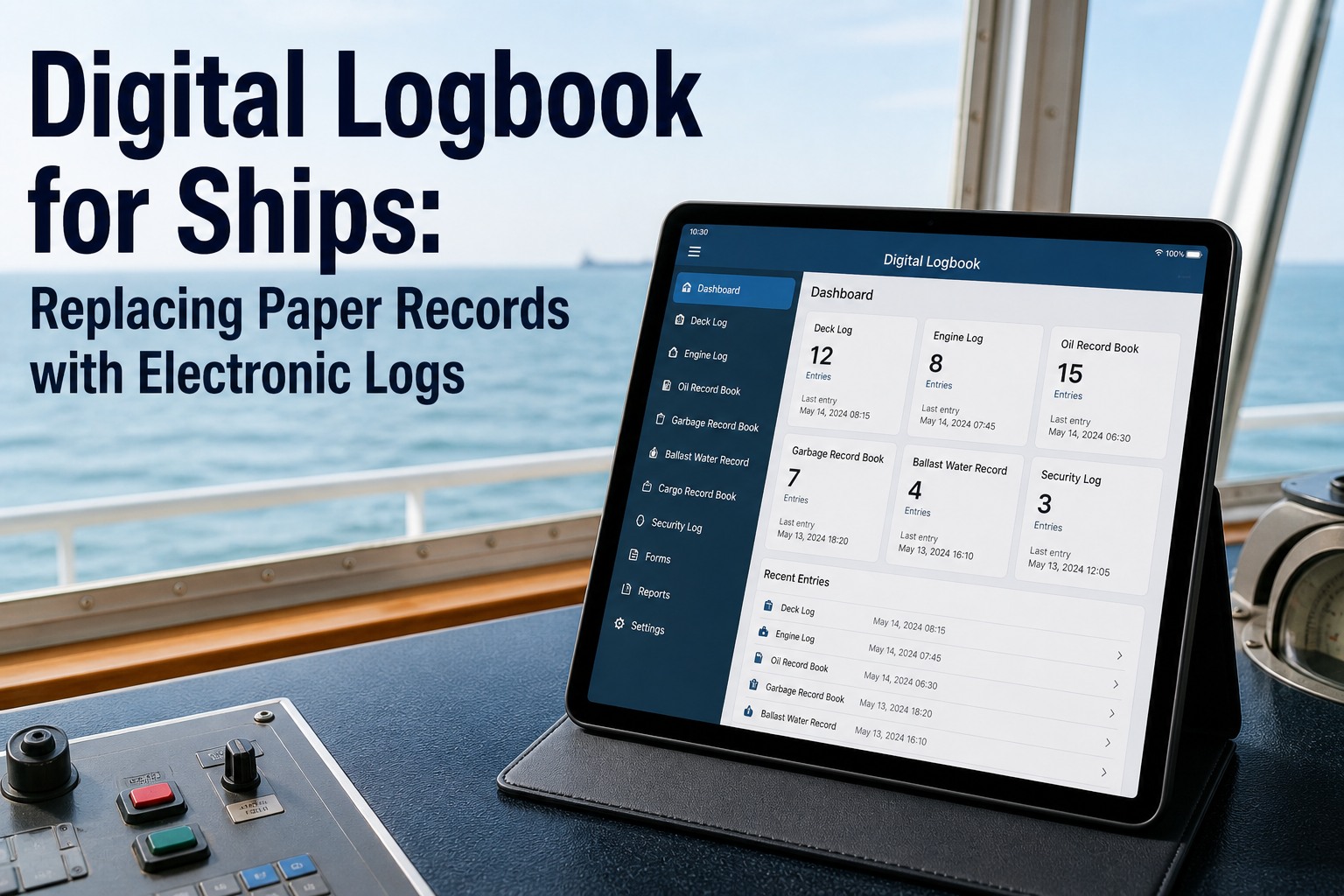
The international regulatory framework for digital logbooks on commercial vessels crossed a foundational threshold on 1 October 2020, when amendments to MARPOL adopted by IMO Resolutions MEPC.314(74), MEPC.316(74) and MEPC.317(74) entered into force, expressly permitting the use of approved electronic record books in lieu of hard-copy MARPOL record keeping. Alongside the amendments, IMO Resolution MEPC.312(74) (adopted 17 May 2019) established the Guidelines for the Use of Electronic Record Books under MARPOL — the technical specification that flag administrations and recognised organisations apply when approving electronic systems. Five years on, the digital logbook landscape spans six MARPOL Electronic Record Books (ERBs), 30+ additional logbook types covering deck, engine, GMDSS, ballast water, biofouling, medical and security operations, more than 30 commercial software vendors, and a flag state acceptance map covering most of the world's major shipping registers. For ship masters and fleet managers in 2026, the question is no longer whether to adopt digital logbooks — it is which platform, which scope, and how to manage the approval pathway. Start a free trial of Marine Inspection to digitize MARPOL Oil Record Book, Garbage Record Book, deck log and engine log workflows with type-approved electronic records.
From Paper to Electronic Record Books
In force since 1 October 2020
312
MEPC.312(74)
IMO Guidelines for ERBs under MARPOL — adopted 17 May 2019, entered into force 1 October 2020
6
MARPOL ERBs Permitted
Oil Record Book Pt I & II, Cargo Record Book, Garbage Record Book Pt I & II, Annex VI records
30+
Logbook Types Available
From deck and engine logs to ballast water, biofouling, GMDSS, mooring operations, medical and night order books
35+
Major Flag States Accept
UK, USA, Liberia, Marshall Islands, Panama, Singapore, Bahamas, Hong Kong, Norway, Malta and most major registers
The Two-Track Regulatory Framework Every Master Must Understand
Digital logbook regulation runs on two parallel tracks. The first is the IMO MARPOL framework — international, mandatory, governed by MEPC.312(74) — covering the six pollution-related record books. The second is the flag state framework — national, variable, governed by individual administration regulations — covering the official deck logbook, engine logbook, GMDSS log, and other operational records. Confusing the two is the most common implementation error. Book a Marine Inspection demo to see how digital records work across both tracks in one platform.
Authority: International Maritime Organization
Foundation: Resolutions MEPC.314(74), MEPC.316(74), MEPC.317(74)
Guidelines: Resolution MEPC.312(74), updated by MEPC.372(80)
In force: 1 October 2020
Scope: Six MARPOL pollution record books
Approval: Type approval + ship-specific Declaration
TRACK 2
Flag State Administration
Authority: Individual flag state administrations
Foundation: National maritime regulations + IMO references
Reference standards: ISO 21745:2019, IMO Res. A.916(22), MSC.333(90)
In force: Varies by flag state
Scope: Official deck logbook, engine logbook, GMDSS, plus 25+ other operational records
Approval: Flag state policy varies — full acceptance, partial, or paper still required
The Six MARPOL Electronic Record Books
The 1 October 2020 amendments and the MEPC.312(74) Guidelines explicitly cover six record books spanning four MARPOL Annexes plus the NOx Technical Code. Each can now be maintained electronically subject to flag administration approval and ship-specific declaration.
1
Oil Record Book Part I (Machinery Operations)
MARPOL Annex I — engine room operations including bilge water transfers, sludge discharge, oil filtering equipment, oil residue (sludge) management. The most heavily inspected of the MARPOL ERBs. Each entry signed by officer in charge; pages signed by master. Common port state control finding when records are inconsistent or incomplete.
Annex I
2
Oil Record Book Part II (Cargo / Ballast Operations)
MARPOL Annex I — for oil tankers, recording cargo and ballast operations including loading, transfer, unloading, ballasting of cargo tanks, cleaning and washing operations, ballast water discharge, slop tank operations. ORB Part II workflow is materially more complex than Part I.
Annex I
3
Cargo Record Book (Noxious Liquid Substances)
MARPOL Annex II — for chemical tankers, recording loading, internal transfer, unloading, tank cleaning, ballasting of cargo tanks, ballast water discharge, accidental discharges of noxious liquid substances. Regulation 15 of MARPOL Annex II governs Cargo Record Book requirements.
Annex II
4
Garbage Record Book Part I
MARPOL Annex V — recording all garbage discharges to reception facility or other ship, all incineration operations, all accidental losses or discharges. Required on ships of 100 GT and above and ships certified to carry 15+ persons. Twelve garbage categories must be tracked.
Annex V
5
Garbage Record Book Part II
MARPOL Annex V — for ships carrying solid bulk cargoes that are classified as harmful to the marine environment (HME). Records cargo residues discharged into the sea and to reception facilities. Distinct from Part I and required additionally where applicable.
Annex V
6
Annex VI Air Pollution Records
MARPOL Annex VI plus NOx Technical Code 2008 — Ozone Depleting Substances Record Book, EGCS (Exhaust Gas Cleaning System) Record Book, Marine Fuel Sulphur Record Book, Status of Marine Diesel Engines (Tier I/II/III), engine parameter records. Sulphur cap and EU ETS reporting integrate here.
Annex VI
The 30-Plus Logbook Universe Beyond MARPOL
Beyond the six MARPOL ERBs, modern digital logbook platforms cover an extensive list of additional operational records — many required by flag state, class society or charterer, others recommended best-practice. Some flag states accept all in electronic form; others require selected logbooks (notably the Official Logbook) to remain in paper form alongside the electronic records.
Logbook Types Supported in Modern Electronic Systems
Navigation & Bridge
Deck Logbook
Bell Book
Master's Night Order Book
Compass Observation Book
Chronometer Rate Log
Radar Log
GMDSS Radio Log
Engine & Machinery
Engine Logbook
Engine Parameters Log
Status of Marine Diesel Engines
Marine Fuel Sulphur Record
EGCS Record Book
Emissions Logbook
Ozone Depleting Substances Log
Cargo & Operations
Oil Record Book Pt I & II
Cargo Record Book
Garbage Record Book Pt I & II
Ballast Water Record Book
Biofouling Management Log
Mooring Operations Log
Register of Cargo Handling Gear
Safety, Security & Crew
Official Logbook (flag-specific)
Medical Logbook
Key Register
Drill & Training Records
Hours of Rest / Work
ISPS Security Records
MARPOL Seal Logs
What MEPC.312(74) Actually Requires of an Electronic Record Book
Approval of an electronic record book is granted against the technical requirements of MEPC.312(74). Operators evaluating systems should be able to verify each requirement is met by the platform under consideration — not just the regulatory bullet-point response from the vendor sales team.
Format Identical to MARPOL
Records presented in the form specified by MARPOL — required code, date format, fields, dropdowns. The system must satisfy all relevant regulations under MARPOL.
UTC Timestamping
Every entry automatically timestamped in UTC. Manual override impossible. System clock synchronisation verified.
Tamper Detection
System must automatically record any attempts to manipulate or falsify any data. Tamper attempts logged immutably.
Role-Based Access Control
Master, chief engineer, deck officer, engine officer all distinguished. Each entry attributed to identified user via login + PIN authentication.
Master Verification (Digital Signature)
Master must verify entries with additional authentication factor — additional credentials supplied by master. Digital signature with title, full name, date and time of signing.
Hard Copy Production
Capability to produce a hard copy of verified records for the master to certify as a true copy, upon request from relevant authorities. Critical for port state inspection and casualty investigations.
Backup & Data Integrity
Backup procedures defined: format, frequency, storage location, retention period. No loss or corruption of original; recovery from system failure validated.
Audit Logging
All edits, deletions, signature events recorded in immutable audit log. Original entries preserved when amended; deleted entries crossed out, replicating the paper logbook approach.
MARPOL Update Compatibility
Updates incorporating MARPOL amendments must not cause loss of existing records nor make them unreadable. Updates completed prior to entry into force of relevant amendments.
The Three-Step ERB Approval Pathway
Approval of an electronic record book is not a single transaction — it is a three-step process involving the software vendor, the flag administration (or authorised recognised organisation), and the shipowner. Each step is a discrete approval event with its own timeline and inspection scope.
01
Software Type Approval
Vendor submits electronic record book software to flag administration or authorised recognised organisation (RO) — Lloyd's Register, DNV, ABS, Bureau Veritas. Software is type-approved against MEPC.312(74) requirements. Approved software listed in the RO's approvals database.
Operator question to ask: Is the platform type-approved by the RO authorised by your flag state? Multiple-RO type approval is preferable.
02
Ship-Specific Installation Survey
For each vessel choosing to use ERBs, the flag administration or authorised RO conducts an installation survey on board. Validates configuration, hardware, power supply, backup arrangement, role assignments, sample records.
Operator question to ask: What is the survey lead time and scope from the RO? Can the survey be aligned with planned class survey to minimize port time?
03
Declaration of MARPOL Electronic Record Book
Following installation survey, the flag administration or authorised RO issues a ship-specific Declaration confirming that the installation meets the requirements of the IMO guidelines. The Declaration is carried on board and presented during MARPOL surveys and port state control inspections.
Critical: Without the Declaration, the ERB and the records it contains have no regulatory standing. PSC inspectors will treat the records as if they did not exist.
Without the Declaration, the ERB Records Don't Exist For PSC
Marine Inspection digitizes the full MARPOL ERB approval pathway — type-approved software, RO-coordinated installation surveys, ship-specific Declaration tracking, audit-ready hard copy production for every port state inspection.
Flag State Acceptance — Variability That Drives Implementation Risk
While MEPC.312(74) provides the international framework, individual flag administrations decide which logbooks they accept in electronic form, which require parallel paper records, and which are specifically excluded. Some flag states accept ALL logbooks electronically; others limit acceptance to MARPOL ERBs while requiring paper deck and engine logbooks; others accept some non-MARPOL logbooks but exclude the official logbook. Verify before implementation.
FULL ACCEPTANCE
Comprehensive Digital Acceptance
Major flag states accepting most logbook types in electronic form: Antigua and Barbuda, Bahamas, Bermuda, BVI, Cayman Islands, Cyprus, Denmark, Estonia, Finland, Germany, Gibraltar, Hong Kong, Isle of Man, Liberia, Malta, Marshall Islands, Netherlands, Norway, Panama, Portugal, Singapore, UK / MCA, USA / USCG.
PARTIAL
MARPOL ERBs Accepted; Selective Other Logs
Some flag states accept MARPOL ERBs (six pollution record books) under MEPC.312(74) but require certain non-MARPOL logbooks — particularly the Official Logbook required under national merchant shipping law — to remain in paper form. Verify the specific list with the flag administration before deployment.
CHECK FIRST
Flag Specific Variations
Smaller flag states and some larger administrations have flag-specific variations: required PIN length, required backup retention period, specific RO designation, language requirements, signature workflow specifics. Engaging the flag administration early in the implementation process is essential.
HYBRID
Combined Electronic + Hard Copy
During transition periods or where flag state accepts only some logbooks electronically, vessels operate a hybrid model: electronic records for MARPOL ERBs, paper for the Official Logbook (or other selected logbooks). Hybrid is permitted under MEPC.312(74) and most flag policies. Operators should plan for this state during transition.
The Operational Case for Going Digital — Beyond Compliance
Compliance is the floor, not the ceiling. Operators implementing electronic logbooks report value across five dimensions that compound into a clear ROI case. Industry analysis suggests up to 90% of data generated onboard never leaves the vessel under paper-based regimes — meaning the operational intelligence locked inside paper logbooks is a missed opportunity. Book a demo to model these value streams against your current paper-based operation.
$
Eliminated Paper Logistics
No more printing logbooks, couriering them to vessels, waiting for replacements. Multiple logbooks must be retained for 10+ years — physical storage onboard is a real estate problem on smaller vessels.
T
Reduced Crew Workload
Auto-completion of repeated fields (vessel particulars, position, time), validation that catches errors at entry, dropdown menus for code-mandated fields, voice-to-text for hands-free logging during busy periods. Hours per week per officer freed up.
A
Audit-Ready Always
PSC arrives. Master prints the verified hard copy on demand. No flipping through binders. No discrepancy hunting. Records sorted, signed, complete, and structurally compliant with MARPOL format.
D
Data Out of the Vessel
Paper logs stay on board; data with them. Electronic logs sync to shore in near real-time. Office sees fuel consumption, ETA updates, oil discharges as they happen. Fleet managers compare vessels, spot anomalies, optimise.
R
Reduced Compliance Risk
Paper logbook lost in a fire? Year of records gone. Crew member tampers? Hard to detect. Validation rules prevent errors? Only if officer remembers them. Electronic systems make tampering detectable, errors blockable, losses recoverable.
The Hybrid Reality — Electronic + Hard Copy During Transition
MEPC.312(74) explicitly contemplates combined electronic and hard-copy record keeping during transitional periods. Most operators run hybrid for some period — particularly where the flag state has not authorised every logbook in electronic form, or where shore management wants paper backup as a transition risk control. Understanding the hybrid regime is essential for practical implementation.
A
Specific Logbooks Electronic
Flag state may accept MARPOL ERBs (six pollution record books) electronically but require Official Logbook in paper form. Vessel runs both: ERB platform for MARPOL records, paper book for the Official Logbook. Supported by MEPC.312(74) and most flag policies.
B
Parallel Paper Backup
Some operators run paper as backup during initial deployment — in case of system failure, port state inspection in jurisdictions unfamiliar with ERBs, or insurance preference. Phased out as confidence in the electronic system builds, typically over 12-18 months.
C
Vessel-Specific Approach
Older vessels operating in jurisdictions less familiar with ERBs may run paper-first; newer vessels in major flag states run electronic-first with no paper backup. Mixed-fleet operators should document the per-vessel policy in the SMS.
D
Scanned Originals to Administration
For specific reporting events (incidents, casualty investigation), administrations may request a scanned PDF of the original electronic records. The scanned copy is digitally signed by the master with title, full name, date and time properties visible.
Implementation Roadmap — From Decision to Live in 12 Weeks
Digital logbook deployment is faster than full CMMS implementation but slower than a typical SaaS rollout because the regulatory approval steps cannot be compressed. Plan for 12 weeks from decision to live for the first vessel; phased fleet rollout from there.
Wk 1–2
Vendor & Scope Selection
Confirm type approval coverage for your flag state and MARPOL ERBs; identify scope (MARPOL only, full digital, hybrid); engage flag administration early.
Wk 3–4
Configuration & Vessel Particulars
System configured for vessel: tank arrangements, fuel types, purifiers, seals, crew roles, signature workflow, backup schedule. Test data entry validation.
Wk 5–6
Crew Training & Pilot Use
Officers and master trained on the platform. Pilot use begins on first vessel — initially in parallel with paper, building confidence before paper is retired.
Wk 7–8
RO Installation Survey
Authorised RO (LR, DNV, ABS, BV) conducts installation survey on board. Validates configuration, hardware, sample records. Aligned with planned class survey where possible.
Wk 9–10
Declaration Issued
Following successful installation survey, the Declaration of MARPOL Electronic Record Book is issued by the flag administration or authorised RO. Carried on board.
Wk 11–12
Paper Retirement & Fleet Rollout
First vessel transitions fully to electronic; paper logbooks closed (and retained per retention rules). Phased rollout to remaining fleet using lessons learned.
Vendor Selection Criteria for Digital Logbook Software
The 30+ vendor landscape presents real choice but also real risk of mismatch. Use these criteria to score candidate platforms before signing a multi-year contract.
01
RO Type Approval Coverage
Multiple class society / RO type approvals — DNV, LR, ABS, BV at minimum. Approval database listing visible publicly.
02
Flag State Acceptance Map
Documented acceptance by every flag state in your fleet, including any flag-specific variations the platform supports.
03
Logbook Scope
All six MARPOL ERBs, Deck Log, Engine Log, GMDSS, Ballast Water, Biofouling, Mooring, Medical and others — match the platform scope to your operational scope.
04
Offline Capability
Full functionality without internet — vessels at sea, polar operations, remote anchorages. Automatic sync when connectivity returns. Conflict resolution built-in.
05
Mobile-First Crew Capture
Officers enter records from phones and tablets in working environments. Voice-to-text. Photo attachment. Quick PIN authentication. Engine room field use validated.
06
Integration With Other Systems
Sync with CMMS / PMS, ERP / accounting, telemetry sources, EU MRV / IMO DCS reporting, performance monitoring. Open APIs preferred over closed ecosystems.
07
Security & Audit
End-to-end encryption, eIDAS-enabled signatures where required, tamper detection, role-based access, full audit log of all edits and signatures.
08
Pricing & Customization
Modular: pay only for logbooks you use. Customisation of templates, validations, integrations included rather than charged extra. 5-year TCO modelled honestly.
How Marine Inspection Digitizes the Full Logbook Universe
Marine Inspection covers the full MARPOL ERB scope plus the deck/engine/GMDSS official logbook universe in a single platform. Cloud-native, mobile-first, offline-capable, designed for officers entering records during the work — not back at a workstation. Sign up for a free trial to explore the platform with sample vessel data.
01
All Six MARPOL ERBs Plus 25+ Other Logbooks
Oil Record Book Pt I & II, Cargo Record Book, Garbage Record Book Pt I & II, Annex VI air pollution records, plus deck log, engine log, GMDSS, ballast water, biofouling, mooring operations, medical, night order book, and more — all in one platform with shared vessel particulars.
02
MEPC.312(74)-Aligned Architecture
Built to MEPC.312(74) and ISO 21745:2019 from the ground up: UTC timestamping, role-based access with PIN, tamper detection, multi-level signature workflows, hard-copy production, MARPOL-update compatibility — every requirement built-in, not bolted-on.
03
Mobile-First, Offline-First, Engine-Room Tested
Officers enter ORB Pt I records during the bilge transfer, not from memory at the end of watch. Voice-to-text for fast entry. Photo attachment for evidence. Full functionality offline; sync when connectivity returns.
04
RO Approval & Declaration Tracking
Type approval verified with multiple ROs. Declaration of MARPOL ERB tracked per vessel with renewal alerts. RO installation survey scheduling integrated with class survey timing to minimize port time.
05
Integration With Maintenance & Compliance
Logbook entries link to maintenance work orders, certificate database, training records. Equipment running hours logged in engine log feed planned maintenance scheduling. One source of truth across maintenance, certification and logbook records.
06
Audit-Ready Hard Copy On Demand
PSC inspector arrives. Master prints the verified hard copy of any logbook on demand — fully MARPOL-formatted, signed, complete with audit log and entry attribution. No binder hunting, no version confusion.
Stop Couriering Paper Logbooks. Start Running Digital Records That Sync to Shore.
Six MARPOL ERBs, deck and engine logs, GMDSS, ballast water, biofouling, medical, mooring — all in one MEPC.312(74)-aligned platform with type approval, RO support, mobile/offline operation, and audit-ready hard copy production.
Pre-Implementation Digital Logbook Readiness Checklist
Use this checklist before signing a vendor contract or beginning the type-approval pathway. Items below combine the regulatory requirements with the practical operational checks that distinguish a successful deployment from a regulatory finding.
Digital Logbook Implementation Pre-Flight Checklist
Regulatory Foundation
Flag state acceptance verified for each logbook intended to go electronic
Software type approval confirmed (LR, DNV, ABS, BV minimum)
MEPC.312(74) compliance demonstrated against each requirement
ISO 21745:2019 alignment confirmed where required
Hybrid scope (electronic + paper) defined per vessel
Logbook Scope
Six MARPOL ERBs in scope — Oil Pt I, Oil Pt II, Cargo, Garbage Pt I, Garbage Pt II, Annex VI
Deck logbook scope and flag-state acceptance verified
Engine logbook and engine parameters log scope confirmed
GMDSS, ballast water, biofouling logs included as applicable
Medical, mooring, night order, key register logs confirmed if needed
Operational Configuration
Vessel particulars, tank arrangements, fuel types configured
Crew roles defined (master, chief engineer, deck officer, engine officer)
PIN length and authentication policy meets flag state requirements
Backup frequency, retention, storage location defined
Hardware, power supply, redundancy validated for offline use
Mobile devices issued and tested in engine room conditions
Approval & Survey
RO installation survey booked aligned with class survey timing
Crew trained ahead of survey; sample records demonstrating use
Declaration of MARPOL Electronic Record Book issued and on board
Hard-copy production tested; master verification workflow confirmed
Paper retirement plan documented (with retention compliance)
Port state control rehearsal completed before first PSC inspection
Frequently Asked Questions
When did MARPOL formally permit electronic record books?
On 1 October 2020, IMO amendments to MARPOL Annexes I, II, V and VI (and the NOx Technical Code, 2008) entered into force, expressly permitting the use of electronic record books in lieu of hard-copy records. The amendments were adopted at MEPC 74 in May 2019 via Resolutions MEPC.314(74), MEPC.316(74) and MEPC.317(74). Alongside the amendments, IMO Resolution MEPC.312(74) — Guidelines for the Use of Electronic Record Books under MARPOL — was adopted on 17 May 2019 to guide flag state administrations in approving electronic recordkeeping systems. MEPC.372(80) provides additional updates.
Which logbooks can be maintained electronically under MARPOL?
Six MARPOL record books are permitted in electronic form under the 1 October 2020 amendments and MEPC.312(74) Guidelines: Oil Record Book Part I (machinery operations on all ships), Oil Record Book Part II (cargo and ballast operations on oil tankers), Cargo Record Book (Annex II noxious liquid substances on chemical tankers), Garbage Record Book Part I (garbage discharges and incineration), Garbage Record Book Part II (HME bulk cargo residues), and Annex VI air pollution records (Ozone Depleting Substances Record Book, EGCS Record Book, Marine Fuel Sulphur Record Book, Status of Marine Diesel Engines).
What about deck and engine logbooks — are those covered by MEPC.312(74)?
No. Deck logbooks, engine logbooks, GMDSS radio logs and the official logbook required under national merchant shipping law fall outside the MARPOL framework. Their acceptance in electronic form is a flag state matter governed by national regulations referencing standards such as ISO 21745:2019, IMO Resolution A.916(22) and MSC.333(90). Most major flag states accept these logbooks in electronic form — UK, USA, Liberia, Marshall Islands, Panama, Singapore, Bahamas, Hong Kong, Norway, Malta and 25+ others. Specific flag state policies vary; verify before deployment.
What is the approval pathway for an electronic record book?
Three steps. First, the software vendor obtains type approval from the flag administration or an authorised recognised organisation (RO) — Lloyd's Register, DNV, ABS, Bureau Veritas — against the requirements of MEPC.312(74). Second, for each vessel, the flag administration or authorised RO conducts an installation survey on board validating configuration, hardware, backup, role assignments and sample records. Third, following successful installation survey, the flag administration or authorised RO issues a ship-specific Declaration of MARPOL Electronic Record Book, which is carried on board and presented during MARPOL surveys and port state control inspections.
What happens if the Declaration is missing during a port state inspection?
During MARPOL surveys or port state control inspections, the absence of a ship-specific Declaration means the electronic record book — and the records it contains — has no regulatory standing. PSC inspectors will treat the records as if they did not exist, potentially leading to detention or deficiency findings for non-compliance with MARPOL recordkeeping requirements. Operators must ensure the Declaration is on board, current, and presented promptly when requested.
Can a vessel run electronic and paper records at the same time?
Yes. MEPC.312(74) explicitly contemplates combined electronic and hard-copy record keeping, and most flag states permit hybrid operation. Common scenarios: flag state accepts MARPOL ERBs but requires the Official Logbook in paper form; operators run paper as backup during the first 12-18 months of electronic deployment; older vessels operate paper-first while newer vessels in major flag states are full-electronic. Mixed-fleet operators should document the per-vessel policy in the Safety Management System.
What technical requirements must an electronic record book meet?
MEPC.312(74) sets out specific requirements: records presented in the format specified by MARPOL; UTC timestamping with no manual override; automatic recording of any attempts to manipulate or falsify data; role-based access control with PIN authentication; multi-level signature workflows including master verification with additional authentication factor; capability to produce hard copy of verified records on demand; defined backup procedures with format, frequency, storage location and retention period; full audit logging of edits, deletions and signatures; updates that incorporate MARPOL amendments without loss of existing records; data recovery and power source standards.
How does Marine Inspection support digital logbook deployment?
Marine Inspection covers the full six MARPOL ERBs (Oil Record Book Pt I & II, Cargo Record Book, Garbage Record Book Pt I & II, Annex VI air pollution records) plus deck log, engine log, GMDSS, ballast water, biofouling, mooring, medical, night order and 25+ other logbook types. Built to MEPC.312(74) and ISO 21745:2019 from the ground up. Type approved with multiple ROs; flag state acceptance documented across major registers; mobile-first interface for crew capture during work; full offline functionality for vessels at sea; integrated with maintenance, certificate management and compliance workflows in one platform.
From Paper Binders to Digital Records — Run Compliance the 2026 Way
Six MARPOL ERBs, deck/engine/GMDSS logs, ballast water, biofouling, medical, mooring — all type-approved, MEPC.312(74)-aligned, mobile-first, offline-capable, audit-ready. Marine Inspection is the platform built for fleet-wide digital logbook deployment.