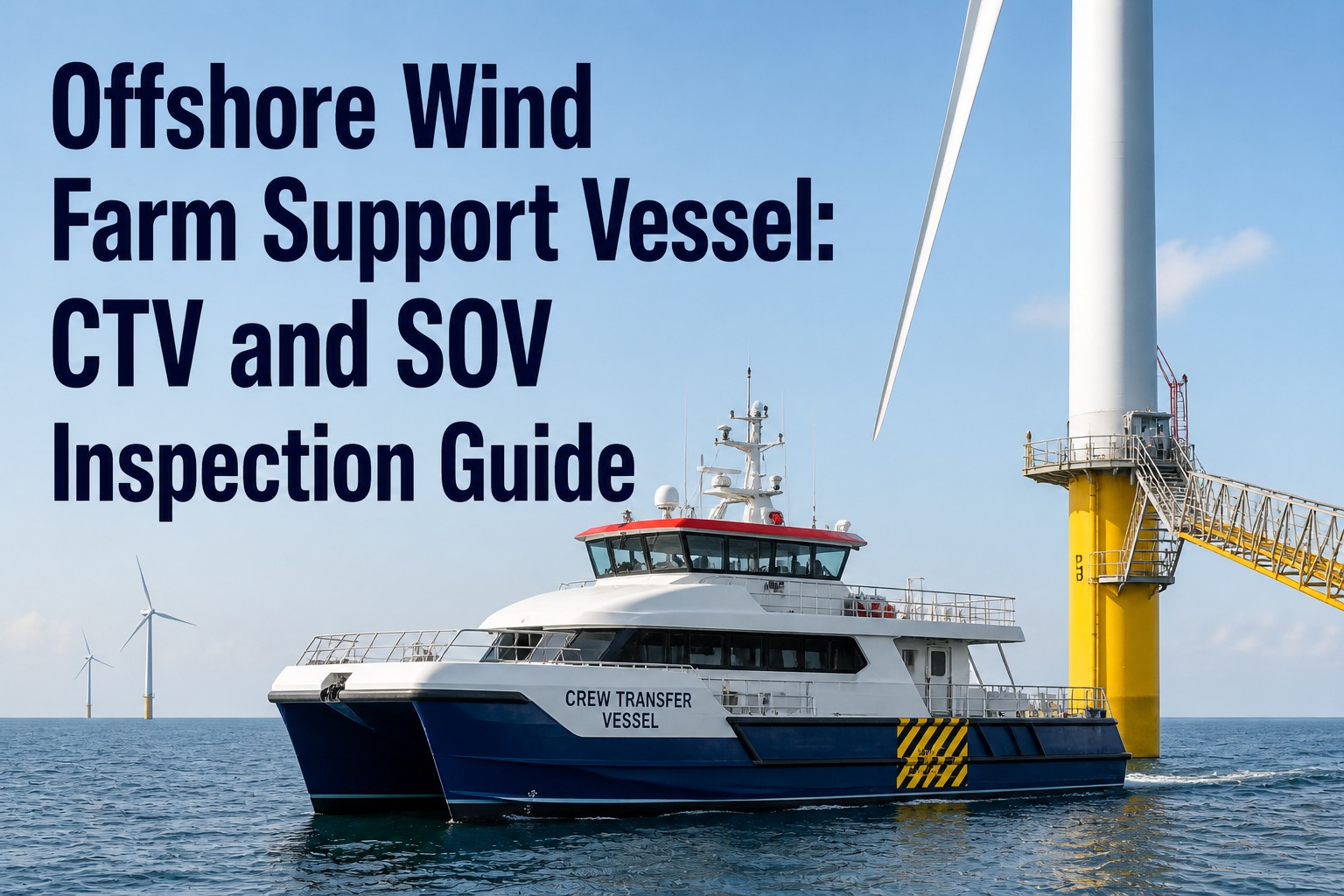
The offshore wind support vessel sector is undergoing the fastest fleet expansion in maritime history. Eight thousand three hundred new turbines are forecast to be installed globally between 2024 and 2030, plus another 15,500 in 2031–2035 — driving global capacity beyond 380 GW. The Tier 1 SOV fleet is set to double from 32 vessels to 64 working units by the end of 2026, while ~480 active CTVs already serve operating wind farms with hundreds more on order. Yet the inspection regime governing these vessels — Crew Transfer Vessels (CTVs), Service Operation Vessels (SOVs), Construction Service Operation Vessels (CSOVs), and the motion-compensated gangways that link them to turbine towers — is barely a decade old. DNV's ST-0358 gangway standard launched only in December 2015. IMCA M254 walk-to-work guidelines were finalised in 2022. HSE issued a 2023 safety bulletin warning of serious injury risk from motion-compensated gangways. The combination of explosive growth and immature regulatory frameworks puts inspection responsibility squarely on operators. Start a free trial of Marine Inspection to digitize CTV and SOV compliance across your offshore wind fleet.
The Offshore Wind Support Vessel Boom in 2026
8,300
Turbines Forecast 2024–30
+15,500 more in 2031–35; 380 GW global capacity by 2035
64
Tier 1 SOVs by End-2026
Doubled from 32 in 2023 — fastest-growing vessel segment
~480
Active CTVs Globally
~400 Tier 1 in Europe alone — UK leads with 300+ vessels
$30B
Market Size by 2032
From $20.45B in 2025 — 7.94% CAGR through 2032
Why Offshore Wind Vessel Inspection Lives in a Class of Its Own
An oil tanker carries cargo. A cruise ship carries passengers. A CTV or SOV carries something different: technicians who will leave the vessel at sea, walking across a moving bridge onto a 100-metre steel tower in open water. Every inspection priority that follows from this reality is unique. Hull and machinery class apply, but they're insufficient. The motion-compensated gangway — covered by DNV ST-0358 since 2015 and IMCA M254 since 2020 — adds a category of inspection that didn't exist a decade ago. The DP system that holds an SOV stationary against a turbine in 2.5m wave height demands continuous verification. The transfer itself is the operation; everything else is preparation. Book a Marine Inspection demo to see how offshore wind operators digitize CTV transfer logs, SOV gangway maintenance, DP function tests, and class society surveys.
The Three Vessel Categories That Serve a Wind Farm
Every offshore wind project in the operations and maintenance phase relies on one of three transfer solutions: CTVs, SOVs, or helicopters. Each has a defined operational profile, weather window, cost structure, and corresponding inspection regime. Most projects use a combination based on distance from shore and project size.
CTV
Crew Transfer Vessel
Profile
Aluminium catamaran, 24–35m, 12–24 passengers (rising to 30+)
Range
Less than 50 km from shore typical
Speed
15–25 knots (up to 30 knots on some)
Transfer
Push-on bow fendering against turbine ladder
Weather
~30–40% downtime in North Sea conditions
Cost
$5.5M (Asia-built) to $12M (US Jones Act)
SOV
Service Operation Vessel
Profile
Diesel-electric, 80–100m, ~60 technicians, hotel onboard
Range
Far-shore wind farms, 30+ km offshore
Charter
Long-term: bound to OEM or operator for 5+ years
Transfer
Motion-compensated gangway, daughter craft, CTV
Equipment
Crane, workshop, spares storage, helideck (some)
Cost
$67–75M (Europe), $97–162M (US Jones Act)
CSOV
Construction Service Operation Vessel
Profile
Larger than SOV, often 100+ technicians
Use
Turbine commissioning, project construction phase
Charter
Short-to-mid term — project-bound
Transfer
Multiple W2W gangways, daughter craft, helicopter
DP class
DP2 standard, DP3 increasingly specified
Lifecycle
Convert to SOV after construction phase
The Tier 1 / Tier 2 / Tier 3 SOV Taxonomy
Industry analysts at Intelatus Global Partners established the SOV tier classification that's now standard reference in the sector. The tier defines what kind of vessel — and what kind of inspection regime — your project is dealing with. Understanding this taxonomy matters because charterers, OEMs and class surveyors apply different criteria to each tier.
TIER 1
Purpose-Built SOV / CSOV
Premium segment — 32 vessels in 2023, 64 forecast end-2026
Designed from keel-up for offshore wind. Integrated W2W gangway, daughter craft handling, technician accommodation, workshop. DP2 minimum, increasingly DP3. Typically diesel-electric with battery hybrid, dual-fuel methanol or LNG capability on newest builds.
Inspection focus: integrated gangway, DP system, daughter craft handling, accommodation systems, hybrid drivetrain
TIER 2
Walk-to-Walk Conversion (Fixed Gangway)
Mostly Gulf of Mexico oil & gas conversions
PSV or MPSV originally built for oil & gas operations, retrofitted with permanently installed motion-compensated gangway. Serves both offshore wind and remaining O&G work. Less integrated than Tier 1 — gangway and vessel systems often supplied by different vendors.
Inspection focus: retrofit gangway integration, original O&G vessel systems, dual-purpose certification, conversion documentation
TIER 3
Temporary Gangway / Spot Charter
Flex capacity for peak demand — short-term opportunistic
Standard MPSV or PSV temporarily fitted with portable motion-compensated gangway (Ampelmann A-type, SMST TAB M, similar). Vessel returns to O&G work between wind charters. Most cost-flexible but requires fresh mobilisation each charter.
Inspection focus: mobilisation surveys, gangway installation certification, sea-fastening, post-mobilisation function tests
Stop Tracking Tier 1, 2, and 3 Vessel Compliance Across Five Spreadsheets
CTV transfer logs, SOV gangway maintenance, DP function tests, class society surveys, IMCA M254 records, charterer audit packs — fleet-wide visibility, mobile capture, exportable on demand.
CTV Hull Types: Six Configurations, Different Inspection Profiles
The "CTV" category is more diverse than most sectors realise. Catamarans dominate the fleet, but six distinct hull configurations are now in service, each with different motion characteristics, transit speeds, weather windows and corresponding inspection priorities.
DOMINANT
Catamaran
~85%
Twin aluminium hulls. Stable platform with good deck space and passenger comfort. The default fleet choice. Inspection: hull aluminium fatigue at high-speed, fender system condition, transom integrity, twin propulsion alignment.
MEDIUM SEAS
SWATH
Niche
Small Waterplane Area Twin Hull — slender struts connect submerged pontoons to topside hull. Excellent motion characteristics in moderate seas, slower transit. Inspection: strut connection fatigue, submerged pontoon integrity, complex hull form NDT.
EFFICIENT
Surface Effect Vessel
Growing
Catamaran with air-cushion plenum between hulls — lift fans pressurise the cushion to reduce wetted surface and drag. High transit efficiency. Inspection: lift fan system, cushion seal integrity, plenum pressure regulation, complex propulsion-cushion interaction.
FAR SEAS
Trimaran
Growing
Three hulls — main hull plus two outriggers. Good combination of monohull efficiency and catamaran stability. Useful for far-from-shore wind farms in irregular seas. Inspection: outrigger connection fatigue, asymmetric loading conditions, three-hull balance.
EMERGING
Hydrofoil
Niche
Foil-borne above hull-speed transition, dramatically reduced motion. Pioneering technology — fewer than five hydrofoil CTVs in service. Inspection: foil structural integrity, foil retraction system, transition control logic, software-driven safety systems.
LEGACY
Monohull
Limited
Conventional single hull. Highest agility in tight spaces (port, near-coastal), lowest stability in seaway. Niche use. Inspection: standard single-hull surveys plus fender and bow access verification.
The Motion-Compensated Gangway: Inspection Center of Gravity
For SOVs, CSOVs, and Tier 2/3 walk-to-work vessels, the gangway IS the operation. Its inspection regime is the single most consequential element of vessel-level compliance. Two foundational standards govern it: DNV ST-0358 (Certification of Offshore Gangways for Personnel Transfer, since December 2015) and IMCA M254 (Guidelines for Walk to Work Operations, finalised 2022 with six appendices). Sign up for Marine Inspection to deploy gangway maintenance and IMCA M254 compliance templates across your W2W fleet.
DNV ST-0358 + IMCA M254 — The Walk-to-Work Inspection Framework
Active Motion Compensation (AMC) System
Sensor Array
Vessel motion sensors detect surge, sway, heave, roll, pitch, yaw. Data feeds to control system at high frequency. Sensor calibration verified at every annual inspection per DNV ST-0358.
Hydraulic Actuators
Three-degree-of-freedom (3DOF) or six-degree-of-freedom (6DOF) actuator arrays adjust gangway tip to maintain stable connection. 6DOF systems (Ampelmann A-type pioneer) the gold standard. Hydraulic pressure tests, ram condition, accumulator function.
Control System Software
Software integrity assurance via simulator testing per DNV's extended certification scheme. Critical safety logic — auto-retraction triggers, push-on force limits, emergency disconnect. Annual function verification mandatory.
Mechanical Components
Telescopic Walkway
Fixed and telescopic sections must extend/retract smoothly. Pinch points and shearing hazards between fixed/sliding components — HSE 2023 bulletin warned of entrapment injuries. Visual inspection at every transfer + scheduled NDT.
Push-On Tip / Connection Point
Gangway tip designed to grip turbine boat-landing or substation push-on point. Connection point design VARIES between turbines and substations — recent incident: gangway broke loose at substation due to design difference. Pre-job verification critical.
Pedestal & Slewing Ring
Foundation supporting gangway on vessel deck. Slewing ring bearing condition, pedestal bolt torque, structural welds. NDT cycle per class society and gangway manufacturer recommendations.
Walkway Surface & Handrails
Slip-resistant flooring, fall-arrest anchors, handrail integrity. End barriers and toe boards. Lighting for low-visibility transfers. Cleaned and inspected each shift.
Operational Procedures (IMCA M254)
Pre-Job Testing
Position gangway ~1m from connection point, visually verify AMC stability and control error within reasonable limits. Verify connection point design fits gangway (turbine vs substation differ — confirmed cause of recent incident).
Auto-Retract Warnings
Auto-retraction must provide audible AND visible warnings allowing users sufficient time to make themselves safe. HSE 2023 bulletin emphasizes this as critical safety control.
Operator Training
Anyone operating an MCG must have sufficient instruction and training, including emergency response procedures. Competence records maintained per IMCA M254 framework.
DP System Verification: Holding Position Against the Turbine
Behind every successful walk-to-work transfer is a Dynamic Positioning system holding the SOV stationary against environmental forces. Wind farms operate in current, wave and wind that would otherwise drive the vessel into the turbine tower. DP class determines what redundancy you have when something fails.
DP1
No Redundancy
Loss of position acceptable. Not used for W2W operations on operational wind farms — single point of failure in propulsion or thruster halts station-keeping. Limited to survey work or pre-job mobilisation moves.
DP2
Single-Failure Tolerant
Standard for offshore wind W2W. Loss of any single active component (thruster, generator, sensor, control system) will not result in loss of position. Industry default for SOVs and most CSOVs in 2026.
DP3
Worst-Case Compartment
Tolerates loss of all DP equipment in any single watertight compartment due to fire or flooding. Increasingly specified on newest CSOVs working on far-shore projects, and on vessels operating around floating offshore wind installations.
Walk-to-Work Operational Safety: The HSE Warning
In 2023, the UK Health and Safety Executive issued a safety bulletin specifically warning of serious injury risk from motion-compensated gangways. Two failure modes drove the bulletin: entrapment in moving parts (fixed/telescopic walkway sections, fixed/moving handrails) and falls from height from the open walkway end. Recent incidents have made the bulletin's findings concrete.
Entrapment / Shearing
Pinch points between fixed and telescopic walkway sections, between fixed and moving handrails. Auto-retraction during transfer is the highest-risk moment — audible AND visible warnings essential.
Inspection control: guard condition, warning system function tests, gap measurements, soft barrier integrity
Fall From Open End
During approach phase or after sudden disconnect, the gangway tip can be exposed without barrier. Crew transferring at the moment of disconnect have fallen from the open end of the gangway.
Inspection control: end-of-gangway barriers, tip-positioning sensors, transfer protocol verification
Connection Point Mismatch
Substation push-on points often differ from turbine boat-landing geometries. A 2024 incident saw a gangway break loose from a substation push-on point because the design differed from previous turbine connections — first transfer succeeded, second failed.
Inspection control: pre-job design verification, gangway-to-structure compatibility check, AMC pre-stability verification
Reduced AMC Performance
Active motion compensation system performance can degrade silently — slower response, drift in calibration, hydraulic pressure decay. Operator and captain may agree to proceed despite visible degradation, leading to incidents.
Inspection control: annual AMC verification per DNV ST-0358, pre-job test refusal protocols, response-time benchmarking
Daughter Craft Operations
Some SOVs deploy daughter craft (small CTV-like boats) for shorter transfers between the SOV and clusters of turbines. Launch and recovery via davits or stern ramp, weather window assessment, crew transfer procedures.
Inspection control: davit / launch system surveys, daughter craft itself certified, MOB recovery drills
Helideck (where fitted)
Some larger CSOVs include a helideck for technician transfer in flyable weather. CAP 437 (UK) and similar national rules apply. Markings, lighting, helicopter approach paths, refuelling arrangements.
Inspection control: CAP 437 compliance audit, friction testing, deck integrity, fire main pressure
The Cost of an Offshore Wind Vessel Inspection Failure
For wind farm operators, vessel availability translates directly into turbine uptime. For vessel owners, charter rates have surged with the demand boom. A failed inspection or a serious W2W incident isn't just expensive — it threatens market position in the fastest-growing segment of offshore shipping.
$$$K/day
Charter Rate Exposure
Premium SOV charter rates have surged through 2024–26 driven by undersupply. Vessel out of service exposes owner to charter penalty terms and replacement-vessel scramble at peak rates.
Audit
Charterer Audits Failed
Major operators (Ørsted, Equinor, Vattenfall, RWE, Iberdrola) run rigorous vessel acceptance audits. Inspection-record gaps, Achilles scoring deficiencies, ISM lapses translate directly to charter loss.
Incident
Serious Injury / Fatality
A W2W incident causing serious injury triggers HSE / national regulator investigation, charterer suspension pending root cause, IMCA incident reporting, P&I claim, reputational damage across the operator's customer base.
Class
Suspended Notation
Class society survey deficiencies on gangway, DP system, or hull and machinery can suspend the relevant class notation. DP-suspended SOVs cannot conduct W2W. Gangway-suspended vessels become Tier 3 spot only.
How Digital Inspection Software Fits the W2W Workflow
For operators managing 5, 20 or 80+ CTVs and SOVs across multiple wind farms, paper systems break under the pace of operations. Digital inspection platforms handle the unique CTV/SOV workflow demands: pre-departure transfer logs, gangway maintenance cycles, DP function tests, IMCA M254 compliance records, charterer audit packs. Book a demo to see W2W-specific workflows.
01
Gangway Maintenance Schedules
DNV ST-0358-aligned gangway maintenance schedules, AMC system verification logs, hydraulic pressure tests, sensor calibration records, software integrity assurance documentation.
02
DP System Function Tests
DP2/DP3 annual proving, FMEA documentation, DP trial reports, sensor failure simulation, redundancy verification — the records charterers and class society require to maintain DP notation.
03
CTV Transfer Logs
Per-transfer records: vessel, turbine ID, weather window, technicians transferred, push-on duration, fender contact pressure, any anomalies. Searchable database for incident investigation.
04
IMCA M254 Compliance
Walk-to-work guideline compliance: pre-job testing records, operator training and competence, emergency procedures, hazard identification framework, induction curriculum delivery.
05
Charterer Audit Packs
Major wind farm operators (Ørsted, RWE, Equinor) run pre-charter and ongoing audits. One-click evidence packs: ISM compliance, ISO 9001 / 14001 / 45001, Achilles records, vessel certifications, gangway certificates.
06
Tier 3 Mobilisation Records
Spot-charter Tier 3 vessels need fresh mobilisation surveys at every project. Sea-fastening certifications, gangway installation certificates, post-mobilisation function tests, trial transfer records.
Run W2W Compliance the Way the Charter Market Demands
DNV ST-0358 gangway records, IMCA M254 compliance, DP function tests, CTV transfer logs, charterer audit packs — Marine Inspection is the platform built for the offshore wind support sector.
Pre-Charter Offshore Wind Vessel Inspection Readiness Checklist
Use this as the pre-charter or pre-mobilisation pressure-test before any major operator audit. Items below cover the full scope of CTV and SOV/CSOV operations including the gangway, DP, accommodation, daughter craft, and certification.
Offshore Wind Vessel Pre-Charter Quick-Check
Vessel Certificates
Cargo Ship Safety Construction / Equipment Certificate current
Class society certificates (DNV, BV, LR, ABS) including DP notation
ISM Document of Compliance and Safety Management Certificate
ISO 9001 / 14001 / 45001 certificates current
Achilles or equivalent supply chain pre-qualification scoring current
Gangway & W2W (SOV/CSOV)
DNV ST-0358 certificate (or equivalent) current
AMC system annual verification complete; sensor calibration records
Hydraulic system pressure test, ram condition, accumulator function logged
Auto-retract audible + visible warnings function-tested
Push-on tip condition; pedestal slewing ring lubrication; bolt torque
IMCA M254 procedures documented; pre-job test protocols followed
DP & Propulsion
DP2 / DP3 annual proving trials complete; FMEA documentation current
All DP sensors calibrated; redundancy verified; failure simulation tested
Thruster condition; main propulsion alignment; emergency stop function
Battery hybrid / dual-fuel systems (if fitted) — function tested
Volvo Penta IPS / waterjets / fixed pitch propellers (CTV) — alignment
Crew, Accommodation & Daughter Craft
Crew certificates including W2W / MCG operator competence (IMCA M254)
Accommodation systems: HVAC, fresh water, sewage, galley, refrigeration
Workshop & spares storage operational; safety signage current
Daughter craft (where fitted) certified; davit launch system function-tested
Helideck (where fitted) CAP 437 compliance audit current
MOB recovery, fire, abandon-ship drills per schedule; records exportable
Frequently Asked Questions
What's the difference between a CTV, an SOV and a CSOV?
CTVs (Crew Transfer Vessels) are smaller aluminium catamarans (typically 24–35m) that transfer 12–24 technicians daily on short voyages from shore to wind farms within ~50 km. SOVs (Service Operation Vessels) are 80–100m diesel-electric vessels with onboard accommodation for ~60 technicians, typically on long-term charter (5+ years) supporting O&M of operating wind farms. CSOVs (Construction Service Operation Vessels) are larger versions of SOVs designed for the construction phase — typically supporting 100+ technicians during turbine installation and commissioning. CSOVs are normally on shorter, project-bound charters.
What's a Tier 1, 2, or 3 SOV?
Industry analyst Intelatus Global Partners established the SOV tier classification. Tier 1 are purpose-built SOVs/CSOVs designed from keel-up for offshore wind, with integrated W2W gangways and full accommodation — the premium fleet. Tier 2 are walk-to-walk vessels converted from oil & gas (mostly Gulf of Mexico PSVs / MPSVs) with permanently installed motion-compensated gangways. Tier 3 are oil & gas vessels with temporary gangways fitted for spot wind charters, returning to O&G work between assignments.
What inspection standards apply to motion-compensated gangways?
Two principal standards. DNV ST-0358 (Certification of Offshore Gangways for Personnel Transfer, launched December 2015) is the foundational technical certification scheme. It covers structural design, motion compensation system performance, control system software integrity, and certification cycle. IMCA M254 (Guidelines for Walk-to-Work Operations, originally October 2020, completed with six appendices in 2022) covers operational procedures, training, hazard identification, and emergency response. The UK HSE issued a 2023 safety bulletin specifically warning of injury risks and required inspection regime expectations.
What DP class do offshore wind support vessels need?
DP2 is the standard for SOV W2W operations on operating wind farms. DP2 means loss of any single active component (thruster, generator, sensor, control system) will not result in loss of position. DP3 — which tolerates loss of all DP equipment in any single watertight compartment due to fire or flooding — is increasingly specified on newest CSOVs and on vessels working around floating offshore wind installations. DP1 is not used for W2W operations.
Why are catamarans dominant in the CTV fleet?
Twin hulls offer the best balance of stability for passenger comfort, deck space for technician movement and equipment, transit speed, and structural simplicity. The dominant CTV configuration is a 25–27m aluminium catamaran with twin propulsion (waterjets or, increasingly, Volvo Penta IPS quad — featuring in 50%+ of new builds). Other hull types — SWATH, surface effect, trimaran, hydrofoil — fill specific niches but together represent under 15% of the fleet.
How is the offshore wind support vessel market growing?
Faster than any other commercial vessel segment. Global capacity is forecast to grow to ~380 GW by 2035 (excluding China), driving demand for ~8,300 new turbines installed 2024–2030 and another 15,500 in 2031–2035. The Tier 1 SOV fleet alone is forecast to double from 32 vessels (2023) to 64 by end-2026. The US market presents a $1B-plus opportunity for shipyards: 60–130 long-term CTVs needed plus 40–80 SOVs through 2035, with Jones Act content requirements driving local construction. Worldwide, ~480 active CTVs serve operating wind farms with hundreds more under contract.
How does Marine Inspection support offshore wind vessel workflows?
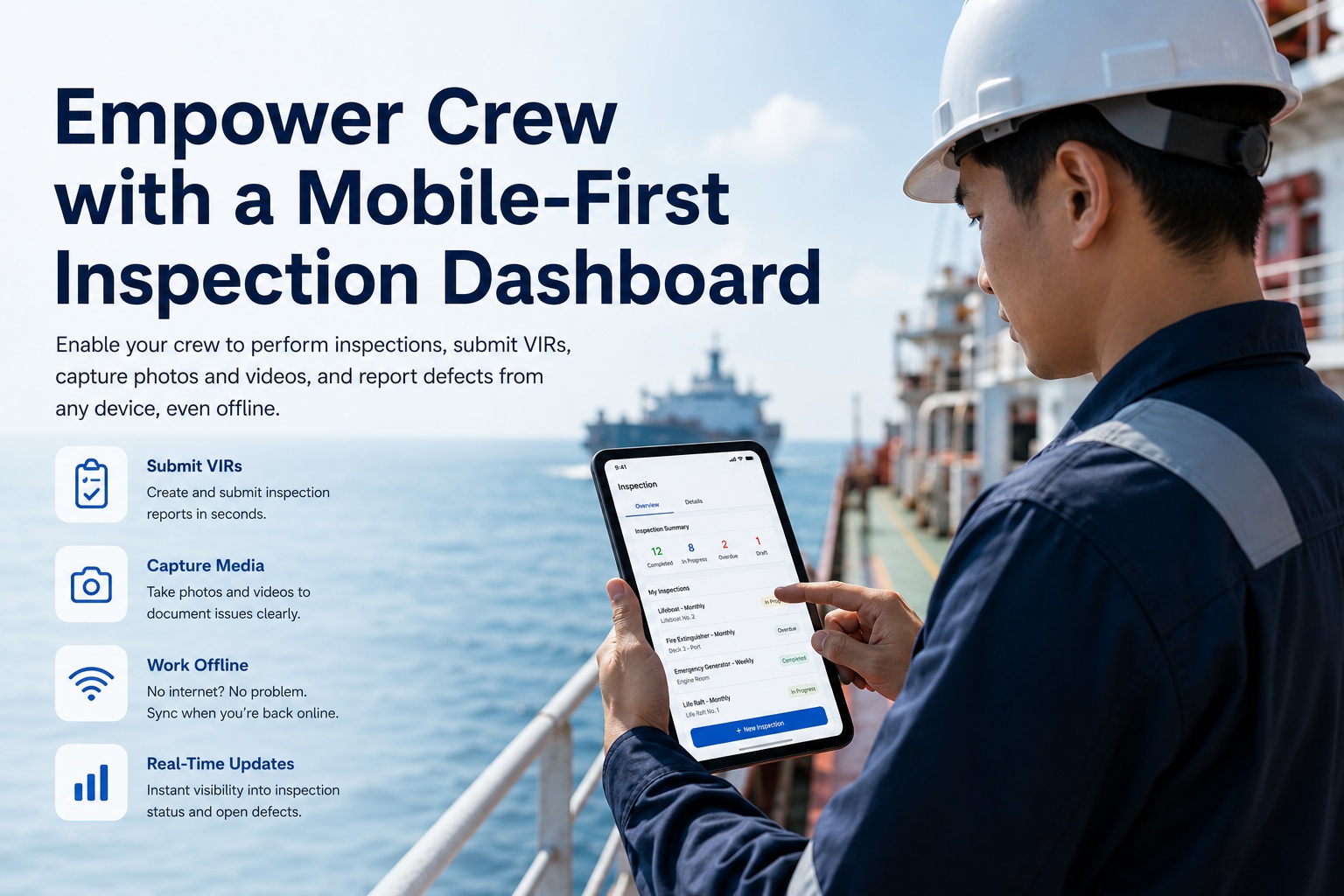
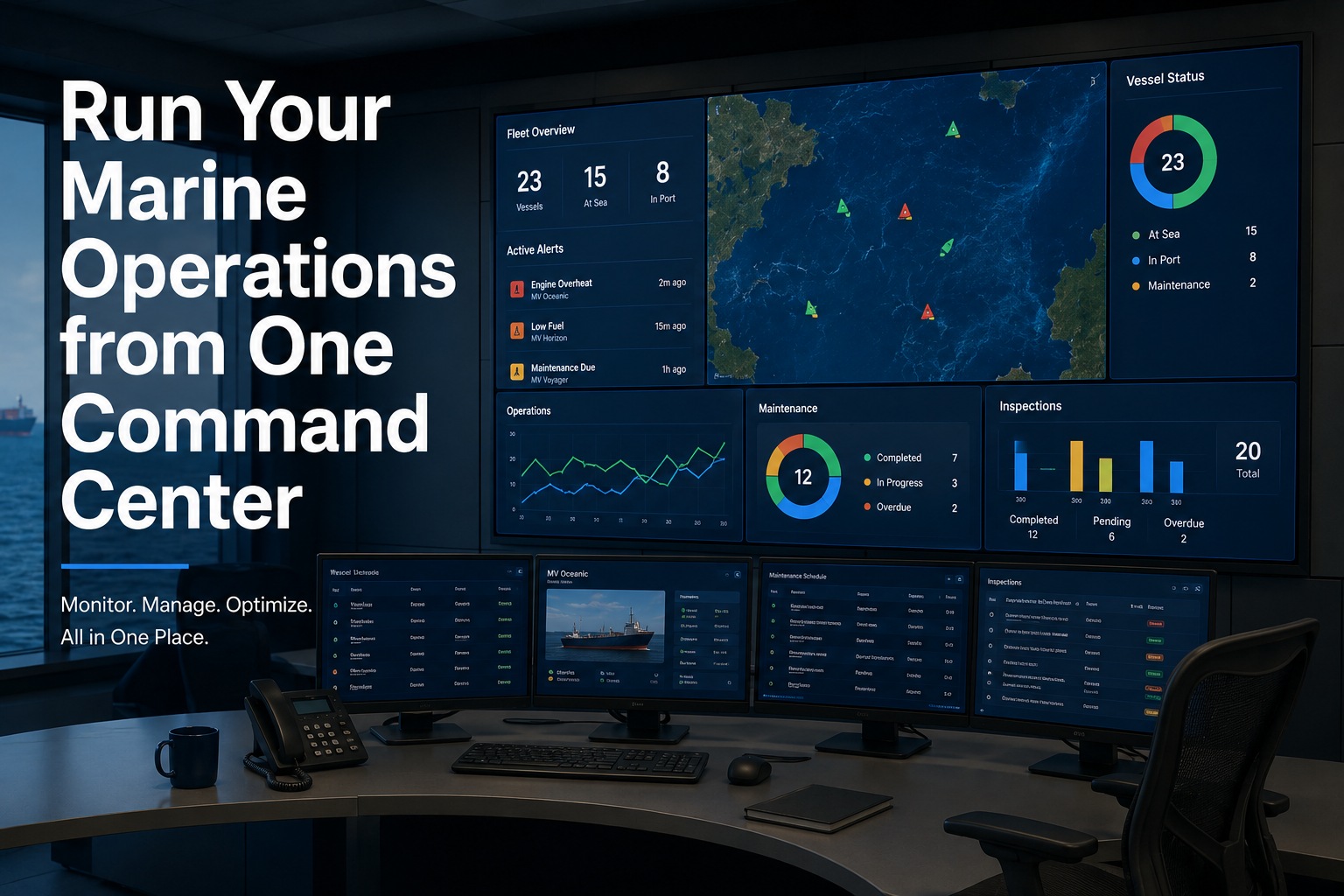
Pre-loaded templates for DNV ST-0358 gangway certification cycles, IMCA M254 walk-to-work procedures, DP2/DP3 annual proving trials, CTV transfer logs, charterer audit packs (Ørsted, RWE, Equinor, Iberdrola formats), Achilles scoring documentation, and ISO 9001/14001/45001 records. Mobile capture for ship's officers at remote project sites with offline-first design, fleet-wide dashboards for shore management, and exportable evidence packs for class society / charterer / port state audits — all on one cloud platform built for offshore wind operators.
8,300 New Turbines by 2030 — Run Your Wind Fleet Audit-Ready
CTV transfer logs, SOV gangway maintenance, DP function tests, IMCA M254 compliance, charterer audit packs — Marine Inspection is the single platform for every offshore wind vessel inspection workflow.