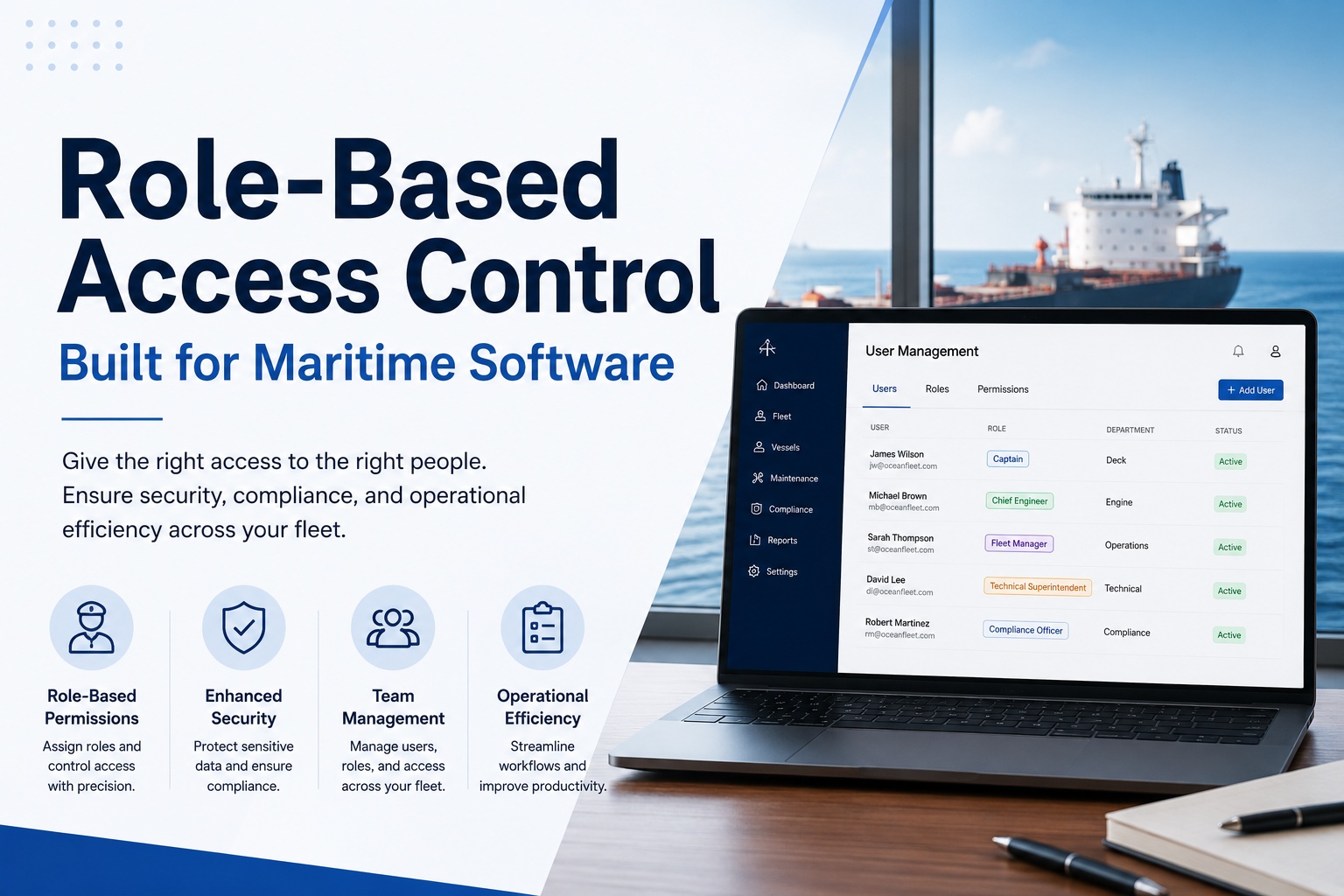
The most common access-control failure on a commercial vessel in 2026 is not a sophisticated cyberattack — it is a master who shares the chief engineer's login because his own account expired three weeks ago and the IT helpdesk has not responded, an ex-crew member whose access is still active four months after sign-off, and a charter-party broker emailing screenshots of the maintenance dashboard to a counterparty because the system has no read-only external view. Maritime fleet software accumulates these problems faster than shore-side enterprise software because the operational reality drives the access pattern: vessels rotate crews every four months, three watchkeeping shifts run continuously, port surveyors and class auditors need data on demand, charterers want visibility into compliance status, and shore-side teams from procurement to commercial all need different cuts of the same vessel data. Without role-based access control built specifically for the maritime hierarchy, the result is either over-broad permissions (which create the security holes that IMO Resolution MSC.428(98) was written to close) or under-broad permissions (which create the workflow friction that drives crews to share credentials). A purpose-built RBAC system for marine software solves both problems simultaneously. Start a free trial of Marine Inspection to see role-based access designed for the realities of vessel and shore operations.
Role-Based Access · Maritime · 2026
Give Every User Only the Data They Need. Every Captain. Every Engineer. Every Auditor.
Maritime-native role hierarchy from cadet to CFO, IMO MSC.428(98) cyber-compliance audit evidence, IACS UR E27 alignment, NIST Cybersecurity Framework mapping. Onboard. Shore-side. External auditors. One platform, twelve plus role templates, zero shared passwords.
Permission Matrix · Live
View
Edit
Approve
Master
Chief Eng.
2nd Engineer
DPA Shore
Class Surveyor
Charterer
Full
Partial
None
The Six Access-Control Failures Every Maritime Operator Has Seen
Before discussing what role-based access looks like done right, it helps to identify the failure modes that drive the demand. Every fleet operator over a certain size has experienced most of these. Each one represents an audit-evidence gap, a security risk, or both.
SHARED
Shared Login Across Engine Department
"Engineer1" account used by chief, 2nd, 3rd engineer, and cadets. Audit log shows everything done by one user. Accountability traceable to no one specific person. Class auditor question goes unanswered.
STALE
Ex-Crew With Active Access
Officer signed off four months ago. Account never offboarded. Login still works. Could read inspection reports, work orders, defect records. Common audit finding under IMO MSC.428(98) cyber risk reviews.
OVER
Everyone Is Effectively Admin
Initial implementation gave broad access "to avoid blockers." Six months later, everyone can edit everything. Junior cadet can close work orders signed off by chief engineer. Separation of duties non-existent.
UNDER
Workflow Friction Drives Workarounds
Permissions so tight that masters cannot file routine inspections without raising a ticket. Workarounds emerge: shared logins, screenshot emails, paper backups. The system designed to prevent risk creates it.
EXTERN
External Stakeholders Get Email Screenshots
Class surveyor needs maintenance evidence. Charterer wants compliance status. P&I surveyor wants incident records. No external read-only role exists. Information leaves the system as email attachments.
AUDIT
No Audit Trail For Permission Changes
Who granted that permission? When? Approved by whom? System has no record. DOC audit reviewer asks for evidence. Answer requires reconstructing from email chains and IT helpdesk tickets.
The Maritime Role Taxonomy — Twelve Plus Roles That Actually Map to Operations
Generic enterprise software ships with three or four user roles — admin, manager, user, viewer. Maritime operations require a richer taxonomy because the stakeholder map is wider and the compliance evidence trail must reflect each role's specific responsibility. The twelve role categories below cover the practical envelope for a commercial fleet, with sub-roles within each category for specific responsibilities. Book a Marine Inspection demo to see the role library configured for your fleet structure.
ONBOARD · BRIDGE
Master
Top-level vessel authority. Full access to all vessel data, sign-off on critical inspections, electronic logbook authority, voyage and port records.
Chief Officer
Deck operations, cargo records, stability calculations, mooring, lifesaving equipment. Can countersign inspections within scope.
Watch Officer / 2nd, 3rd
Watch records, navigational data, voyage events. Cannot edit certificates or close superintendent-flagged defects.
ONBOARD · ENGINE
Chief Engineer
Full engine room data authority. Work order approval, parts requisition sign-off, machinery certificate management, oil record book.
2nd Engineer
Auxiliary systems, fuel management, lube oil, scheduled maintenance execution, work order completion within delegated scope.
3rd / 4th Engineer / ETO
Cooling systems, compressors, electrical systems, instrumentation. Time logging, defect capture, no system-level approval.
SHORE · TECHNICAL
DPA / HSEQ Manager
ISM compliance, audit findings, near-miss reports, drill compliance, deficiency closure across fleet. Cyber-incident escalation owner per MSC.428(98).
Technical Superintendent
Vessel-level technical oversight, work order approval, parts and budget authority, drydock planning, class survey coordination.
Fleet Manager
Multi-vessel rollup, KPI dashboards, capital allocation, charter acceptance, deployment planning. Read across all vessels, edit within scope.
SHORE · COMMERCIAL & FINANCE
Commercial / Chartering Manager
Charter party records, voyage P&L, demurrage, freight rates, ETS allowance positions. Read-mostly on technical data, write on commercial.
CFO / Finance Director
Vessel-level OPEX, fleet ROI, budget variance, audit-trail review. Read fleet-wide, write only on financial categorization and approval workflows.
Procurement / Crewing
Purchase orders, supplier management, crew payroll, manning schedules. Scoped write authority within their function, read on related areas.
SHORE · IT & CYBER
Cyber Risk Officer
Permission audit trail review, role assignment governance, MSC.428(98) evidence. Read all access logs, no operational data write authority.
System Administrator
User onboarding and offboarding, role provisioning, account locks. Cannot self-grant operational data permissions — separation of duties enforced.
Vendor Tech Support
Time-bounded access for support tickets only. Auto-revoke after ticket closure. All actions logged with vendor identity and ticket reference.
EXTERNAL · TIME-BOUND
Class Surveyor
Read-only access to class-relevant evidence: certificates, surveys, work orders, defect closure. Time-bounded to survey window. No edit, no export of bulk data.
Charterer Auditor / Vetting
Read-only on SIRE 2.0 / charterer-relevant records. Scope limited to vessels under charter consideration. Time-bounded to audit window.
P&I & Insurance Surveyor
Incident records, defect closure history, drill compliance, claims-relevant evidence. Read-only with full audit logging of every record viewed.
The Three Foundational Principles Every Maritime RBAC System Must Honor
Three principles from foundational access-control literature underpin every credible RBAC implementation, maritime or otherwise. Maritime applications add operational realities — crew rotation, satellite-link constraints, multi-jurisdictional regulatory footprint — but the underlying principles are non-negotiable.
01
Principle of Least Privilege
Each user role grants only the permissions needed to complete that role's tasks — nothing more. A 3rd engineer logs maintenance and captures defects but cannot close superintendent-flagged work orders. A class surveyor reads class-relevant evidence but cannot edit anything. Limits the damage from compromised accounts and reduces opportunities for both insider and outsider misuse.
PoLP
02
Separation of Duties
Critical operations require multiple parties. The chief engineer who logs a defect cannot also approve its closure without a superintendent counter-sign. The procurement officer who creates a vendor cannot also approve payments to that vendor. Constrained RBAC encodes these separation rules — vital for fraud prevention and required by class society audit expectations.
SoD
03
Role Hierarchy With Inheritance
Senior roles inherit the permissions of junior roles plus role-specific additions, rather than being defined from scratch. Master inherits everything Chief Officer can do plus master-specific authorities. This NIST/ANSI/INCITS RBAC standard hierarchy reduces role duplication, simplifies governance, and makes the role library maintainable as the organization evolves.
Hierarchy
The 2026 Maritime Cyber Regulatory Stack RBAC Must Satisfy
Marine RBAC is not just operational hygiene — it is a regulatory requirement under multiple overlapping frameworks. The four most directly applicable to access control are summarized below. Auditors at DOC verification and class society reviews will ask for evidence of access control practice; "we have RBAC" without supporting documentation rarely satisfies the question.
IMO
MSC.428(98) — Maritime Cyber Risk in SMS
Mandatory since 1 January 2021. Cyber risk management — including access control and account management — must be incorporated into the Safety Management System under the ISM Code. Verified at DOC annual verification by flag state or recognized organization.
IACS
UR E26 / E27 — Cyber Resilience Class
IACS Unified Requirements E26 (system integration) and E27 (essential onboard systems) mandatory for newbuilds with construction contracts after 1 July 2024. Vendors and yards must demonstrate access control practice including default-account removal and least-privilege configuration.
USCG
Cybersecurity Final Rule
US Coast Guard cybersecurity rule effective 16 July 2025 with phased implementation milestones. Access control evidence — unique logins, least privilege, account offboarding records — central to the audit packet for vessels trading to US ports.
EU
NIS2 Directive
NIS2 entered force in 2023, with EU member states required to transpose into national law by 17 October 2024. Applies to operators of essential services including major ports and shipping companies. Access control governance is a required reporting element.
NIST CSF
NIST Cybersecurity Framework Mapping
IMO Guidelines on Maritime Cyber Risk Management (MSC-FAL.1/Circ.3) align with the NIST Cybersecurity Framework's six functions: Govern, Identify, Protect, Detect, Respond, Recover. RBAC sits primarily under Govern (defining roles and responsibilities) and Protect (enforcing access control). Audit-grade RBAC delivers evidence for both functions in the format auditors expect to see.
How Maritime RBAC Compares to Generic Enterprise Permissions
Generic enterprise RBAC platforms work for shore-based offices but break down under marine operational realities. The comparison below summarizes the structural differences. Scroll horizontally on mobile to see the full table.
| Capability |
Shared Logins / Excel |
Generic Enterprise RBAC |
Maritime-Native RBAC |
| Pre-built role templates |
None |
Generic admin / manager / user |
12+ maritime-specific roles |
| Crew rotation handling |
Manual sharing of credentials |
Manual reassignment per cycle |
Automated handover with new crew login |
| Offline / satellite operation |
Local copy with no sync |
Often online-only |
Offline auth, syncs when reconnected |
| External read-only access |
Email screenshots |
Custom role build per case |
Class surveyor, charterer, P&I templates |
| Time-bounded access |
Manual revocation |
Sometimes supported |
Auto-expire on survey close |
| Vessel-scoped permissions |
All-or-nothing |
Cost-center workaround |
Per-vessel native scope |
| Watch-rotation handover |
Same login for all watches |
Manual per shift |
Watch-aware role assignments |
| Permission change audit trail |
Email chains |
Standard logs |
Immutable, MSC.428(98)-grade |
| Separation of duties enforcement |
Honor system |
Configurable rules |
Pre-built marine SoD patterns |
| Vendor / support time access |
Permanent vendor account |
Configurable expiry |
Ticket-bound, auto-revoke |
| Class survey evidence pack |
Manual screenshot binder |
Custom report build |
One-click access-control evidence |
| NIST CSF / MSC.428(98) mapping |
None |
Generic ISO 27001 alignment |
Built-in maritime framework mapping |
Stop Failing DOC Audits Over Access Control Hygiene
Marine Inspection delivers maritime-native RBAC with 12+ pre-built role templates, MSC.428(98) audit evidence, IACS UR E27 alignment, and time-bounded external access for class surveyors and charterers. Cyber-compliance posture moves from manual reconstruction to one-click evidence pack.
The Six Permission Dimensions Every Maritime Role Spans
Real-world role definitions span six dimensions of permission. Not just "what can the user see" but "on which vessel, for what time window, with what action authority, under what approval chain, with what audit trail." Generic RBAC stops at the first dimension; maritime RBAC must handle all six.
A
Data Scope
Which records the role can see — work orders, certificates, defects, financial data, crew records. The classical "view permission" dimension that generic RBAC handles well.
B
Action Authority
What operations the role can perform — view, create, edit, delete, approve, sign-off. Maritime RBAC adds sign-off authority for class-relevant evidence and master countersign requirements.
C
Vessel Scope
Which vessels the role applies to. A technical superintendent may have authority over six specific vessels; a fleet manager spans all. Per-vessel native scoping is non-negotiable in mixed-fleet operations.
D
Time Bounds
When the role is active. Class surveyor access expires at survey close. Vendor support access expires at ticket closure. Crew member access expires on sign-off. Auto-revoke without manual administration.
E
Approval Chain
Which actions require which other roles to countersign. Defect closure requires chief engineer plus superintendent. Budget overrun requires fleet manager plus CFO. Encoded as RBAC constraints rather than honor-system process.
F
Audit Trail Granularity
What gets logged for which actions. Class-relevant evidence needs full immutable trail with timestamp, user identity, action, before-and-after states. Routine actions log lighter. Maritime RBAC tunes audit depth per data category.
Five Workflows Where Marine-Native RBAC Earns Its Implementation Cost
Beyond the regulatory and security baseline, well-designed RBAC pays back through specific workflows that reduce friction or eliminate audit findings. Each of the five below corresponds to a real operational pattern observed in fleet implementations.
01
Crew Rotation Handover Without Friction
Outgoing chief engineer signs off; incoming chief engineer receives the role and all in-progress work orders, defect logs, and parts requisitions on day one. Account creation, permission grant, handover transfer — minutes, not days.
02
Class Surveyor Pre-Authorized Access
Class surveyor scheduled for week 32 survey. RBAC provisions read-only access to class-relevant evidence one week before, auto-expires three days after survey close. No manual ticket. No screenshot email. Surveyor walks aboard with everything ready.
03
Charterer Vetting Without Data Leakage
Charterer evaluating vessel for 6-month time charter. RBAC provisions scoped read access to that vessel's SIRE 2.0 records, certificates, and recent inspection history. No access to commercial data, other vessels, or crew records.
04
Vendor Support With Ticket-Bound Access
Vendor opens support ticket. RBAC grants tech support engineer time-bounded access scoped to the affected vessel and module only. Access auto-revokes when ticket closes. All actions logged against ticket reference.
05
DOC Audit Evidence in One Click
Flag-state auditor arrives for DOC verification. Cyber risk officer generates one-click evidence pack: role assignments, permission audit trail, offboarding records, separation-of-duties enforcement, time-bounded external access logs. Audit time cut from days to hours.
Implementation Roadmap — From Decision to Live RBAC in 6-8 Weeks
Maritime RBAC deployment is faster than enterprise IAM rollout because the role library is purpose-built rather than designed from scratch. Most mid-size fleets reach productive use within 6-8 weeks, with phased role assignment by vessel cohort. Book a demo to see the deployment timeline against your fleet structure.
Wk 1
Role Mapping Workshop
Existing organizational structure mapped to maritime role library. Custom role variations identified. Separation of duties patterns confirmed. Approval chains documented per critical action.
Wk 2-3
User Provisioning & Single Sign-On
User accounts provisioned per actual organizational structure. SSO integration with existing identity provider where applicable. Multi-factor authentication configured for shore-side admin roles.
Wk 4-5
Pilot Vessel & External Access
Pilot vessel cohort active with full RBAC. External access templates for class surveyor, charterer auditor, P&I surveyor configured and tested with real users. Audit trail validated end-to-end.
Wk 6-8
Fleet Rollout & DOC Evidence
Phased onboarding of remaining fleet. Cyber risk officer trained on permission audit and evidence pack generation. First DOC audit run with one-click access-control evidence rather than manual reconstruction.
Why Marine Inspection For Maritime RBAC
Marine Inspection delivers RBAC built around the realities of vessel and shore operations: 12+ pre-built role templates spanning bridge, engine, shore-technical, shore-commercial, IT/cyber, and external audit roles; offline authentication for at-sea operation; time-bounded external access for class surveyors and charterers; immutable audit trail meeting MSC.428(98) and IACS UR E27 evidence requirements. Sign up for a free trial or book a live demo to see role-based access designed for maritime operations within weeks.
01
12+ Maritime Role Templates Pre-Built
Master, chief engineer, 2nd engineer, DPA, technical superintendent, commercial manager, CFO, class surveyor, charterer auditor, vendor support — all configured out of the box with appropriate scope, action authority, and audit trail.
02
Six-Dimension Permission Model
Data scope, action authority, vessel scope, time bounds, approval chain, audit trail — all configurable per role rather than the single-dimension permission model of generic enterprise RBAC.
03
MSC.428(98) Audit Evidence Built In
Cyber risk audit evidence pack generated on one click with role assignments, permission audit trail, offboarding records, and separation-of-duties enforcement. NIST Cybersecurity Framework mapping included.
04
Offline Authentication For Open Ocean
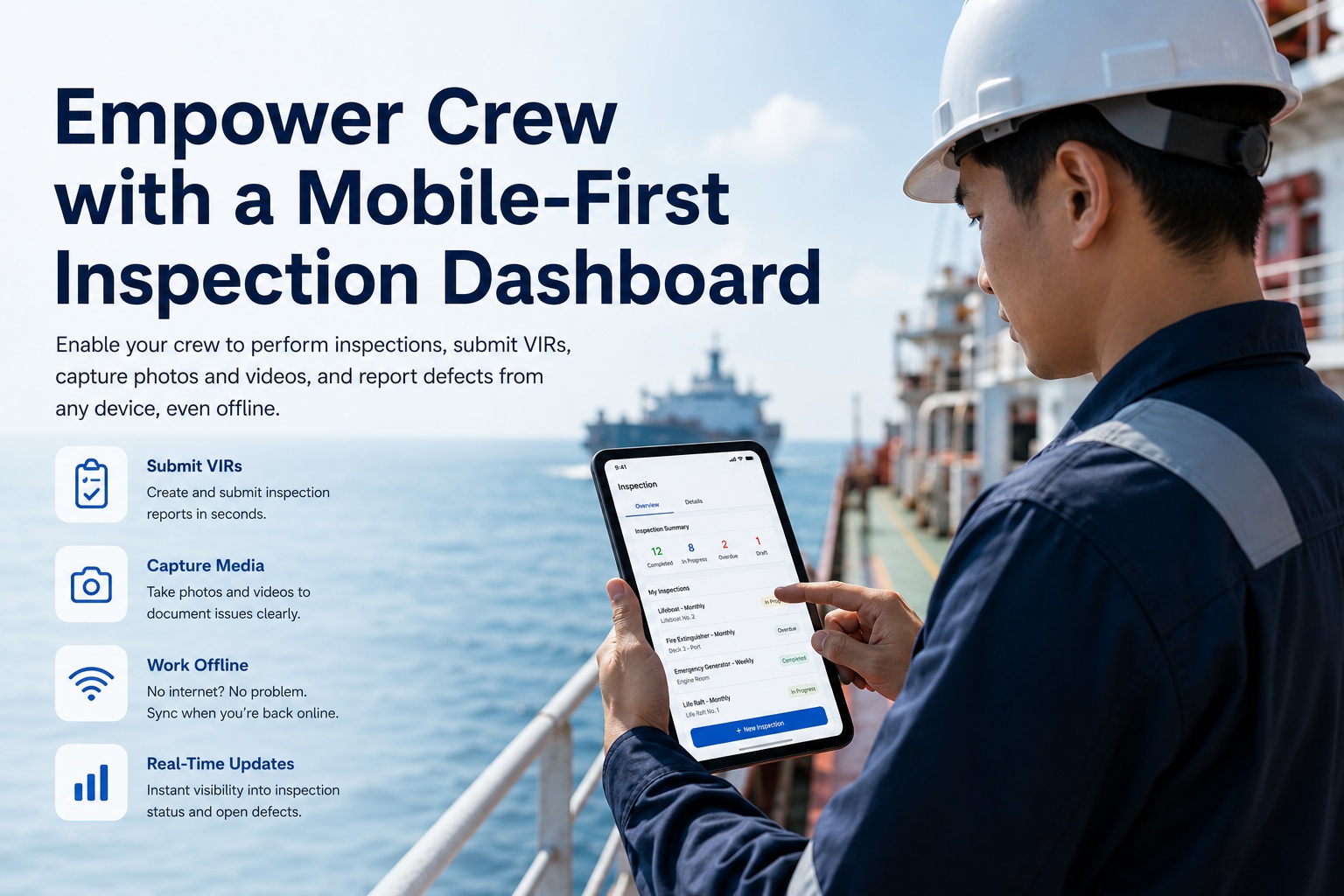
Authentication and permission enforcement work without satellite connectivity. Crew login, work order signoff, and audit trail capture continue at sea. Sync to shore the moment connectivity returns.
05
Time-Bounded External Access Templates
Class surveyor, charterer auditor, P&I surveyor, vendor tech support — all with pre-built time-bound, scope-bound templates. Auto-expire on event. No manual revocation tickets. No data leakage through email.
06
6-8 Week Deployment
From decision to live RBAC for typical mid-size fleets in 6-8 weeks. Role mapping workshop, user provisioning with SSO, pilot vessel rollout, full fleet onboarding. No enterprise IAM project required.
Walk Into the Next DOC Audit With One-Click Access Evidence
Twelve plus maritime role templates, six-dimension permission model, MSC.428(98) audit evidence, IACS UR E27 alignment, NIST Cybersecurity Framework mapping, offline authentication, time-bounded external access — all in one platform built for maritime operations. Six to eight week deployment. Book a demo or start a free trial today.
Frequently Asked Questions
What is role-based access control and why does it matter for maritime?
Role-based access control (RBAC) is an authorization model where access permissions are mapped to organizational roles rather than to individual users — and users are then assigned to those roles. Instead of granting each crew member custom permissions, the system defines roles like "Master," "Chief Engineer," "DPA," and "Class Surveyor," each with appropriate permissions for that job function. Users get permissions only through the roles they hold. For maritime, RBAC matters because the stakeholder map is wider than typical shore-based operations (onboard crew, shore staff, external auditors, regulators) and the regulatory environment specifically requires evidence of access control practice — IMO Resolution MSC.428(98) since 2021, IACS UR E26/E27 for newbuilds since July 2024, USCG Final Rule since July 2025.
What is the principle of least privilege?
The principle of least privilege (PoLP) is a foundational security principle stating that each user should receive only the permissions needed to complete their job function — nothing more. In maritime context: a 3rd engineer logs maintenance and captures defects but does not have authority to close work orders signed off by the chief engineer; a class surveyor reads class-relevant evidence but cannot edit anything; a charterer auditor sees the vessel under consideration but not other fleet vessels or commercial data. PoLP limits the damage from compromised accounts and reduces opportunities for both insider misuse and outsider attack. RBAC implements PoLP by purpose-building roles around specific job functions rather than granting broad access "for convenience."
What is separation of duties and how does maritime RBAC enforce it?
Separation of duties (SoD) is a security pattern requiring multiple parties for critical operations — preventing dangerous concentrations of authority and reducing fraud risk. The classic example: the user who creates a vendor cannot also approve payments to that vendor. In maritime context: the chief engineer who logs a defect cannot also approve its closure without superintendent counter-sign; the procurement officer who creates a purchase order cannot also approve payment to the supplier; the user who can grant role assignments cannot self-grant operational data permissions. Constrained RBAC (the third level of the NIST/ANSI/INCITS standard) encodes these separation rules into the system rather than relying on honor-system process.
How does RBAC support IMO MSC.428(98) compliance?
IMO Resolution MSC.428(98) requires cyber risk management — including access control and account management — to be incorporated into the Safety Management System under the ISM Code, verified at DOC annual verification since 1 January 2021. The audit packet expectations include evidence of unique logins per crew member, least privilege configuration, account offboarding records, separation of duties enforcement, and roles and escalation lists with deputies for cyber incidents. Maritime RBAC delivers all of this as one-click evidence rather than manual reconstruction. The IMO framework also aligns with the NIST Cybersecurity Framework's six functions (Govern, Identify, Protect, Detect, Respond, Recover) — RBAC sits primarily under Govern and Protect.
How does maritime RBAC handle external auditors and surveyors?
Best practice maritime RBAC includes pre-built templates for external time-bounded access. Class surveyor template: read-only access to class-relevant evidence, scoped to the vessel under survey, time-bounded to the survey window with automatic expiry afterwards. Charterer auditor template: read-only access to SIRE 2.0 and charterer-relevant records on the specific vessel under charter consideration, time-bounded to the audit window. P&I surveyor template: read-only access to incident records, defect closure history, and claims-relevant evidence. Vendor tech support: time-bounded scoped access tied to a specific support ticket, auto-revoking when the ticket closes. All actions logged with the external user's identity for full audit trail.
How does RBAC handle crew rotation?
Crew rotation is a maritime-specific operational reality that generic enterprise RBAC handles poorly. Best practice maritime RBAC supports automated handover: outgoing chief engineer signs off; the chief engineer role transfers to the incoming officer; in-progress work orders, open defects, and parts requisitions move to the new owner; the outgoing officer's account is deactivated with full audit retention. The whole transition runs in minutes rather than days, and there is no period where either both officers have the role or neither does. This eliminates the most common workaround of crew rotation — sharing credentials during the handover gap.
What audit trail requirements does maritime RBAC satisfy?
Maritime RBAC must produce immutable audit trails covering: every permission grant or change with timestamp, granting user, justification, and approval chain; every login with timestamp and source; every action taken with user identity, vessel, record affected, before-and-after state; every external access event with surveyor or auditor identity, scope, and duration; every account offboarding with timestamp and approval. The audit trail must be tamper-proof for class society review and DOC audit evidence. Granularity is tuned per data category — class-relevant records get full immutable logging, routine actions log more lightly to control storage cost.
How does Marine Inspection deliver RBAC for maritime operations?
Marine Inspection delivers role-based access control built around the operational realities of vessels and shore: 12+ maritime-specific role templates spanning bridge, engine, shore-technical, shore-commercial, IT/cyber, and external audit categories. Six-dimension permission model covering data scope, action authority, vessel scope, time bounds, approval chain, and audit trail granularity. Offline authentication for at-sea operation with sync on connectivity restoration. Time-bounded external access templates for class surveyor, charterer auditor, P&I surveyor, and vendor tech support. Immutable audit trail meeting IMO MSC.428(98), IACS UR E27, and NIST Cybersecurity Framework requirements. Single sign-on integration with existing identity providers. Six to eight week deployment for typical mid-size fleets. Book a live demo or start a free trial to evaluate against your fleet structure.