The marine insurance landscape that closes the 2026 fiscal year is structurally different from the one that opened it. February 20, 2026 saw the International Group P&I renewal conclude in the 5% range with most clubs reporting negative combined ratios and pool claims at new record highs. Then on March 1, 2026, Gard, Skuld, NorthStandard, the London P&I Club, and the American Club issued coordinated 72-hour cancellation notices for war risk extensions across the Middle East — pulling cover effective March 2-5 as the US-Iran conflict escalated, and triggering a collapse of Strait of Hormuz transit traffic from a seven-day average of 77 crossings per day down to 4 by March 3. The Joint War Committee of the Lloyd's Market Association expanded its high-risk area listing to include waters around Bahrain, Djibouti, Kuwait, Oman, and Qatar. Additional Premiums for Gulf transits surged from approximately 0.2% of vessel value to as much as 1%. Meanwhile EU sanctions designations against shadow fleet vessels reached 43 in a single package — and P&I clubs immediately ceased coverage on every designated vessel, with an S&P Global study finding 82% of 940 high-risk tankers without any IG P&I coverage. None of this is annual administrative paperwork. Vessel insurance documentation has become an operational risk capability — the question is whether every policy, every endorsement, every renewal deadline, and every certificate is current, traceable, and audit-defensible across the fleet. Start a free trial of Marine Inspection to centralize every insurance document on one audit-grade platform.
Marine Insurance Document Management · 2026
Every Policy. Every Endorsement. Every Renewal. One Platform Built For The 2026 Insurance Reality.
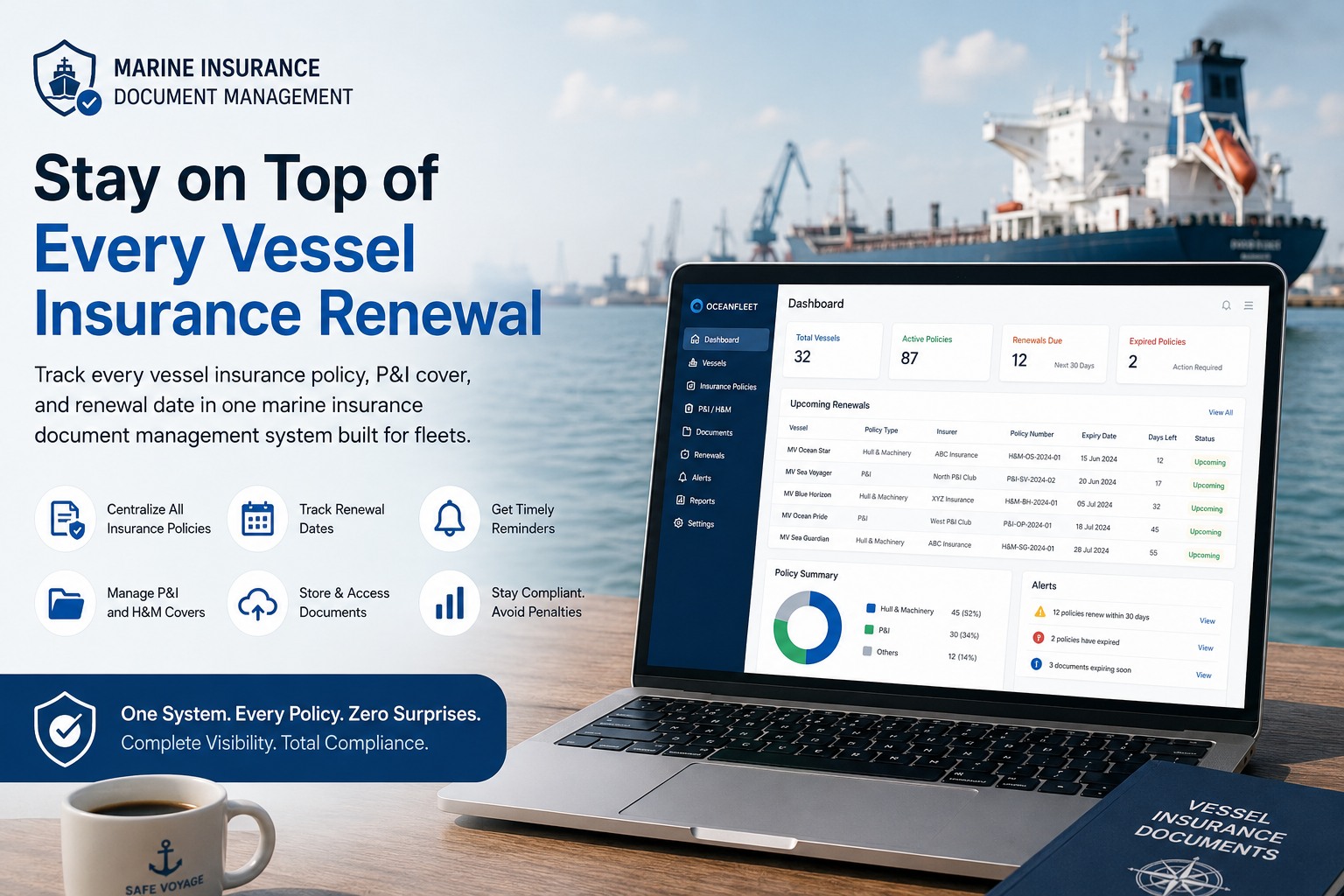
Hull & Machinery, P&I, War Risk, FD&D, Cyber Liability, Strike, Cargo — every policy tracked per vessel with renewal alerting, premium tracking, claims history, and one-click audit packs for charterers, class society, and financing parties.
Policy Stack · M/V Pacific Star
8 active policies
HULL & MACHINERY
Norwegian Hull Club
Renews 14 Apr · 89 days
P&I COVER
Gard
Renews 20 Feb 2027 · 285 days
WAR RISK EXTENSION
JWC HRA review pending
Action required · 18 days
FD&D / LEGAL COSTS
Skuld FD&D
Renews 20 Feb 2027 · 285 days
CYBER LIABILITY
Lloyd's syndicate 1234
Renews 01 Jun · 137 days
Why Marine Insurance Document Management Became Strategic in 2026
For most of the past two decades, marine insurance documentation lived in filing cabinets and shared drives. A vessel had a Hull & Machinery policy, an entry in a P&I Club, a war risk endorsement when needed, and a stack of certificates renewed roughly annually. The renewal date sat on someone's calendar. The certificates surfaced when a charterer or auditor asked. None of that operating model survives the 2026 environment intact. Five structural shifts moved insurance documentation from back-office task to strategic operational capability.
01
War Risk Coverage Cancellations
March 1, 2026: Gard, Skuld, NorthStandard, London P&I, American Club issued coordinated 72-hour cancellation notices for war risk extensions across the Middle East. Strait of Hormuz traffic collapsed from 77 to 4 daily transits. JWC expanded HRA to Bahrain, Djibouti, Kuwait, Oman, Qatar. Vessels without replacement cover cannot be chartered.
02
Sanctions-Driven P&I Withdrawals
EU's 43 new shadow fleet designations triggered immediate P&I cover withdrawal from designated vessels. Aggregate asset impairment exceeded $800M. S&P Global study found 82% of 940 high-risk tankers without IG P&I coverage. A vessel without P&I cannot legally operate — making documentation traceability a regulatory exposure.
03
IG P&I Renewal Volatility
February 20, 2026 IG renewals concluded in the 5% increase range. Pool claims at new record highs. MV Dali / Baltimore Key Bridge liability case implications ongoing. IG GXL structure changed: Layer 3 expanded from $600M to $850M xs $1.5bn, Russia/Ukraine sublimit raised from $100M to $125M. Documentation traceability matters for renewal positioning.
04
Hard-Market Spillover On Hull & Liability
After prolonged hardening since 2018, marine hull and liability cautiously entering buyer-friendly phase as new Lloyd's syndicates add capacity. Good-loss-record accounts seeing 2.5-5% premium reductions. Adverse loss experience accounts facing severe increases. Documentation discipline directly impacts renewal positioning and capacity access.
05
Litigation Costs & Jury Verdicts
US jury verdicts in excess of $10M increasingly common. Crew injury, cargo damage, and pollution liability exposures escalating. Underwriters scrutinizing safety programs, training records, and contractual risk-transfer evidence. Insurance documentation now feeds renewal underwriting rather than just sitting in archives.
The Seven Policy Types Every Marine Fleet Manages
Vessel insurance is not a single policy. It is a stack of seven distinct covers, each with different insurers, different renewal cycles, different rule sets, and different documentation requirements. Centralized insurance document management means tracking all seven per vessel in one place — not seven spreadsheets, seven email folders, and seven different brokers' portals.
CORE 01
Hull & Machinery (H&M)
First-party cover for physical loss or damage to the vessel itself — collision damage, grounding, fire, machinery breakdown, total loss. Typically placed in London, Scandinavian, or Continental markets. Renews on policy anniversary. Subject to Joint Hull clauses and ITC Hulls forms.
CORE 02
Protection & Indemnity (P&I)
Third-party liability cover: crew injury and death, cargo damage liability, pollution liability, collision liability (excess of H&M), wreck removal, fines, legal defense. International Group of 13 P&I Clubs covers ~90% of global merchant fleet. IG renewal February 20 annually.
CORE 03
War Risk
Cover for war perils — armed conflict, terrorism, missile and drone attacks, naval mines, electronic warfare. Hull war risk policy plus separate war risk P&I extension. Joint War Committee HRA designations drive Additional Premium pricing — currently 0.2% to 1%+ of vessel value per Gulf transit.
SUPPORT 04
FD&D (Freight, Demurrage & Defense)
Legal costs cover for charter party disputes, demurrage claims, bunker disputes, freight collection. Typically provided by P&I Club as separate class of business. Renews alongside P&I on February 20. Critical given rising legal costs and jury verdict exposure.
SUPPORT 05
Cyber Liability
First-party and third-party cyber risk cover — ransomware, business interruption from cyber incident, regulatory fines from data breach, cyber-related cargo or pollution liability. Standalone cyber policies now standard given IMO MSC.428(98) and IACS UR E26/E27 evidence requirements.
SUPPORT 06
Strike, Riots & Civil Commotion
Cover for losses from strikes, riots, civil commotion, terrorism (in some structures), and labor disputes. Often packaged with war risk. Activated in regional unrest scenarios. Premium varies with trading patterns and port-specific exposure.
SUPPORT 07
Cargo & Charterer's Liability
Cargo insurance on goods, charterer's liability when not the owner-operator, and bunker pollution liability under CLC/Bunkers Convention. Renews on charter cycle or annual policy anniversary. Documentation feeds charterer vetting and financing conditions.
The IG P&I Club Ecosystem And The February 20 Renewal Cycle
The International Group of P&I Clubs is the most consequential institution in marine insurance. The 13 member clubs provide third-party liability cover to approximately 90% of the global ocean-going merchant fleet, with the IG Pooling and Group Excess of Loss (GXL) Reinsurance contract structuring how claims above individual club retention are shared and reinsured. Every IG renewal cycle closes on February 20 each year — making the preceding 90 days the most concentrated underwriting season in the global insurance calendar.
2026/27 IG Structure At A Glance
Individual Club Retention
USD 10M per claim
Pool Layer
USD 90M xs USD 10M
GXL Layer 1
USD 650M xs USD 100M
GXL Layer 2
USD 750M xs USD 750M
GXL Layer 3
USD 850M xs USD 1.5BN
Collective Overspill
USD 1BN xs USD 2.35BN
2026 Renewal Headlines
Renewal Range
~5% general increase across IG clubs concluded February 20, 2026, consistent with pre-renewal forecasts and rising pool claim severity.
Pool Claims Trend
2024/25 and 2025/26 pool claim activity returned to higher levels consistent with 2019-2021. Layer 3 expanded by USD 250M to absorb severity trend.
Reinsurance Sublimits
Russia/Ukraine/Belarus excluded risk aggregate cover raised from USD 100M to USD 125M. Malicious cyber and pandemic risks: USD 1.6BN aggregated cap each.
Free Reserves
IG club free reserves at record high — approximately USD 5.94BN as of 2025 reporting. Capital returns from profitable clubs partially offsetting rate increases.
The 2026 War Risk Withdrawal — Why Insurance Documentation Equals Operational Continuity
The March 1, 2026 war risk cancellation cascade is the clearest 2026 demonstration that insurance documentation is operational, not administrative. P&I clubs Gard, Skuld, NorthStandard, the London P&I Club, and the American Club issued 72-hour cancellation notices simultaneously for war risk extensions covering Middle East waters. By March 3, only 4 vessels transited the Strait of Hormuz — down from a 77-per-day seven-day average. At least 150 vessels remained at anchor on either side, unable to proceed because the underlying insurance had been withdrawn.
Mar 1
Coordinated Cancellation Notice
All major P&I clubs issue 72-hour cancellation notice for war risk extensions on vessels trading in Middle East waters. Notices posted to club websites simultaneously, triggered by reinsurance market withdrawal.
Mar 2-5
Cancellation Effective
War risk extensions to standard P&I cover cease across Middle East trading. Vessels without replacement cover cannot legally operate or be financed for cargo in affected waters.
JWC
HRA List Expansion
Joint War Committee of Lloyd's Market Association expands high-risk area list to include waters around Bahrain, Djibouti, Kuwait, Oman, and Qatar. Designation drives Additional Premium pricing structure.
AP
Additional Premium Surge
Gulf transit Additional Premiums rise from approximately 0.2% of vessel value to as much as 1%. A USD 50M vessel facing AP of USD 500,000 per voyage rather than USD 100,000. Some underwriters declining new war risk terms entirely.
Mar 3
Operational Impact
Strait of Hormuz transits drop to 4 vessels (from 77 average). 150+ tankers and bulk carriers anchor on either side awaiting cover. 7+ tankers struck by drones or missiles off Oman, UAE, Bahrain since hostilities escalated.
Sanctions Exposure And The Shadow Fleet Insurance Crisis
The 2026 enforcement reality created a second insurance documentation imperative beyond war risk. Sanctions designations now trigger immediate P&I cover withdrawal — and a vessel without P&I cover cannot legally operate. The EU's designation of 43 additional shadow fleet vessels eliminated coverage and produced aggregate asset impairment exceeding USD 800 million. Documentation traceability is now the practical defense against being caught in the sanctions screening pipeline. Book an insurance audit walkthrough to map your fleet's current policy coverage against 2026 sanctions exposure.
82% Of High-Risk Tankers Uninsured
S&P Global Commodity Insights study found 940 crude and product tankers confirmed by Western authorities to have violated sanctions or be at high risk of breaching them, of which 82% did not have IG P&I coverage. The shadow fleet operates with no Western insurance contact.
P&I Withdrawal Is Final
When a P&I club withdraws coverage in response to sanctions designation, there is no appeal. The mechanism is invisible and irreversible. Vessels become uninsurable in Western markets immediately upon EU, US, or UK designation. Replacement cover from Russian state-linked insurers is opaque and not accepted at most ports.
Baltic Inspection Of Documents
Baltic Sea nations and the UK now physically inspect insurance documents of vessels suspected of shadow fleet participation. Authorities frame this as a crackdown on unregistered ships operating without valid accident insurance or with fraudulent documentation.
Documentation As Defense
Legitimate vessels need to produce verifiable current insurance documents instantly — at port state control, at boarding inspection, at charterer vetting. Centralized tracking with audit-grade evidence becomes the practical defense against being caught in the sanctions screening pipeline.
The 90-Day Renewal Cycle — Five Phases Most Operators Compress
Marine insurance brokers advise initiating the renewal process 90 days in advance to ensure thorough vetting of all renewal documentation. In practice most fleets compress the cycle into the final 30 days, producing rushed underwriting submissions, higher premiums than necessary, and avoidable gaps. The five-phase 90-day cycle below is what disciplined insurance management actually looks like.
T-90d
Loss Record Review
Pull current loss record per vessel. Outstanding claims status documented. Crew injury, cargo damage, pollution, and collision exposures tabulated. Loss ratio per vessel calculated for renewal positioning.
T-75d
Submission Pack Assembly
Underwriting submission compiled: vessel particulars, trading patterns, fleet loss record, safety management evidence, IMO MSC.428(98) cyber compliance, IACS UR E26/E27 documentation, charter type mix. Targeted broker delivery.
T-60d
Market Strategy & Quotes
Market strategy locked with broker — incumbent retention vs market test. Quotes requested from target panel. Reinsurance position and capacity availability confirmed.
T-30d
Quote Negotiation
Quotes received, terms compared, negotiation begins. Premium, deductibles, coverage scope, exclusions, war risk endorsement structure all under review. Decision sign-off prepared.
T-0
Binding & Documentation
Cover bound. Certificate of Entry issued. Premium installment schedule confirmed. New policy documentation distributed to vessel master, technical superintendent, and charterer if applicable. Audit trail updated.
The Six Hidden Costs In Marine Insurance That Centralized Tracking Surfaces
Premium is the smaller half of total marine insurance cost. Six categories of hidden cost regularly inflate effective spend by 15-30% when documentation discipline is weak — and contract by similar margins when documentation discipline is strong. Centralized insurance document management surfaces each one.
Underwriting Penalty For Weak Docs
Incomplete or late submission pack signals weak management to underwriters. Renewals concluded under time pressure typically settle at the higher end of indicated range, costing 5-10% on premium.
Supplementary Call Exposure
P&I clubs may issue supplementary calls when underwriting losses exceed projections. Members participate in calls based on entry tonnage. Documentation traceability matters for budget forecasting and call dispute positioning.
Additional Premium On Hot Routes
Joint War Committee HRA designation drives AP charges of 0.2-1%+ of vessel value per transit through high-risk areas. Multiple Gulf transits per quarter on a USD 50M vessel can produce USD 1M+ in AP alone.
Release Calls At Exit
P&I Club exit triggers release call — covering the member's share of unresolved claims from previous policy years. Without documentation discipline, release call disputes become protracted and costly to resolve.
Charterer Vetting Delays
Charterers increasingly require current insurance documentation as part of vetting. Slow document delivery delays charter fixing and can lose voyages. Centralized tracking delivers documents in minutes.
Claims Documentation Gaps
When incident occurs, claims processing depends on documentation produced quickly. Gaps in inspection records, certificate currency, or safety evidence can lengthen claims settlement timelines and reduce recovery.
How Centralized Insurance Tracking Compares To Spreadsheet Reality
Most fleets in 2026 still track insurance through some combination of spreadsheets, broker portals, email attachments from underwriters, and the marine insurance manager's personal memory. Each fails differently under the 2026 environment. Scroll horizontally on mobile for the full comparison.
| Capability |
Spreadsheet + Email |
Broker Portal Silos |
Centralized Insurance Docs |
| Multi-policy view per vessel |
Tab per policy type |
One per broker |
Unified per-vessel stack |
| Renewal calendar visibility |
Single expiry date |
Per-broker reminders |
90-day 5-phase alerting |
| War risk cancellation alerts |
News-driven discovery |
Broker email if remembered |
Immediate platform alert |
| Sanctions exposure check |
Not possible |
Not standard |
Cover status per vessel |
| Audit pack generation |
Manual assembly hours |
Per-broker portal dive |
One-click delivery |
| Premium tracking across years |
Year-over-year by hand |
Broker statement |
Multi-year trend per vessel |
| Claims history searchability |
Email archive dig |
Broker-dependent |
Per-vessel claims log |
| Charterer vetting document delivery |
Hours to days |
Portal lookup chain |
Minutes via one-click |
| Multi-vessel renewal positioning |
Vessel-by-vessel manual |
Per-broker view |
Fleet-level submission pack |
| Implementation timeline |
Already broken |
Already in place |
6-8 weeks to live |
Insurance Audit Walkthrough
Audit Your Fleet's Insurance Documentation Against 2026 Reality
A 30-minute session with a Marine Inspection product expert. Map your seven-policy stack per vessel, identify gaps in renewal phase tracking, surface war risk and sanctions exposure, and produce a sourced consolidation plan with deployment timeline.
The Six Workflows That Make Centralized Insurance Pay Off
Beyond the renewal baseline, well-designed centralized insurance document management earns its place through specific workflows that prevent risk, reduce premium leakage, and eliminate the "we didn't have the document ready" failure mode. Each workflow below corresponds to a real operational pattern observed in fleet implementations.
A
War Risk Cancellation Response
P&I club issues 72-hour cancellation notice for war risk extension. Platform alerts insurance manager, identifies all affected vessels by trading pattern, generates replacement quote brief for broker — within hours rather than days.
B
90-Day P&I Renewal Orchestration
November (T-90) loss record review, December (T-75) submission pack, January (T-60) market strategy, late January (T-30) negotiation, February 20 binding — the full annual cycle managed in one platform with phase-specific alerts.
C
Charterer Vetting Document Delivery
Charterer requests current P&I Certificate of Entry, Hull Cert of Insurance, war risk endorsement, and last 3-year claims summary as part of vetting cycle. Platform delivers a one-click vetting pack with current verified documents within minutes.
D
Sanctions Exposure Defense Pack
Boarding inspection or port authority demands proof of current P&I cover, ownership trail, and trading pattern attestation. Platform produces verifiable current documentation with chain of custody — the practical defense against shadow fleet screening.
E
Claims Documentation Assembly
Incident occurs. Platform produces claims documentation pack with vessel records, inspection history, certificate currency, safety management evidence, crew certification status — accelerating claims processing and recovery.
F
CFO Premium Budget Reconciliation
CFO needs forward 12-month premium budget by vessel, by policy type, by quarter. Platform produces reconciled forecast in minutes — including AP exposure on routes, supplementary call provisions, and renewal escalation scenarios.
Why Marine Inspection For Insurance Document Management
Marine Inspection delivers centralized marine insurance document management built on the seven-policy universal model with renewal alerting, premium tracking, claims history, and 2026 regulatory pre-alignment. Start a free trial or book an insurance audit walkthrough to see what credible insurance documentation looks like on your fleet.
Seven-Policy Universal Stack
Hull & Machinery, P&I, War Risk, FD&D, Cyber Liability, Strike/Riots, Cargo & Charterer's — every policy tracked per vessel with version control, premium ladder, and audit-ready retrieval.
90-Day 5-Phase Renewal Alerting
T-90, T-75, T-60, T-30, T-0 alerts per policy per vessel — loss record review, submission pack assembly, market strategy, quote negotiation, binding. No phase missed across multi-policy fleets.
War Risk & HRA Monitoring
Joint War Committee HRA designations and P&I club war risk circulars tracked centrally. Affected vessels by trading pattern surfaced instantly. Replacement quote brief generated automatically.
Charterer & Audit Pack Generator
One-click delivery of vetting packs to charterers, audit packs to class society, financing confirmations to lenders, and sanctions defense packs to inspection authorities. Hours to minutes.
Premium & Claims Tracking
Multi-year premium trend per vessel and per policy type. Claims history searchable per vessel and aggregated for renewal positioning. CFO budget reconciliation produced in minutes rather than days.
6-8 Week Deployment
Policy library audit and rule-set configuration weeks 1-2. Document migration and broker integration weeks 3-4. Renewal alerting validated weeks 5-6. Live operations within a fiscal quarter.
Frequently Asked Questions
Why did marine insurance documentation become strategic in 2026?
Five converging factors moved marine insurance documentation from back-office paperwork to strategic operational capability. First, the March 1, 2026 coordinated war risk cancellation cascade — Gard, Skuld, NorthStandard, London P&I, and American Club issued simultaneous 72-hour cancellation notices, collapsing Strait of Hormuz traffic from 77 to 4 daily transits and stranding 150+ vessels at anchor. Second, sanctions-driven P&I withdrawals where EU's 43 new shadow fleet designations triggered immediate cover cancellation with USD 800M+ aggregate impairment, and S&P Global found 82% of 940 high-risk tankers without IG P&I coverage. Third, IG renewal volatility with February 2026 concluding in the 5% range and pool claims at record highs. Fourth, hard-market spillover where good-loss-record fleets see 2.5-5% reductions but adverse experience drives severe increases — documentation discipline directly impacts renewal positioning. Fifth, litigation costs with US jury verdicts above USD 10M increasingly common, making insurance documentation feed renewal underwriting rather than just sit in archives.
What are the seven policy types a fleet must track?
Vessel insurance is not a single policy but a seven-policy stack. Three core covers: Hull & Machinery (first-party physical damage, placed in London, Scandinavian, or Continental markets), Protection & Indemnity (third-party liability — crew, cargo, pollution, collision, wreck, fines, legal — IG renewal February 20), War Risk (war perils with separate hull war risk and war risk P&I extension, JWC HRA-driven AP). Four supporting covers: FD&D (Freight, Demurrage & Defense legal costs — typically P&I Club separate class), Cyber Liability (ransomware, business interruption, IMO MSC.428(98) and IACS UR E26/E27 evidence), Strike/Riots/Civil Commotion (often packaged with war risk), Cargo & Charterer's Liability (cargo on goods, charterer's liability, bunker pollution under CLC/Bunkers Convention). Each has different insurers, renewal cycles, and documentation requirements — making centralized tracking essential at scale.
When do P&I Club renewals happen?
All International Group P&I Club renewals close on February 20 each year. The IG comprises 13 mutual clubs (NorthStandard, Gard, Skuld, UK P&I, London P&I, American Club, Britannia, and others) covering approximately 90% of the global ocean-going merchant fleet. February 20, 2026 saw renewals conclude in the 5% general increase range. The 2026/27 IG Pooling and GXL Reinsurance structure includes: USD 10M individual club retention per claim, USD 90M xs USD 10M pool layer, USD 650M xs USD 100M GXL Layer 1, USD 750M xs USD 750M Layer 2, USD 850M xs USD 1.5BN Layer 3 (expanded from USD 600M), and USD 1BN Collective Overspill xs USD 2.35BN. Russia/Ukraine/Belarus excluded risk sublimit raised from USD 100M to USD 125M. Free reserves at record approximately USD 5.94BN across the market.
What happened with the March 1, 2026 war risk cancellations?
On March 1, 2026 the major P&I clubs — Gard, Skuld, NorthStandard, London P&I Club, and American Club — issued coordinated 72-hour cancellation notices for war risk extensions on vessels trading in Middle East waters, effective from March 2-5. The trigger was withdrawal of reinsurance for those risks following the US-Iran conflict escalation. The Joint War Committee of the Lloyd's Market Association simultaneously expanded its high-risk area list to include waters around Bahrain, Djibouti, Kuwait, Oman, and Qatar. Additional Premiums for Gulf transits surged from approximately 0.2% to as much as 1% of vessel value. By March 3, Strait of Hormuz transits dropped to 4 vessels per day from a 77-vessel seven-day average. At least 150 vessels remained at anchor on either side unable to proceed because cover had been withdrawn. The episode demonstrated that insurance documentation traceability is operational continuity — not paperwork.
What is the 90-day renewal cycle?
Marine insurance brokers advise initiating the renewal process 90 days in advance to ensure thorough vetting of all renewal documentation. The disciplined cycle: T-90 days loss record review (current loss record per vessel, outstanding claims, exposures tabulated, loss ratio calculated), T-75 days submission pack assembly (vessel particulars, trading patterns, fleet loss record, safety management evidence, IMO MSC.428(98) compliance, charter type mix), T-60 days market strategy and quotes (incumbent retention vs market test, target panel quotes, reinsurance position confirmed), T-30 days quote negotiation (premium, deductibles, coverage scope, exclusions, war risk endorsement structure), T-0 binding and documentation (cover bound, Certificate of Entry issued, premium installment schedule confirmed, new documentation distributed). Most fleets compress the cycle into the final 30 days, producing rushed submissions, higher premiums, and avoidable gaps.
How does insurance documentation defend against sanctions exposure?
The 2026 sanctions enforcement model designates vessels and triggers immediate P&I withdrawal — a vessel without P&I cannot legally operate. The EU's 43 new shadow fleet designations produced USD 800M+ aggregate asset impairment. Baltic Sea nations and the UK now physically inspect insurance documents of suspected shadow fleet vessels. Documentation defense means producing verifiable current P&I Certificate of Entry, Hull Certificate of Insurance, war risk endorsement, ownership trail, and trading pattern attestation instantly when challenged. Centralized insurance tracking with audit-grade evidence becomes the practical defense against being caught in the sanctions screening pipeline. Replacement cover from Russian state-linked insurers like AlfaStrakhovanie or Ingosstrakh is opaque and not accepted at most ports — making credible Western insurance documentation operationally essential for legitimate trading.
What hidden costs does centralized tracking surface?
Six categories of hidden cost regularly inflate effective marine insurance spend by 15-30% when documentation is weak — and contract by similar margins when it is strong. Underwriting penalty for weak documentation packs (incomplete or late submission costs 5-10% on premium). Supplementary call exposure (P&I clubs may issue calls when underwriting losses exceed projections, with members participating based on entry tonnage). Additional Premium on hot routes (JWC HRA designation drives 0.2-1%+ AP charges per transit — multiple Gulf transits on a USD 50M vessel can produce USD 1M+ in AP alone). Release calls at exit (P&I Club exit triggers release call for unresolved claims share from previous years). Charterer vetting delays (slow document delivery loses voyages). Claims documentation gaps (gaps in records lengthen claims settlement timelines and reduce recovery).
How does Marine Inspection manage insurance documentation?
Marine Inspection delivers centralized insurance document management on the seven-policy universal model — Hull & Machinery, P&I, War Risk, FD&D, Cyber Liability, Strike/Riots, and Cargo & Charterer's Liability — with version control, premium ladder, and audit-ready retrieval per vessel. Pre-loaded renewal alerting on the 90-day 5-phase cycle (T-90, T-75, T-60, T-30, T-0) ensures no phase missed across multi-policy fleets. Joint War Committee HRA monitoring and P&I club war risk circular alerts central. One-click audit pack generation for charterer vetting, class society review, financing confirmation, sanctions defense, and CFO premium reconciliation. Multi-year premium trend tracking per vessel and per policy type. Claims history searchable per vessel and aggregated for renewal positioning. 6-8 week deployment for typical mid-size fleets. Book a 30-minute insurance audit walkthrough to map your current policy stack and identify gaps.
Ready When You Are
Every Policy Tracked. Every Renewal Defended. Every Audit Ready On Demand.
Seven-policy universal stack, 90-day 5-phase renewal alerting, JWC HRA monitoring, charterer and audit pack generation, premium and claims tracking, CFO budget reconciliation, 6-8 week deployment — all in one platform built for the 2026 marine insurance reality.