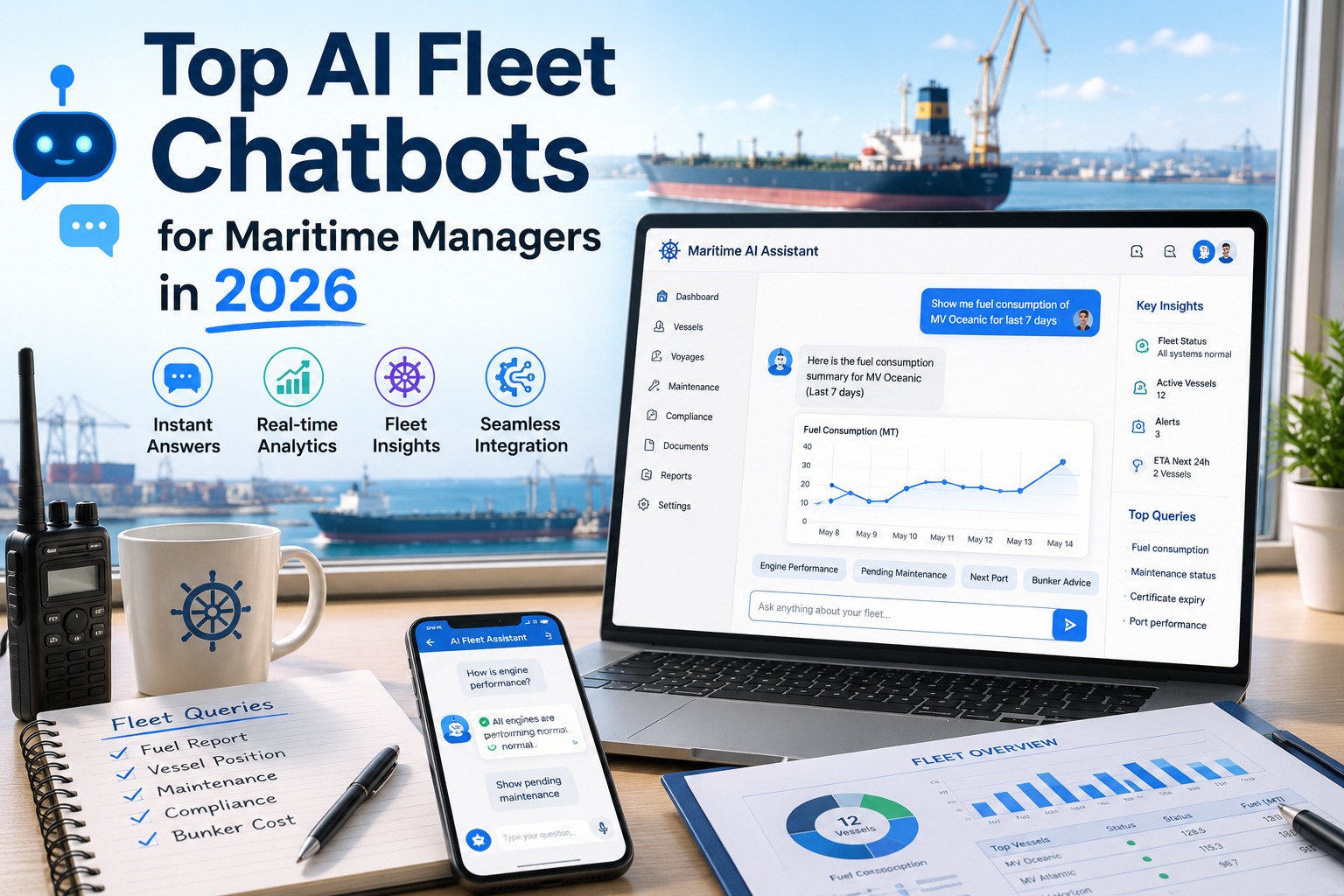
The way maritime managers get answers from their fleet data is being rewritten. Instead of opening a dashboard, choosing a vessel, setting a date range, and reading a report, a manager now types a question — "which vessels are trending toward a poor CII rating?" — and gets the answer in plain language, in seconds, drawn from years of records. That is the promise of the AI fleet chatbot, and in 2026 it is moving from novelty to expectation. But the category is crowded and uneven. Some tools are thin wrappers around a general language model that cannot see your fleet at all; others are deeply integrated assistants that query your real maintenance, fuel, and compliance data; and a growing class are agents that do not just answer but act. The features that separate them are specific — how well they handle conversational queries, whether they return genuine instant analytics or just chat, and above all how deeply they integrate with your actual fleet data. This guide reviews the top AI fleet chatbots for maritime managers in 2026 against exactly those criteria, shows the kinds of questions a good one answers, and maps which type fits which operation. To see a fleet assistant query a live vessel's data, book a Marine Inspection demo.
2026 buyer's guide
Top AI Fleet Chatbots for Maritime Managers in 2026
Compare the leading conversational fleet assistants on what matters — natural-language queries, instant analytics, and integration depth — so you choose one that actually knows your fleet, not a chatbot that only sounds clever.
Which vessels are trending toward a poor CII rating this year?
Three vessels are at risk. Two are sliding from C to D on rising fuel-per-mile after their last dry-dock, and one is borderline on increased port time. Want the fuel trend for each?
Yes, and raise a hull-cleaning review for the worst one.
Done — review task created and assigned. Here is the fuel-per-mile trend for all three.
The Three Things That Separate a Real Assistant From a Toy
Every vendor now claims an "AI assistant," so the comparison has to cut through the label. Three capabilities decide whether a chatbot is genuinely useful to a maritime manager or just a novelty bolted onto a dashboard. See all three in a demo.
01
Conversational queries
It understands plain-language questions in marine terms — vessels, voyages, defects, fuel, compliance — and answers without you learning a query syntax or building a report.
02
Instant analytics
It returns real numbers, trends, and formatted summaries drawn from your data — not vague prose — so the answer is something you can act on immediately.
03
Integration depth
It is connected to your real maintenance, fuel, inventory, and compliance records. Without that connection, an assistant can only chat — it cannot actually know your fleet.
The Questions a Good Fleet Assistant Answers
The clearest test of a fleet chatbot is the range of real questions it can answer from your data. A capable assistant handles all of these conversationally, returning the figures rather than telling you where to look. Ask your own in a demo.
Performance
"Which vessels burned the most fuel per mile last quarter?"
Maintenance
"What overdue work orders are open across the fleet right now?"
Compliance
"Which certificates expire in the next 60 days, and on which ships?"
Troubleshooting
"How do I respond to this purifier alarm, and has it happened before?"
Inventory
"Do we have the spares aboard for the next planned overhaul?"
Reporting
"Summarize this month's defects by vessel and category."
Deep Dive — Conversational Queries and Instant Analytics
The first two capabilities work together: understanding the question, then answering it with real data. The strongest assistants do both reliably, which is harder than it looks. See it in a demo.
Understands marine context
Unlike a generic chatbot, a fleet assistant knows vessels, voyages, machinery, defects, and the terminology, so it interprets the question correctly.
Grounded in your data
Questions are translated into queries against your real records, so the answer reflects your fleet's actual figures, not a plausible-sounding guess.
Returns trends, not just text
It produces numbers, comparisons, and formatted summaries on demand, generating in seconds the report that used to take a manual dashboard session.
Explains its reasoning
A trustworthy assistant shows how it interpreted the question and which data it used, so the manager can rely on the answer rather than guess at it.
See it on your fleet
Ask Your Fleet a Question and Get a Real Answer
Marine Inspection's assistant understands plain-language questions in marine terms, queries your real maintenance, fuel, inventory, and compliance data, returns trends and summaries in seconds, and can raise a task from the answer. Book a 30-minute demo to ask your own questions against a live fleet, or start a free trial and try it on your data today.
Copilots Suggest, Agents Act — the 2026 Shift
The biggest change this year is conceptual. The first wave of fleet AI answered questions; the new wave can take action. Understanding where a tool sits on this spectrum is central to comparing them.
Wrapper
A general language model with no access to your fleet data. It can discuss shipping in general but cannot answer anything specific about your vessels.
Copilot
Connected to your data, it answers questions, surfaces trends, and drafts reports — assisting the manager, who still takes every action.
Agent
Beyond answering, it acts — raising a work order, assigning a review, or flagging a risk — turning a query into a completed task within the system.
Gartner expects a large share of enterprise applications to feature task-specific AI agents by the end of 2026, up from almost none a year earlier. For a maritime manager, the practical question is how far up this ladder a tool sits — and a tool can only act on your fleet if it is deeply integrated with it, which brings the comparison back to integration depth.
Integration Depth Is the Real Decider
Of the three criteria, integration depth is the one that quietly determines all the others. An assistant is only as capable as the data it can reach and the actions it can take, which is why this is the question to press hardest in any comparison. See the integration in a demo.
Reaches all your data
Maintenance, fuel, inventory, logs, and compliance in one connected source, so the assistant can answer across the whole operation, not one silo.
Reads from manuals & history
Trained on equipment manuals, defect history, and procedures, it answers troubleshooting questions with context from past issues, not just live data.
Can take action
Deep integration lets the assistant raise a work order or assign a task, closing the loop from question to action inside the same system.
Learns your fleet
The more of your data it sees, the more useful it becomes — a platform that gets smarter the more it is connected, not a disconnected add-on.
The 2026 Fleet Chatbot Landscape
The market splits into recognisable types. Rather than crown one best in the abstract, match the type to how integrated you need it and whether you want it to answer or to act. Scroll the table on mobile to compare.
AI Fleet Chatbot Types for Maritime
The consistent lesson is that the impressive conversation is the easy part; the value is in what the assistant can see and do. A tool that talks well but reaches little will disappoint, while one wired into the whole operation turns a question into an answer and an answer into an action.
The Buyer's Scorecard
Bring these questions to every demo. The answers separate an assistant that knows your fleet from a chatbot that only sounds like it does.
Can it query my actual fleet data?
A real assistant answers from your records, not general knowledge or a guess.
Does it return numbers and trends?
Instant analytics means figures and summaries you can act on, not vague prose.
How deeply is it integrated?
Across maintenance, fuel, inventory, and compliance — or just one narrow module?
Does it understand marine terminology?
Vessels, voyages, machinery, and defects — not a generic business chatbot.
Can it take action, not just answer?
Raising a work order or task closes the loop from question to outcome.
Does it explain its reasoning?
Showing how it read the question and which data it used makes it trustworthy.
Where Marine Inspection Fits
Marine Inspection sits in the integrated fleet-copilot tier: its assistant is connected to the same platform that runs maintenance, inspections, fuel, inventory, and logbooks, so it answers from your real data rather than general knowledge. It understands marine terminology, returns trends and summaries in seconds, draws on equipment context and defect history for troubleshooting, and — because it lives inside the system — can turn an answer into an action like raising a work order. For fleets that want an assistant wired into the whole operation rather than a chatbot bolted onto one dashboard, it is built for exactly that. Sign up free to try it, or book a demo to ask your own questions against a live fleet.
Frequently Asked Questions
What is an AI fleet chatbot for maritime?
It is a conversational assistant that lets a maritime manager ask plain-language questions about the fleet — performance, maintenance, compliance, inventory — and get instant answers drawn from real data. The best ones are integrated with the fleet's maintenance, fuel, and compliance records, understand marine terminology, and can take actions such as raising a work order.
What should I compare when choosing one in 2026?
Three things: conversational query quality (does it understand marine questions), instant analytics (does it return real numbers and trends, not vague prose), and integration depth (is it connected to your actual maintenance, fuel, inventory, and compliance data). Integration depth is the decider, because an assistant can only know what it can reach.
How is a fleet chatbot different from ChatGPT?
A general language model has strong language ability but no access to your fleet — it can discuss shipping in general but cannot tell you which of your vessels is overdue for maintenance. A fleet chatbot is integrated with your real data and marine context, so it answers specific operational questions about your ships and can act within the system.
What is the difference between a copilot and an agent?
A copilot assists — it answers questions, surfaces trends, and drafts reports, but the manager takes every action. An agent goes further and acts, raising a work order, assigning a review, or flagging a risk directly. The 2026 shift is from copilots that suggest to agents that act, and a tool can only act if it is deeply integrated with the fleet.
Can a fleet assistant help with troubleshooting?
Yes, when it is trained on equipment manuals, defect history, and procedures. Asked how to respond to a particular alarm or fault, such an assistant can give conversational guidance, link to the relevant manual steps, and note whether the issue has occurred before — turning scattered technical knowledge into a single decision-support layer for crew and shore.
Is a standalone chatbot or an integrated assistant better?
For maritime management, an integrated assistant is far more useful. A standalone chatbot can converse but cannot see your fleet, so it cannot answer the operational questions that matter. An assistant built into the platform that holds your maintenance, fuel, and compliance data answers from reality and can act on what it finds — which is where the real value lies.
Built for maritime fleet management
An Assistant That Knows Your Fleet, Not Just Language
Plain-language queries in marine terms, instant analytics from your real maintenance, fuel, and compliance data, troubleshooting from manuals and defect history, and the ability to act on an answer — all inside one connected platform. Marine Inspection gives maritime managers an assistant wired into the whole operation. Book a tailored walkthrough or start a free trial today.